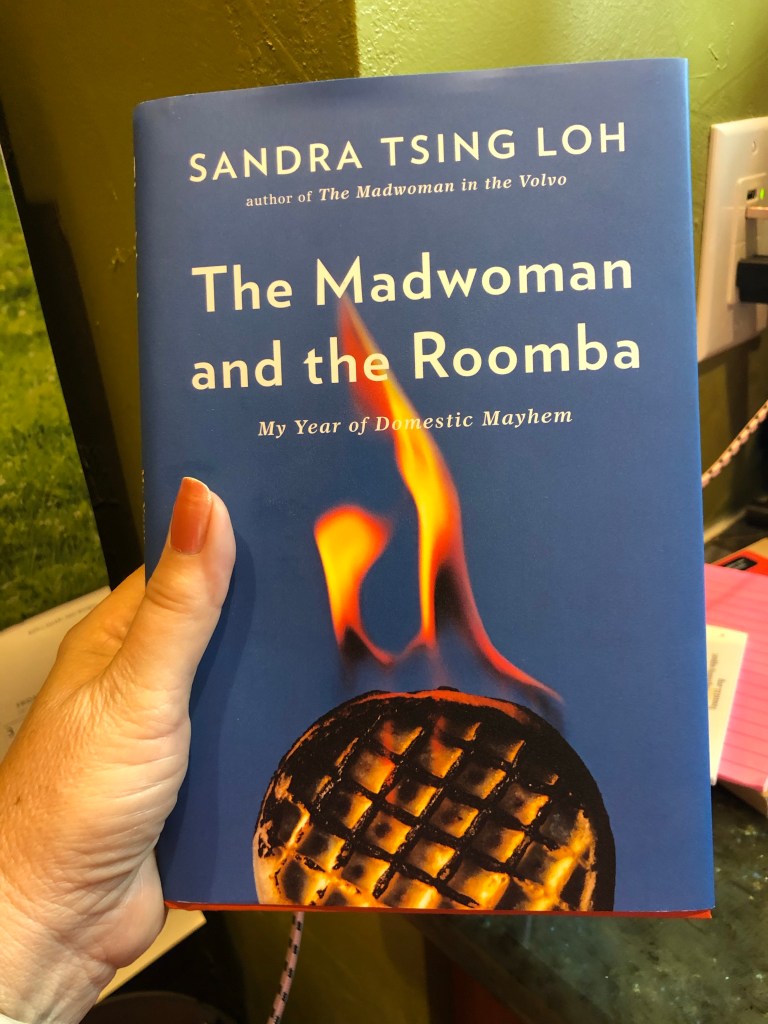
So, this book, The Madwoman and the Roomba: My Year of Domestic Mayhem, by Sandra Tsing Loh, was this month’s Austin neighborhood book club selection. I think we were all looking forward to a nice, lightweight comedy book to get us through yet another month of being unable to hang out together and hug.
The flaming waffle says it all.
Indeed, Ms Loh is a really gifted teller of tales, and her slice of middle-aged life in California stories are very funny. I laughed a lot. People in my age bracket who are a little hippie-dippy like me will see a lot of themselves in her desires to live in her Costco massage chair (we ALSO got the big discount), her honest assessments of her mothering skills, her ambivalence about having divorced her kids’ dad, and such.
I was really enjoying this trip through a recent year in her life. Then it hit me. This was a trip through 2018 or 2019, and certainly not 2020. I’d be reading along and suddenly think, “Ah, meeting friends at a coffee shop, I miss that,” or, “Look at her enjoying a relaxing trip to Costco, I remember just browsing and taking my time.”
Our massage chair from Costco does get used pretty often, but in between times, it’s one of Carlton’s beds.
In the end, the funny book about a woman’s quirky family and friends (I love her domestic partner, especially, and just about spit out my beverage when he was revealed to be a disciple of the hugging saint Amma *and a bunch of her entourage appeared) turned out to be a little time capsule of the past. I ended up doing as much sighing as I did laughing as I pretty much devoured every page of Loh’s writing.
I’ll probably read some more of her stuff when I need a humor break, though it might be more funny next year.
Look at all those clouds! It may rain today or tomorrow.
By the way, each chapter in the book suspiciously reminded me of a blog entry. I wish I were as funny as Loh, because I’d have a book ready to go. Mine would be rather more whiny and angsty, and totally devoid of other characters, because hardly anyone I know would want to be in a book. Well, I’ve talked myself out of THAT idea pretty quickly.
I hope you have a good book, television show (I recommend Star Trek:Picard), or project to fill your weekend with fun!
*I wondered how all the Amma followers are doing now that hugging is not such a great idea, so I looked it up. It turns out they are donating a lot of money to coronavirus research, and interacting online, like the rest of us. Keep spreading that love!
What follows won’t be my normal book report. I don’t know what it will be, really, because I’m not sure if I’ll be able to adequately explain the profound effect that The Sacred Enneagram: Finding Your Unique Path to Spiritual Growth, by Christopher L. Heuertz has had on me. Anyway, I knew I picked up those Enneagram books for a reason.
If You Don’t Know What an Enneagram Is, Skip This Part
I liked it. A lot.
By the time I finished the book, I realized I had mis-typed myself, and thankfully someone who understands this mumbo-jumbo better than I do helped me figure out why that happened. I feel good about things now, even if it turns out I am a Type 1 perfectionist. Ugh. But accurate. In my younger years, I veered off to the adjacent Type 2, who want to help everybody and everything, and since menopause, I have been leaning to Type 9, so no wonder I thought that was my type originally.
I’m grateful to my two friends named Victoria who talked to me and helped me figure that all out. It’s so good to have a sounding board when you know there’s something not quite right, but you can’t figure out what it is.
Here’s the Fascinating Part
At least it’s fascinating and surprising to me. The author of the book is a young man who has spent much of his life doing charity work and comes from a strong Catholic background. I talked about this, and how he even knew Mother Teresa, when I reviewed The Enneagram of Belonging, his other recent book. So, yeah, he sprinkled examples from his own spiritual journey throughout this book, as well.
The thing is, the way he wrote about the practices of his teachers, their attitudes toward God and Jesus, and their goals for their spiritual development really resonated with me. As I read on and on about the contemplative Christian tradition, I felt more and more at peace with their goals and practices.
Toward the end of the book, when Heuertz talks about ways of prayer that will help you find your spiritual home, I was deeply moved. The aims of these Christian prayers and practices practically mirrored my own, other than the words they used to refer to the Divine. There is centering, stillness, attention to your breathing and body, and invoking love. Just like what I do.
What works for me may not work for you. Image by @linnflorin via Twenty20.
It fits in very well with the kind of Buddhist teachings I am most drawn to, as well, which are the more nature-focused ones that view us on Earth as all part of one entity. Just like the Christian God being in us all and accepting us all just the way we are.
I even see where Brene Brown’s spirituality comes from, though she may well approach it from a different tradition. It all boils down to acceptance of our whole selves (not, in my case, the perfect self I keep trying to get to with all this self help, education, and introspection).
So, for me (and I would think to many readers who plow through the whole book), the Enneagram types and interrelationships all turn out to be a tool to use to figure out how to get past all that stuff. Wow. Mind blown!
As a non-Christian, the most intriguing part (and the one I want to know a LOT more about) is how these contemplative Christians fit Jesus into all this, since you sorta do have to be a fan of Christ to be a Christian. When Heuertz goes into stories about Jesus, it reminds me of my years stuck in a basement with two former theologians (supposedly writing our dissertations), where it dawned on me slowly that they knew perfectly well there’s a lot of analogy, metaphor, and interpretation going on when it comes to the role of Jesus in their faith.
One Thing This Book Did for ME
Going through this book, and reading a little more about the groups of Jesuits, Sufi, and other spiritual guides Heuertz talks about, woke me up to an area where I have needed to do more work. I realized, deep in my heart, that not all people in organized religions fit into my stereotypes. My history with Christianity has led me to some pretty unfair over-generalizations, which I’ve been trying to rid myself of, slowly but surely.
There are lots of paths to inner peace and oneness with the Divine. Mine now makes sense. I wish this for all of you, whatever your path.
This book did it. I now feel entirely comfortable with the Christian path trod by people Heuertz’s spiritual guides (and Jim Rigby, and Joanna Fontaine Crawford, and other Christians I know who are working so hard for equality, love and understanding among people).
I knew intellectually that religious folk are like any other group: so diverse that I can find people I feel kinship with as well as people I just don’t understand at all. Now I feel it in my heart.
Personal growth for the win!
PS: Of course this is just MY spiritual journey. Yours is just fine for you as long as it is helping you be the best you possible.
Take a minute to look at things from a long point of view. Reading (or just looking at) this beautiful book lets you leave the now and enter the enduring. I’m so glad we still have trees around to take care of us and the earth long term.
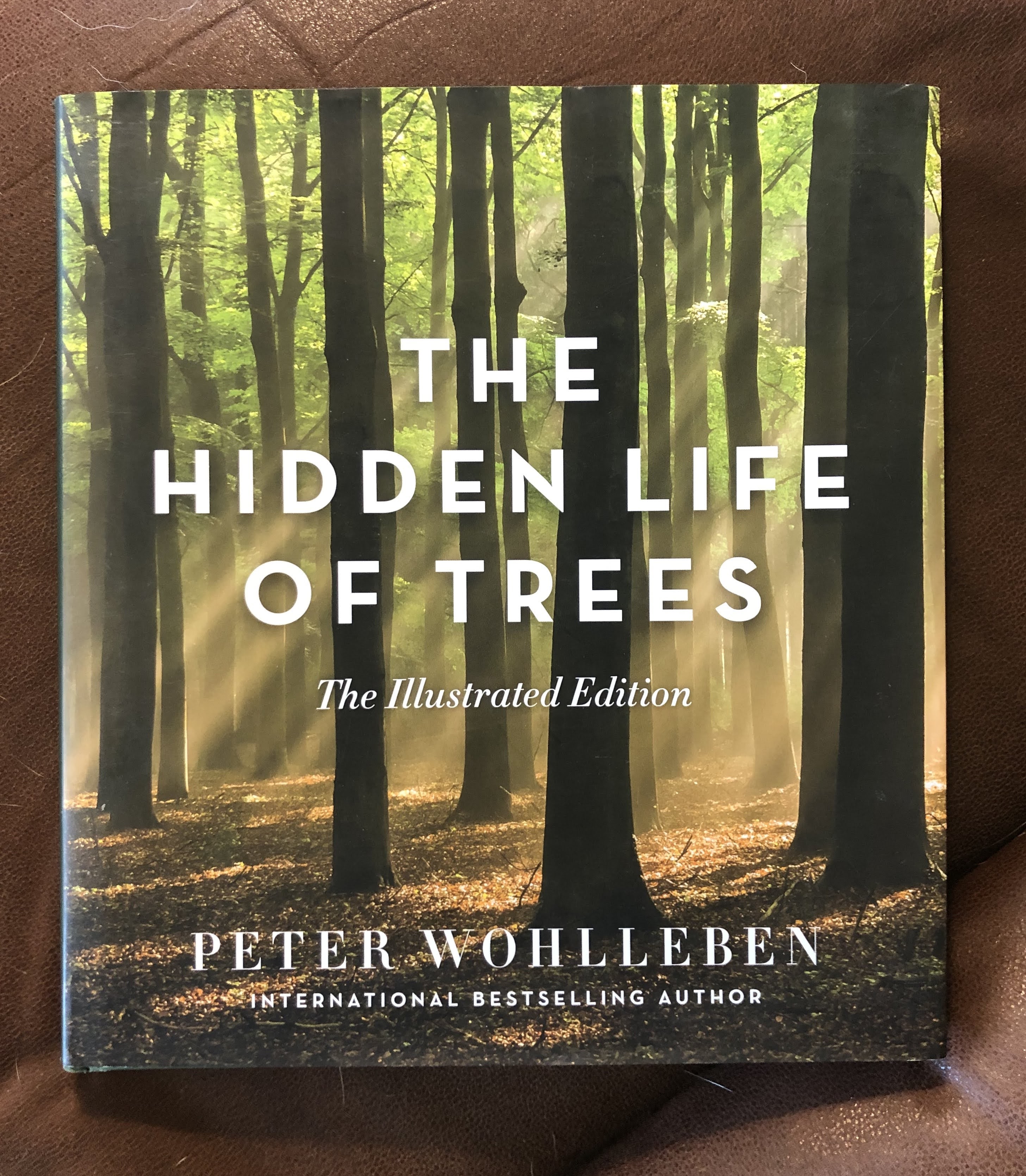
I’ve been reading a lot of Peter Wohlleben’s books, such as The Inner Life of Animals, which I wrote about in April of last year, and The Secret Wisdom of Animals, which I wrote about in June 2019. This one, The Hidden Life of Trees: The Illustrated Edition, is not the entire original book, but long excerpts from the original, punctuated with beautiful photographs of trees around the world. I bought this version for those photos (and eventually will read the unabridged book).
I admit that I am really, really fond of pictures of trees. I usually have one in my immediate environment, like here in my office.
My main tree image in my office, by Sean Wall.
My whole life I’ve been drawn to trees. My mother used to tell me how she’d find me in the yard chatting away to the huge live oaks surrounding our house. And I remember when I was able to visit my home town again after moving away, I insisted on visiting certain trees in what is now Tom Petty Park and the Duckpond area in Gainesville, Florida. Yes, I was always this way.
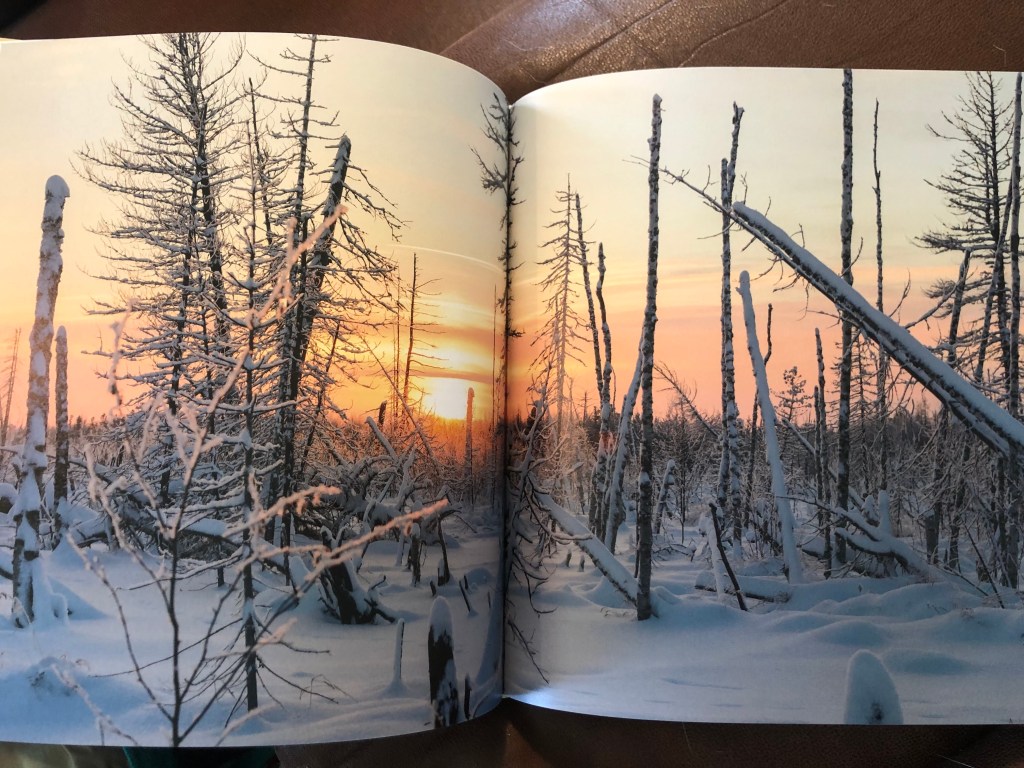
So, this book gave me a lot of pleasure. It’s not like someone went out and took a lot of great photos to add to the book, because most of them are iStock photos, according to the credits. Nonetheless, the photos were well chosen to accompany the text, so they brought me joy.
Here’s one beautiful photo from the book.
Of course, Wohlleben does a great job presenting fascinating research about trees in a format that any lay person can enjoy and be amazed by. Now that I know how trees communicate, I don’t think I’ll be planting one all by itself ever again. And that’s only ONE thing I learned.
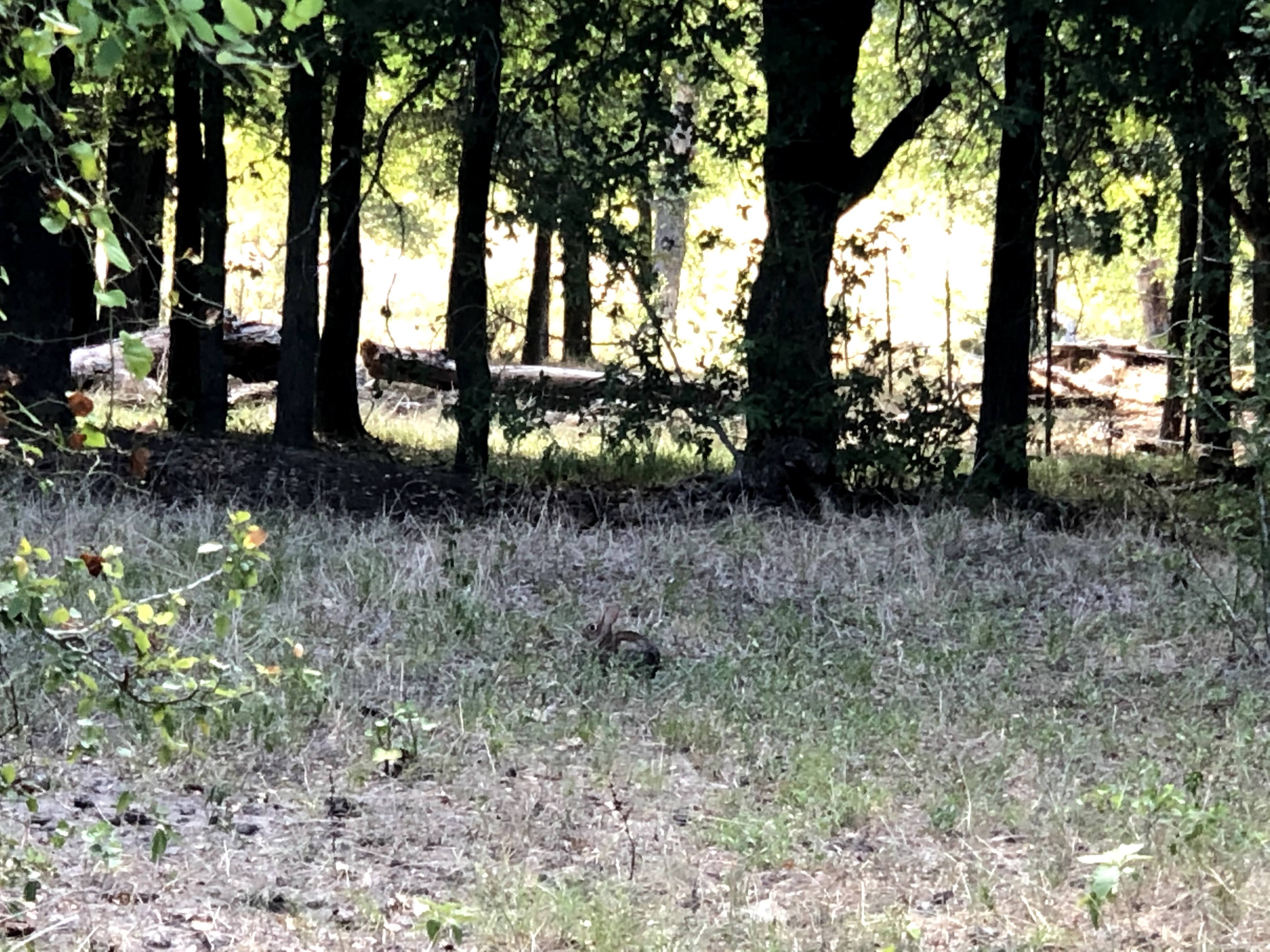
The trees (and bunny) in our woods have lots of friends, and the downed trees are allowed to go back to the earth and provide nutrients.
I found myself reading a bit, then just lingering in the photos, imagining myself in those places, smelling the earth, hearing the wind in the leaves, seeing all the creatures the trees support. That’s worth the price of the book, right there! You can bet I’m going to keep that book on my coffee table, which is part of a tree, to dive into whenever I need to.
My other tree art in my office. It’s a watercolor by LE Martin, from 1995, which we found in the Rattlesnake house, unframed, in a cabinet.
I’ve been reading Dare to Lead, a book by my favorite self-help author, Brené Brown (it’s the book I reviewed the horrible workbook for back in March). It was my suggestion for our work book club at Planview. What’s annoying is that I keep leaving the book in Austin, so I hadn’t been able to keep up, but I finally remembered to bring the book back with me last time I went, so I was able to read the correct chapter for today’s meeting.
I sure am glad I did, too, because some of the things she has us thinking about in the “Living Our Values” section helped me focus on not only how to effectively deal with coworkers, but also how to deal with the people around us during this pandemic.
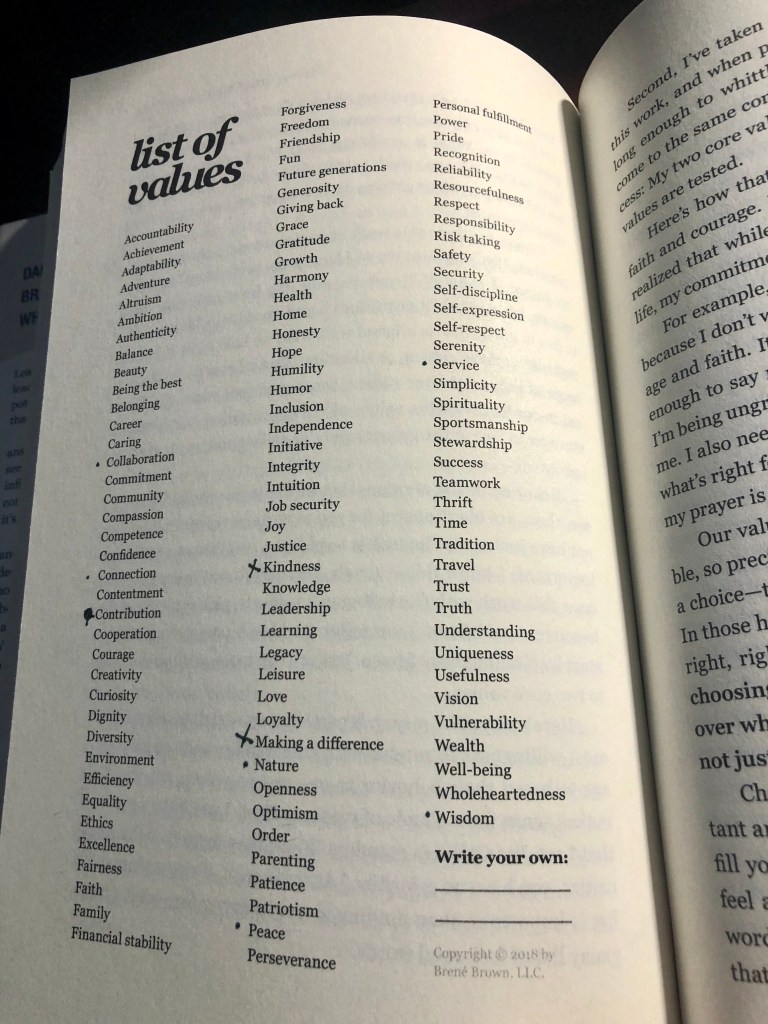
Brown stresses that it’s important to know what your personal core values are, because they will affect how you make decisions, work with others, and treat yourself. And you only get to have TWO of them (though she lets you pick sub-values, too). I already had a set of guiding principles I live by:
Treat others how you’d like to be treated
Assume good intentions
Love yourself
But, I’d never chosen a mere two words to be my core values. So, this was an interesting exercise to me. I ended up with these:
Kindness
Making a difference
Kindness was easy. I have always tried my best to be kind, and feel unsettled and weird if I realize I’m not being kind (usually it’s when I find myself being judgmental, and I have to snap out of it).
I had a little harder time figuring out that making a difference was the correct second value. I thought about my past career choices, both paid and volunteer, and I easily saw that what tied them all together was that I wanted to somehow make life easier for others and/or make a genuine contribution to society with what I did. I’ve helped build educational databases, taught college students, helped mothers breastfeed, gave organizations and individuals websites to spread their messages, written documentation and made e-learning for software companies, etc. In all of these, I’ve been wanting to make a difference to people.
When the time came to do our book club meeting, the three of us who’d made choices of values had all chosen kindness as one of them. I guess I’m not as original as I thought, or people who choose kindness tend to join book clubs! I really enjoyed talking to the other three women who were able to attend today, and am almost glad it was a small group, because we were able to share in meaningful ways. Thanks, Zoom meetings!
Other parts of the little chapter I read hit me very close to home, too. Brown included a discussion of keeping this in mind when you are providing feedback:
“…everyone is doing the best they can.”
p. 215
It helps me with the judgmentalism I need to worry about so much in myself. And it’s my core belief that I need to assume good intentions. And like Brown’s husband Steve pointed out, even if it’s not true, things sure work out better if you just go ahead and make that assumption.
Hmm, can you try to do that with people on the other side of the mask wearing issue? Of the other political party? I find that to be a very interesting exercise, and one that I wish I could share further. It’s not that, “Oh, why can’t everyone just get along,” plea. It’s more of a, “Where are the people I disagree with coming from, and can I use that information to better understand them, or to talk to them productively?”
The kindness art I have on my bulletin board.
I’d really like to talk with more people about these core values and how they inform our lives, and these really helpful attitudes toward other people. Feedback is welcome!
The accompanying text is organized in a fun and interesting way, where slowly but surely, you’re able to learn all about how birds “work,” mentally and physically. I learned something new on nearly every page, and I thought I knew quite a bit about birds! There are many fascinating diagrams of how birds fly, digest food, lay eggs, and so much more, too.
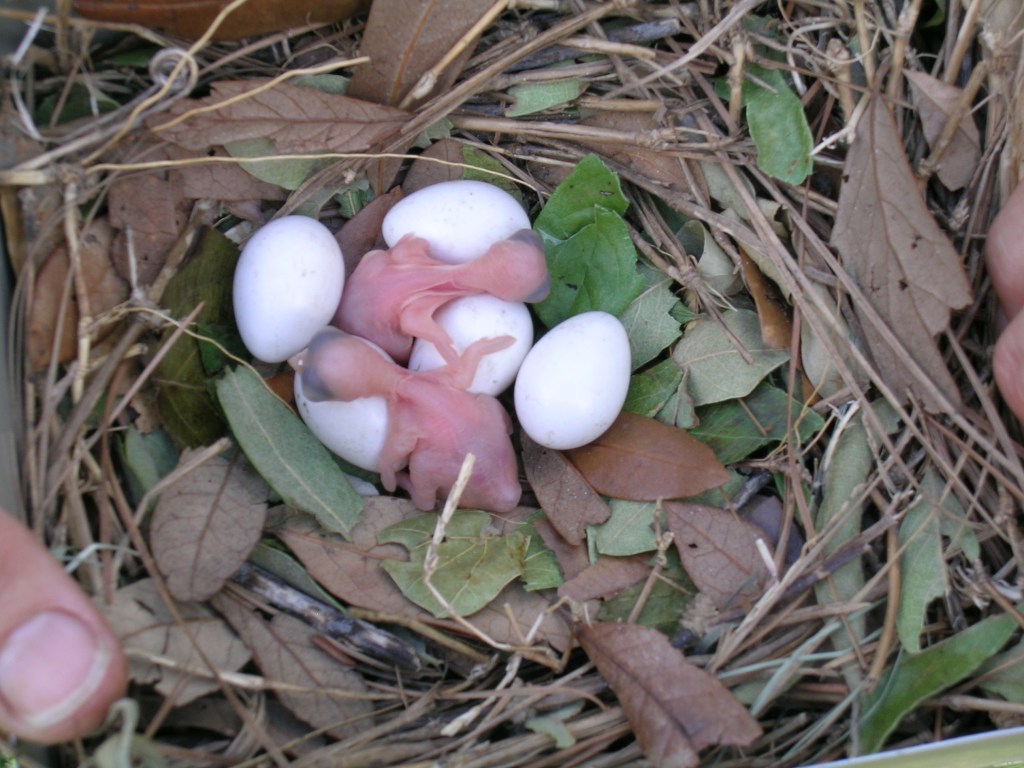
It’s fun to learn the difference between birds whose eggs hatch fully able to get around and do things (precocial), like chickens, and birds whose eggs hatch all naked and vulnerable (altricial), like purple martins (photo below is from a Master Naturalist blog post I just sent out, by my friend Donna).
These little dudes can’t do much other than open their mouths and ask for food.
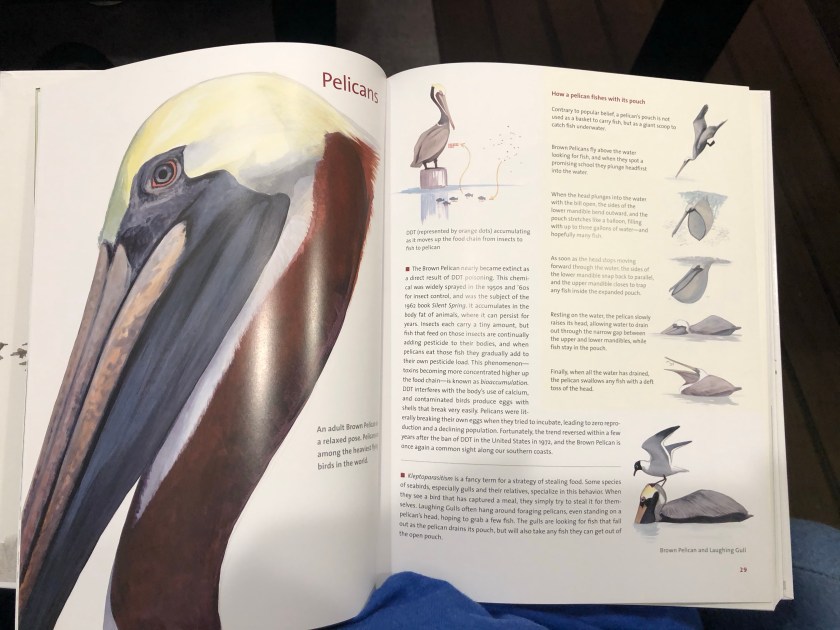
A sample page, showing how pelicans catch fish. It’s not how you imagined, I’m guessing, unless you’re an ornithologist.
I spent a long time just looking at the illustrations, and plan to keep the book out on the coffee table, so I can leaf through it when I need some inspiration. I can see many other uses for the book. It would be fun to share with younger folks, who can look at the pictures while an adult tells them how birds sing or how a woodpecker keeps from getting concussions while pecking. If I had grandchildren, that’s what I’d do!
Now, this isn’t a comprehensive guide to the birds of North America. Sibley chose common birds seen throughout the region as exemplars of various bird traits, though he did do his best to show examples of each type of bird, from water birds to songbirds. If you want ALL the birds, buy one of his guides. But to learn how birds “tick” from an educated lay person’s point of view AND enjoy some amazing artwork, you cannot go wrong with What It’s Like to Be a Bird.
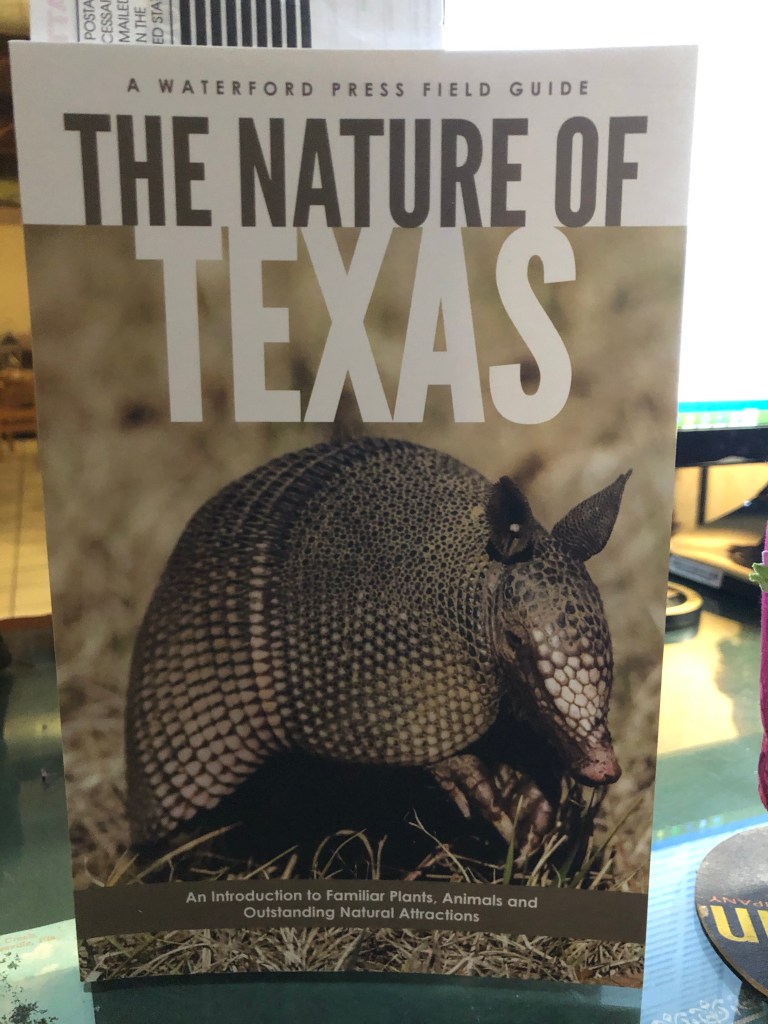
Any book with an armadillo on it is a book I like!
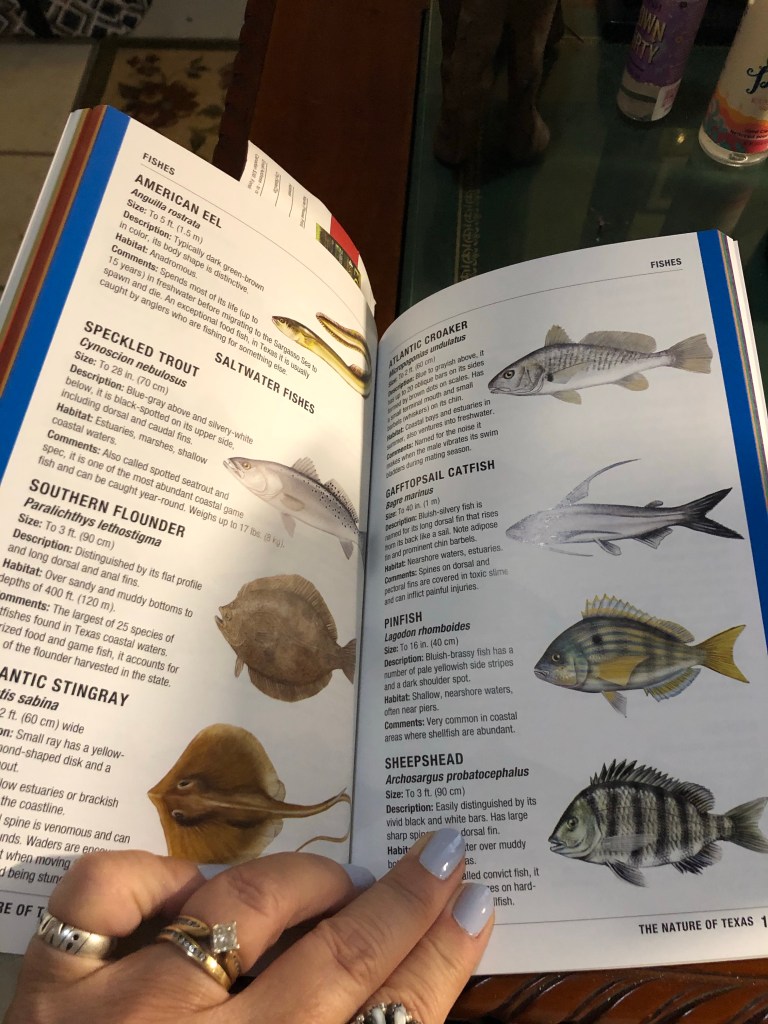
This isn’t one of those huge compendiums of every single living organism in the state; instead, it highlights plants and animals that an average person with an interest in the nature in Texas might run into. The descriptions are brief and in lay terms, and the illustrations are really lovely (good job, Raymond Leung).
It’s a bit too basic of a book for me to carry around, but I could easily imagine giving it to a teenager or older child who’s going camping and wants to know what they might find out there, or someone who just moved to Texas and wants a nice overview. It would be fun to put on the bedside table for your out-of-state visitors, or on the coffee table of your rental property.
An example of the text and illustrations.
The back of the book has two handy features. One is a brief list of interesting places to go to see the natural wonders of Texas, with clear maps. The other is a series of checklists you can use to mark off wildlife and native plants that you see in your travels. That would be a fun family project (though I’d have to add a bunch of things, like more owls).
I do recommend The Nature of Texas, just for the beautiful illustrations alone. And the introductory essay, “But a Watch in the Night,” written by James Rettie in 1948 is a real treasure, too. It’s a great reminder of how little time humans have actually been present and messing around with our planet.
As I talked about recently, I have been looking into the Enneagram to see what insights it could give me into how I could function better as a person and interact with others.
Two of the types came close to describing me, 2 (helper) and 9 (peacemaker). I eventually decided I was a 9 after realizing how strongly my urge to keep peace around me had affected my life (not always positively).
I broke down and spent the twelve dollars to take the official test, the Riso-Hudson Enneagram Type Indicator (RHETI). That test identifies how your responses to a series of questions match each type. I found the results interesting:
Enneagram Type Score Type 2, The Helper 28 Type 9, The Peacemaker 24 Type 4, The Individualist 18 Type 7, The Enthusiast 17 Type 5, The Investigator 14 Type 6, The Loyalist 13 Type 3, The Achiever 12 Type 1, The Reformer 10 Type 8, The Challenger 8
The two I’d self identified were the two highest, by far. The results commentary said: “Your primary Enneagram personality type is most likely the highest of these scores, and almost certainly among the highest two or three.”
I’m still going with 9, but with a lot of 2. I don’t know if the standard version “allows” being mixed with two types, but, there ya go, I gotta be me. The two types on either side of you are supposed to be your “wings” to draw from. Note that those were the two least identified with me (and 8 is my spouse’s type, oh my).
Reflecting on how Type 2 people tend to want to rescue others, form large groups of friends, and focus on helping, I do see that I have been that way, but more in the past. It may be that I am moving from Type 2 to Type 9 as I get older. A lot of the things Type 2 people do are just not me, while pretty much everything in Type 9 hits home with a bang.
Just knowing how I tend to react to things has helped me explain how I am to others, and has already made communication easier in my family. So, I’m grateful for that. If you want to take the test yourself, here’s the link.
Books
Anyway, I read a couple more of the most recent books on the Enneagram, so I may as well tell you what I thought of them.
Another blogger writes a book.
The Honest Enneagram, by Sarajane Case, is an introductory level book that uses “normal” language to help people understand how to apply knowledge of their type to their lives. It didn’t tell me anything I didn’t already know, but you sure get the idea that Sarajane is a kind person who wants to help everyone be their best. I gave the book to Kathleen to look over and share with Chris, because it’s a nice intro. It’s also a really pretty book.
If you know your type, this is interesting for sure.
The other book I got was The Enneagram for Relationships: Transform Your Connections with Friends, Family, Colleagues, and in Love, by Ashton Whitmoyer-Ober. Ashton is another person who just oozes concern for people. I am getting a bit more new information out of this one, especially about others (like my son and spouse). It’s really helpful, because this book gives you ideas for how to let people you love know you care for them, and how to best communicate with them. That’s useful information. I got some good ideas for how to communicate with a lot of people I know, at work, as friends, and as family members. I will use this one as a reference for a long time, I’m sure.
Both these books are available on Kindle for not much money at all, so check them out if you’re interested. I have one more book to read, then I’ll move on, since I may have found a new spiritual path!
What’s been bringing YOU insight? Are you using this time of being close to home to look inside yourself like I have been doing?
I was a little worried that we are pampering the chickens and guineas. For example, I wandered out into the woods today to make more perches and shade for the chickens.
Hedy and Hedley are on the new perch.
And Chris made a new shelf and perch for the guineas. They have really grown since we got them!
The perch in front and the shelf in back. They still haven’t figured them out.
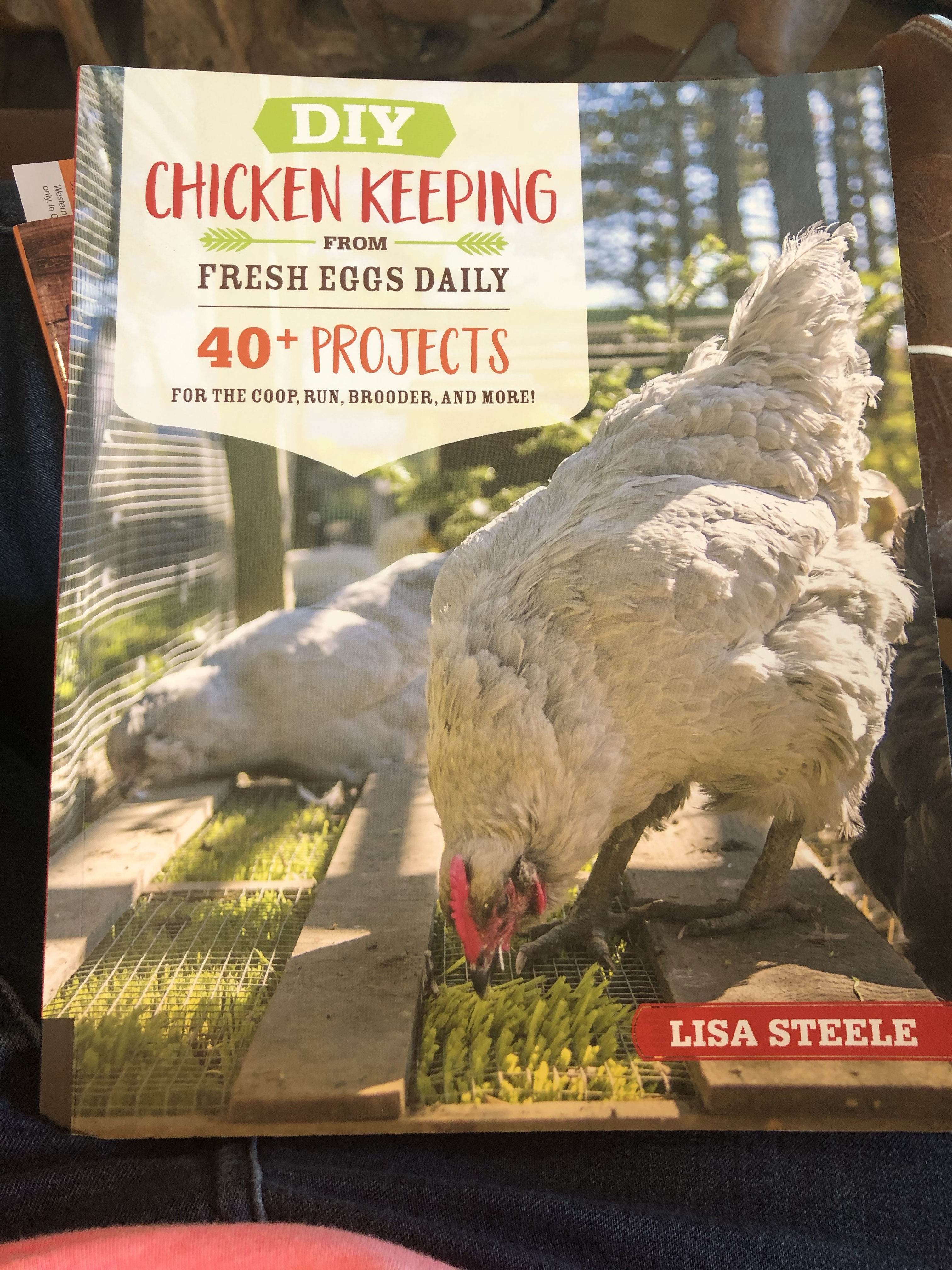
I feel much better now, though. I got two books of chicken projects at Tractor Supply, and they had some of the most indulgent yet cute projects imaginable. One has 40 projects; one has 50. I guess their editors had the same idea.
Keeping Chickens
Chicken Keeping
Very similar titles, both full of helpful ideas. Not the greatest or the worst.
One of the authors, Lisa Steele, who is apparently a big chicken blogger,* puts curtains on all her hens’ nest boxes, because some are shy. Lordy. And she makes them salves and feeds them herbs. And builds many adorable hen swings.
We only got to have our shelf because Chris added chicken wire to the top of our cage so we can’t get out.
I did enjoy the projects in both books (Janet Garman is a little more serious but also obviously LOVES chickens) and got some good ideas, like making a low perch for the Jersey Giants. Right now Hedy loves it the most, followed by Henley and Bruce. The young hens do love all the new things. They still like to play.
We love our new perch, say Hedy and Henley.
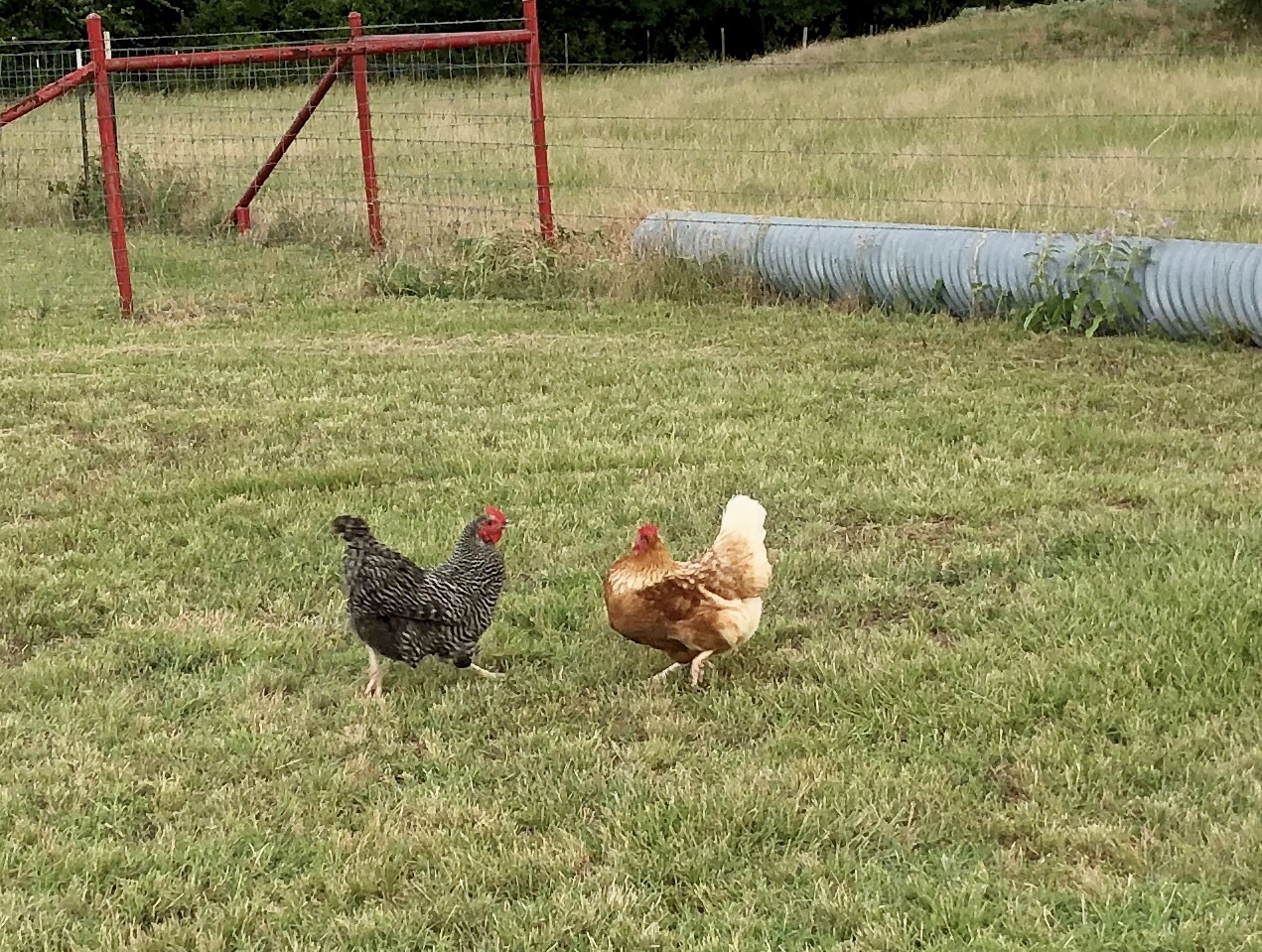
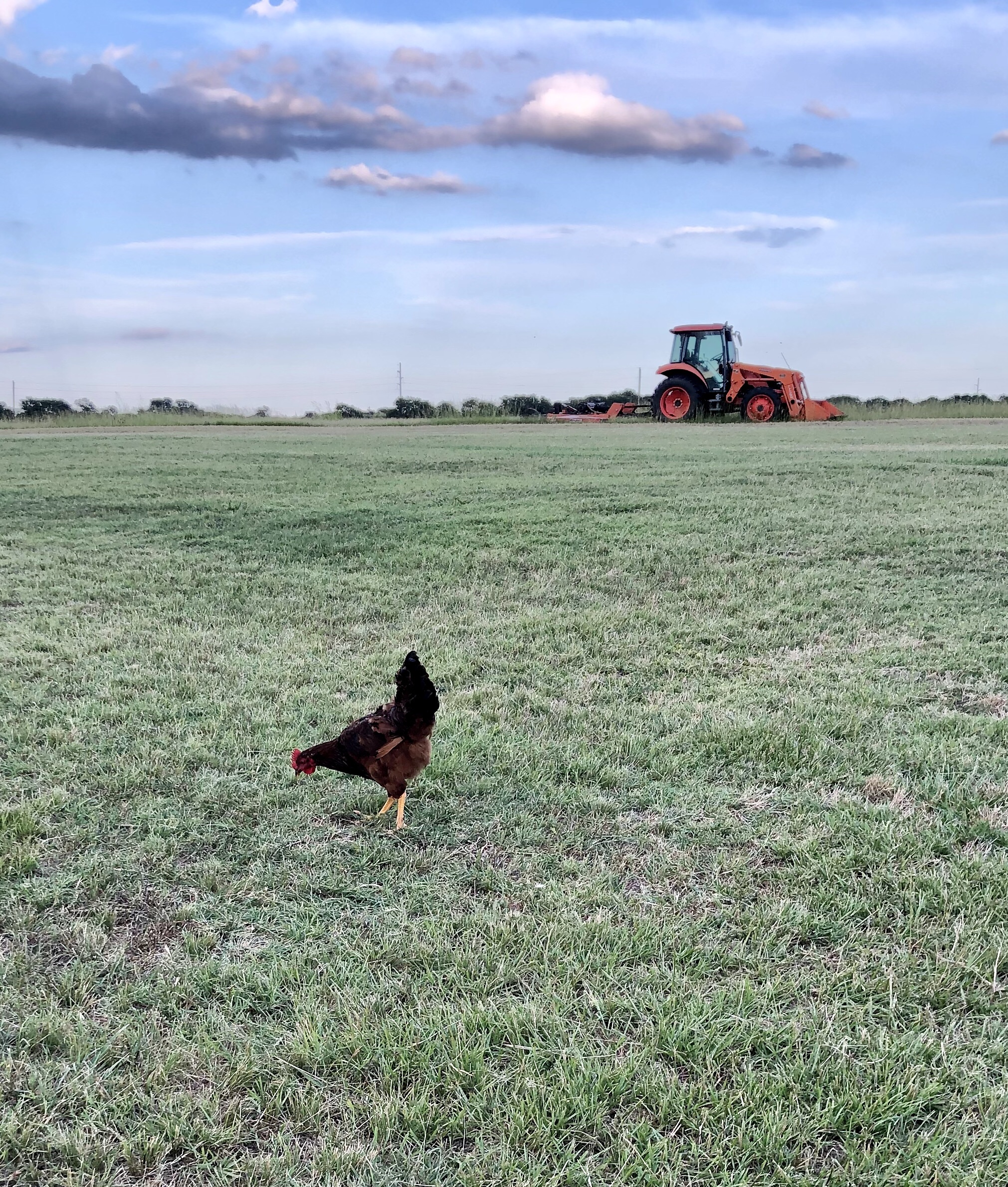
Oh! I forgot to share that last night I let Ginger and Bertie run around and chase grasshoppers for a while. Lee and I were mighty entertained. Those gals are good! Even Clarence came out and caught some. I got them all back in pretty easily once they had their fill.
You go this way. I’ll go that way.
Going after the same bug
I got a moth.
Free ranging
I hope we can let them out more often. As long as the big dogs are inside, they’re fine. Vlassic and Gracie just watch like we do!
Nope. Our chickens aren’t pampered. Just fun.
*Like I can talk. I’m a not-big sort of ranching sort of venting blogger.
I’ve always been a sucker for personality tests, astrology, and other ways of categorizing people’s personalities or figuring out what makes people tick. I love archetypes, too, as evidenced by how much I enjoy tarot. I have always liked to meditate and I do a lot of reading about self-help topics and ways to lead me to get along with others better, enjoy life, and love myself. I am very aware that some of the science (if there is any) behind these kinds of things is suspect or non-existent. I happily coexist with my cognitive dissonance, and take what works from the things I explore and leave what doesn’t work behind.
When I first read about the Enneagram, back in its earlier days, I didn’t see any science in there at all and a lot of mysticism. It reminded me a lot of numerology, which I also had a hard time with (but who knows, numbers may very well have effects on us).
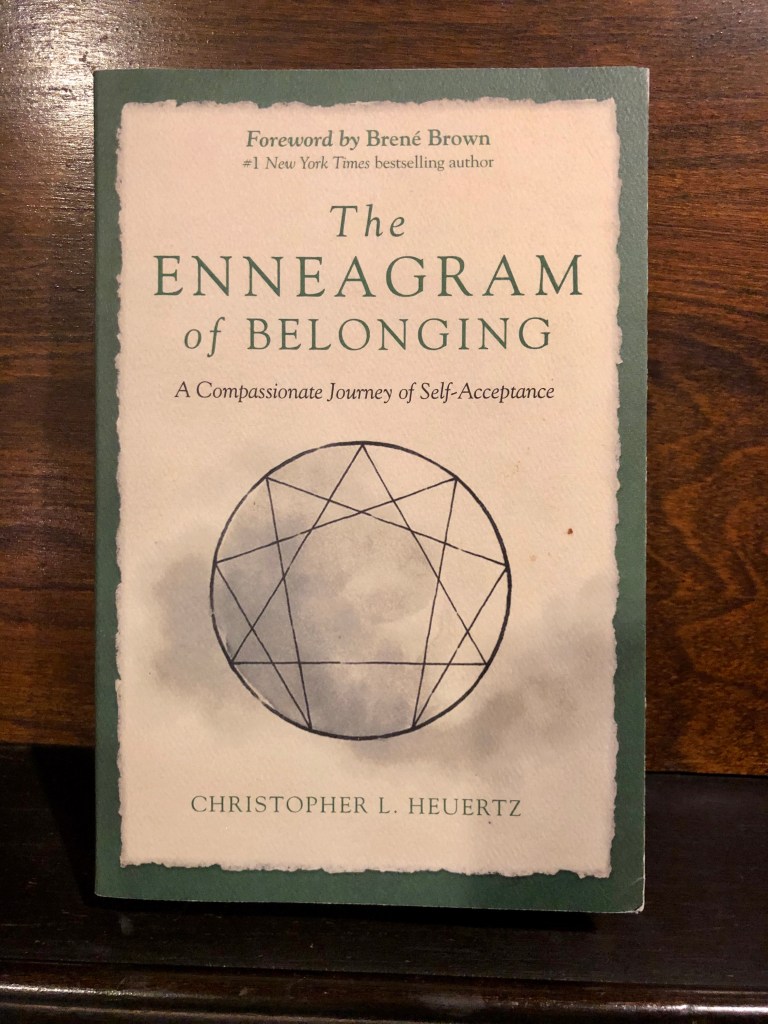
I picked this book up, though, because I’d heard there has been a lot of work in the Enneagram community, and a couple of friends were very enthusiastic. Plus, seeing the words “compassionate” and “self-acceptance” in the subtitle made it sound like the book would fit in with all the work I’ve done on self-love. And Brene Brown wrote the introduction!
On to the Book
I ended up getting a lot of ideas and insights, and a lot of it I credit to the author. Heuertz is very good at making the complexities of the Enneagram make sense and is very careful to make clear that the spiritual aspect of the system are way more important than identifying your type and buying a t-shirt with your number on it. (Nonetheless, I am adopting the sloth as my official mascot since my type’s main passion is sloth.)
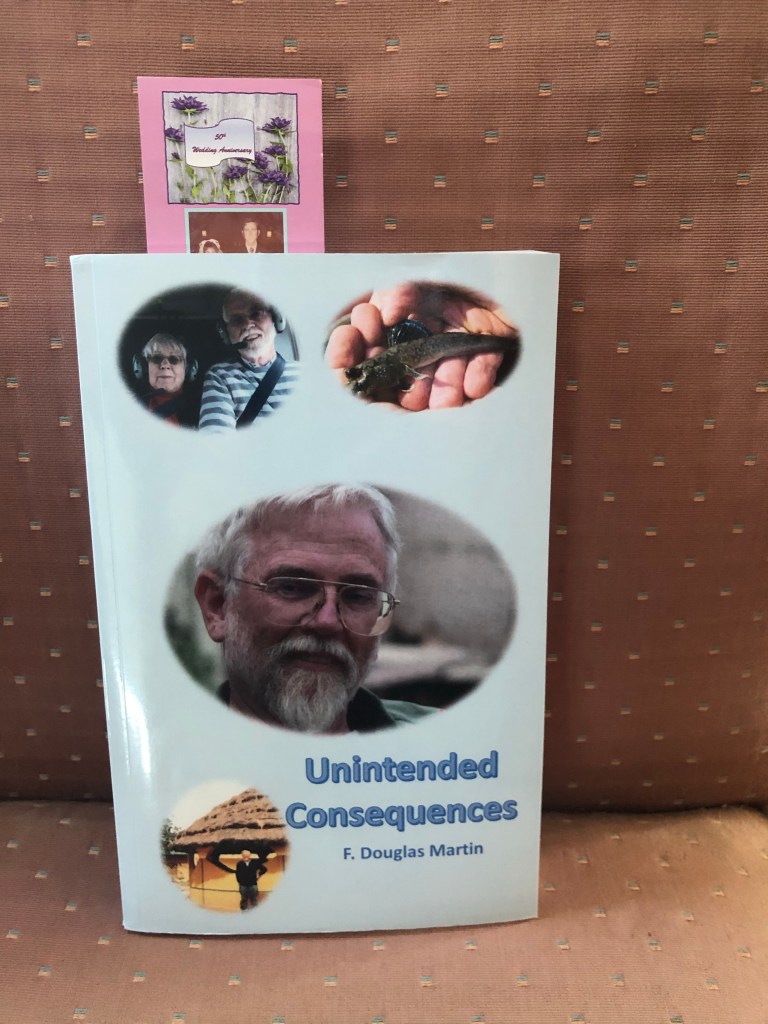
This is a different type of book review. For one thing, you can’t buy the book anywhere; I was lucky enough to receive a copy from the author.
The book comes with a free bookmark Doug and Mary made for their COVID-postponed anniversary party.
You see, Unintended Consequences, by F. Douglas Martin, is a collection of stories of the life of one of my friends from my old church. He had been sharing stories from his life on Facebook for months, and I found myself eagerly anticipating each new post from Doug. I just loved the cast of characters who went through his life, the stories of his upbringing, and tales from his fascinating career working with fish around the world. Yep. Fish. It’s fascinating, and not just to other scientists or amateur naturalists!
Apparently, I was not the only one who loved his tales, so his friends and family finally convinced him to put the stories together in a book. His wife, Mary Hengstebeck, took on the task of compiling the MANY stories, putting them in some kind of order, and adding photographs and clip-art illustrations for each story. That was some kind of job!
Sure, the book’s obviously self published, and because it’s a collection of separate stories, there’s some repetition, but that doesn’t detract from the joy of reading the tales of the amazing stuff Doug got away with doing as a child, the hilarious folks he worked with in his life, and the love story between him and Mary.
It’s just the story of a normal person’s life, but I love it. I’m still reading it, but since I read the original stories, I feel competent to say the whole book is a pleasure, and a wonderful distraction from the news of the world right now.
What This Means for YOU
Doug is just a well-educated guy who tells good stories, not a famous celebrity or politician. Still, his memoirs are a joy to read. In the past couple of days, I’ve tried to convince a couple of my friends who have led interesting lives that their stories deserve to be preserved and shared.
This katydid would not go in my memoirs, but it’s an interesting photo.
Both said that no one would care about their stories. Well, Doug probably thought his wife and children would be the only ones who would read his. Really, sharing the stories of our lives is valuable. Future historians will be happy to find details about how people actually lived in the 20th and 21st centuries, and family, friends, and interested others WILL like reading it, especially if you can write well and have lots of interesting photos.
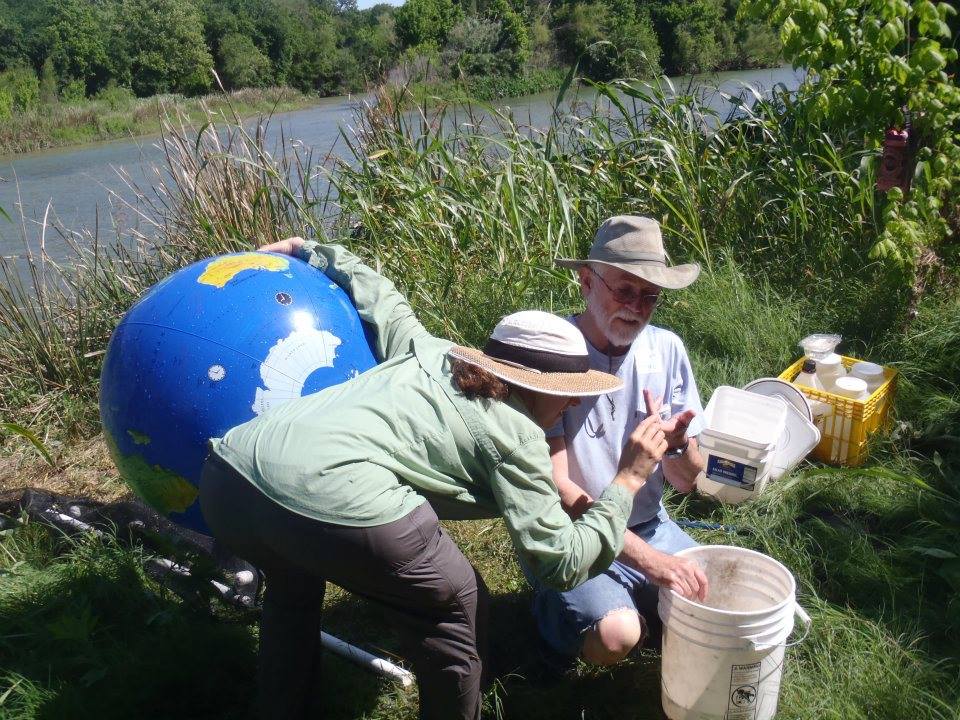
Here’s Doug doing research at Hornsby Bend. I didn’t get permission, since this review is a surprise. But it was public on Facebook.
I know LOTS of people who fit this category. Maybe YOU are one. And even if you aren’t the greatest writer on earth, you probably know someone who can review your writing and clean it up a bit. Honest. I want to read your story.

















 The Hermits' Rest