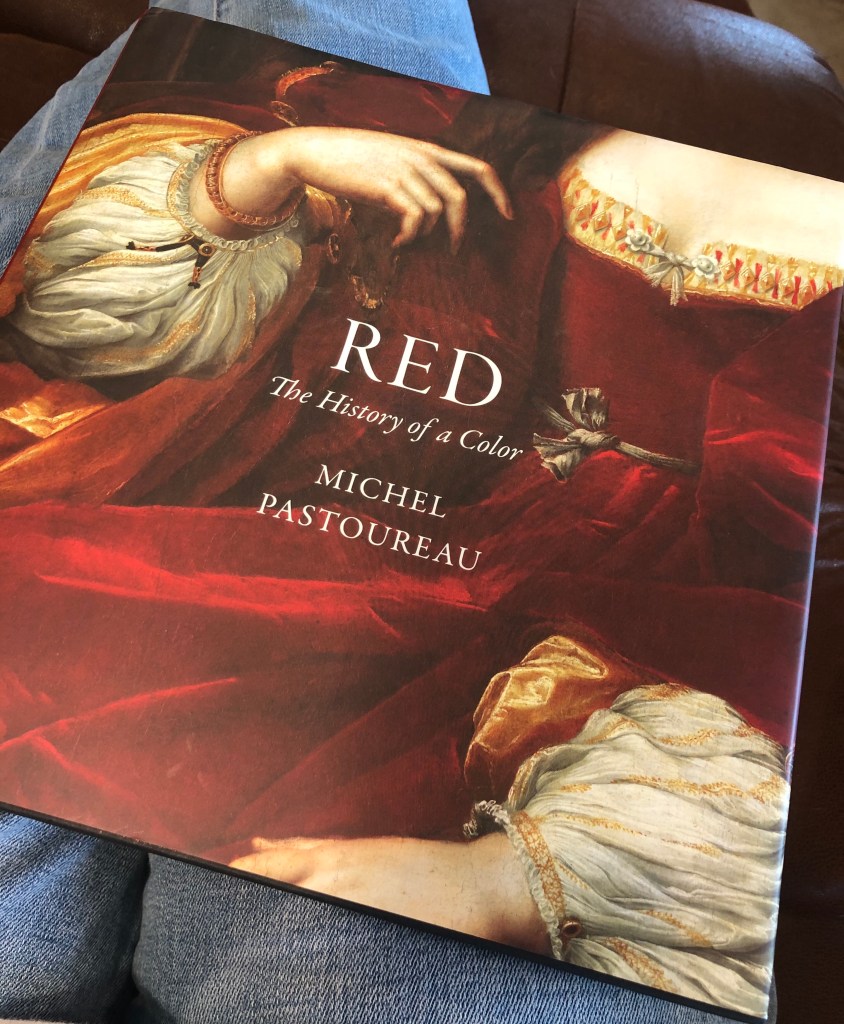
I talked earlier about how fond I am of the color red and how much I enjoyed the session on cochineal, a red dye, last week. So, naturally, the first of the series of color books by Michel Pastoureau I just got that I’m going to report on is Red: The History of a Color.
Beautiful book!
The quality of this book is drool-worthy. Each book in the series is hefty and dense. The paper for the pages is so thick, and the printing is sublime. The illustrations are so interesting that I’ll go back to this book over and over.
Example of one of the illustrative images. This is by Jan Van Eyk.
While I did get lost in the photos, I also learned a lot about how red figured throughout European history. It was the most important color up until the last few centuries, when blue took over. Boo, blue (I guess I’ll be more on Team Blue when I read the blue volume).
My kitchen is Team Red, too.
The author teaches us a lot about how color has been perceived by humans, which I learned from earlier color books, but the focus on red and how it was perceived earlier than colors other than black and white made the history pretty memorable. it turns out names for many colors show up quite late, as the chapter on pink showed.
Pink and red at my house. Also, roosters were revered because of their bright red combs!
I enjoyed learning a lot about how people dressed through European history, and not just the royalty and rich people. Peasants always liked red!
Sapphire points out that her breed had particularly red combs, and eyes.
Any book in this series would be a nice gift for an artsy or crafty friend. A high-quality book on your favorite color that’s also a work of art in itself—what’s not to love? And red’s the color of love!
Maybe it’s irritating; maybe it’s righteously indignant; maybe it’s newly awakened evangelism. Whatever it is, I can’t stop talking to all my friends about the Caste book I just read. I keep retelling the parts about the lynching postcards, Hitler’s use of the US as a model in how to de-humanize Jews, and the clear explanation of why poor whites identify more with powerful elites than to other poor people. Apparently, I have been deeply affected by Isabel Wilkerson’s scholarship, and I simply MUST share.
This woman is inspiring.
Have you ever read something that you can’t shut up about? I was recently that way about Nature’s Best Hope, which I begged everyone I knew to read (and at least I know all my Master Naturalist friends will read after hearing Doug Tallamy speak in person. I can remember being that excited over The Color Purple, too, as well as the first book on feminist spirituality I ever read. But, it doesn’t happen often, so forgive me, if you know me in person, if I keep going on and on about things the US has institutionalized to maintain an artificial difference between two groups of people.
These are the kinds of things that just get me angry at my fellow white people.
You will be either pleased or annoyed to know I just got Wilkerson’s first book, The Warmth of Other Suns, which is about the immigration history of the US. I can’t wait to learn which group of misfits gets scapegoated decade by decade. I’ll try to keep my enthusiasm to a dull roar, hee hee.
I’ve been thinking, though, about what gets me all riled up into a pile of agitated activism. It always seems to center around people or other living beings not being treated fairly. That’s what sparked my religious outrage in the past, nearly all of my strong political feelings, and my advocacy of child and animal welfare. None of us is ACTUALLY any better than anyone else, people, animals, plants, rocks, whatever. At least that’s what I’ve been socialized to believe.
Just shut me up. Hey, at least this stuff keeps me from dwelling on other things that annoy me. Yeah, Suna, just keep on shaking your fist at the status quo!
Thanks to all the reading I’ve done lately, though, I can see how other people come to view things differently. I may not think it’s right all the time, but it’s odd how learning about the treatment of minorities, indigenous people, and disfavored groups has led me to a better understanding of how desperately people cling to anything that lets them believe they are members of favored groups.
I’m still thinking. In the meantime, what book (or movie or television program) has led you to get all riled up and ready to take action about injustice?
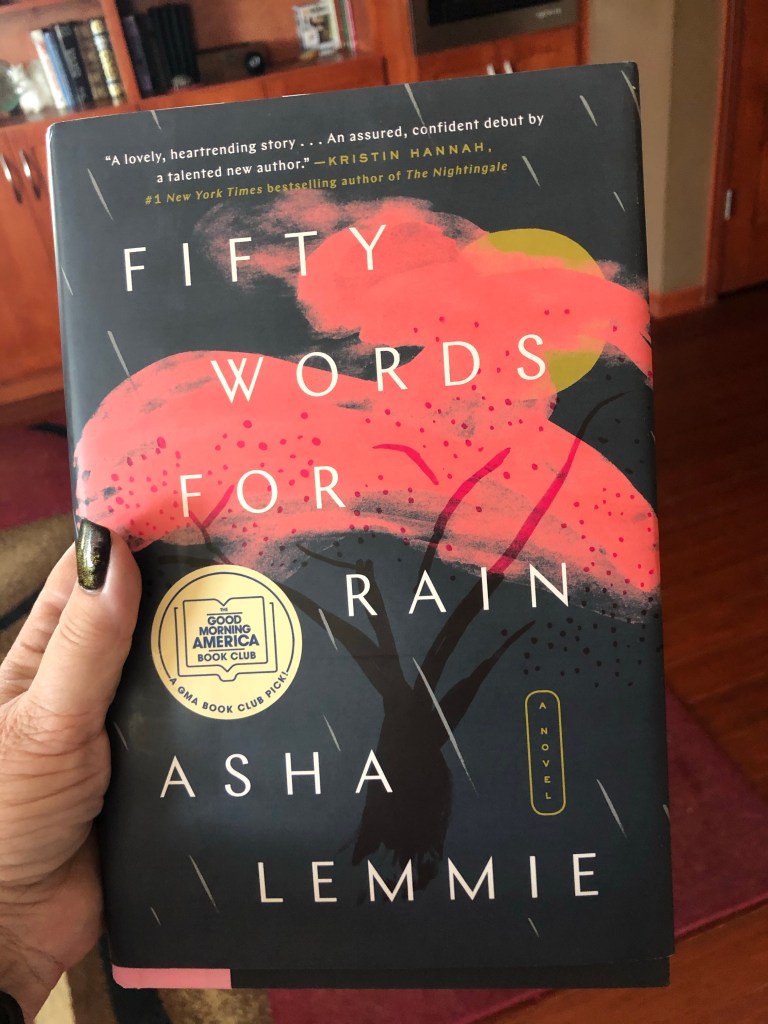
After the emotional turmoil of reading Caste, I wanted something less intense and not about race. Well, the next book I read, Fifty Words for Rain, by Asha Lemmie turned out to be intense and about race, but it also had fun elements, so it was a bit of a break. Here’s how the Amazon description starts out:
Kyoto, Japan, 1948. “Do not question. Do not fight. Do not resist.”
Such is eight-year-old Noriko “Nori” Kamiza’s first lesson. She will not question why her mother abandoned her with only these final words. She will not fight her confinement to the attic of her grandparents’ imperial estate. And she will not resist the scalding chemical baths she receives daily to lighten her skin.
Turns out little Nori is half Black, and that was quite a problem back then, especially for a member of the Imperial Family. The poor girl certainly has a hard time, but she’s one of those resilient types, thankfully. I found it interesting how she made the best of whatever situation she was in, and was able to learn and grow into an amazing person. She is amazingly good at being alone, that’s for sure.
Pretty cover.
Other than a few annoying repetitions (how many times must Nori bite her lips so hard that she tastes blood?), I enjoyed the writing and the fascinating (if sometimes scary) characters Nori encounters. Her family puts the D in dysfunctional, to put it mildly.
The other part that was fun for me, in particular, is the Japanese language and culture from the times I’m most familiar with that is spread through the novel. I’m way better with formal Japanese than colloquial, so I understood most of it (I was trained by a fairly formal Japanese speaker, or actually, I’m glad Swann-sensei didn’t teach us what he did know; that would be fifty words for alcoholic beverages). At least some of the horrors of that culture didn’t shock me, since I knew about them. Other readers might find some of the book a little disturbing, but that’s what you need in a novel, right? Something to get you to turn the pages!
I predict Lemmie’s writing will only get better, so I look forward to future work by her. Even if the race theme keeps popping up to remind me not to become complacent, it’s worth it. Go ahead, get it! It will give you a nice break from reality. It certainly improved my Saturday afternoon and evening!
Oh my. Here’s a book you probably should read. I guarantee you won’t “enjoy” it, but you may well be a better person for having read it. You know how they say there are things you can’t “un-see?” Well, this book hammers you with things that you won’t be able to “un-read” even if you want to.
I set it on a pretty backdrop.
I had to stop reading Caste: The Origins of Our Discontent, by Isabel Wilkerson, for a couple of weeks, because I was having nightmares about lynchings and beatings. I was ignorant of how many there were in the 20th century, as well as how people came to see the lynched people, took photos with them, and even sent postcards of it, until the Post Office banned them. Nightmare stuff. This was in my parents’ lifetime.
That’s just one example of what Wilkerson shares as she lays out the history and consequences of what she defines as the two-caste system in the US, which is unique to this country. Oh boy, makes me so not proud. Makes me sick.
Taking a break to breathe.
She also makes it frighteningly clear how similar the US caste system parallels the way Nazi Germany was set up. What horrified me most was learning that they based their system for de-humanizing the Jews and others on how the high-caste people in the US made people from Africa into non-humans, to justify how they were treated in the slave economy. I got sick to my stomach just typing this.
Yeah, it’s a hard book to read. But it’s so important to look at the way Black people have been treated here in the US and (most important) how they continue to be treated up until the present. Especially for those of us who just happened to be born in the high caste, if you don’t have this information presented to you, right in your face, it’s easy to assume everything’s just fine, because, heck WE like our black colleagues and friends and treat them well. Oops. Not true.
Breathing some more. What a lovely morning sky. Sure looks like our electric pole is slanted.
No, things are NOT better, and no, people have not stopped treating lower-caste people as less than human. Yes, progress has been made, but all you have to do is look at how panicked a large portion of the white people in the US got when a Black man became President. Preserving the status quo turns out to be more important for this group than many things that might help them as a group (and that’s all I’ll say about this; read the book).
In good news, not all the book makes you sick to your stomach if you have any empathy at all for fellow humans. Wilkerson does talk about interesting historical parallels in India and talks about ways to make things better. Like I’ve always thought, she concludes that actually getting to know people and seeing their common humanity, one at a time, is how ANY of us can work to break the caste system down.
People who show a greater sense of joint responsibility to one another when they see their fellow citizens as like themselves.
page 353
It’s just that we still have a lot of work ahead of us, and it will go way slower if we don’t actually LISTEN to our fellow citizens, even when it hurts.
I did not exactly “enjoy” the journey through this book, but I’m glad I embarked on it. And I am glad I finished.
The chapter of Caste that gobsmacked me was the one at the end, where she shares the consequences of the caste system and the fear and distrust it engenders in the US. When put in the context of the rest of the world, this is one weird place. Examples from the book:
Americans own nearly half the guns in the world owned by civilians.
If the U.S. prison population were a city, it would be the fifth largest in America.
page 355
I know this is not a popular thing to say right now, but I can see why so many of my friends are moving to other countries. I’ve just been conveniently ignoring a lot of things that are right in front of my face, passively watching fellow Americans support and encourage the caste system, and failed to do the work needed to make this a good place for all of us. I’m so afraid of the dominant caste and the masses it’s indoctrinated that I’m not much better than them.
Well, that is changing, thanks to what I’ve been learning this year, and I’m just going to have to deal with the nasty consequences from fearful fellow citizens. It’s not like I have to be on the defensive every second of every day like so many Black people, the ones I know and care about included, must deal with. Because, as Wilkerson notes:
There are thriving, prosperous nations where people do not have to sell their Nobel Prizes to get medical care, where families don’t go broke taking care of elderly loved ones, where children exceed the educational achievements of American children, where drug addicts are in treatment rather than in prison, where perhaps the greatest measure of human success – happiness and a long life – exists in greater measure because they value their shared commonality.
pp. 353-54
I don’t know for sure how I came out this way, having grown up in the American South. But I don’t want to see people’s potential wasted just because of what they look like or where their parents were born. We need all the contributions of all the brilliant humans out there…so maybe we can live in peace. I’m still gonna try, no matter how cynical books like this make me.
Not gonna give up. Image from peaceoneday.org – Peace Day is September 21!
Wow. Just wow. My life is now so much better, having heard the amazing Doug Tallamy speak at the Texas Master Naturalist meeting. He’s just about as inspirational as a speaker gets, and I now have my answer when people ask what famous person I’d most like to have dinner with. I could talk to him for hours, or more likely, listen.
I recently read and reviewed his book, Nature’s Best Hope, and once again I must encourage everyone to read it. It’s one of the few books I’ve read lately that made me feel empowered to go out and actually make the world a better place, right on my own property.
Listening to him speak to us, sounding just like some nice guy you’d talk to at your meeting, but with an amazing wealthy of information, was a mind-blowing experience. And the information he shared about how he and his wife turned their property into a place that is both beautiful AND attractive for natives was nothing short of inspirational.
Tallamy reminded me WHY I don’t want all the land around the ranch scalped into a beautiful monoculture lawn and why I ask that the wildflowers be allowed to grow, bloom, and seed each spring. They support so much of the diversity of animals and insects that we are rapidly losing.
When he shared how many different moths grow on the goldenrod on his Pennsylvania property, my heart swelled, since you may recall just yesterday I wrote about how much I saw growing on goldenrod plants (and I skipped a wasp that I couldn’t get a clear photo of). I feel like at least some parts of our ranch are helping the earth heal itself, while still providing food for people. I think it’s a win-win.
He provided lots of useful links, but I was too enthralled to take many screenshots. But here’s something you might be interested in, which is the keystone species that support the most insects, birds, etc.
The Hermits’ Rest has lots of these! Just not many maples.
I’m not going to write down everything Tallamy said, but I hope you will go to his website to learn more. There’s TONS of fascinating stuff there. This one point he makes sums it up for me:
From the Bringing Nature Home website
We ARE part of nature and need to live with it, wherever we are. I’m going to hold that in my heart and work as hard as I can to help Professor Tallamy achieve his goals.
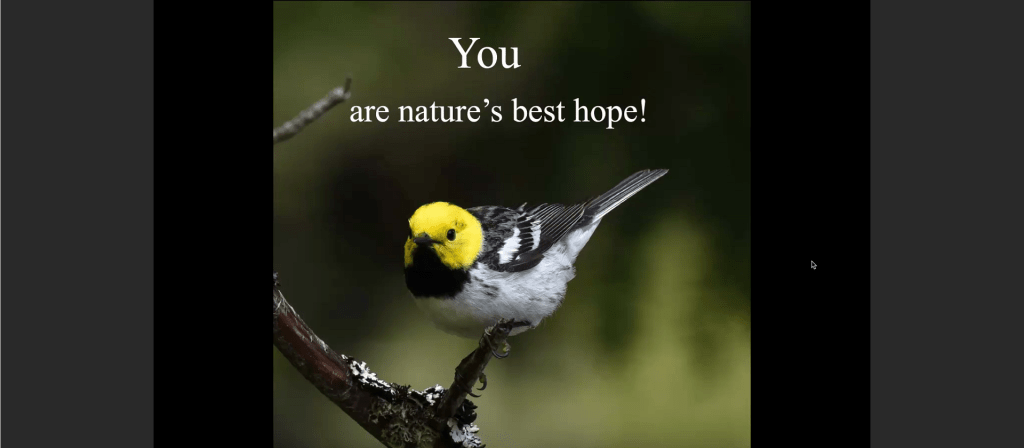
His final slide.
I encourage those of you who want a better world for the children who are around today to read his books and take action. It’s awfully easy to plant some native plants. Many of them just show up, after all (“weeds”). And as soon as you have them, insects will follow.
Even if all you have is a balcony or some space outside your office, you can make the world a better place. Now, that’s awesome.
Are there any books, movies, or other media that you made it through once but just NEVER want to go through again? Last night my sister asked me about the handmaid costume she saw somewhere. I told her about The Handmaid’s Tale book, and that it had been made into a series. I read the book when I was in graduate school, and probably lost a lot of popularity as a professor by making a class full of engineering students read it and write a report.
Protesting handmaiden. Image by @straubmuller via Twenty20.
But right now, I could not stomach that book, nor could I bring myself to watch the Hulu Series. It seemed eerily possible in the 1980s, and today I could see women becoming property again, just like in the book. Shudder. I have had many nightmares brought on the The Handmaid’s Tale.
Please. Image by @jenni.heller via Twenty20.
In fact, many of the books I don’t think I could take reading again are in a similar vein. You are NOT going to see me cracking open 1984 or Fahrenheit 451 any time soon, either. I think those books have already come true, and not in a good way. Yeah, the whole dystopian novel genre isn’t good for me.
Neither are books or movies about Nazi Germany. No, thank you. A couple of movies in that genre have scarred me for life, including Julia (a beautiful film, but gave me bad dreams) and Seven Beauties (eww, ick, yuck, don’t watch it). I realize now that I watched way too many of these really sad movies during my most impressionable late teen years. I STILL have Apocalypse Now nightmares, too. I wonder if High School Boyfriend knew what a pacifist he was creating by taking me to all these violent and psychologically terrifying movies?
As I have mentioned before, I’m one of them there Highly Sensitive People, which means media violence and cruelty really get to me (as well as teasing, bullying, name-calling and putdowns). I pay attention to violence warnings on books and movies for good reason!
Oh and for goodness sake, I don’t want to ever see that damned Red Pony book again (curse you, Steinbeck, and curse you, school librarian who gave it to me to read in the THIRD GRADE). Graphic descriptions of the deaths of beloved pets, innocent wild animals, and other harmless creatures aren’t for me, either. I managed to get through that book about the dog that keeps dying over and over (The Art of Racing in the Rain), because I knew all would end well (and I didn’t want to look like a wimp in front of book club).
Oddly enough, I can watch Dr. Pimple popper and shows about surgery just fine. I just don’t like violence and loss.
What are your topics you just don’t want to read about or watch these days? (I realize for many of you it may be politics, but I’m not here to encourage bashing of anyone’s views, just wondering what turns you off.)
The book I’m talking about today is next month’s topic for the cul-de-sac book club in Austin. The Trouble with Goats and Sheep was Joanna Cannon’s first novel, which came out in 2015. Since I wasn’t reading novels five years ago, I’d never heard of it, but dutifully ordered it when it was decided upon by the group.
I even read a paperback. Wow!
I got it on Monday, and finished it last night. It was a nice respite from the more solemn reading I’ve been doing lately, but it doesn’t mean that Cannon didn’t sneak in some messages, some of which are quite current today.
I’d say almost anyone would enjoy reading this, though it helps a LOT to be familiar with the everyday items in England in 1976. I know what Fairy Liquid is, thanks to spending so much time in Ireland, but do you? (It’s dish washing soap.) And candies are very important, at least to the main characters, so it would help to Google those as they come up.
The fun thing about the book is that it’s about a cul-de-sac and the varied characters who inhabit it, which of course reminds me and my neighbors of OUR little Bob Cat Run, with its fascinating cast of characters. We will have to decide who is the “Walter Bishop” of our street (he’s the one everyone has a bad opinion of). Oh wait, I think I already know, ha ha. It’s not me or Anita, either!
Much of the story revolves around two young girls who are best friends, Grace and Tilly. They are the junior detectives in the mystery aspect of the book, who, after one neighbor disappears suddenly, decide to find God in the neighborhood. Eventually Jesus shows up, which is a fun twist (I won’t tell you how that happens). All the neighbors get their chance to shine, too, and you eventually learn all their secrets. That’s the fun of the book.
You’ll love the woman who wears a bikini and tans in her front garden every day, the couple with the very nervous wife, Grace’s parents (and her very odd mother), the guy who lives with his elderly mother well into his forties, the friendly widow, the refreshingly rational gardening guy, the exotic new family, etc.
What really makes the book special, though, is how gently Cannon weaves lessons about honesty and lies, ignorance and enlightenment, and most important to me, about how each and every one of us has secrets we think will be ruinous if revealed, but are probably worse being hidden. It’s a fun read with interesting characters, but it also makes you think about morality and judgment. That’s what elevates The Trouble with Goats and Sheep from a pleasant escape to a book that will live with me for a long time.
By the way, it’s also really funny. I had to read passages aloud to Lee. I think I laughed the hardest when Grace’s father tries to convince the new neighbor he’s a worldly, tolerant guy by repeating racist stereotype after racist stereotype. I was happy to see the two of them actually ending up talking to each other from the heart and becoming friends. That’s what we all need to do when confronted with “the other,” I think.
I have a nice stack of books on my shelf, so I’ll start another one while patiently reading a chapter a day in Caste.
If you know me or have read this blog a few times, you won’t be surprised to learn this, but I’ve always been a tree hugger, and I mean always. My poor mother (happy birthday wherever your spirit is) used to find me as a toddler wandering around the yard talking to the huge oak trees on our property. When I moved away, I mourned the loss of my tree friends around the town, and even now, when I go back I make sure to check in and see who’s still around and who’s gone.
That may explain why I have been reading so many books about trees, forests, and how they work for the past few years. It may explain why I became a Master Naturalist. It certainly explains why I have a hard time with cutting down trees for human convenience, though I am trying my best to be cooperative with other folks’ agendas in that respect. It explains why I bought the parts of the Hermits’ Rest ranch that I did – there were lots of trees, not a monoculture of non-native grass. I was born an annoying hippie tree hugger!
Of course you use your Sierra Club bookmark on the tree book.
So, then, why did I wait so long to read The Overstory, by Richard Powers? It won a Pulitzer Prize last year and everything! And it’s about trees! Anita and I both ordered it this time last year and planned to read it, so I had good intentions.
But, the first chapter was so sad it made me cry. And the second chapter had nothing to do with the first chapter, so I got confused, put the book down, and read all those other things I keep writing about (of interest to no one but me).
I ran out of books I hadn’t read last week (at least ones I could easily locate). I gritted my teeth and picked up The Overstory again. This time I looked at the table of contents, which was quite helpful. There, I saw that the first chapters were all about different people. I figured I’d just need to hold my horses through those first chapters and it would all come together in the gigantic middle section. Spoiler: it does.
Table of contents that makes reading the book easier!
By the way, they aren’t kidding when they say this is the greatest novels ever written about trees and perhaps one of the greatest about anything. There’s nothing I like better than a complicated plot that weaves new knowledge and a much-needed perspective on how to change the world. No, make that a much-needed perspective ON the world, one I share.
That Richard Powers. When I was in grad school, he was already a legend, the topic of many a conversation in the English department. He left just a semester before I got there (I was in another department, but many of my friends were in the English department with my brilliant boyfriend). Probably because I got sick of hearing about him, I didn’t read his first book. I got bogged down in The Gold Bug Variations (about music and genetics) but should probably go back and find that one to read.
Because Powers is such a polymath and so incredibly gifted, he crams a lot into a book. It’s not one of those quick summer novel kind of things. It’s more of a book to read when you are all alone, overwhelmed by real life, trapped by a pandemic, surrounded by people who don’t want to talk most of the time. Hey, that’s ME! I was in the right situation to immerse myself into the interwoven plots, make it through the deep despair the novel can raise in a tree hugger, and come out of it with my personal beliefs validated.
I sort of needed “Do Not Disturb” signs when I was trying to finish The Overstory, because it came right when Lee was in one of his talkative moods. My sometimes elusive goal is to stop what I am doing when he starts talking, so I had to re-read a lot.
Maybe that was a good thing; maybe it drove the message home. I’m finding it very helpful and very comforting to take that message to heart. We are not in charge of the earth. There are other minds and other forces at work, ones our perception of time makes it hard to notice. I take comfort that no matter what crazy Armageddon humanity is hell-bent on driving itself toward, Gaia, the trees, and the deeper consciousness will heal and persevere. It gives me the grain of hope I need to keep a-going.
No, this isn’t a book about the second amendment to the US Constitution; it’s a book about Liberty DeVitto. Who’s that? He was Billy Joel’s drummer for the longest time (Billy Joel lyric humor, there). I always really admired the drumming in Billy Joel’s band, because there were always so many creative percussion techniques, but the drumming never stole the show–just drove the music.
I do like the cover!
Liberty: Life, Billy, and the Pursuit of Happiness, by Liberty DeVitto, did a great job answering my questions about the percussion in my favorite Billy Joel songs (admitting here that I got less and less fond of Mr. Joel as he sounded more and more like a lounge singer to me). My favorite part about this book was that he told the story about every single song on every album up until the time Billy dumped him from the band. But, that’s decades of albums! I got to found out who did the castanets on “Say Goodbye to Hollywood,” and other important (to me) musical nuggets. It’s a real musician’s book, for musicians, which makes sense, since it was published by a musical publisher (Hudson Music – I’ll talk about that later).
I’m glad I heard DeVitto talking about the book on NPR one afternoon, or I never would have bought it, or probably heard of it. I really learned a lot about how the generation just before mine grew up, and even got some insight into why some folks love New York. And, DeVitto is brutally honest about his upbringing, his own mistakes, and his very dark side. I’m glad he had drumming, or he probably wouldn’t have made it past his 20s.
He sure wasn’t very good to women through most of his life. He barely even gave women he was in relationships with names, and had a deep sexism and disrespect for women that turned me off a lot. The good news is that he grew, eventually, and thinks his current wife is actually a fellow human being worthy of respect, not an annoying object.
So, basically, he’s not a particularly likable guy, but he probably figured that out, himself. I do give him props for naming every single person he did music with, saying how they influenced him, and giving credit where it is due. Thank goodness he had nice things to say about Karen Carpenter and Ronnie Spector, even though they were women, or I’d have quit reading!
Enough about good ole Lib. Let’s talk about the book. Whoever designed it got a D+ at best in their book design class. More probably, they didn’t take one at all, and instead someone took a Microsoft Word file, added table of contents tags, and printed that mother out. They could at LEAST have turned on widow and orphan control, though. The headings at the bottoms of pages with no words under them, combined with the single lines at top and bottom of pages, made me shudder.
Also the fonts and tiny margins. Oy. They sure chose some inelegant fonts. I’ll spare you. And TYPOS. The name of a town in Italy is spelled two different ways on the same page. Pity a poor proofreader!
Leland, you took a great picture, and Mike, the cover is nice. Joe and Rick, don’t give up your day jobs.
I’m guessing that whoever printed the book charged by the page, because there is exactly ONE blank page in the book, other than the ends pieces, which are on thicker paper. That’s right. It just marches right along from title, to a quote, to copyright (on the wrong side of the page and where, OMG, people admitted to design and typography), to a dedication, to the table of contents (crammed onto one page with some crazy tabs), to acknowledgements, the foreword by Billy, to a prologue, and finally to the book. No blank pages to rest your eyes on here! Keep moving along, folks! The text is also crammed in, since it’s both justified and sans spacing between paragraphs. That makes it dense. Thank the Maker for the rather large asterisks that separate sections. Ahh, breathing room.
I did look up Hudson Music, and they are a company that specializes in drums and drumming. They have a biography series on great drummers, of which this is one. They probably do a way better job on music instruction and such, and I salute any publisher who supports musicians, no matter how critical I may get. Still…
…Okay, this was obviously a labor of love and as close to vanity press publishing as it can get, but I want to point out to any of you who want to be authors that making your book look like a professional book is important, at least to many of your potential readers. I don’t mean just publishing snobs, but people for whom reading a book is an aesthetic as well as intellectual experience. Take the time and effort to make the book look good and showcase your words well.
And Liberty, enjoy your happy ending. I’m glad you got to publish your book. You worked very hard on it, and it shows.
Even though practically no one reads my book reviews, I have another one already. That’s what you get when you pick up a Young Adult selection; they go fast.
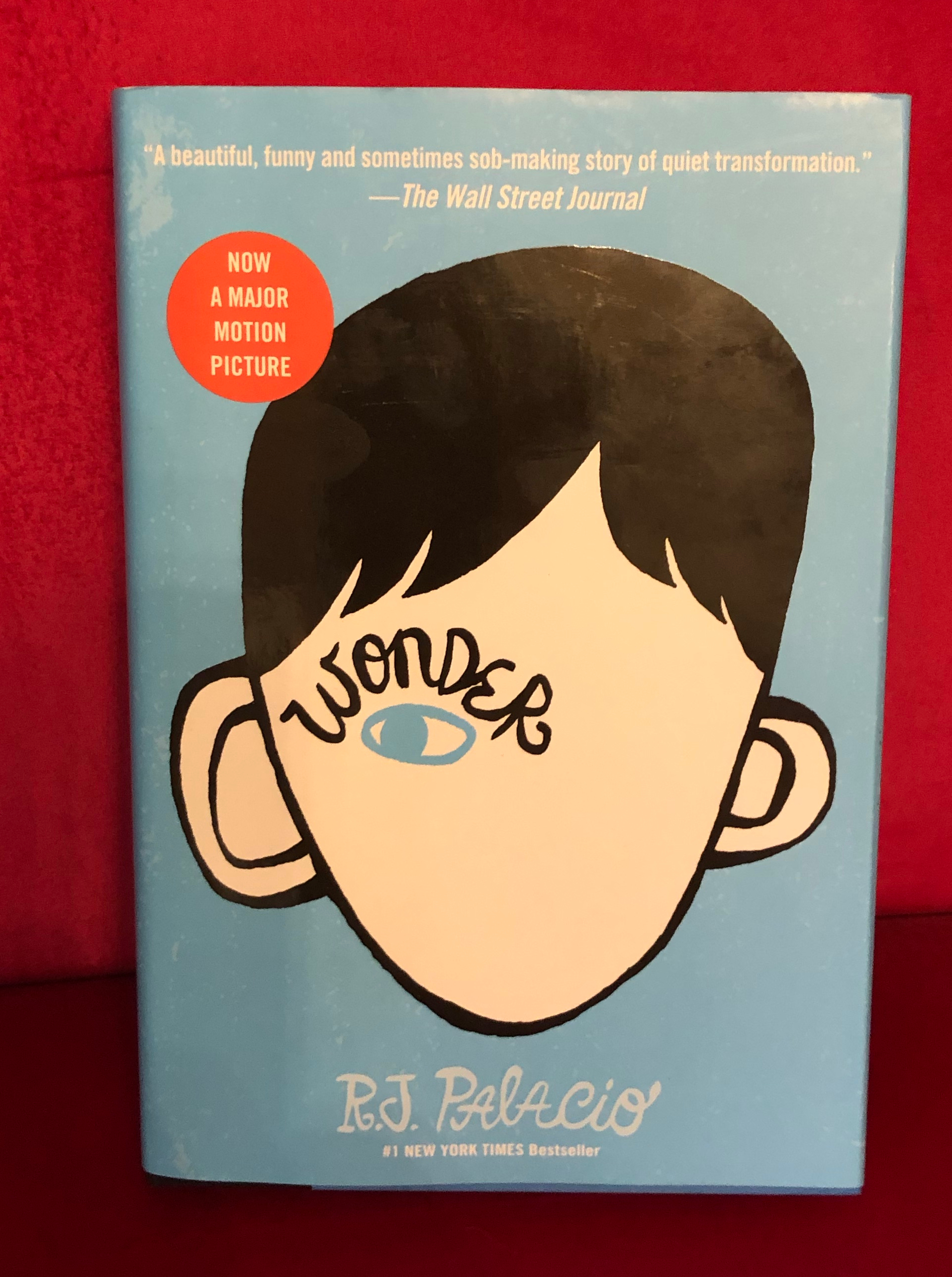
The Wall Street Journal is right! The cover does not lie.
Oddly enough, I am not sure where this book came from. Maybe someone loaned it to me? Maybe I bought it that last, wonderful time I went to Barnes & Noble and got it on sale? Anyway, I’m glad Wonder, by R.J. Palacio (apparently a pseudonym) showed up magically in my stack of books to read. I needed something uplifting and cheerful, in which everyone learns from their mistakes and grows.
I can see why Wonder was a best seller and why lots and lots of adults read it. All the characters in the book were interesting and fun to learn about. It made you want to follow them as they go through the rest of school. It’s great to see how people learn and screw up and keep learning, including the adults in the book.
Also, it’s just funny, and I think that’s important, since a book about the trials of a child with facial deformities going to school for the first time could be mostly heartbreak, otherwise. Instead, you empathize along with everyone as the hero, Auggie, shows how much of a normal (and resilient) kid he is and makes it through the ups and downs of his first year in a school.
Lee and Penney patiently waited for me to read the book aloud, but I told them I’d do it later.
If you have a child who’s “different” in any way, this would be good to read along with. And if you were a “different” child, you’ll enjoy rooting for Auggie and his family. I’m glad I had parents who were supportive like his, since I played the role of Auggie’s big sister in protecting my younger brother, who wore an eye patch and got picked on when he was little. We both ended up fine, or at least survived to adulthood!
I promise I’ll write something on another topic later. Until then, enjoy the new week.