Let’s see if I can get anything written today. I’ve been having technology issues, annoying bill-paying issues, and trouble doing what I set out to do today. Cows are mooing their asses off outside, too. So, I’m hoping a pleasant blogging break will help get me back on track to do some proofreading.
We seem to be lost. Update: not lost, separated so they can get some treatments. Still, unhappy.
Meanwhile, as I briefly mentioned last week, I have been looking more into how bullet journaling works, since my work book group friends all said they sort of do it, but would like to know more. You know me, I went out and bought the book, after reading up on two popular forms of bullet journaling online, the original bullet journal (by Ryder Carroll) and the Full Focus Planner (by Michael Hyatt), which is what Lee uses.
I might have ordered this because it looks cool and has cork on the outside.
Even though I have a nice-looking journal I use right now, in what turns out to be a semi-bullet journal format, I ordered another journal, because I forgot to check whether the book I’m using opens flat. It doesn’t, and that is more than a little irritating, even though it’s a pretty little book. I can use it for something else.
I know this journaling style is all the rage these days, but, as usual, I avoided looking into it, since I have my own system. But, one of my goals is to learn more, in general, so I’ll learn more. So far, I’ve learned how important BuJo journal proponents believe it is to write things down by hand. I’ve always agreed with their premise that writing helps cement things, which I why I was such a big note-taker in college.
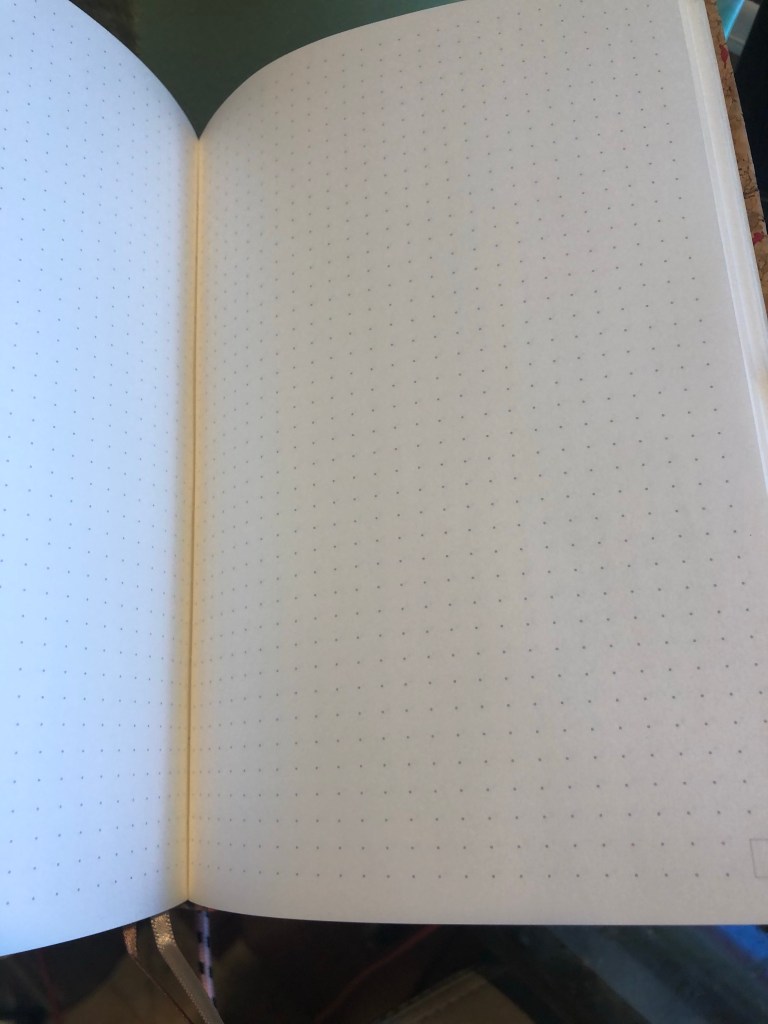
Bullet journals use dots, not lines. I think this is for freedom? I’m not that far in the book. I like dots, though.
The handwriting fans maintain that typing is not as good for focusing as the act of writing on paper, mainly because typing goes so fast that you don’t necessarily really think about it. Hmm, no wonder my blog doesn’t make sense; my hands just go typing way ahead of my brain. I honestly find typing to be equally helpful, but I also think my brain works a little differently than some people’s.
Nonetheless, I know my handwriting has become a LOT worse since I stopped doing it so often, so maybe writing more intentionally in a bullet journal will help with that. You see, a LOT of people make their journals into pieces of art, which all sorts of colors, drawings, stenciled headings, and stickers upon stickers. That has to slow down the “rapid logging” process, don’t you think? Maybe they just do it as they prepare their monthly sections. Maybe I should read more of the book.
I think one reason I hesitated to look into this stuff is that before, I felt the way Lee journaled was very rigid, and that may or may not be right. It is very goal oriented, so you don’t get to do things that don’t contribute to a goal. There goes my fondness for random activities and plain old fun (so, one of my goals is to have fun…HA).
My practice. I even put in a sticker and used a template yesterday (blurred to obscure work notes).
I was happy to see that there’s a LOT of freedom in bullet journals. You can put in art, write stories, keep lists, track your food, or whatever you find important. The best freedom, though, is to get rid of things that don’t work for you. That’s very Agile, I think, as is the iterative monthly planning. Oh goodness, Agile project management is everywhere in my life these days!
Let’s see what happens once I get my journal actually going. I’m still using the old one and practicing BuJo style bullets and style. I need to finish the book and learn about all the components before I mess up the new one. I mean, use it however I want to.
Do you journal? Is blogging journaling? Memoir writing? Narcissism? Who knows.
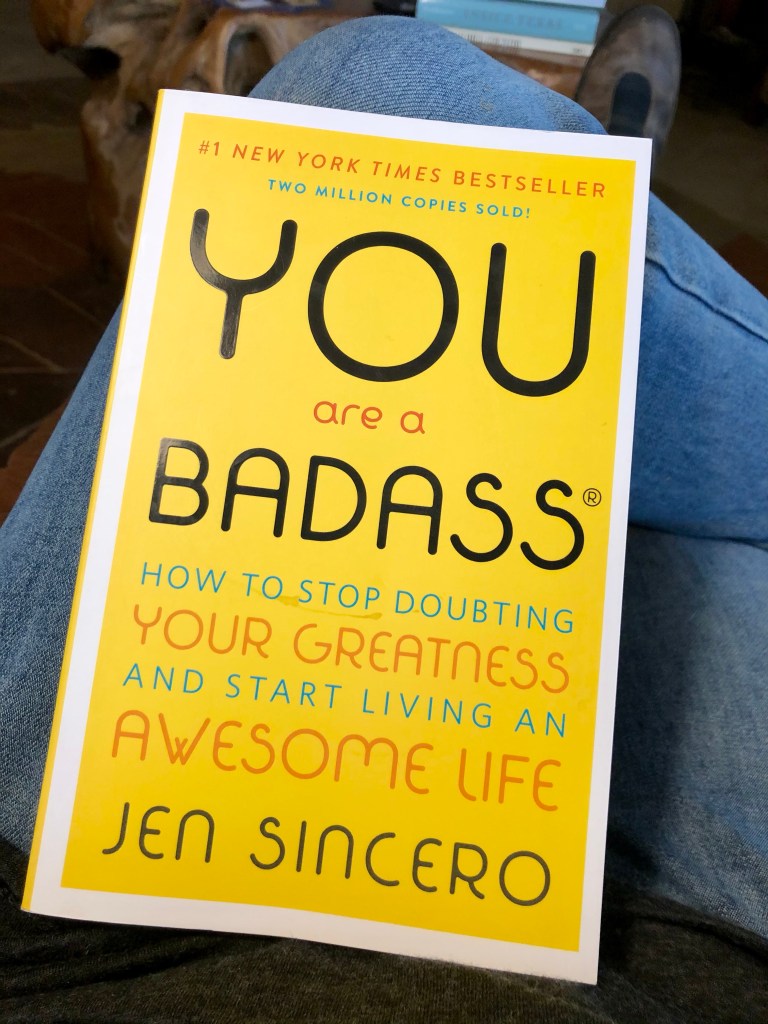
Here’s another book I started out hating, so I put it down for a good while. It all worked out for the best though, because I picked it up right when I needed it most.
I got this book, because it’s the one my work book club selected. When I started out, I was really put off by the tone and all the assumptions the author made about who her readers were. They are most assuredly people who are not me. But then, those people need books, too, right? It’s meant for people in their twenties and thirties, from what I can tell from the popular culture references strewn throughout the text. And it is most certainly for Americans, for the same reasons.
Sincero does try to notice that not everyone has the privileges she has, but there’s a lot of exhortations to just DO a thing and all will be well. Plus, there’s an undercurrent of blaming people for their own misfortunes. I don’t think she intends it, but it does come across if you know anyone who is actually poor, abused, or has other big-ass hardships.
No doubt, a lot of people will enjoy her light-hearted tone and short, easy-to-read-in-a-sitting chapters. Sincero’s heart is in the right place, and I guess she’s just talking like a life coach, making me very glad, once again, not to have a life coach. She repeats that important notion that you’re fine just as you are, and that it’s okay to let go of things (andpeople) that don’t serve you. And I think for anyone setting out to figure out who they are and who they want to be, her ideas, visualizations, and focusing techniques can be truly helpful.
I thought hard about it and realized I know who I am, where I want to be in life, and how I’m going about getting there. I know where my blockages are and am laser focused on moving through them. (I am NOT perfect; I just already introspect the heck out of myself and keep changing and adjusting.)
Here’s What Was Serendipitous
The cool experience I had with You Are a Badass (registered trademark) is that I set it down from November until last week, when I realized I needed to read the next section for our long-delayed book club meeting soon. Then I said to myself, “Let’s just get this book over with, and kept plodding away.
Now, I’d been dealing with a person who’d been in my life a while, but whose habits and actions really bothered me. I talked about it in my bully post. I knew perfectly well what I needed to do to stop letting myself feel annoyed, and deep beneath my subconscious there was an elusive piece of insight I knew I needed to apply, but it had slipped my mind. Not to worry, by delaying reading this book until the right moment, my reminder popped up, right there on page 180.
p. 180, BINGO
I’ve heard that before, and even applied it to myself (for example, I learned to deal with a constant “my problems are worse than yours” friend by realizing I had that tendency, too, forgiving the friend, and working on my own shit. Y’all do NOT get to read about all my problems here (just things I want to share, in case they are helpful to someone), and you can thank that friend.
But yeah. Sincero’s example was even right on. This person feels as if he just HAS to be the smartest person in the room, delivering lectures at the drop of a hat, and not entertaining alternate ideas or thoughts. That is another tendency I fall into myself. I hate being wrong (or screwing up). Luckily, this is another thing I’ve worked on (and had a LOT of opportunities since I came to rural America). I no longer feel it necessary to trot out my knowledge of whatever it is I’m so knowledgeable about unless I really think someone WANTS to know about it or would make any use of my expertise. I’ve been called out on this a few times (Suna, aren’t you a professional writer? Why didn’t you say anything to that person pontificating about writing?) Unless it’s worth the effort, I’ll just let people figure stuff out for themselves; I don’t have to be Professor of Everything I Know About.
But, that does explain one reason that person annoyed me. That person also has a savior complex, and feels that it’s their duty to fix the problem of every sob story they hear about (human and otherwise). Helping others is good. Helping others to get attention for it is less great. And oh have I been accused of doing that in the past! I am pretty sure that, while I’ve helped some people, my motives may have been messed up some of the time. No wonder seeing that in someone else annoyed me.
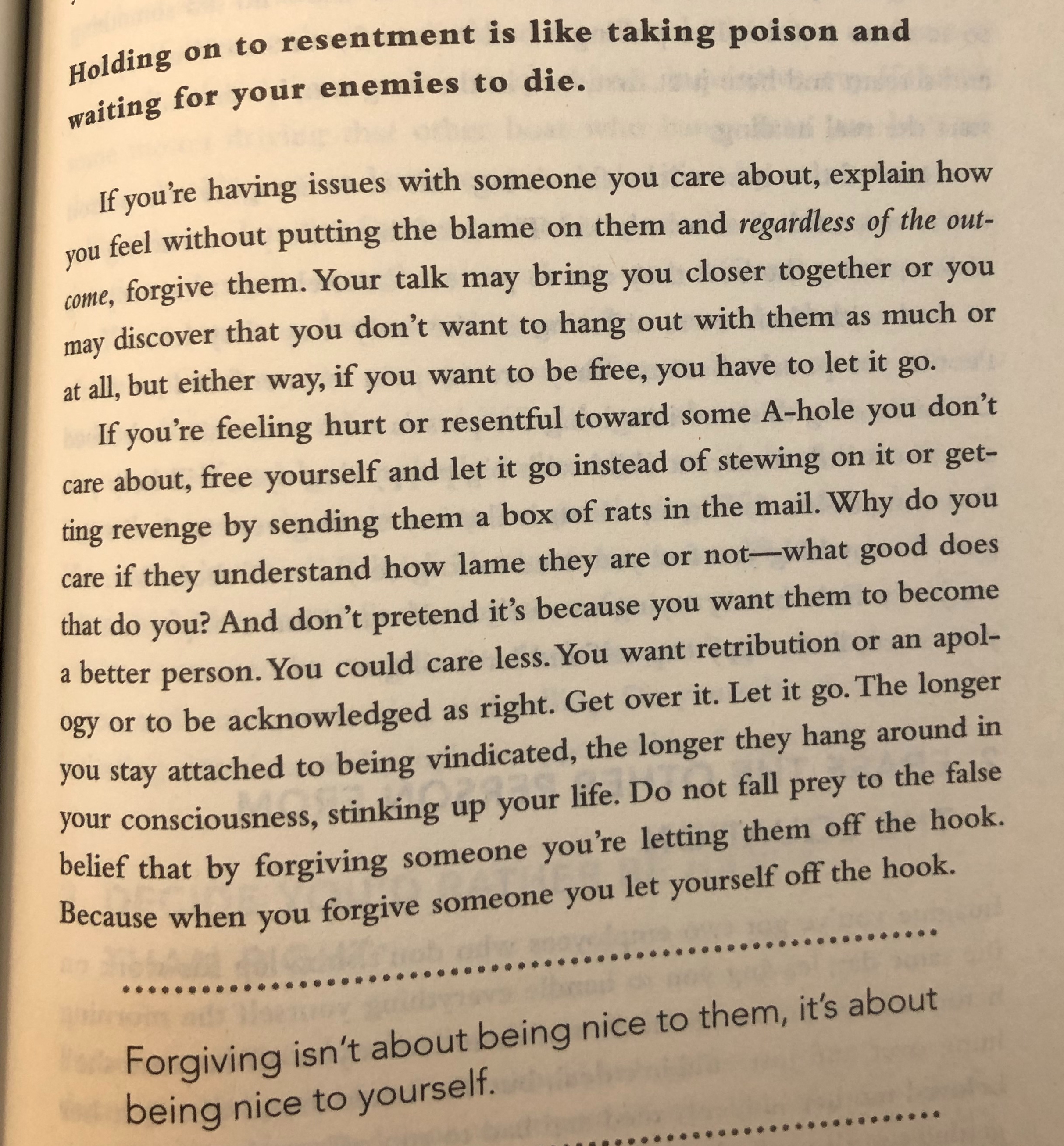
Seeing this made me feel much better about needing some distance, and also helped me get over being annoyed. That leads to the next nugget I ran into, all about how to get past being irritated and move on. I needed a reminder of this, too.
page 123, the nugget of goodness
Right on! I am learning to talk to people I care about if I have issues with them, and to listen when people do that to me. She’s right, it can bring you closer. But, in the case of the bully, Sincero is dead right. It is totally useless to think about revenge, proving myself right (I am), or some other vindication. It’s not worth the mental effort nor the physical symptoms all that vitriol can cause.
I knew I needed to just let it go. I had been telling myself that, but this passage helped me realize it was for my own good to do this. If karma bites that person in the butt, I may not see it, but that’s fine. If it becomes clear to them that I was doing the right thing all along by resisting the bullying, well, maybe that will help them, but it won’t be my problem. I’m over here with people who like me, learning about being a better human being, and dealing with my own issues.
That’s plenty, right? I’m glad I came across those passages right when I needed them.
Small Warning
The last part of the book, where she goes into full-throttle, goal-setting, laser-focused dream achievement is something you might want to skip. The end of the book has advice that, if I took it, I’d be one miserable human being. I think it would be very hard to be so focused on some goal that you have no other life. Also, her belief in the Secret, or whatever it is, that things come if you just focus on them, well, it’s great for some stuff.
But it felt to ME that she came from a really entitled white lady space in a lot of the last part of the book. I don’t think she knows REAL struggle, systemic racism, and the like.
Just my thoughts. If you fit her intended audience, though, maybe you, too, can bring out the internal badass that’s always been there. I find that Brene Brown says similar things in a way that resonates more with me. But then, she is closer to my age.
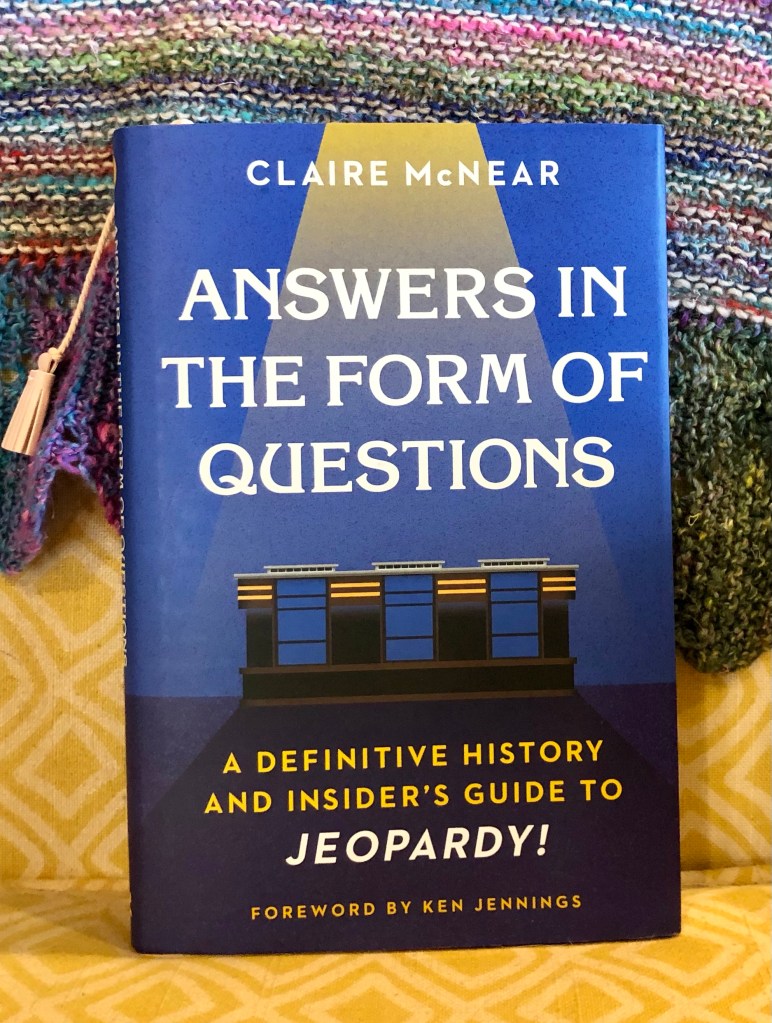
I’ve been sitting on this book report for a few days, because there were so many things to write about that I actually had a backlog! So, today let me share about Answers in the Form of Questions: A Definitive History and Insider’s Guide to Jeopardy! by Claire McNear. I wanted to read this book so much that I bought it twice. The first copy seems to have been taken from the office porch or delivered to another address. I do hope whoever got the book read it and enjoyed it!
As someone who’s been fascinated by words and word games my whole life, I was thrilled to learn this book came out. I enjoyed Answers in the Form of Questions, and would recommend it to anyone interested in the game of Jeopardy! (exclamation point mandatory) and its history. You learn a lot about how people prepare, as well as what people who have been on the show do later. Apparently, they hang out a lot and go to trivia events at various bars and restaurants.
I gained even more respect for good ole Merv Griffin, who invented that game and Wheel of Fortune (among others). I always thought he was that boring guy who asked Charro funny questions in the afternoon when I got home from school, but nope, he was a pretty darned smart and innovative television pioneer.
I enjoyed learning more about Alex Trebek and his personality. I had no idea how popular his mustache was or how upset people got when he shaved it off! Dang!
I guess this was the world’s most admired ‘stache.
There were a couple of things that I had trouble with in the book. McNear repeats the same information more than once in different chapters, so you read the same stories multiple times, as if she forgot she mentioned something. A good editor would have caught this and had her refer to the previous tale rather than repeating them.
The sun in the process of attacking my desk chair a few days ago. Note a Big Boggle game beside my chair. No one will play it with me. Sniff.
And the book really could have stood to have its publication delayed by six months or so, since it was written during the awkward time when many changes were about to happen for Jeopardy! People were about to retire, changes were about to be made, and Alex Trebek was still alive, but obviously terminally ill. It would have been nice to wait a couple of months or add an addendum with kind words about him and information on how the show is going forward. Maybe they will add something in a second edition.
I get that they probably rushed the book out to cash in on interest following Trebek’s death. It’s marketing!
Goodbye for now from my home office sanctuary. I’m enjoying the view of phoebes, meadowlarks, and mockingbirds until the sun attacks me every afternoon. I need a darker Roman shade!
How appropriate that I finished this book just as civilization began to unravel where I live. But, here’s a nice post about nothing scary. It’s about The Fabric of Civilization, by Virginia Postrel (2020). From the five stars in my rating, you may infer that I enjoyed this book. Whew, I sure did.
This was one fascinating book. Postrel sure did her job by showing that a topic people might thing was boring and insignificant, cloth, is actually critical to the development of much of human culture and civilization. The best news is that this one’s written in an interesting and fun style that makes you want it to go on and on and on.
One of the best points Postrel makes is that, while we go on and on about wearing natural fibers, none of the fibers we wear is in the natural state for the plant or animal from which it comes. Wild cotton is almost all seeds. Today’s cultivated and carefully hybridized silkworms would not last long at all out in the natural mulberry groves, wherever those are. Wild sheep are brown and shed their wool (thank goodness, since there’s no one out there on a mountainside to shear wild sheep).
As Postrel goes through the chapters, each of which is a self-contained unit you could read by itself, you learn how fabric contributed to civilization way more than just by covering people up. It was one of the earliest forms of money. Trading it led to the development of bookkeeping and checking. Figuring out new ways to create fiber has led to all sorts of scientific discoveries, from way back when people were trying to figure out how to dye fabric (I can’t get away from that topic) up to today, when they are trying to make clothing with batteries and computer chips in them that’s comfortable (comfort is the hard part).
One thing I wish is that the folks at Basic Books had budgeted for some color photographs. In a book that talks so much about weaving gold fabric and other shiny things, it sure would be nice to be able to see them in detail. The black-and-white images aren’t clear at all.
I should also warn you that it really helps to have some basic understanding of weaving, knitting, and looms to get the most out of the chapter on cloth. Thankfully, Postrel does include a glossary in the book (Judith Flanders, the author A Place for Everything, would appreciate that alphabetized learning aid). Plus, with 30 pages of end notes, you can rest assured research was involved in this.
One thing’s for sure, I will never take the clothing on my back, the upholstery on my chair, or any piece of fabric I come across for granted. Knowing me, I’ll analyze whether it’s woven or knitted (more likely knitted, since the vast majority of our clothing to day comes off knitting machines, not looms) and what the yarn or thread is made of. Then I’ll wonder how it was dyed…yep, even with all my years of working with fiber, I learned a lot from The Fabric of Civilization, and it’s sticking with me!
There’s one final book review for this year, and it’s a book I always wanted to read: the history of alphabetical order! Be still, my heart! A Place for Everything: The Curious History of Alphabetical Order, by Judith Flanders is a book that begged me to read it. And with its huge index (alphabetized, of course), end notes, and all the hallmarks of a modern nonfiction book, it did not fail to disappoint, at least if that’s the kind of reading material you like.
Nice cover!
I’ll have to resort to memoirs to explain my excitement at finding this book. You see, when I was in second and third grade, I was annoying to teachers. They could not find enough work for me to do to keep me quiet, and I kept raising my hand to answer all the questions. I probably annoyed other kids, too. To remedy this, they passed me off to the patient librarian at Sidney Lanier Elementary School in Gainesville, Florida (also at the time home of education for deaf, mentally handicapped, and otherwise challenged kids, which was GREAT for teaching us that those are regular kids that are fine for playing with at recess). And yes, I know now that Sidney Lanier served in the Confederate military, but we were told he was a poet. The End.
Anyway, I proceeded to read through the contents of the library that matched my reading ability. I also needed books that matched my social development, which means not books with a lot of sex or overly “adult” themes that would confuse me. The librarian was very glad that I loved horses, because that made it simple. Just give Sue Ann books about horses, she thought. Then, she taught me how to find them myself in the magical card catalogue. OOOOOOO.
I loved the card catalogue. I’d just browse through it, amazed at its orderliness. I aged a bit and started my own collection of books, of course starting with Black Beauty. Duh. Once I had more than a few books, I was compelled to alphabetize them, by author, of course. There WERE a few I organized by size (which I learned from the book I’m supposed to be reviewing was common).
By the time I was in middle school, I had my own card catalogue (always spelled that way in my mind), made from index cards. I had a title index and an author index. Each card said when I got it and had an indication of its type (mainly F, NF, and SF for fiction, nonfiction, and science fiction (I moved on from horses)). This went with me and was updated throughout high school.
Sigh, alphabetized by author, but not title.
Even as I got older, I obsessively alphabetized my books. It made me happy. It also made finding books easy. I was an academic. I had a LOT of books, but added categories like Japanese, linguistics, knitting to the system.
Once I had children, I gave up and just shelved books by type. Every time I’d get them alphabetized, something would mess them up, so I gave up.
Back to the Book
Judith Flanders taught me a lot about books and their organization, or lack thereof. First off, there weren’t many books for a long time, and they were often bundled together randomly. That’s parchment books. Papyrus ones were scrolled, of course. And you generally read a book from start to finish, so there weren’t many organizational helps like subtitles, page numbers and such. All those things had to be invented!
Once libraries showed up there were lots and lots of ways to organize them. Some organized by size, some by topic, and some by the conventionally used systems of organization, which were fascinating hierarchies. God always came first, then rich people, then other subjects. That’s how lists of all sorts were organized, not just books. I have no idea how anyone found anything in the olden days. People also wrote all over books, and no two copies of any book were the same, since they were hand copied. Challenging.
Eventually, typing and carbon paper made organizing correspondence less complex, while double entry bookkeeping made financial stuff easier, but that all depended on having notebooks and files. So many things we take for granted today are NOT that old, like filing cabinets, file folders, staples, desks, and more. This book will blow your mind and really, really make you respect all those humans of the past who had to memorize everything.
So, as you can see, Everything in Its Place shares the history of a lot more than ordering systems! There’s writing systems, ways to permanently or impermanently record things in writing, storage methods, and of course, organizing systems.
Today’s shelves are beautiful, but disorganized. We are still unpacking books. I still have a lot in Austin. Eek.
That brings me to my favorite discovery in the book, which is about Dewey of the Dewey Decimal System. I was always very annoyed by this whole thing. Topics just didn’t make sense to me, especially the order in which they were arranged (all that Christian stuff in the beginning with lots of numbers, but then just one number for each other religion, for example, and science was weirdly arranged). I never arranged my books by that system, nope.
Was I ever thrilled to discover that Melvil Dewey was an asshole! A sexist! An anti-Semite! A homophobe! A creep! I just knew it. And these biases of his made finding certain topics really hard (there were changes made…but now I see why they use other systems now).
In the end, while Flanders didn’t make the book overly exciting, she did add some fun footnotes that I enjoyed, and she was certainly thorough in her research, which was complicated by the fact that there actually hasn’t been all that much research on organizational systems and alphabets. People just take them for granted. I was glad she addressed how to organize information in non-roman alphabets, like Chinese, Japanese, Korean, etc. I really feel bad that typewriters are still based on Western principles, which can make typing and printing take a while.
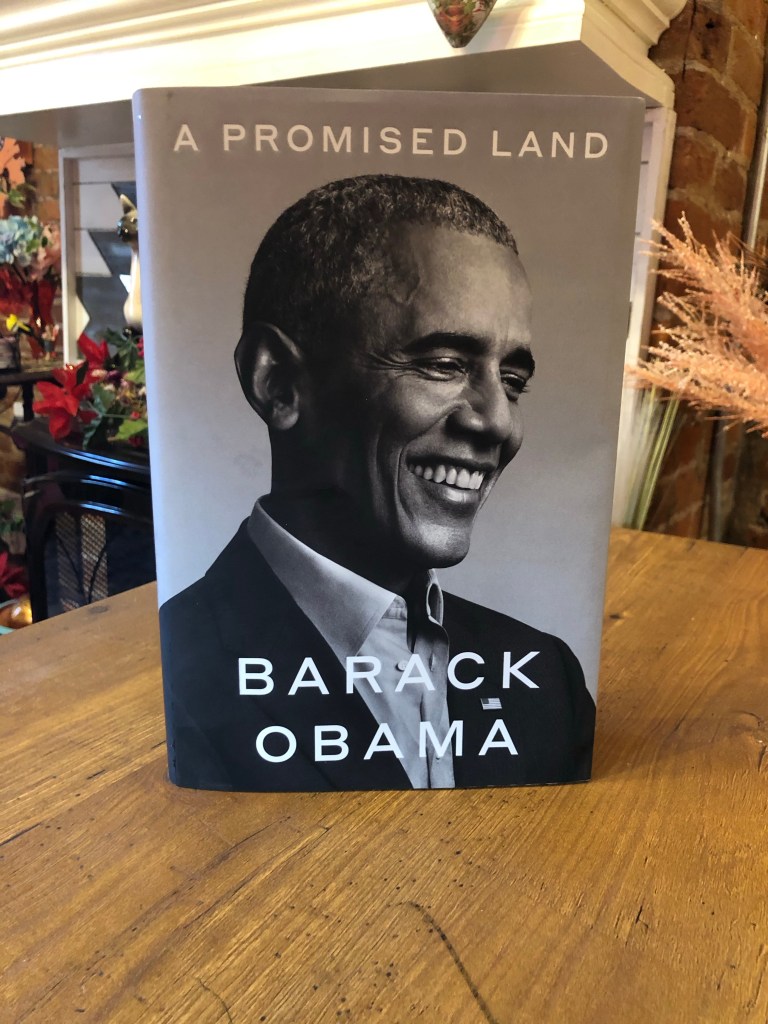
If you finish a 700-page book and are still happy with it, you know it was a darned good book. And yes, A Promised Land, by Pres. Barack Obama, was a really fascinating book. That’s saying a lot, because I have mostly been bored to tears by books about presidential politics, international relations, and recent history.
He’s pretty funny sometimes, too, especially about his ears.
Somehow, Obama manages to talk about his life in such a way that it’s easy to keep up with who’s who, and you feel like you get to know the many, many people he comes across. Whoever helped him organize the book and recommended putting in the short-but-helpful descriptions of his friends, colleagues, opponents, and staff members wins my earnest thanks. I didn’t lose track of people in this story, at all. And they all seemed so real, not like names to memorize in a history book.
As you may know, Obama is a pretty smart guy (even if you don’t like him, that’s a fact). He loves explaining things, and this book gives him the opportunity to do so at length, rather than in sound bites. By taking his time and explaining why he did things, why compromises had to be made, and how he could see what other people wanted and needed from their perspectives, I was actually able to understand the complexities of elections, dealing with dignitaries, working with Congress, etc.
The typesetting of the book made it hard for me to read when I was tired. Whenever there were a bunch of letter “g” together, it made a big blob. There’s one in the middle of the right page. I did love the letter “Q” in this font, though, and there were lots, thanks to al-Qaeda.
I think I’d have been drawn into this book even if I wasn’t already a fan, because he does a great job of pointing out where he screwed up, when other people were right, when hard decisions had to be made, etc. It helps to have the context and to realize how much those of us consuming the news don’t get to know (I’m not talking about Fox News, I’m talking about more moderate outlets).
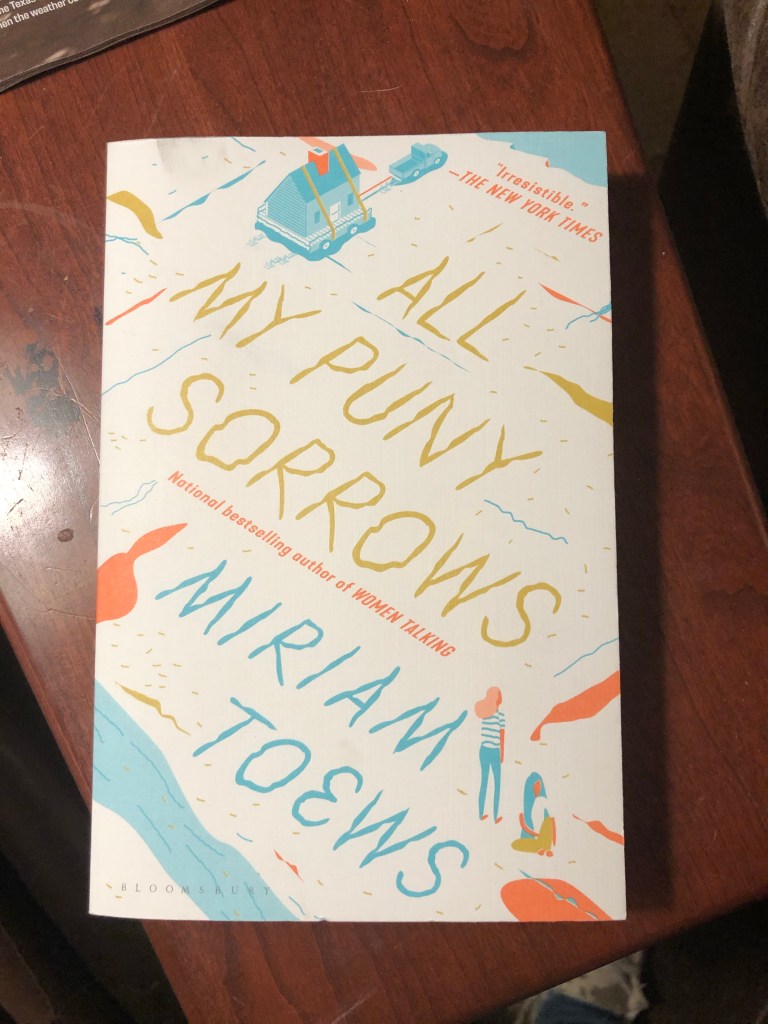
I’m only halfway through the Obama book, but I took a break to read this month’s neighborhood book club selection, so I’d be sure not to totally fail like last month. I’m glad I did, because All My Puny Sorrows, by Miriam Toews (2014) was a beautiful jewel of a book.
My poet friend, Kelly, recommended it so strongly that I just had to get it. Then, when we learned more about it, the neighborhood women also wanted to read along.
I hope they like it as much as I did. A book about a Canadian woman (Elfrieda) who is driven to commit suicide doesn’t sound like fun, you end up enjoying the story very much. The interplay among the family members is so poignant and nuanced, that sometimes I had to re-read the dialog.
I enjoyed getting to know the protagonists, a family burdened by an oppressive Mennonite upbringing. The main character is the younger sister of the suicidal piano genius (Yolandi). She has her own issues, which are fascinating to watch unfold as the book progresses. She was fascinated by her sister, but readers will be fascinated by her.
Then there’s her mother and aunt, completely charming women on their own journeys of discovery. Their banter and insight will live with me a long time. That and all the poetry Toews shares just makes you want to savor this book. You’ll hardly notice that the book sort of lacks a plot.
Who cares. It’s both funny and poignant. I’ll be reading this again. I wish I were articulate enough to really convey the beauty of the language and the depth of the characters in All My Puny Sorrows, which apparently is semi-autobiographical. I’ll have to read Women Talking or another of her books, too.
Even with all this knitting, I am still reading a lot. This one will not be the last in my color series for a while, because I think there’s a yellow book in the queue at the ranch. But on to this one.A Perfect Shade of Red: Empire, Espionage, and the Quest for the Color of Desire, by Amy Butler Greenfield (2005), was recommended in the Master Naturalist session I took on cochineal. I’m glad I picked it up and read it, even though I’ve already read two other books on the color red. The history part was a lot of fun.
The book, along with the back of the stole I’m working on.
This book concentrates on the ups and downs of using that little Mexican insect, cochineal, to dye things red, starting from the very beginning and continuing to current times. One thing I learned is that, unlike the wild cochineal that grows out at the ranch, the kind that has been developed in Oaxaca to produce the most dye is a finicky thing. No wonder Spain held on to its secrets for so long and monopolized its import (when those pesky English pirates weren’t stealing it). They just couldn’t get it to grow well other than its native territory for hundreds of years.
I wonder if they used cochineal to dye the leather for my journal?
Without the exact right climate with not too much rain, not too much wind, and not too much cold, they keel over pretty fast. The other books I’ve read didn’t go into as much detail about how many places tried to grow cochineal. It failed spectacularly all over the world, and was particularly unsuited to being grown by slaves like sugar cane, corn, or cotton. Oh well.
Random red objects for you to enjoy.
I did learn that eventually, patient people finally got it to grow in the Canary Islands and Guatemala, of all places. They even surpassed Mexico toward the end of the popularity of cochineal dye.
Another thing the other books didn’t tell me was that thanks to Red Dye No. 2 being identified as so poisonous, cochineal began coloring foods in modern times again, but it’s not popular with vegans and there ARE people allergic to it, too. Huh.
The book kept insinuating that red clothing can be gaudy. I don’t know where they get that idea. This is my holiday shirt for this year.
Even if you’re less than fascinated by dyeing things red with little insects, this book is a fun read, because you get an interesting perspective on European history from it. Much of the book makes England seen like a pretty nasty place, but the descriptions of Hapsburgs and their jaws made me rather sad for European royalty. What an inbred mess. All the intrigue between kings, queens, pirates, merchants, chemists, and others is a lot of fun.
It appears I have another race book and a novel ahead of me, though there IS a memoir I may sneak in. Thanks for bearing with me on these book reports.
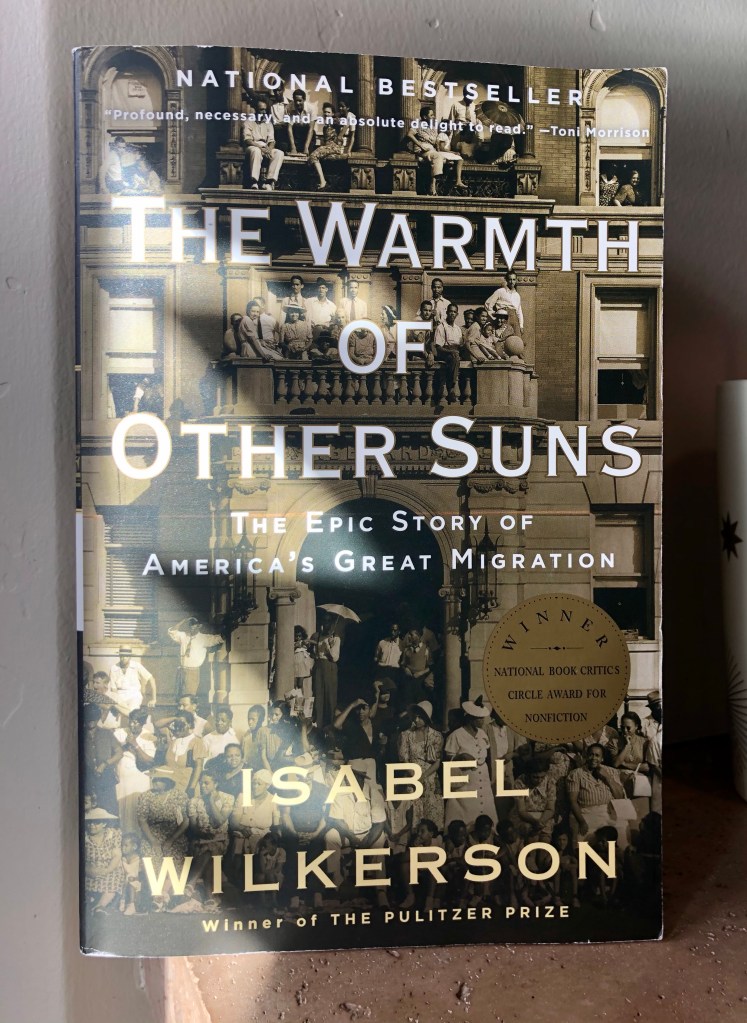
You’d think I would have finished a couple of books by now, since I’ve been mostly alone in Utah for two weeks. But, there has been knitting, and that does take away from reading time. And the book I have been reading is over 600 pages. But, I finished The Warmth of Other Suns: The Epic Story of America’s Great Migration today! It’s the 2010 first book by Isabel Wilkerson, who wrote Caste, the book that has moved me so much.
I took the photo with sun shining on it.
Many people told me I just had to read this book, and I’m glad they did, since it provided a lot of context for my life, both in the American South and my 20 years in Illinois. I would recommend this book to everyone, but especially to Black friends, because it really does a great job making sense out of both the people who migrated northward from the 1930s to the 1960s, as well as to those who stayed and stuck it out through really awful times.
For sure, reading about the struggles of “colored” people, as Wilkerson correctly calls the folks living before the 1960s, makes it clear how hard the parents and grandparents of the current generations of Black Americans worked to get us to where we are now. Whenever I think there’s been no progress, I can think of the people in this book and realize that yes, things ARE better now for Black citizens. They just aren’t good enough (as the Caste book explains and anyone with eyeballs can see for themselves).
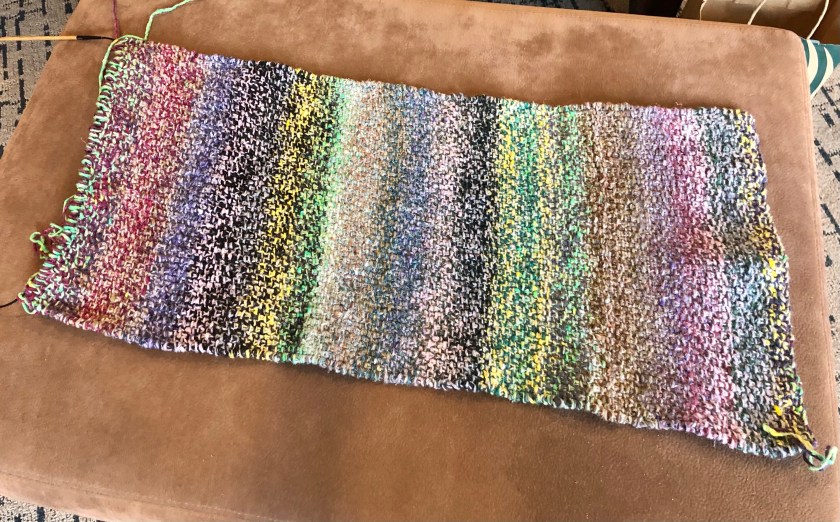
The table runner I’m working on is certainly stripey.
I was a white child in the Deep South, and I recall how separate the worlds of our races still were in the 1960s. What I didn’t see were some of the really, really awful things a child wouldn’t see, such as how hard it was to buy a house, get an education, or get a non-menial job for the colored folks where I lived. No wonder so many people left, hoping it would be better in the North.
But wow, I now know how things got the way they were in the big cities back then, how hard it was to live anywhere but crowded areas, how quickly a neighborhood would empty of White folks (and their businesses) once integration occurred. I remember it happening in the South, where my dad told me his brothers kept moving to get away from Blacks, only that’s not what they called them. I didn’t think it was like that up in the North, where people were free. Or so I thought. Now I know.
Why we aren’t out having fun today. Ugh.
Wilkerson follows three different people and their families, who moved to Chicago, New York City, and Los Angeles in this book. I like that she humanizes what could easily have been a dry, intellectual discourse, by sharing the lives of real people. The three are fallible, human, and above all, honest about their lives, and Wilkerson does an amazing job of interspersing their stories with historical background and generalizations about migrants to the North all over the US. The human element just keeps you drawn in and helps you get through the sad stories of beatings, lynchings, cruelty, and unfairness.
One thing is for sure, anyone who reads this book and learns the stories of the people in the Great Migration will not be able to figure out when the heck America was ever “great,” at least for large segments of the population. And that is why more of us should read this book, because it puts our history into perspective. We can be proud of the hard work our citizens have put in to make life better for others, but seeing what a battle it’s been clarifies WHY we still have to work so hard for all of us.
I now understand what was going on during the years I spent visiting Hyde Park in Chicago, whereas at the time I was just a frightened young woman wanting to safely get from that integrated oasis to downtown and transportation. I understand what was going on with the trains going through my hometown. I understand why it was so hard to integrate the schools there: people were scared of each other. People are still scared, perhaps for different reasons, and I realize not much has changed in that respect.
But, when I think back to how I lived 20 years next door to a Black family and had nothing but good neighborly experiences, how my children had friends whose parents had migrated from all over the world, how no one looks sideways at people dating members of other races and cultures, and how many bright and talented Black folks DO get a chance to shine now, I feel a bit better. I have no illusions that we are a “post-racial” society. But I have hope.
By reading this book, any reader will have the context to understand how and why we got to where we are in 2020. Now to keep working together to build a better world. Like my dear husband told me last week, even when there are setbacks, we have to keep trying. We’re all worth it, aren’t we?
Whew, sorry I got so pedantic there. I’ve just been thinking a lot, here by myself. Now I will go to the convenient exercise room and do my walking. Indoors.
Yes, another book report. That’s what happens when you take time off from your usual busy-ness-hood. Today’s book is another really special one that I bought after the Master Naturalist meeting. Fantastic Fungi is a companion to a film I need to see. The book is edited by Paul Stamets, an expert on mushrooms, who also contributes essays.
Cool book cover, plus Penney.
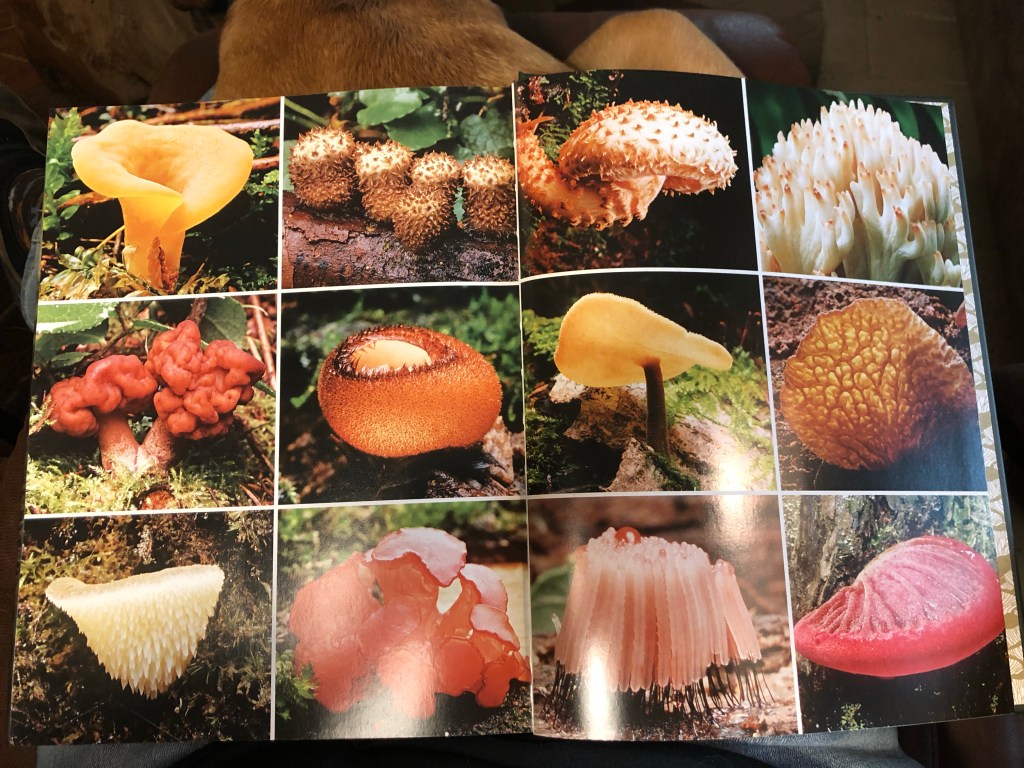
Before I go on and on about the writing, though, let me gush about the illustrations, which are mostly gorgeous photographs by Taylor Lockwood and others. I could look at them all day. The variety of shapes, textures, colors, and forms that mushrooms and other fungi can take surprised me. There are things in this book that I’m awed by.
The inside back cover. Look at those things!
And now for the content of the book. There are lots of short essays, interrupted by annoying large subheadings (my only complaint). The greats of mushroom science contributed, and it’s weird to read “and I discovered x in my research,” rather than “this famous person discovered x.”
Since mushrooms are an area where I lacked knowledge, I learned a lot about how mycelium and fungal networks are organized. I knew they could be very large and very old, but the contribution they make to life on this planet are way more significant than I’d realized.
My favorite page, because of all those shapes.
And that’s where this book switched from being a pretty book about a part of nature I only knew a little about to something much more significant. Over and over, the contributors to Fantastic Fungi, stressed that fungi have much to teach us and may even be able to save us, if we learn how. The subtitle is: How Mushrooms Can Heal, Shift Consciousness and Save the Planet, after all.
Reading about how we seem to be designed to use the nutrients, chemicals, and other aspects of mushrooms makes me realize we are related. And that’s the point the contributors are trying to make. Without mushrooms, plants and animals would suffer greatly. Paul Stamets, especially, speaks eloquently.
A core concept of evolution is that, through natural selection, the strongest and fittest survive. In truth, (and scientifically proven), communities survive better than individuals, especially communities that rely on cooperation. Acting on such a principe, people want to give in order to receive, which I think reflects the power of an essential goodness.
Paul Stamets, p. 66
It becomes clear from Stamets and others that all of the organisms here in Earth depend on each other. Humans have been woefully ignorant of this.
Then, they bring in the heavy hitters, Michael Pollan and people he’s worked with to talk about how mushrooms (psilocybin) can help humans realize this (which I did read about in How to Change Your Mind). And they bring in more research on the experiences people have with these mushrooms. Good stuff.
What they mainly say is that people overwhelmingly have experiences of oneness and connection with other people and the earth. Maybe this is what mushrooms are trying to tell us? If so, I’m all for it. A bit more acknowledgment of our commonality and less artificial differentiation would be fine with me.
I’m inspired. And it strikes me that focusing on this kind of mutual connection is yet another way we can help get past racism, bullying, and needless antagonism. Thank you, fungi.
Hmm. I seem to be on a journey, don’t I? Are those mushrooms growing on the cow patties what I need?
(No, I’m not gonna do it. Too law abiding. And don’t want to poison myself.)