Wow. I’m not saying I’m a saint who never has bad thoughts about others, but when presented an actual opportunity to experience some good old schadenfreude, roll around in it, wallow for a while, and maybe even gloat, I find I can’t dredge it up.
Let me share what happened, as vaguely as I can. Last year, my favorite boss ever, was “let go” as they always said in La Leche League while firing anyone with institutional knowledge or history in the organization who didn’t drink some very bitter Kool-Aid.
Even though we were prepared, those of us who worked for this boss were sad, really sad, because we’d done a lot of good work together and were a great team. Of course, we had nothing to do with whatever the C suite’s issues were, and that wasn’t our call. But, it hurt some of us a lot, including the old boss.
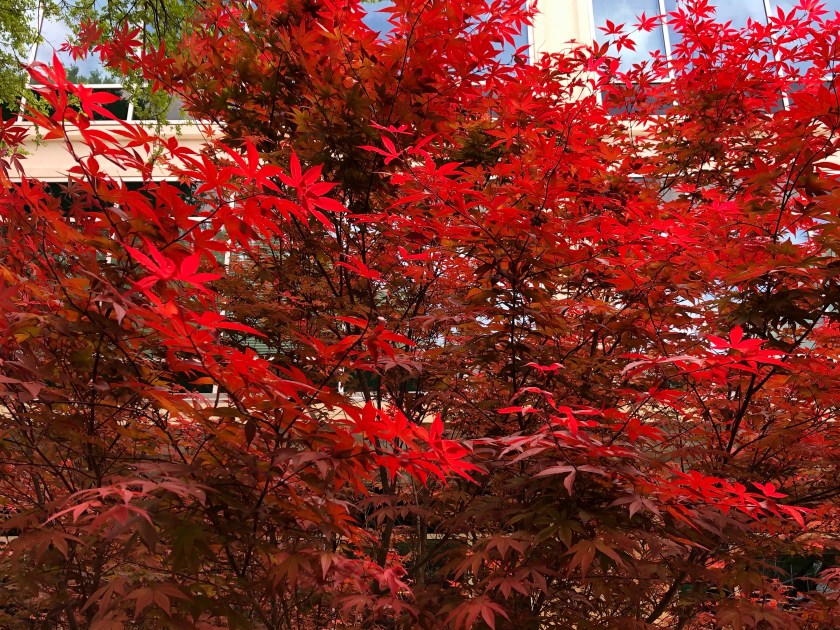
Everybody’s beautiful, in their own way, right? This Japanese maple sure is.
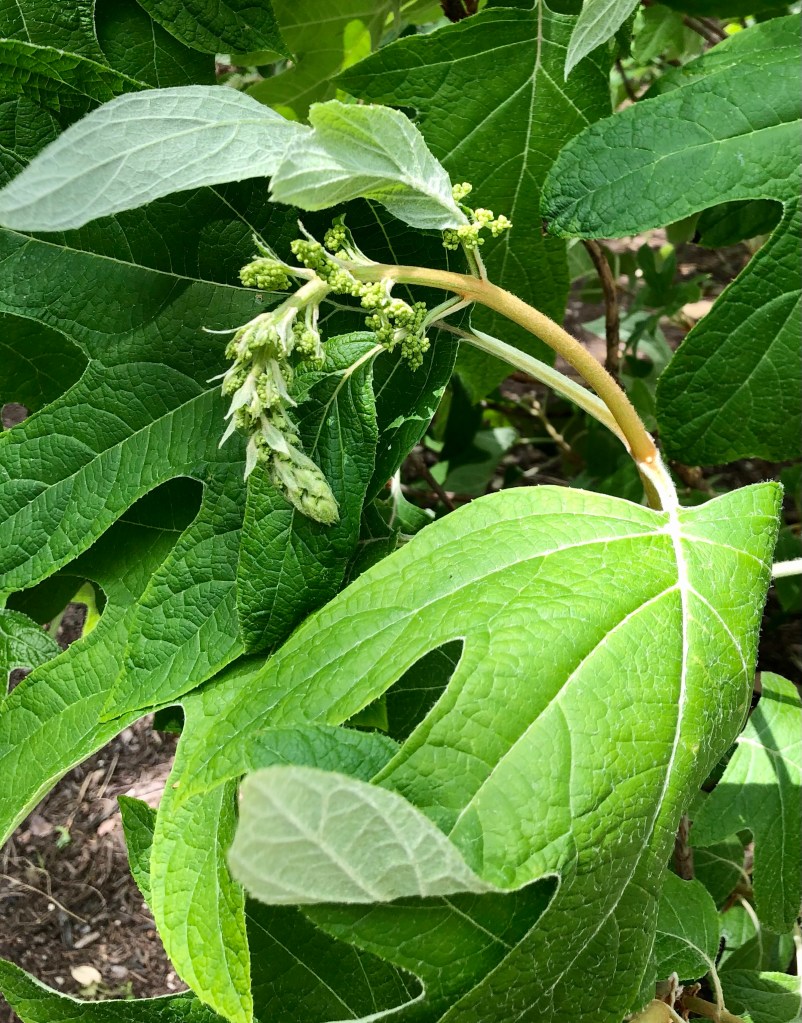
Changes make me want to hide, like this budding hydrangea.
Fast forward to today, and the person responsible for that “letting go” (and for me losing the two coworkers I tried to hire last year) was let go today. I had dreamed of the day when that darned so-and-so got their comeuppance. I was ready to take immense pleasure in the pain of that other person, true schadenfreude. But, no. I felt sad, instead. I know how hard it is to see that unemployment train coming and have it roll over you. All I could feel was empathy toward my former nemesis.
Why? Well, I’d recently gotten to know that executive as a person, and saw them as more than just the instigator of a really bad year. I found out things we had in common, and our mutual humanity won out over my biases. Shoot, the stuff in those unconscious bias books is actually true; you really can’t hate someone you know as a well rounded person.
It’s okay!
How about that? I’m not as vindictive as I thought I could be, when it comes down to it. And that’s a good lesson to learn. I’m sure I’ll be fine as the changes keep coming where I work. It’s normal, corporate America stuff, after all. But I can still have empathy with former colleagues as I keep trying to keep up with the changes.
Actually, I feel like I had an omen or portent of the future this afternoon. As I was walking in the courtyard trying to get my bearings (me and big changes are just not friends), I found myself surrounded by common whitetail dragonflies, all female. They’re a symbol of change, metamorphosis, and good things to me. I felt comforted.
As always, things are changing in my life. One of the changes anticipated for this year is that Anita and I will need to move out of the Bobcat Lair house in Austin. That’s sad, because we really love the setting, the house, and most of all, the neighbors. But, the cost of just paying the City of Austin property taxes is more than the mortgage to our old house, and now that we are getting closer to me retiring from paid employment, we’ll need the money from that house as part of our income stream. Things are winding down, and it’s time for investments to pay off.
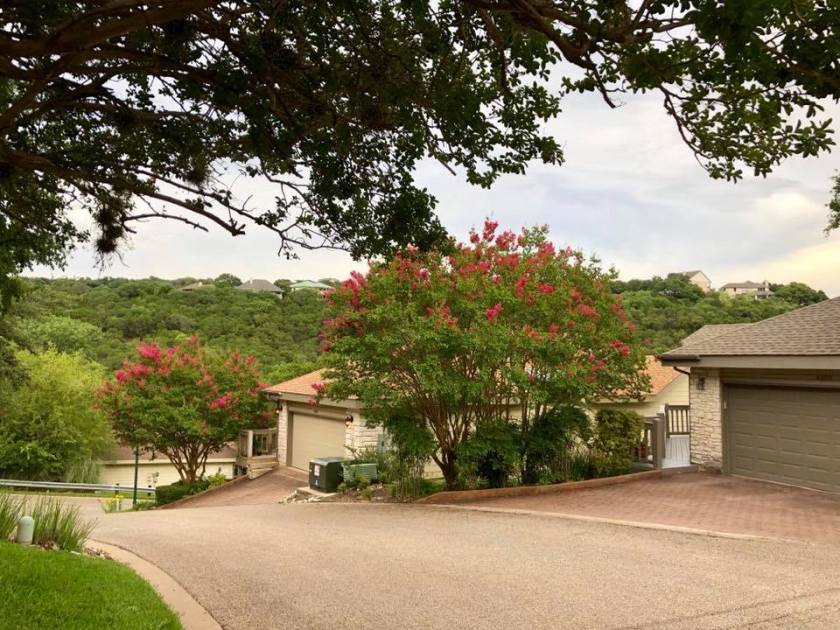
It’s the Austin house (Bobcat Lair) showing lovely dark rain clouds. Ah.
Yes, that’s all logical and good. Anita has her own little house in Cameron that we hope to get renovated as soon as her contractor is available and her tenant, who’s already month to month, knowing Anita is going to need to live in the house herself, finds another place to live. This is all quite reasonable, right?
But, when Anita started talking to me yesterday about how much she’s packed up already (she does all her moves all by herself, because she would rather invest her time than her money), and that she gave her tenant notice that she needs to be out, I found myself going back into one of my old, unproductive ways of reacting. I am not good with moving, AT ALL, and the thought of having to leave my beloved sanctuary sent me into a panic. It just seemed like a HUGE amount of work, change, and uproar was impending, and I kind of shut down.
A little wine on the deck helped me feel better, too.
Anita (bless her) kept talking me through it, and I began to realize that I can do things in stages, that I actually don’t have all THAT much furniture in the Bobcat Lair, and that I even have a place to store things like my books and such. And all the boxes I still haven’t unpacked (though there aren’t all that many now!!).
Plus, I plan to rent an apartment near my work, so I can easily figure out what things go where, move them, then get the rest moved to Cameron (except for what’s needed to stage the house). I’m just trying to breathe as I think of more things that need to be done, like electrical work to fix outlets that stopped working…but it’s not too much.
I just have to face it; I’m who I am, and I’m going to have trouble with changing things when it comes to my home, because having my own place grounds me. I’m still a fine person!
Ernesto apparently agreed with my coping strategy. Photo by @juleslang via Twenty20.
I’m Not Alone
Speaking of my issues, which I am, I had an odd experience last night watching the PBS show on Ernest Hemingway. Now, he’s not someone I ever would have thought I had anything in common with, other than being fond of short sentences (he was way better at actually writing them, though). As I learned how he grew up, the experiences he had with his family, and how he coped later, I was really surprised to see how we have a LOT in common when it comes to our inner demons and how we deal with them.
One part of the show, in particular, hit me hard. He was talking about how happy he was when he had both his wife and another woman he was also in love with. He said it made him inexplicably content, even if he knew it was hurtful. And then he talked about how, in his relationships, he always made sure to have another love interest all lined up before he left someone. Ouch. Those were my destructive patterns in my younger days.
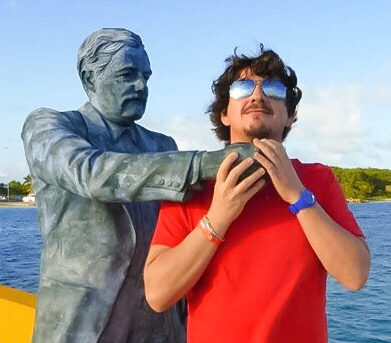
Hemingway statue in Cuba that apparently chokes people up. @prezioso02 via Twenty20.
I’m really glad I didn’t live such a public life as Hemingway did, because reading all the criticism of my life, like he had to, would have been really uncomfortable. I’m glad I just got to judge myself harshly without too much help from others (except former partners).
I don’t think Hemingway was able to get much control over his demons, much like his father, who committed suicide when he couldn’t get a handle on his mental struggles. He knew perfectly well what his problems were, which is clear from his books, but knowing what his challenges were didn’t mean he could fix them, any more than I can help my issues with moving.
I’m glad I had help, good reading, and inner work that has gotten me out of destructive patterns, at least with romantic and friendship relationships. I’ll be interested in watching the rest of this series and getting more insight into this fascinating writer and historical figure.
What a good thing that we happened to watch this interesting Ken Burns documentary right after I was beating myself up for repeating patterns from my youth (I know perfectly well that I hate to move house because leaving my beloved home as a teenager was so hard on me). It gives me perspective to cut myself some slack and bear in mind that some of our personality “features” are deeply ingrained, just like those unconscious biases.
We can only do the best we can and keep making an effort to improve. Thank goodness I’m a lifelong learner and never plan to stop enjoying the challenges of living up to my best intentions. Let’s all keep open to ways to learn more about ourselves and others, and be patient with ourselves.
That’s my lecture for today. Take what works for you and leave the rest!
A Note from a Friend
After reading my blog (with all the typos I just fixed), my friend Kelli Martin Brew responded to echo my thoughts. I really got a lot from what she said, so I’m happy she allowed me to share her thoughts with you:
I love this. The longer I live, the more it seems clear that a lot of who we are and what we do is hardwired. But how I have wanted to believe that knowing something was the same as changing it! At this stage in life, I think we can use this hard-won knowledge to be more merciful – and to be honest about our own struggles and behavior. I grew up with a huge mandate to “be a good example.” At this point in life, I have contented myself with being just an honest “example” of… something. Whether it is deemed “good” or not will be decided sometime in the future, if at all.
Kelli, Facebook, April 6, 2121
I really treasure connections that allow us to share our inner thoughts, struggles, and learnings. I plan to be an example, too!
Wait, wait, I’m not going to tell anyone not to continue in their work to fight racism, point it out when they see it, or work on their own behavior and bias with regard to race. Nope, nope, that’s not where I’m going. But, I do want to share some insights I’ve been having as I watch discussions about race happening, and how the books I’ve recently been reading cause me to see them differently.
Here’s a very passionate young person I do my best to learn from.
The material I’ve been reading on unconscious bias has made it clear that, thanks to growing up in a particular society at a particular time, each of us presents ourselves to the world through the lens of our own biases, some of which are helpful and some of which may be less so. A good thing I’ve read is that the people born more recently may well be less prone to some of the racial biases that older people may have grown up with. A large percentage of younger adults in the US grew up in diverse neighborhoods, attended diverse schools, and are familiar with a wider range of US cultures (most young people I know are fans of music from urban, African, Caribbean, Latino, Korean, Indian and other artists), and have friends and colleagues from highly diverse backgrounds. So, they have a different set of biases from older Americans.
People my kids’ age tend to make friends based on common interests and experiences. This often leads to racially diverse friends with strong bonds in other areas. (Some don’t; I over-generalize.) Photo by @SBphoto via Twenty20.
I am very happy about this, and very interested in learning from people of my children’s generation. Sometimes it’s hard, though, because in their anti-racist enthusiasm they push their audience away.
Another fact about a large subset of younger adults is that their preferred methods of interacting with others tend to be more confrontational, less “polite,” and less patient when sharing their views with others (not implying only young people act this way, it’s more appropriate in some cultures, too). This is the part that causes communication problems with people who grew up avoiding confrontation, focusing on polite behavior, and a conversation style that includes acknowledging the potential validity of the other person’s point of view. Neither of these ways of interacting is all right or all wrong; there are issues with each one, which I’m going to let you think of for yourselves.
Admirably, many people in the 18-30-ish age group want to create a better society and are working hard toward those goals. They feel passionate about the rights of people of color, LGBTQ+, poor people, and the oppressed around the world. Yay for them! Those are goals shared by many older people, too, though their methods of working toward it are different, and often unpopular with younger folks (which is fine and normal; I’m not complaining, just noticing).
The thing is, I’m wondering what the goals the young and fervent activists are working toward might be.
Are they trying to change people’s minds? I wonder if calling people you don’t know racist for actions you don’t even know that they’ve done is terribly helpful (for example, I have been sitting back and watching a woman lecturing an obviously white woman about how race and racism work, blissfully unaware (or not listening hard enough to realize) that the second woman has a black husband and family members). It’s racist to assume someone has beliefs because of their looks, period. And yes, being in an interracial relationship doesn’t mean you have no bias and can shut down conversation (sorry if I’m not clear about this; I’m still learning).
Are they trying to prove how ethically advanced and modern they are? In this case, demonstrating that you’re a passionate anti-racist while bullying and insulting others shows ALL your ethics, quite clearly.
Are they trying to sow unity? Are they trying to add to divisiveness? These are my big questions. I’ve been observing people pick at others for not being non-racist in the “right” way (say, for adopting a child of another race, without knowing whether a white adoptive parent may have a black or Asian partner or other black or Asian children). It reminds me of one branch of a religion not saying another branch is Christian enough, or Muslim enough, or the right kind of Buddhist, without remembering they all are focused on the same overall goal, which is love.
This is why I wish more of us knew HOW our unconscious biases work, and that none of us is above them or immune to them. I see a lot of bias against older people in the passionate younger folks. That’s too bad, since when I was a young, passionate feminist, I learned a LOT from the women who’d gone before me, which helped me not repeat some mistakes and not burn some bridges. Perhaps some of us older folks might have useful insights, if we could share our perspectives without being silenced or labeled.
I know I harp on this message. It’s because I think the ONLY way we can make a better world is to listen to each other, maybe even respectfully.
And some of us elders want to silence and label younger folks. None of that is helpful, because the one thing I’ve learned is that the best way to limit the effects of unconscious bias is to get to know members of the groups you may have trouble with. Spending quality time in conversation and interaction with the “other” is guaranteed to help all of us realize that “they” are not a monolithic group, but diverse, varied, and interesting. Not all elderly people are the stereotypical MAGA-hat wearing, flag waving, insular white folks. They are not all inflexible members of the liberal elite. Not all young people hate everything that isn’t socialist or everyone who doesn’t fall into their definition of “woke” (insert current term for woke there). But, if we just talk AT each other rather than WITH each other, we’ll never figure that out.
We all have our blind spots, our prejudices, our biases, and our areas of passion. Not everyone will share them, and not everyone will even express the same biases and passions in the same way we do. We will never grow as human beings nor as a society if we don’t listen to other points of view. Even people we think are dead wrong in one area may have something “right” to share with us in another area, which we’d never find out if we just dismiss them out of hand.
I know my audience skews toward people of my age, but still, I want to reach out to those younger than me to listen to us, and give us a chance to share what we’ve been through and how we got there. And then share with people my age what YOU are going through and how you got there, rather than pointing fingers at us, labeling us, and dismissing us. Being young doesn’t invalidate anyone’s experiences and insights, but neither does being old. We can all learn from each other, but we might have to stop talking sometimes and listen.
Rather than trying to drag others kicking and screaming into the new and more advanced world, I’d love to see enthusiastic and passionate people reaching out a hand and gently lifting up others, knowing that they used the experiences of those who came before as stepping stones to get where they are today.
Did you think I was finished with unconscious bias books? You’d be almost right. I just have this one more book to talk about before I move on to books about diversity and inclusion. Totally different, yep. This one’s really good, though, even though it talks about many of the same topics as the previous books did. Everyday Bias: Identifying and Navigating Unconscious Judgments in our Daily Lives (updated edition), by Howard J. Ross (2020) is guaranteed to get you thinking, challenge you, and to my immense relief, offer some hope for humanity.
I really like the “voice” of Ross, which shines through all the book’s content. You feel like you’re right there with him figuring out that we’re all acting on our biases 24/7 and that’s just the way we are built. He shares lots of data about our friend, the amygdala, and how it’s apt to put us on autopilot any time something stressful or scary happens. And he notes that we can’t make that thing stop!
Somewhat garish cover, but great book!
Ross also reminds us that we can’t exactly help where we were born, in what community, and to which parents. All of these things get us wired in certain ways that we can’t control. I like that he declares it a waste of time to constantly apologize for being biased or to poke at people for having them. His best point in the whole book is that by constantly reminding people of the harm their biases causes others (like women telling men how they’ve been harmed, black people saying the many ways white culture has affected them) we aren’t going to make things better. The reverse is often the case, and can perhaps explain all the racist and sexist groups we are hearing from more and more these days.
I think it’s true that some folks are just going to continue on their merry ways with their biases against certain other people and groups, and there’s not much we can do about it. No one’s immune, so we are just gonna have Jews who are biased against blacks, gays who dislike Muslims, or so on and so on. No group of humans is without us versus them ingrained in us, because it’s normal.
Luckily, Ross reminds us of neuroplasticity, which is the ability of our brains to change. He then spends the last part of the book providing clear, helpful ideas for working to mitigate the effects of our bias in the workplace and in our personal lives. He gives great information on six things to work on in Chapter 7:
Recognize that bias is a normal part of human existence. (Stop judging others so much and work on your own self. I have a few super-judgy trolls in groups I maintain that need this.)
Develop a capacity for self-observation. (It turns out that relaxing, meditation, etc., can calm that amygdala right down and let you think about your thinking.)
Practice constructive uncertainty. (Stop to figure out WHY you have a strong reaction to something.)
Explore awkwardness and discomfort. (Figure out your triggers.)
Engage with people in groups you may not know very well, or about whom you may harbor biases. (Get to know an Other!)
Get feedback and data. (Facts!)
In the next chapter, he lists eight ways to work on eliminating bias in hiring, promotions, and that sort of thing in businesses. It’s quite helpful.
And finally, what warmed my heart is that Ross truly feels that if we pay attention to our biases, we can create a better world. He talks about how what appear to be groves of individual trees are in reality one big, connected organism (as I’ve read before), and uses it as a metaphor for people:
We look at the “other” as if he or she is separate from us. We see the other group as a threat. And yet, we are all deeply connected. We share a common destiny on this planet. We all seek pleasure and do our best to avoid pain. We all want what is best for our children and grandchildren. All of us are the products of that which we have seen before. And we are all (for the most part), unconscious about the “programming” that runs our thoughts and our lives.
We can transcend. We can, through discipline, practice, and awareness, find a new way to relate that honors our differences yet also builds upon our similarities.
Howard J Ross, p. 148
I think he finally put into words all the reasons why I have been so doggedly introspective for the past few years. I want to GET THERE NOW and do my part to fix some of my ingrained biases. It’s not possible to know all that’s going on in our busy brains, but with at least some of us trying to raise awareness of some of our areas of bias, it’s a start.
Yesterday, I achieved a milestone that was a long time coming. In fact, it was one of my “life goals” since I was a small child, and something I never thought I’d be able to do. On the surface, going over to the barn, saddling up my horse, and going for a nice ride doesn’t sound like a big deal. But it was. A huge deal. The amount of personal growth, courage, emotional maturity, and understanding of another living being required to get to this milestone was huge, and I’m just going to say it – I’m really proud of myself.
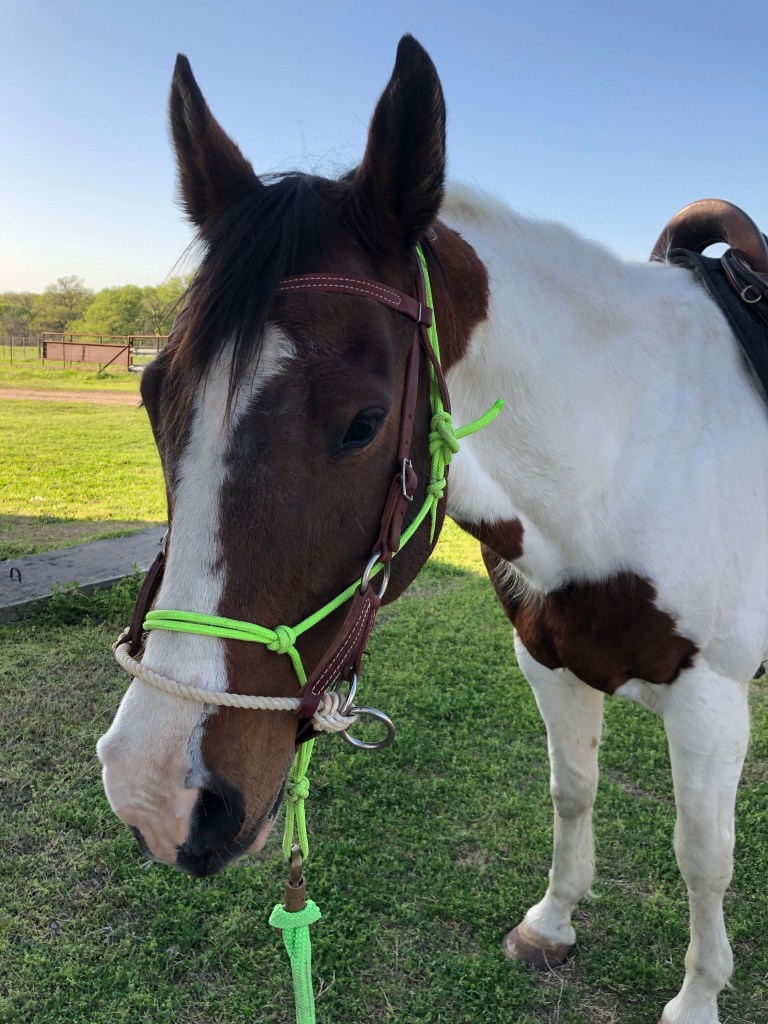
I’ve been riding Apache for a good number of years now, at least five. One of my life’s dreams came true when Sara generously gave me Apache (and his expenses, ha ha) when she realized that his health challenges meant he’d never be the hard-driving athlete she needed to fulfil her own dreams. It was obvious that I loved that generously rounded horse, regardless of his rideability, and I’d be just fine hanging out with him and doing things on the ground, if it came to that. It also helped that he seemed fond of me, too.
We took some Parelli lessons (a natural horsemanship style) back when I had money to do that kind of thing, and we got a pretty good foundation from it, though being in crowds with people barking orders at us made both of us nervous. That is an important insight.
I’m the happiest horse on the ranch. My human and I make a great team.
Since then, we have worked at our own pace, getting better at various horse/human activities, and understanding each other more and more. I am sort of glad I didn’t have the money for more lessons, because it was good to work things out on my own, with Sara providing guidance. The progress was slowed down by the fact that Apache has metabolic issues, so sometimes his feet hurt and I can’t ride him…like much of last year, right when we’d been making really good progress going out in the ranch with Sara and Spice, exploring. I learned that Apache is as curious as I am about seeing new things, as long as he can take his time.
Today I was telling the story of skunks and escaping horses, and someone said, “You need to have some kind of ranch adventures blog or podcast!”
“Um, I do,” I said, and said to go look up The Hermits’ Rest. I actually saw people write it down.
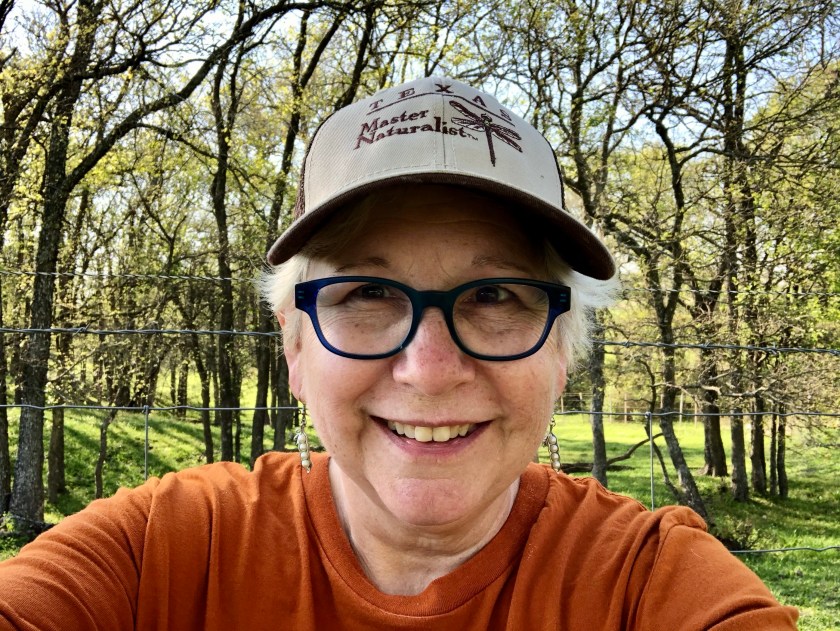
Look, here I am having ranch adventures. I’m in one of the horse pastures.
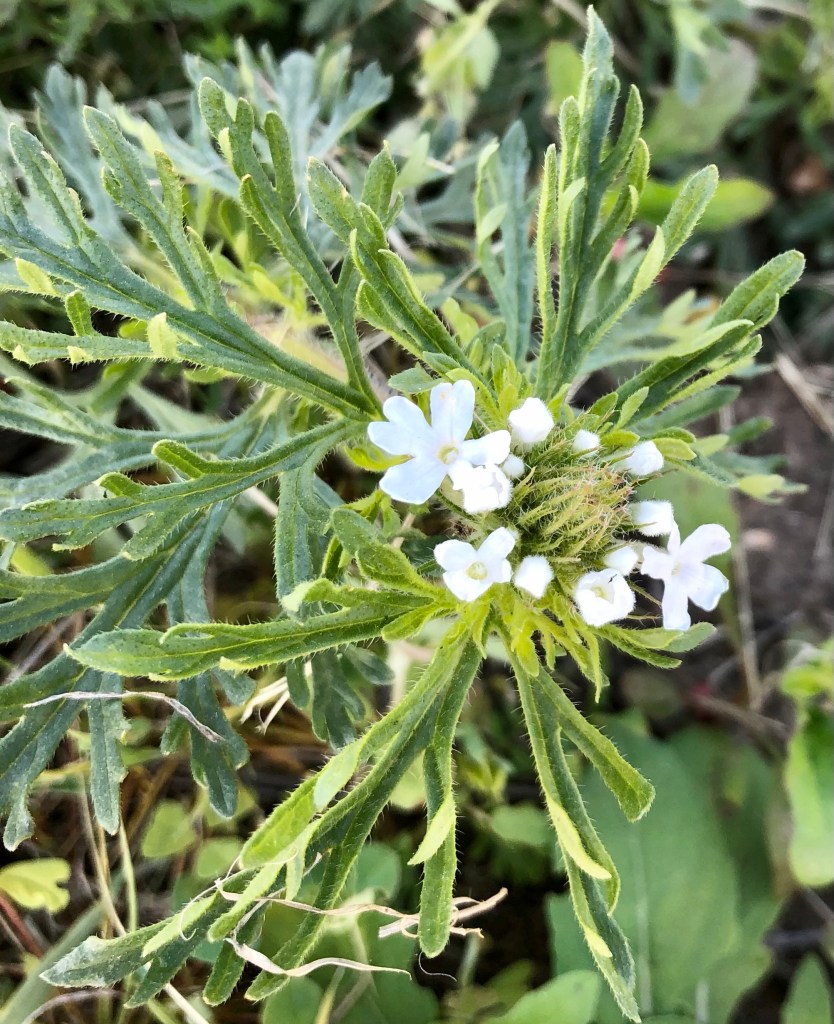
More ranch adventures: we found WHITE verbena on our county road! That’s research!
So, it appears that I have not been doing the greatest of jobs at publicizing my funny ranch stories and personal rants. That’s probably because I don’t really enjoy self-promotion, though I make myself do it anyway.
On that note, I did start a podcast of verbal versions of this blog. I have found it to be surprisingly fun to record and put together. The people who have listened (all 21 of them) find it at least slightly interesting (and they love the theme song, by my talented son). I mean, whoa! That podcast is GREAT. That’s better.
I told myself that if I got a hundred plays of the episodes, I’d do more publicity. Today is that day. Time to get self promoting!
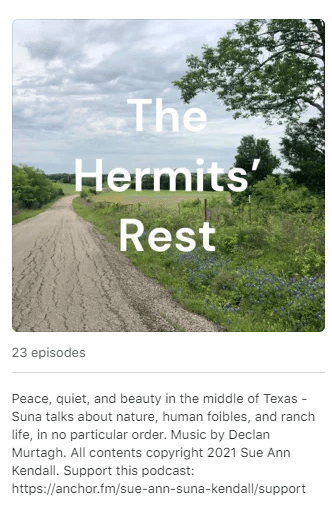
Look, here’s the podcast!
Just click that Play button and you can hear me yack about the horse and the skunk. I talk just like I write, too. The podcast is like a free bonus to this blog, which also, you may note, costs you nothing other than annoying ads. So far, the ads have raised a whopping $59.80 over the past two years, all for me to squander as soon as it hits $100 (maybe by the time I retire!).
If I’d had any hopes of paying for my blog hosting fees with those ads, I was foolish. I mean, I have plenty of followers and readers, but I’m no influencer. I guess they’re the ones who make money. You know, because they influence. I have tried to influence people to be kinder and more peaceful, but I’m not sure how well that’s worked.
So, Does the Podcast Have Ads?
It turns out that the Anchor platform where the podcast is hosted also has a deal where you get paid for ads. I had to make one, for Anchor (so far it’s my only sponsor). But, I DO get paid for it! I’m up to a DOLLAR! That’s right, kids, a dollar since March 10! I’d rather not have to put ads in, but to do that, I have to do the OTHER thing.
That thing is to get supporters. You can actually support the podcast (and the blog, since they are the same content in different forms) by making a monthly donation. What? Yes. Like being a patron on Patreon or something. Or like funding some startup. Only it’s me, talking about dogs, horses, plants, knitting, bias, and such. I do support a couple of other people this way, and it feels good, plus you get “bonus content” and such. It appears I can create bonus content on the podcast. The possibilities are endless.
I’ve made no bonus content, because I have no supporters. [insert frowny face.] But, that can change!
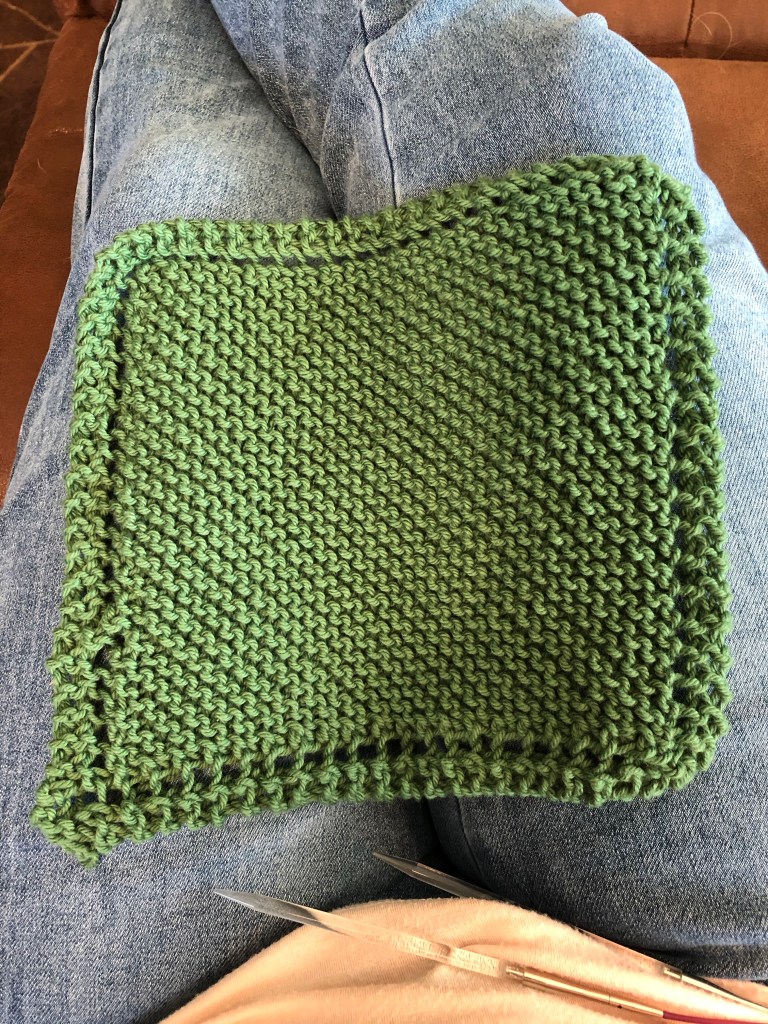
In fact, I’ve shared in a couple of spots that the first ten people who becomes a supporter get to have dishcloths made by me! And the first person to support at any level higher than $.99 a month will get a lap blanket made by me, and I’ll discuss the pattern with you and everything! What a deal!
UPDATE! The lap blanket has been CLAIMED! I’m still ready to knit on those dishcloths!
I could even knit a heart.
Why on Earth Are You Doing This, Suna?
I’m doing this, because podcasts with supporters get shared and recommended more than ones that don’t. And they get more offers for sponsors, too. Like maybe I could have a more interesting ad! Or rotate them! My mind is boggled by the possibilities. I could make fun and funny ads!
I can only do those things with sponsors. They will make Lee happy that I’m not “wasting” money on WordPress fees, and help support me in my old age. Who knows, if I get a couple of sponsors, I might be able to get a better phone with a better camera, or one of those nice microphones…
Raise my self esteem! Or tell me I need to STFU. Either way.
To sum up, the podcast has been more fun than I thought it would be to create. I’d love to have you check it out, on most podcasting platforms. And I’d be honored to have a supporter or two, who will be lauded, I promise! And get prizes if you hurry! AND I hate self promotion, so this will be IT for a while. I hope I get a supporter!
No podcast will be created from this post. (hooray)
That’s my question for this first morning of spring, should I keep up with what appears to be a new undertaking for me, trolling with kindness? What the heck do I mean by that, anyway?
And by the way, Ostara (Vernal equinox) greetings to all of you!
Well, the book I just finished, Blind Spot, made it quite clear that humans are hard-wired to participate in us versus them thinking, and that there are actually good things about feeling a part of a group. Group membership conveys a sense of safety and belonging, and encourages us to take care of other members of our group.
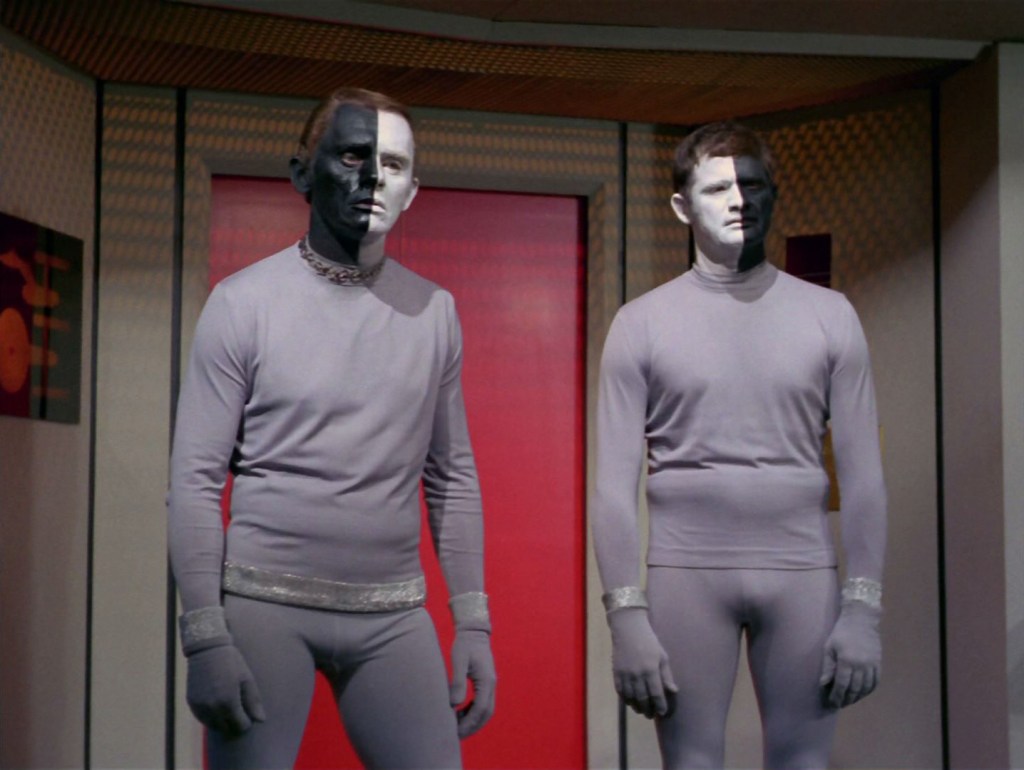
You can’t really avoid creating “others” who are not in your group, and it is natural to focus on your differences to clarify who’s in what group. The authors of Blind Spot pointed to the Dr. Seuss book, The Sneetches, which arbitrarily had a star on their chest or not, leading to great division. And I think of that Star Trek episode, Let That Be Your Last Battlefield, where the people who are black on the right and white on the left are mortal enemies of people who are white on the right and black on the left. Both of these are heavy-handed examples, but they are right: we will work very hard to find ways to divide ourselves.
Yes, our outfits are embarrassing, and we do agree on that.
So, I am totally and completely aware that anything I do is not going to change people’s adamant insistence that “the other side” consists of horrible, no-good, bad, creepy people. Still, I know that even people who are biased to one belief system can start to question things, and that one way to initiate questioning is to repeatedly be exposed to other perspectives. THIS is why I feel compelled to “troll with kindness.”
Bubbling up inside me is a mission to not just keep scrolling when I see people making assertions that further our divided society. Rather, I am compelled to say something in a kind and/or neutral way that provides another way of looking at things.
Today’s example came when someone I used to know, sort of, posted something about President Biden tripping on the stairs of Air Force One. Commenters commenced to making all sorts of assertions about Biden’s age, competency, and such. I responded by asking if none of them had ever tripped on stairs before, that it seems common and not worthy of partisan commentary. Someone replied that they are doing it because once the previous president slipped and the media picked at him. So, I pointed out, nicely, that the tit for tat stuff isn’t very helpful, but I understand that it’s not going to stop.
And after that, I’m out of the conversation. I hope that just by planting the seed that being mean to someone because someone was mean to a member of your group in the past really doesn’t help anything at all. I don’t plan to prod and respond, just to provide another viewpoint.
No doubt I could have done a better job on today’s attempt, but it was only my second try. Maybe I’ll get better or get some suggestions. I know I won’t change anyone’s mind, but it makes ME feel better to gently point out that there are other ways of looking at things.
The chickens heard the Ostara Bunny was coming for their eggs.
Diversion About Today’s News
I know I’ve been pretty naïve most of my life about the hatred deep inside people. My conscious mind has worked so hard to overcome prejudices and stereotypes that I’m often genuinely surprised to find out how others feel about their fellow humans. It’s never occurred to me to think badly about people of Asian descent (consciously; I now know I’ve no clue what’s lurking in my brain).
I’ve always found Asian cultures interesting (since I was a tiny girl in love with kimono) and I’ve had many close friends who are Asian, even dated more than one. Once again, thanks to that linguistics education and that Japanese minor! For some reason, my bias toward Asians is more like they tend to be fun people and potential friends. My upbringing didn’t overtly cause this, though; it was something inside. (I always said it was because there were so few people I had things in common with that I didn’t want to rule out potential friends because of race, gender, religion, or sexuality.)
(here I give you a little piece of my history, again.)
It occurs to me that while my mom was not shy about her traditional Southern US white people view of Black folks, she was equally unhappy with Japanese (who killed her fiancé in WWII) and loved to sing some truly horrid song about “Chink-chink Chinaman named Chow Chow,” that I never understood, but is still in my brain, right along with the sound of her endlessly reading Little Black Sambo to me.
Still, just like she actually loved Black people she knew personally, she was really fond of her Chinese-American friend, Fay Eng.* Fay owned the only Chinese restaurant in the town I grew up in, and she and Mom became friends when my sister and her child were young. It was a long-time friendship, because I knew her all my childhood, and took all my friends to meet her and eat at the restaurant in college. Ha, I remember thinking Chop Suey was an exotic Asian dish. I did quickly learn better in college.
Sorry, I keep coming back to my mom, because I am pretty sure her attitudes about people got imprinted deep within me. I guess I rebelled in a constructive way by getting to know people of so many races and ethnicities and dragging them home to confront her stereotypes. And I’m sure my own children, who had a more diverse set of friends than I did (and do) are at least helping carry on the lessening of racial biases the Blind Spot book mentioned.
(back to the topic)
Where I was originally going with this was how blown away I was to learn about the murders of mostly Asian people in Atlanta this week. I don’t get it, at all. Hurting people just because of the way they look seems like the deepest depths of horrible human behavior. I’m now crying for my Asian-American friends just like I’ve been for African-American friends for so long.
Yes, it’s convenient to divide up according to superficial things like skin color, but it’s just not right, and I WILL speak up about this, and it may not be trolling with kindness.
*Oh my gosh, I looked Fay up to be sure I spelled her name right, and as of last year, she was still alive, at age 95 and a Democratic voter, not only that, she was a poll worker, and used to serve cookies from her father’s recipe, which used to be served at the restaurant I ate in my entire young life! She still lives with her daughter, in a beautiful home. Good for you, Fay. Mom picked a great friend.
Oh, my friends, this anniversary of the pandemic lockdowns has not led to a bunch of happy, hopeful humans in my little world. The people who are struggling to maintain their equilibrium are just not doing it. And even those of us who’ve been keeping our heads above water feel like we are sinking. The hope that truly IS out there is just hard to see!
The little pink flowers of hope are hiding among the prickly cactus that is life with COVID-19.
Heck, I’ve been doing sort of okay most of the past year, but for the past few days, it’s been quite difficult to get through a day. It doesn’t help that my meetings seem to have meetings in them and I get really tired of Zooming. I put the image below on Facebook, and got a lot of support from friends who said this has been an extra-hard few days for them.
*then get back up and do the needful.
It’s weird. I’m NOT all afraid like my friends in the Other World (that’s what I’ve decided to call the Fox News watching crowd) keep telling me. I’m living my life. I’m getting my second vaccine today, actually, and I look forward to some travel in a couple of months. I do have hope, but it feels like helpless hope. I honestly think I just can’t believe positive news.
For example, President Biden gave a talk last night, and it was full of hope and positive energy. People in the US might actually get vaccinated. People who are not me are getting money from the government, too. He spoke kindly, stayed on script, and didn’t call anyone names. This normally would have made me feel better.
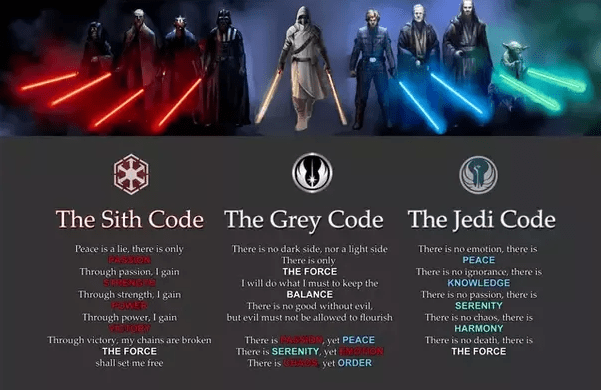
But no, the cycle I’ve gone through in the last few decades (Bush, Obama, the previous guy, Biden) has led me to not put any credence into good news. There’s always something awful just down the road. Don’t get me wrong, I am fully aware that life is suffering (I read Lion’s Roar, after all) and that there will always be positive and negative aspects to life, the dark and light sides of the Force, and all that. But the un-ending, pounding, grinding succession of challenges, struggles, meanness, and and obstacles the past year has brought with it have taken a lot out of me. It helps to know I’m not alone.
Don’t force yourself to choose unless you want to, says Suna the Grey.
I admire the folks who are hanging in there and posting the positive memes every day (like my dear niece who could find the good in our sun going supernova, I think). Hope is needed. But right now, I’m in a place that I don’t believe it, no matter how nice it is to see it in others.
All I have for y’all is some virtual hugs. I think I mentioned needing hugs just a couple of days ago! And I appreciate the return hugs and good energy. I’m absolutely confident that I’m just dealing with a passing depression episode that’s completely understandable. Just know that I’m still helplessly hoping, and some day I may even believe my hope and get back to all that cautious fun I was managing to have earlier in the pandemic period.
Oh yes, it’s my job to mention that I do have podcasts now of all my most recent posts. I usually record each blog post within 24 hours of posting it here. You can go to Apple podcasts, Spotify, and many other places, search for the Hermits’ Rest, and follow our spoken journey. I also promise to mention anyone kind enough to sponsor my podcast, which will help repay all the money I spend to bring you this blog!
I’m in Austin this week, and my cul-de-sac neighbors held one of their happy hours to say belated happy birthday to me. We met in a driveway on a windy evening and had a nice time chatting and catching up.
I had a message for the neighbors.
One of our main conversation topics was how far along we are with our COVID-19 vaccinations. Since we are all “getting up there,” some are fully vaccinated, and others are getting close. Only a couple of us haven’t started, but they are slightly younger people who have been pretty isolated.
We could all use hugs, unless, well, we aren’t huggers.
By the end of the visit, as we were saying goodbye, we realized that by the next book club we might be able to hug each other. I must sheepishly admit that I got all extra full of anticipatory glee at the thought of being able to hug Angela, who’s a nurse, in two weeks.
Oh my gosh. Hugs will be possible soon. And we might even be able to meet indoors in April or May!
Yes. Hugs. Someday.
And maybe we can have Sunday dinners with our friends again. It’s like a dream. A simple dream. To reconnect. Just talking to friends this evening felt so luxurious.
What simple luxury are YOU looking forward to in the coming months, if vaccinations go as planned? Please share!
Want to support my blog and podcast so I can keep going? Your monthly donation would help cover my blog expenses. I can assure you that on a blog as little as this one, the ads only give me a couple of dollars a month, so even a dollar makes me happy!
First, I’ll get this out of the way. I’ve decided to do a podcast to go along with this blog, since a lot of people would rather listen than read (like my husband). Some posts will work better than others. I’m still working out the kinks (like adding a consistent intro and ending blurb, but I do have three of them up at this site.
I have not gone overboard on this design.
Currently, it appears to be on Spotify, but maybe you can find it elsewhere. I did one post with an “automatically translate” feature, but I haven’t listened to it yet. Let me know if you listen. I can re-record if it’s totally awful.
I plan to slow down my speech (I do actually know how to record things, since I did it for my job for a long time), but I was having a lot of equipment issues at the ranch, due to my fancy headphones and/or something preventing me from playing back sounds.
Podcasts and Me
It’s sorta funny that I have resisted doing a podcast for so long, given my long history with them. Back when I was working for the nonprofit organization, one of my dearest coworkers, Elisabeth Lewin, was a podcasting pioneer, and she got us all set up doing podcasts from our international conference. I was (and still am) in awe of her equipment. I learned a lot from her.
I took what I learned and was able to help my musician housemate, Jeff Tveraas, get a website and all the accoutrements needed to set up a podcast of his own, which was called the Austin Connection. I really enjoyed those and was sad when he had to stop producing them, and wish the old episodes were still available.
I’ve watched as every single radio show I listen to has developed its own podcasts, as every vaguely famous news person has done, etc. And I’ve seen some of the blogs I read move to podcast-only format. I even pay money to a couple of people to support their blogs or YouTube channels that I actually don’t listen to. It’s obvious where the trend is going.
Nonetheless, I am apparently NOT an audio learner, so I never enjoyed listening to them, myself. I’ll listen to some of the ones Lee shares, but for some reason, I have no patience with wading through the sponsorship information, the plugs for how to obtain them, and the listening itself. I blame the fact that I read so quickly on my impatience with spoken media. I can zip through a blog, unless I pause to enjoy photos, while a podcast takes, well, as long as a podcast takes (same with learning off YouTube; I can’t stand all the blather).
Still, as I mentioned, I recorded e-learning videos for many years, which were like podcasts with accompanying slideshows. I’m not afraid of microphones, audio editing equipment or anything like that. I could easily make podcasts, but didn’t want to bother with all the uploading and editing.
So Now
When WordPress started hounding me to turn my blog posts into podcasts, I ignored it for a while. Then I started thinking about my husband, who will not go onto Facebook unless he has to say something for work and who hasn’t been able to figure out how to get my blog posts mailed to him. He does listen to podcasts, pretty much all the time, including when he is sleeping. What better way to reach him than to speak to him in his sleep! Creepy fun, right?
Plus, it’s something else to do! I love me a good project! The Anchor software that WordPress promotes makes it easy to do a podcast, as long as you have a microphone. There’s not a lot of editing software that I can use, so I’ll just leave my mess-ups in there. And I will see if I can get a son to record me some soft guitar music (NOT lengthy) to put on the opening.
The folks at Anchor claim you can make money from people subscribing to your blog. Yeah, right, the people at WordPress say I can make money from people looking at ads on my blog, and so far I have amassed nearly $60 (in over a year)!
But, what the heck, if you are a fan of my blog, or want to support the podcasting thereof, you are very welcome to subscribe. After all, I’ll need income after I retire.
You are ALSO very welcome to continue to read my blog for fun, entertainment, or to help you get to sleep. I’m happy to have an outlet for venting and sharing nature stuff, but, if someone wants to listen to me talk, they can do that, too. Just look for The Hermits’ Rest on Spotify, or wherever you get your podcasts. I love subscribers, and will not turn down supporters!
















 The Hermits' Rest