Book Report: A History of the World in 6 Glasses

Rating: 4 out of 5.

You know a book is good when you start repeating things you learn in it to everyone you talk to. This one, A History of the World in 6 Glasses, by Tom Standage (2006), is one of those books, all right. I never would have even heard of it, but it was referred to in This Is Your Mind on Plants, and it sounded so interesting that I ordered it, along with a book on coffee, as soon as I finished Michael Pollan’s book.

They had to work hard to make that cover do what it needed to do.

The fun premise of the 6 Glasses book is to look at how the preferred beverages of humans throughout history (beer, wine, spirits, coffee, tea, and Coca-Cola) affected their health, civilization, and progress. It’s so full of tidbits that I’d never thought of before that it did a GREAT job of relaxing me over the weekend and getting my mind off the rest of my life. Here are a few things I learned (don’t worry there’s LOTS more):

  • Beer was one of the main reasons people stopped being nomadic and started settling down: they needed to store it.
  • Beer, wine, coffee, and tea were important because they had properties that made water safer to drink. Boiling water to make beer, tea and coffee killed germs, and antibacterial properties of wine did the same.
  • The Greeks and Romans thought it barbaric to drink wine straight. It had to be watered down.
  • The first corporate logo to be developed was for Twinings Tea.
  • One reason there were so many sugar cane plantations needed in the New World (and thus the need for so many slaves) was all the English people insisting on sugaring their tea.
  • Oh, so much more, especially about history and how these beverages affected it.
  • Coffee is legal and encouraged because it makes workers more effective and alert.

I really enjoyed reading about all sorts of noble people and their beverage obsessions, but also how even the regular folks had their beverages. People were paid in beer for much of recorded history (THAT helped start writing systems!). There have always been systems to show social standing by what kind of wine or tea you serve and how you serve it.

Standage gives just enough information about each drink to keep you wanting more, without bogging you down in chemistry or complexities, so it’s fun as well as educational. That’s my kind of book!

By the way, I’m not the only one who ordered books after reading This Is Your Mind on Plants. Kathleen ordered two different books that Pollan referred to. He makes you just want to keep reading and reading!

Book Report: Olive Kitteridge

Rating: 5 out of 5.

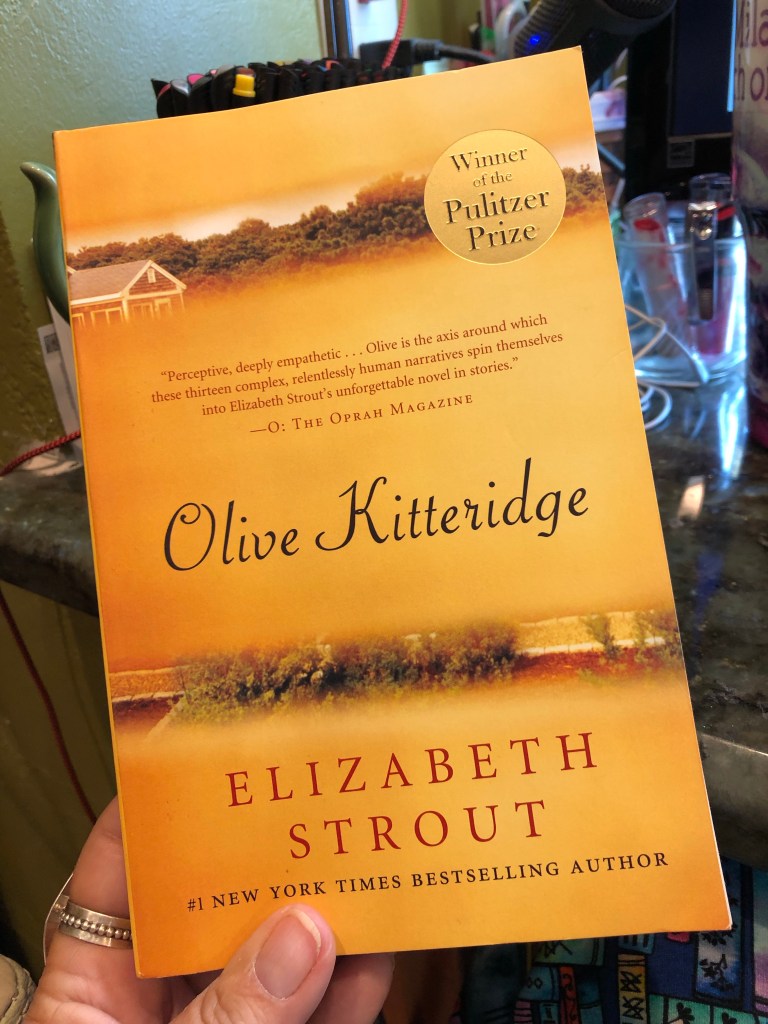
A friend recommended I read the books by Elizabeth Strout on Olive Kitteridge, because I said I was interested in good character development. I ordered them, and just finished Olive Kitteridge. It’s a quiet masterpiece.

The book is a series of short stories, sort of, though the same people in a small Maine town appear and re-appear. Olive, a large sorta grumpy woman is the pivotal character who appears in each story. It’s fun to wait and see how she turns up and how the other people perceive her.

I love how normal and real the people in the stories are, but also how they each have personal tragedies that shape them. One theme I detected in the book was of people daring to do something unexpected or out of character. It usually works out well, but not always. It reminded me of my own attempts to get out of my shell, tell my truth, or speak up. Only mine tend to backfire. Never mind…

I did find many beautiful phrasings and observations about daily life, beauty, and appreciation of your current moment. But mostly it was about feeling lonely.

When he was in town, it seemed he saw couples everywhere; arms tucked against each other in sweet intimacy; he felt he saw light flash from their faces, and it was the light of life, people were living.

Starving, p. 99

And she has an amazing way of showing how disconnected and lonely people can let themselves be. I felt like framing a couple things Strout has her characters think or say.

It’s just that I’m the kind of person that thinks if you took a map of the whole world and put a pin in it for every person, there wouldn’t be a pin for me

Criminal, p. 236

What I get from Strout’s interrelated tales is that we can all feel our separateness deeply, and we all seek intimacy in our own ways. I’m grateful for all the glimpses into everyday intimacy that the stories in Olive Kitteridge provide. I will probably turn to this book often just to re-read some of the words and slip back into the feelings they elicit.

Great book. Thanks so much to the friend who recommended it!

Book Report: This Is Your Mind on Plants

Rating: 3.5 out of 5.

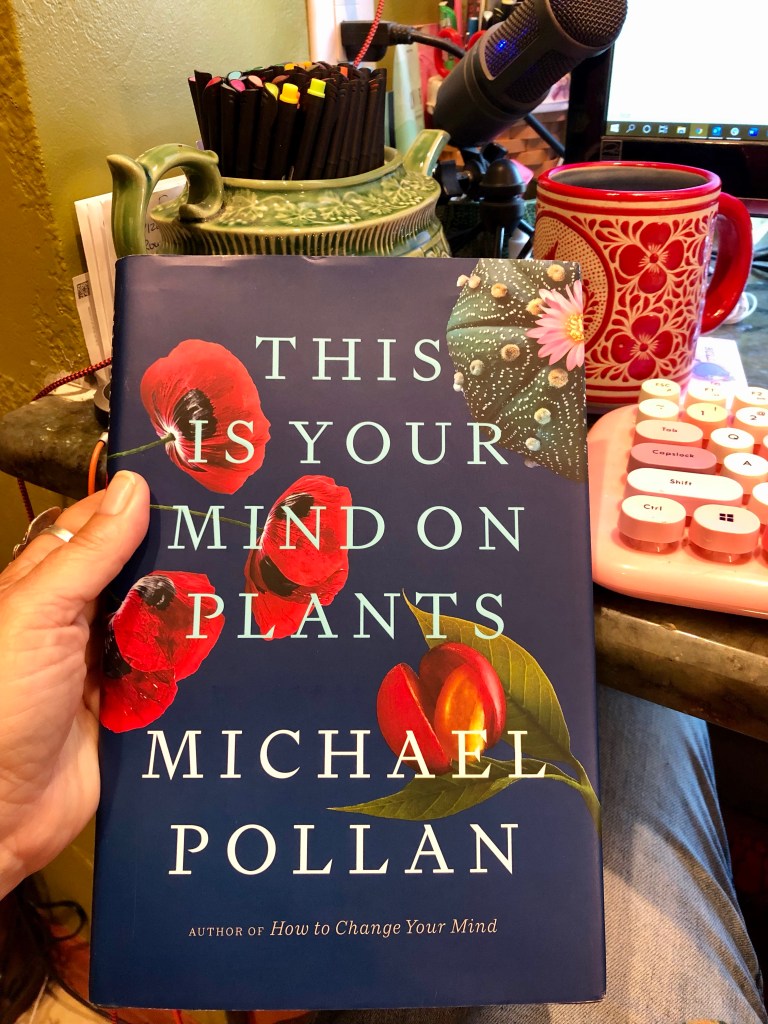
Oh, that Michael Pollan. He’s gonna convert us all to lovers of mind-enhancing substances, I think. His latest offering on this topic, This Is Your Mind on Plants (2021), makes me want to run out and try peyote, so it’s lucky that I am too white to get ahold of it (as you find out in the book, only Indians are allowed to obtain and use it in the US, as a legally protected religious right).

I had to put my coffee cup in the picture, to show I’m an addict. Lucky for me, I don’t have withdrawal symptoms.

But that’s not all the book’s about. The ever-curious Pollan explores four plants that have been used by humans to mess with their minds: opium poppies, coffee beans/tea leaves, and peyote cactus. I was especially curious about caffeine, which provided my favorite section of the book. I was surprised to learn that the caffeine fixation in Western culture is not very old at all. More fascinating to me was its relationship with the new ways of working that came up as society became more and more industrialized. Caffeine enabled people to concentrate longer, stay focused, and be more productive. Coffee breaks were actually invented to give workers their doses of their drug of choice!

Yep, it turns out that nowadays, caffeine is the most widely used addictive substance in the world, more than nicotine or alcohol. And it isn’t benign, especially since it messes with sleep patterns.

I also learned a lot about opium, but the opium section is more about the issues Pollan had when he grew some poppies for a writing assignment and discovered he could be in trouble with the law. Now, as someone who remembers lovely poppies growing in the garden at her church, this amused me. Apparently, the government doesn’t want people to know it’s easy to make a tea from poppy seed pods, or that if it’s used occasionally for aches and pains, it’s not going to addict you. Like most things, moderation rules. As I know, it’s a real good pain killer (I remember picking up Mom’s drugs when she was dying, and feeling really weird about carrying this giant thing of morphine).

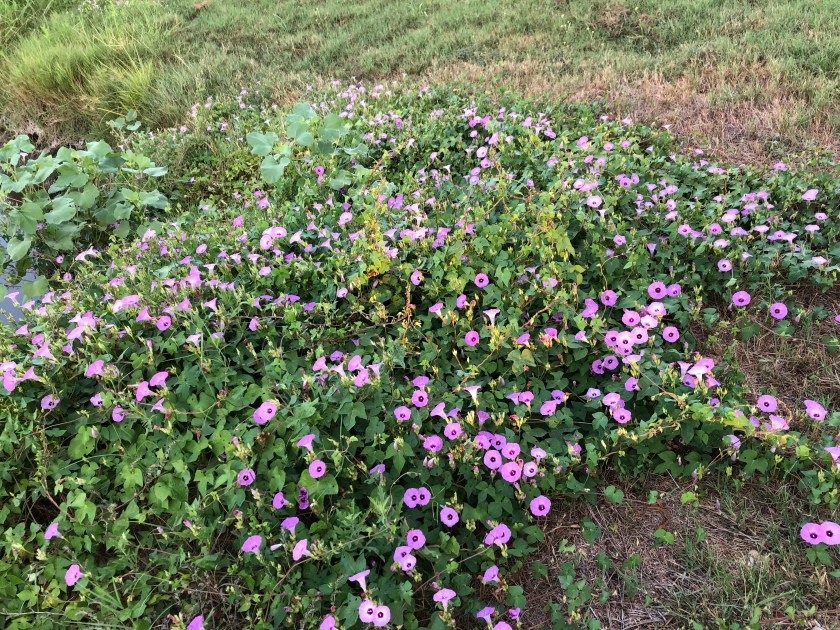
Isn’t there some kind of drug in morning glories, too? Why yes, they also can be hallucinogenic.

On to more cheerful topics, and that’s good ole mescaline. What a kind drug it turns out to be. And it’s another thing that used carefully, in the right setting, provides many insights. Its effects certainly sound less potentially scary than LSD and the ilk. It apparently takes away the brain’s filters that only make you conscious of inputs that are relevant and lets you really see everything. So, you basically sit around and look at the world in its raw glory. I can see how that would be really cool, but not a way of life.

This section of the book was a lot of him trying to find the stuff and talking to various folks that a lot of readers might find a bit woo-woo, but they were okay. I would have liked to know more about the chemical aspects of how mescaline works.

To sum it all up, this is not Pollan’s most brilliant work, but I enjoyed what I learned, and always enjoy his writing. I’d like to read more about safe and intentional use of tobacco, marijuana, and alcohol, but I guess enough’s already been written about them.

Book Report: Before We Were Yours

Rating: 4 out of 5.

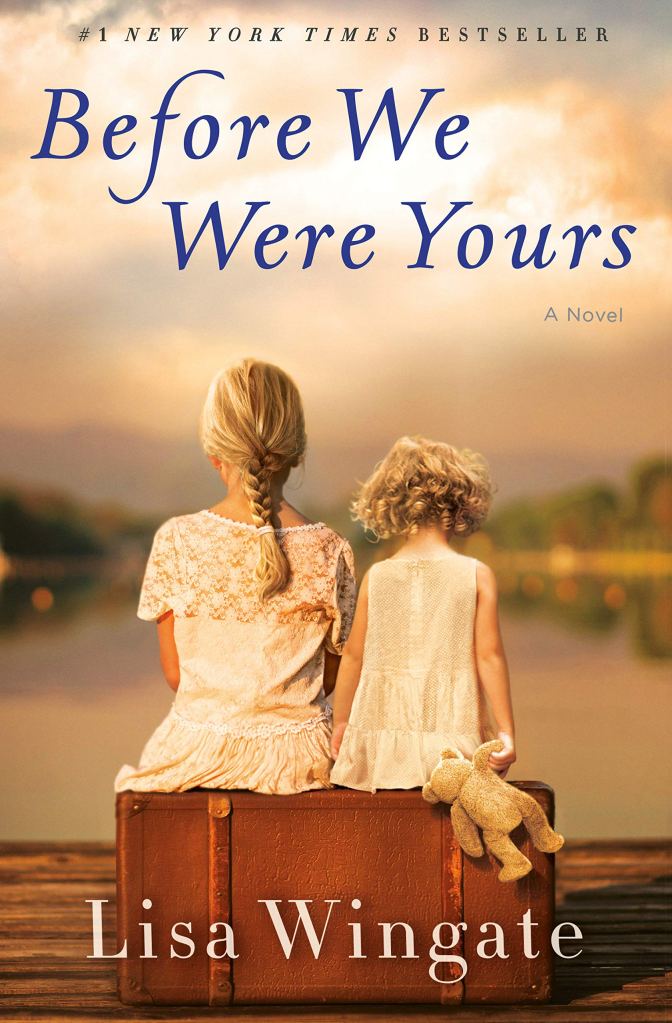
I’ve been hearing about this book for a long time and just hadn’t gotten around to reading it yet. So, when it was suggested for the September neighborhood book club book, I was fine with it. Before We Were Yours, by Lisa Wingate, was very popular when it was published in 2017, and many of my friends read it then. It sounded really sad to me, and that was when I was skipping anything that sounded remotely sad (thus, was reading nonfiction).

What’s sad about the book is that it’s based on something that actually happened, right here in the USA, in Memphis, Tennessee to be exact. There was a horrible and awful woman named Georgia Tann, who ran an adoption agency there, serving all sorts of famous and wealthy people. They wanted attractive babies and would pay anything for them. So, Georgia Tann would send out people to take attractive, poor children off the streets, force mothers to sign adoption papers while under anesthesia, and other dubious tactics. Names were quickly changed, which made it hard for poor families to find their lost loved ones. Shudder.

The actual Georgia Tann

Yeah, that sounds like a chipper beach read, doesn’t it? And it isn’t chipper, but it is fascinating. The characters in the book all seem very realistic, and you come to admire both the siblings who are taken away from their parents and the present-day adults who try to unravel their mystery. Your heart just hurts for all the families Georgia Tann destroyed, as well as for adoptive parents who were lied to and had no idea where their much-wanted children came from (this includes movie stars like Joan Crawford).

The book is both a historical novel and a mystery, so fans of both genres will enjoy it. You certainly will have a hard time putting it down, as you grow more and more fond of the people you’re reading about.

If you are like me, you will want more background on the actual events. Here’s an article from the NY Times about it. I’m glad these events led to some reform in adoption agencies and that any actual needy children did get good homes (apparently some of the things Tann did were legitimate, and she did help to remove the stigma against orphans that was prevalent early in the twentieth century.

If you’ve read it, share your opinions. If you haven’t, this is a good one to check out.

Book Report: A Girl Is a Body of Water

Rating: 4 out of 5.

I was sort of sad to finish my latest relaxation read, A Girl Is a Body of Water, by Jennifer Nansubuga Makumbi, because I sure was enjoying my education in the culture, food, and clothing of Uganda. Basically, all I knew about Uganda before was Idi Amin, and he certainly isn’t something worth representing an entire culture with. Well, and I knew the Gandan people spoke Lagala there (among other languages), from when I studied linguistics. I guess that put me one step ahead of most people in my culture.

I also really like the cover.

Do you have to be interested in the culture of Uganda during the 20th Century to read this book? Absolutely not, because the story is beautiful, interesting, and very captivating. You grow to love the characters as you learn more and more about them, especially Kirabo, the main character, and Nsuuta, the blind woman of mystery who is inextricably linked to Alikisa, Kirabo’s grandmother. You just want to know what’s going on with this fascinating and many-layered family!

But for me, the information about traditional Ugandan culture, how it changed with colonialism, through Amin’s reign, to more modern times, was fascinating. The book does a fantastic job of delving deep into the traditional and modern roles of women in Uganda, which parts change and which parts stay traditional. Many of the women Makumbi writes about were among the first to try to do things differently, and you might be surprised at some of the consequences and who encouraged and discouraged them. The way feminism and traditional roles came together in A Girl Is a Body of Water was really skillful.

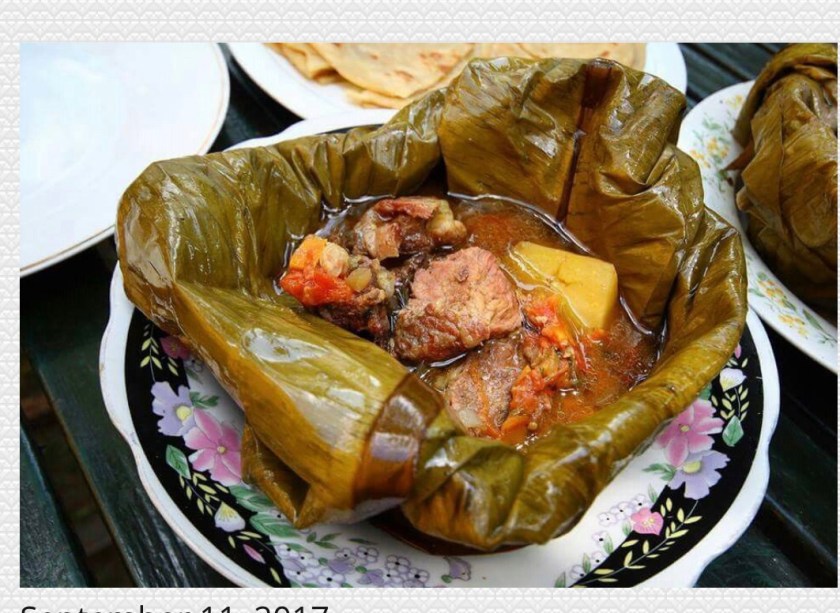
Makumbi does a great job of introducing new Ugandan words, ideas, and concepts in the course of developing the plot, so it’s easy to learn as you go. I found it fun to try to figure out what some of the words meant, especially foods and items of clothing. I admit to looking some words up, like luwombo, which is a kind of stew-ish dish served in banana leaves. Some words, though, I waited until I could figure them out from context. That is MY idea of a good time. YOU might want to keep Google handy.

Luwombo, from an online brochure. It can feature any meat.

The culture stuff was really fun to learn, too, like what constituted beauty to them, how who was related to whom was calculated, who counts as “family,” and how the deal about having multiple mothers in households with more than one wife worked. It sounded like a lot of love, actually. It was fun to imagine living in a society so different from mine, with different mores and guidelines, but that made perfect sense in its context.

I’m glad I finally was able to get around to reading this book, which I’d had to put off for a while. If you are like me and enjoy learning history through the eyes of women in a culture, you will enjoy this book very much. It’s going to stick with me, and I’ll always wonder how Kirabo did after the book ended. Hey, a sequel, that would be fine with me!

Book Report: The Four Winds

Rating: 4 out of 5.

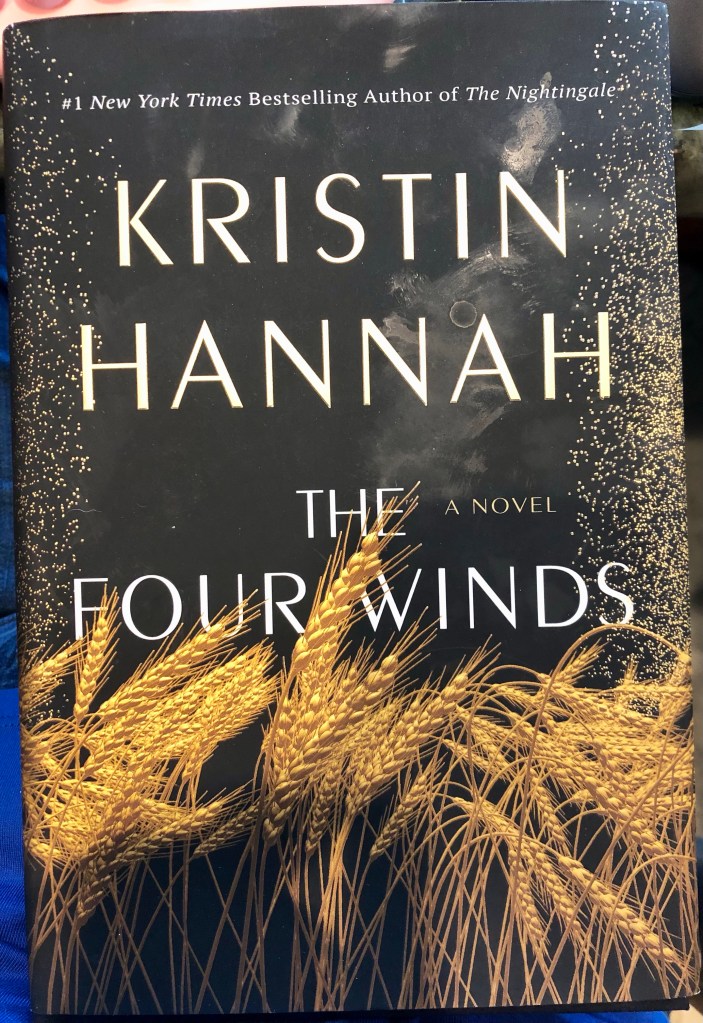
Finally, I was able to read a neighborhood book club book again. The Four Winds, by Kristin Hannah (2021) is set in the 1930s, during the Great Depression and the horrible Dust Bowl times in Texas, Oklahoma, and surrounding states. It’s definitely not a feel-good beach read, though there is plenty of goodness in it.

This book draws you in quickly, as you’re taken in by the story of CCX and her isolated life in west Texas. Hannah truly tells a good tale and make the characters seem real.

Every once in a while someone says or does something that seems out of character to me, but I just rode along with it. I think some of it is how jarring Elsa’s breakthroughs of her “true self” appear, like when she suddenly goes out and BOOM has sex with the first male she encounters.

You also can’t avoid drawing parallels with our current times. Those hard working farmers just couldn’t grasp that they were actually the source of the problems. The message isn’t subtle, but the points ring true.

The Four Winds seems eerily prescient in 2021 . . . Its message is galvanizing and hopeful: We are a nation of scrappy survivors. We’ve been in dire straits before; we will be again. Hold your people close.”

The New York Times

I was fascinated by the depth of the horror people lived through during the Dust Bowl times. The graphic images of dirt and more dirt are sobering, as are the details of the lives of “Okies” who fled to California.

You’ll come to admire the tenacity of Elsa and her kids and have a hard time putting this one down. I love historical novels like this, where you learn a lot as you enjoy a good tale.

Book Report: Green: The History of a Color

This is the fourth book in the series of books by Michel Pastoureau that detail how colors have been perceived and used through European history that I’ve read. It’s convenient that I was reading this along with the Greenlights book, which has all the green print and green pages. I find the color series really interesting and entertaining, so if you like colors, check out Green: The History of a Color. A lot of what I learned surprised me.

Jane Fonda is smokin’ on the cover, in more ways than one.

You do begin to feel sorry for green, like you did poor yellow in the book I read most recently. It really didn’t get much mention in historical texts, and wasn’t even used in paintings for a long time. One reason was that it has always been difficult to get a green dye that wasn’t made of copper or arsenic or some other poisonous substance. The safe ones were pretty dull. Another was that people just didn’t divide things into colors the way we do now, so a lot of what we would call green was blue or brown to the eyes of people in the past.

Then, poor ole green had a bad reputation of being a color of evil, deceit, and treachery (green knights were never up to any good), unless they were very young men, who were “green” in the untested sense. As time went on, it came to symbolize young love (not necessarily faithful love), peace, and fairy folk.

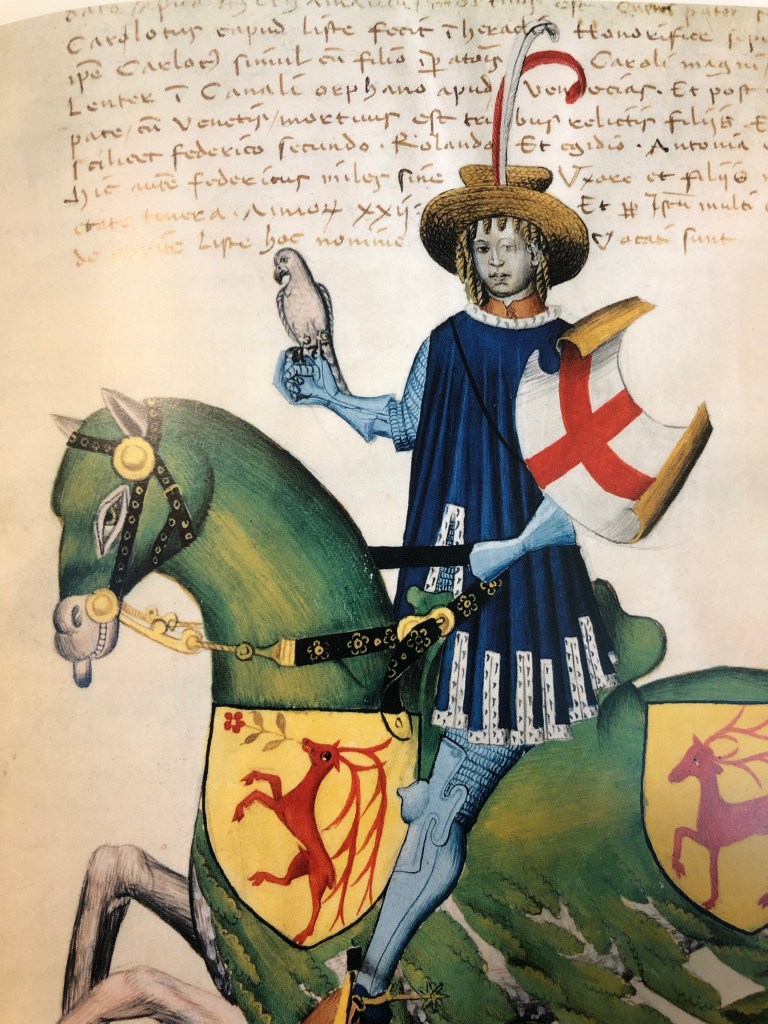
Apparently, saucy horses wore a lot of green. I love the fact on that horse.

People just didn’t like to wear it, other than a few brief fads where various rulers decided green was their color. Then the sickness came…apparently from covering walls with paint and wallpaper that was green. Some even think that’s what actually got Napoleon.

Green and nature do go hand in hand, though, so there is a lot of green in landscapes and such. A lot of it wasn’t very stable, though, so some landscapes that look brown were once green. And natural objects like the sky, sea, lakes, and rivers were often painted green, not blue. I found that interesting.

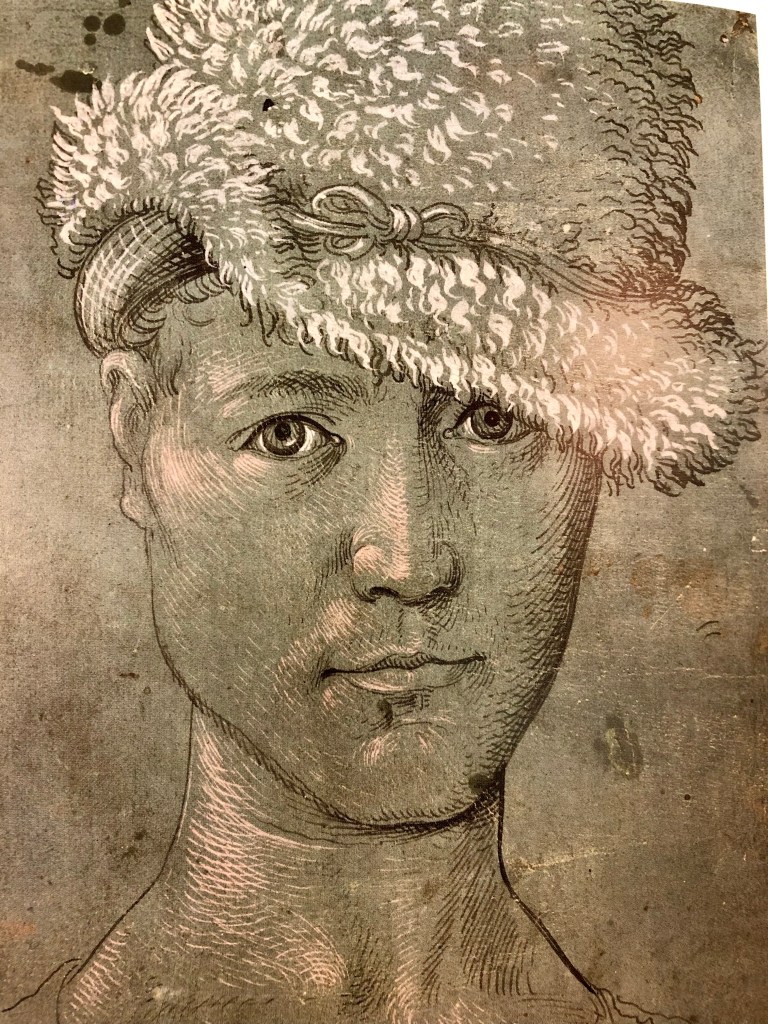
Etchings on green paper were popular. I just like this dude’s fuzzy hat.

Since this book dealt primarily with European history, Pastoureau didn’t bring up the color green in other parts of the world. From my studies, I know that Japanese didn’t have a word for green for a long time; aoi meant both blue and green. And the number of colors languages distinguish vary from three to dozens. It just depends on what’s important in a society. For Europeans, Pastoureau notes that texture and other tactile features were more important than color in describing objects (also, apparently in the Middle East when people were writing Biblical passages), which I found pretty interesting.

In addition to all the history stuff, the illustrations in the Green book are just as gorgeous as in the others in the series. These are majorly great coffee-table books (in fact, mine are on the coffee table!) and they are just fun to page through.

Your friends will be green with envy if you display this one, with that fine smoking Jane Fonda on the cover!

Book Report: Brood

It’s rained nearly all day again today. The younger folks saw it was going to rain yesterday and took off for the beach, leaving us hermits to fend for ourselves. Lee was handed a bunch of paperwork before Kathleen left, so he had a project. All my original plans for the weekend were outdoor ones, so I had to regroup. Knit? No, my project is too fuzzy and hot. I decided to read. so, here’s another book report.

A few days ago, one of my old LLL friends shared Brood, by Jackie Polzin, and said the description reminded her of me. I looked at it, saw it was about a woman and her small flock of chickens, and ordered it.

Brood is Polzin’s first novel. Her style is spare and graceful. She tells us just enough to feel moved by her experiences but not so much that you can’t picture yourself in her shoes.

As someone who randomly got chickens and found their habits fascinating and their propensity to die at the drop of a hat pretty confusing, I emphasized a lot with the experiences of the unnamed protagonist of Brood. And her life, while not like mine, mirrored many of my experiences in a broad way. She seems to just float through life, following others, while getting her joy from her ability to control the quality of her avocation (for her, it was cleaning and for me it was knitting).

Anyway, this book packs a subtle but sizable wallop. I got out of it that paying attention to the now is how to lead an authentic and satisfying life. I find that Polzin does a very credible job of demonstrating the centeredness that can come from feeling okay with the transience of everything you care about.

You know, just writing about this little gem of a story made me realize that Brood has helped me see the good in some of my quirks and the validity of some of my awkwardly existentialist/Buddhist leanings.

I feel like reading this every few months, even though I know the plot. The plot is the least important part of Brood for me. I had no idea this novel about a lady in Minnesota and her four chickens would move me. It did!

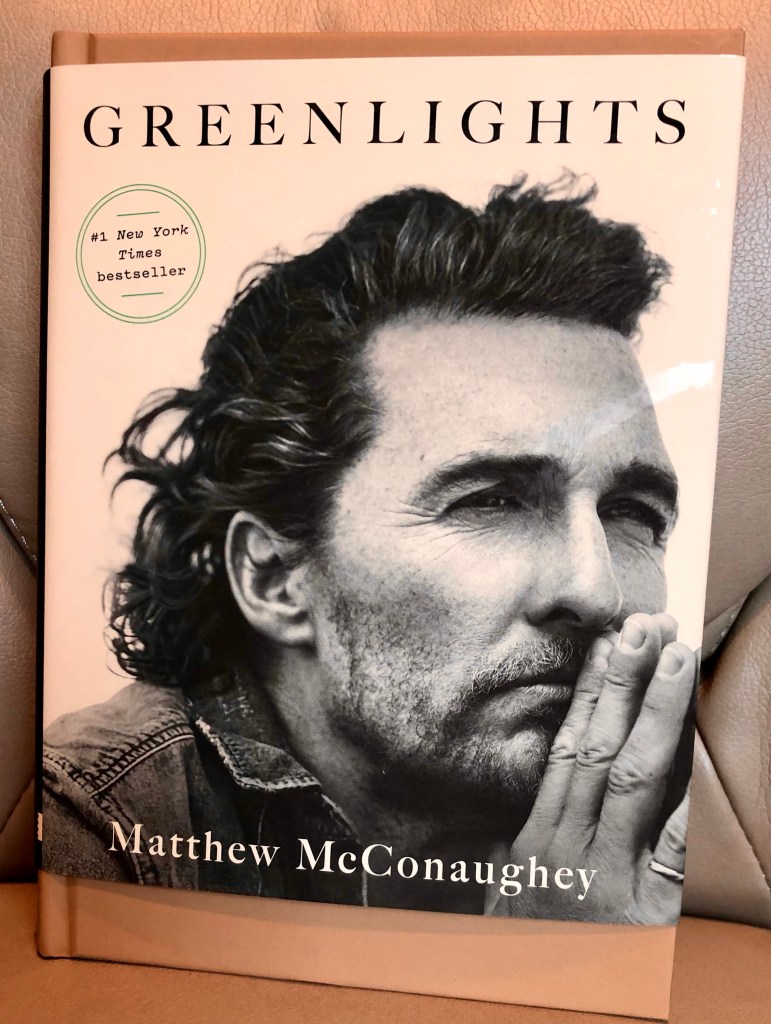
Book Report: Greenlights

Rating: 5 out of 5.

Did you think I wasn’t reading anymore? Not the case; I’m reading a long-ass book about working equitation and a book in my color series, on green. But, this green-themed book showed up yesterday, so I diverted to read it on a very rare rainy July day.

I didn’t jump to read Greenlights, by Matthew McConaughey, the moment it came out last year, because I was busy reading other stuff. But, my love of memoirs by quirky people got the best of me, and when I was ordering another book, I stuck this one in my order. I’m glad I did, because this book is a fun adventure to read and a nice break from some of the “celebrity” books I’ve seen.

My favorite thing is that MM (as I’ll call him, to keep from having to type his surname over and over) is unabashedly honest about himself, which makes reading about his personal and spiritual journey am unexpected joy. As you probably know, one of my favorite pastimes is learning how different people “tick,” and MM gives you a lot of insight into how he got to be the way he is today. His morality is very consistent, and when he sees himself deviating, he goes off and works on it, by gosh. It’s no wonder one of the reviews on the back of the book is by Lee’s hero Ryan Holliday, the modern Stoic guy.

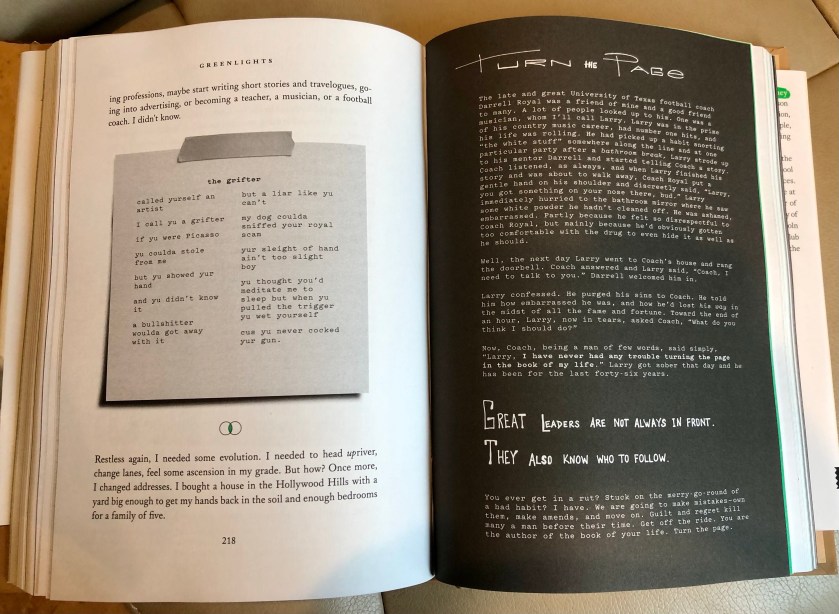
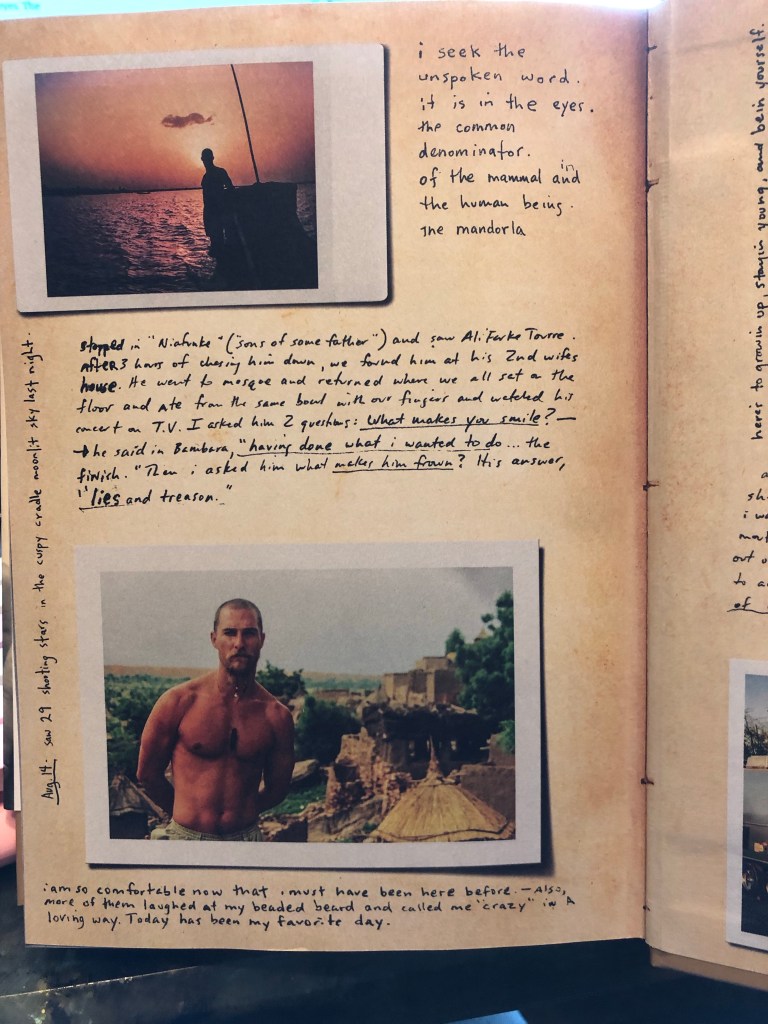
And, yes, it’s a philosophy book as well as a memoir. I’ll admit that some of the stuff seemed to be a bit simplistic, but I didn’t disagree with any of it, either. And I certainly enjoyed how he presented his ideas in photos of sticky notes, bumper stickers, and images of his hand-written notes from various stages of his life. Seeing someone else’s unedited thoughts is quite insightful, and I admire MM for sharing them!

A sample of the book’s layout.

About the Book Itself

Something else I liked about this memoir is the book itself. I like it when a publisher takes a chance and makes a book’s design a feast for the eyes. The physical book itself is even different in a good way. The book jacket is not the size of the book, and is on lovely paper. Then, when you open the book, you’re greeted with all sorts of photos and words inside the cover. This part contributes a lot to the story of MM, and is a delightful surprise.

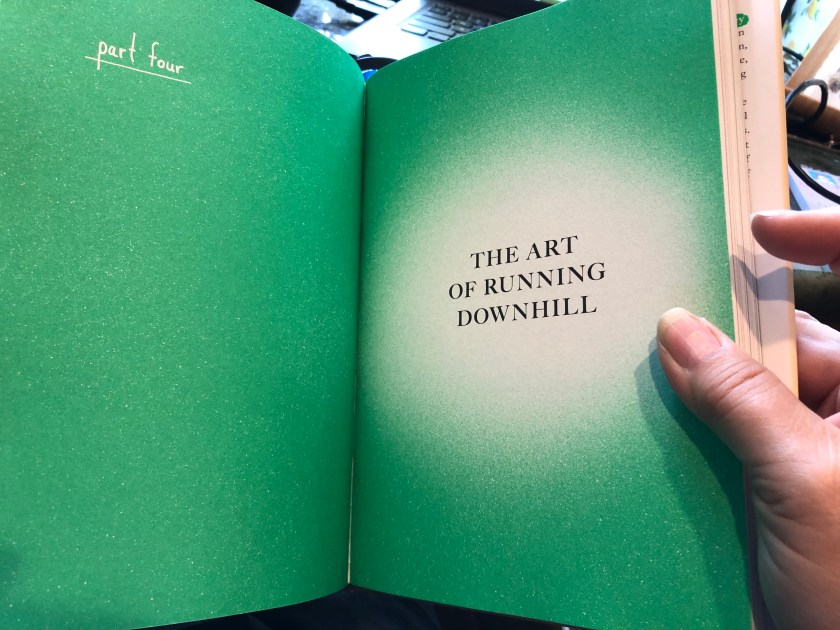
The book itself has a theme, and by gosh, it sticks to it. MM talks about “greenlights” in his life, which are signals he’s on the right path. The color green appears in the section dividers, in the Venn diagram used to mark sections within chapters, and every time he says “greenlight.” The use of a typewriter-style monospaced font in any content that’s a poem or a philosophical break helps you keep track of what’s in the narrative and what’s an aside. Plus, the bits in MM’s handwriting show what isn’t edited at all.

Section head.

The Content

The other thing I want to say about this book is that it does what I like best in an introspective book, and that’s to NOT go on and on about every famous person the author encounters, every fancy thing the author ever did, etc. Instead, MM focuses on his own thought processes and introduces only people who let him toward his greenlights, most of whom aren’t all that famous (though a few are). His humility seems genuine, not a put-on, and you end the book not thinking how great it was to get to know a movie star, but rather how great it was to follow a man and learn from his insights as he grows and changes. (I also enjoyed reading about his times in Austin, which brought back memories.)

Why I sat and read all day yesterday.

Nope, MM is not much like me at all, but he earns my respect for being true to his ideals, for learning from his mistakes, and for focusing on what he learns from all his experiences. Well, in that way, he IS like what I’d hope to be!

By the way, I read the book by first reading through the narrative part (the “regular book” bits) so that I could keep track of the passage of time, then I went back and read all the inserts and philosophical asides. Those parts are timeless, though it’s cool to figure out where MM was on his journey when he wrote his notes.

So, if you like modern philosophy, spiritual growth, or funny stories about wrestling on other continents, playing bongos naked, or any combination of the above, you’ll like Greenlights. You might even start looking at your life’s challenges in a more positive way.

Book Report: Finding the Mother Tree

Rating: 4 out of 5.

My excuse for not finishing this one sooner is that I was trying to catch up on magazines, thanks to all the “subtle” hints that I have too many piles of them. I did at least get all the horse and decorating magazines finished, so last night I got myself to the end of Finding the Mother Tree: Discovering the Wisdom of the Forest, by Suzanne Simard (2021). What a journey this book is!

If this doesn’t make you go hug a tree, nothing will.

I got the book the minute it came out, which is no surprise given how many books on trees, how trees talk to each other, and forest ecology I’ve read in the past couple of years! Simard wrote it in an interesting way, where autobiographical sections are interspersed with some pretty hard-core science content. If you just like stories, you can skim the science; if you just want to know exactly how trees communicate with and support one another, you can bypass the story of her life (but you’d be missing out on an interesting life!).

Simard was born, full of curiosity, into a western Canadian family full of loggers and tough woodland pioneers. It’s no wonder she ended up as a biologist. And she, too, is a pioneer. She had a very hard time getting anyone to listen to her as she explained the effects of clear cutting and re-planting as it was practiced at the end of the 20th century. I really came to admire her tenacity and conviction that she was right.

Mother tree I saw at the horse competition.

Of course, it helped that all her data backed her up, and that eventually she got enough grad students and fellow researchers to make it clear that trees help each other and need each other to survive. I’m glad she did, because her findings are fascinating. Different types of trees are connected, and certain ones use different kinds of fungi help different kinds of trees in their connections, too. It’s all complicated, as one would expect, but fascinating.

The highlight of the book is when Simard talks about “mother trees,” which appear in healthy forests. They are very old, and very well connected. They give their energy to new seedlings and distressed neighbors. It kept making me sad to read about them getting cut down, but I have to credit Simard for acknowledging that we need wood; we just need to be careful with managing forests so they can keep giving us wood!

I know the tree I have pictures of here is or was a mother tree. Just look at her beautiful roots.

Forests that are managed and have all the trees the same age, planted in rows, don’t get the advantages of having mother trees, nor of the diversity of companion trees and understory plants necessary for optimal health, resistance to pests, and protection from diseases.

I’m so glad scientists, and now foresters, are listening to Simard, and that she has passed her work on to her daughter. This woman is an amazing role model for us all.