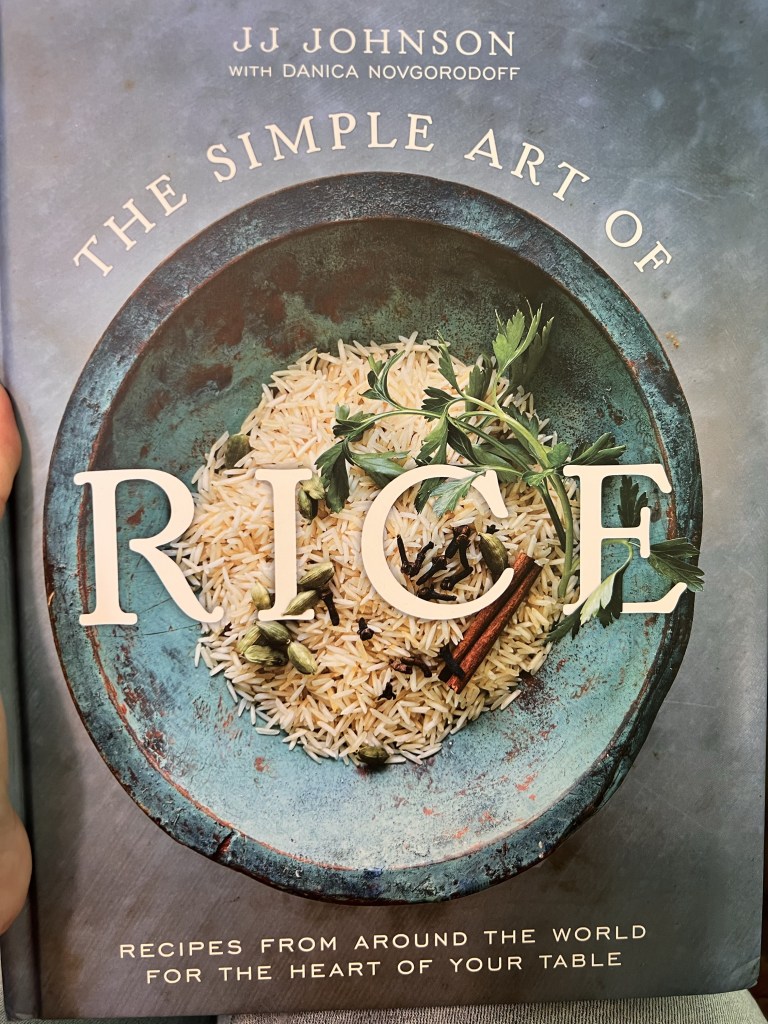
Few things are as frustrating as reading a cookbook all about a specific ingredient, knowing full well that you are completely out of that ingredient. But I did it, I read this fascinating rice cookbook in one of the very few times in my adult life that I was out of rice.
I thought there was another giant bag of rice in the freezer, but there wasn’t. Luckily, Lee got me some Basmati rice today when he grocery shopped. But now that I’ve read The Simple Art of Rice, by JJ Johnson (with Danica Novgorodoff), I know I need more kinds of rice, like my beloved sushi rice, brown rice, and black rice.
I discovered this book the way I discover so many, on an NPR interview. It’s a good thing I’m not in the car listening as much as I used to, because I found two books in one day driving to and from College Station.
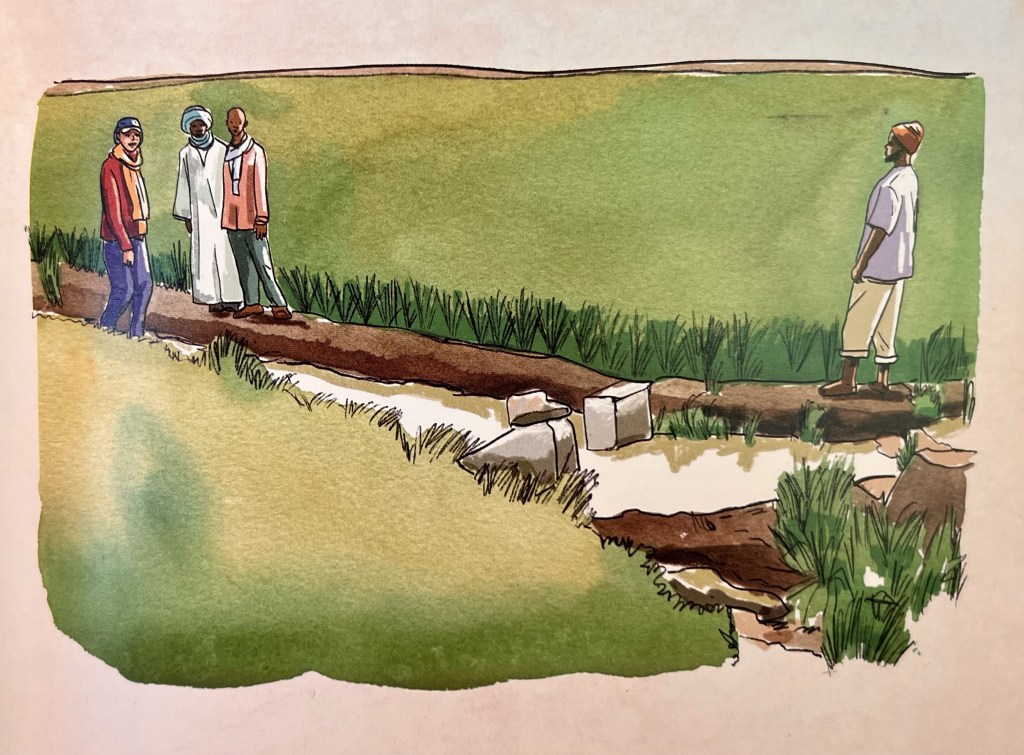
Anyway, this book is gorgeous, with lovely photos of the rice dishes from many cultures as well as elegant watercolor illustrations by the co-author. I love a substantial hardback book.
Sample illustration.
Most importantly, the content is interesting, with a nice mix of rice history, stories of cultural ties to rice, some science, and a well rounded collection of recipes that Johnson collected from workers at the many restaurants where he’s worked.
Now JJ Johnson is a famous rice chef, but I enjoyed how he didn’t re-do traditional recipes, just added a little to some. I enjoyed learning African, Asian, Caribbean, and American traditions and how they are interrelated, often due to the forced African diaspora to North America and the islands around it.
Most of the recipes would be easy to try for the average cook. They all sound very flavorful. Some call for special ingredients from cultures whose grocery stores are not near Milam County, Texas, but maybe I can get some in Austin. I expect I’d be the only one to eat some of the ones I’d like to try most, because they’re full of cilantro, very hot peppers, and the dreaded curry. But that would give me more leftovers!
Extraneous giant swallowtail for you
I suspect my family would love some of the desserts, though. And dishes I know they love are in there…with so many variations of beans and rice! We eat that!
All in all, I had a blast reading the stories, interviews, and cultural nuggets in this book. The recipes are like a delicious bonus! This is a great addition to any collection of cookbooks, especially of home cooking.
This visitor to the ranch is glad there were no turtle gumbo recipes.
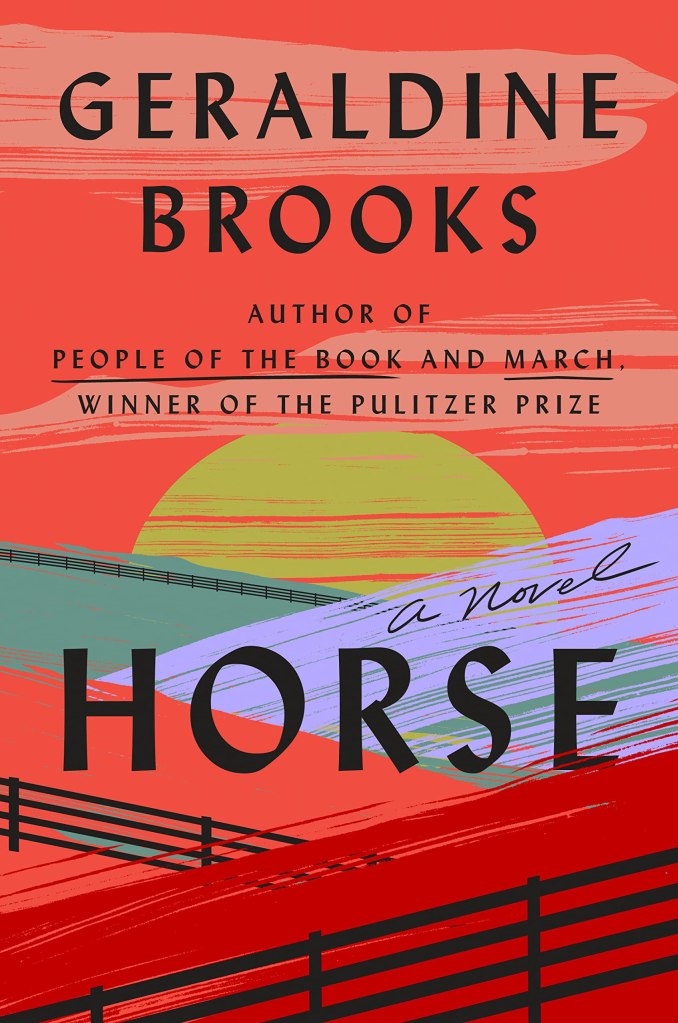
After I finished my depressing but informative book on Florida history in Myrtle Beach, I had some extra time to read, but my huge pile of magazines was at home. But that’s why I brought my Kindle with me! I opened the next book on my list, Horse, by Geraldine Brooks (2021), and got sucked in deeply.
The title makes you wonder what aspect of a horse the book will be about.
It turns out to be a book about race horses, horse racing in the 1800s, modern skeletal reconstruction, race relations (past and present, all sad as hell), art history, and love (among people and animals). Something for everybody, by gosh.
The first part of the book made me want to run show it to Tarrin and Sara, who love horse anatomy so much. Brooks goes into a lot of detail and it’s so accurate. In fact, she’s accurate about everything, as far as I can tell. She is one excellent researcher.
Lexington’s skeleton when it was displayed outdoors.
Horse chronicles the great American race horse, Lexington and his lifetime companion, Jarrett, who grows to be a man as Lexington ages. Interspersed with their story is a story about what happened to Lexington’s bones and the portraits painted of him as he aged. We learn about the artists, horse owners, jockeys, who revolve around Lexington and how they negotiate respect and trust during the time before the US Civil War. Race relations among the modern-day folks are equally complicated, but feel quite real.
To write about all this, Brooks did a LOT of research. I mean, a lot. She comes across as knowledgeable about so many different things that my mind was practically blown. This book satisfied my desire to learn as well as my love of a good story. I guess I can see how she won a Pulitzer Prize in the past.
Lexington the horse was such an interesting animal, and thank goodness he was raised well. It makes me feel great about how I treat my horses, though they aren’t fancy!
Lexington
Not all the parts of Horse that dealt with race relations weren’t all awful. There was love and respect, which always give me hope. However the sad parts were really sad, and after reading about how horribly early white settlers acted in Florida in my previous book, I feel more and more hopeless. People aren’t going to change. They are going to find ways to dehumanize and demean those they deem to be the “other.”
Sorry about the pessimism, but mine is growing worse and worse. Nonetheless, I just loved the book and all the characters in it. Brooks may be Australian, but she sure knows how to depict US history vividly.
If you like horses, horse lovers, and history, you’ll just love this book. Want to know more about Lexington? Here’s a good article.
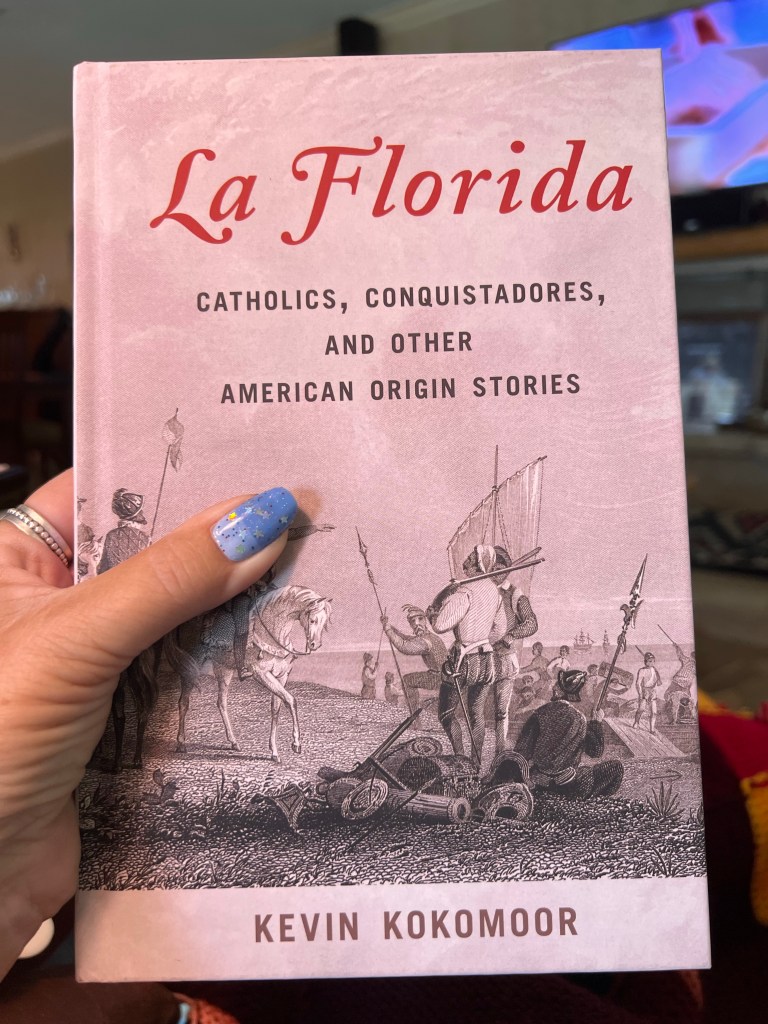
I actually read a book over my time in Myrtle Beach. Impressive! I have been so overwhelmed with magazines (which I read, not just look at pictures) that I haven’t been finishing books lately. The book I read was La Florida: Catholics, Conquistadores, and Other American Origin Stories, by Kevin Kokomoo (2023). It’s not actually published yet, so I was happy to get a copy from Kevin.
I blocked Hernando de Soto’s head. I’m not a fan.
Kevin teaches at Coastal Carolina University, where he focuses on the history of Florida and the rest of the southeast. We bonded last year when I found out he knew the story of when my mother’s family showed up in Florida and that we had lots of fun Florida stories from our youth. That Ocean Enclave place hires the most intelligent and interesting bartenders!
Since I had a lot of alone time while I was in Myrtle Beach, it was easy to get through La Florida, especially since I enjoyed its mix of academic rigor with humor and a bit of conjecture thrown in to bring the history of Spanish Florida (which was much bigger than the state) to life.
You must have a pretty strong stomach to get through the uncensored accounts of what the Spanish explorers did on behalf of their King and church. It’s incredibly violent, though it’s sorta fun to see how those “valiant” conquistadors ended up dying pretty miserably as they wandered cluelessly through the South. Florida was a lot harder to conquer than some other parts of the “New World” were.
Being mean to a French guy. Don’t worry, French guys were also religious fanatics.
It’s easy to reach the obvious conclusion that the more things change the more they stay the same after reading La Florida. Kevin’s chapter on the influence of the Catholic Church on the actions of the Spanish in Florida both horrified me and didn’t surprise me. In a nutshell, the violence against the early residents of Florida was justified because they didn’t accept the Church the moment they were presented with the opportunity to do so. How did they get this opportunity? Well, priests read them an announcement of the requirements for peace, which might have had a better chance of coming across if they hadn’t read the announcement in Latin. Once they determined native folks weren’t Catholic, then they were no longer people, and slaughter was just fine.
I pity the poor Mississippian culture. If all the slaughter wasn’t bad enough, of course the Spanish left lots of diseases to which they lacked immunity. Good times? Nope. (They disappeared, leaving holes for many other tribes to fill—the parts of the book on these groups, especially the Seminoles, filled in a lot of gaps in my knowledge.)
And it wasn’t just various native groups that were slaughtered because they weren’t Catholic, there were fellow Europeans who had the nerve to be Huguenots, who also were deemed to be not human, thus killable if they dared show up and try to bother poor old St. Augustine (what a non-success story that was, but at least it lasted). There were so many wars and invasions and burnings to the ground!
Slavery was another huge part of early Florida history, and I enjoyed learning about enterprising slaves who made big contributions to Florida history. I think slaves fared better because they figured out that getting married and doing other Catholic things got them slightly better treatment. Of course, it wasn’t all that great. No one seemed to have a lot of fun in La Florida. I guess maybe things got better after England took over and the rest of Mom’s family showed up.
In among the descriptions of plunderings, diseases, starvation, and slavery, there are interesting tidbits about how Florida got to be the way it is, such as how citrus fruits showed up, and the history of barbecue (spoiler alert: fish were the first meats to be cooked this way).
So, what are my opinions? I really enjoyed the book, other than coming to the depressing realization that the way people in the US are treating each other today by dehumanizing them isn’t much different from people’s beliefs 600 years ago. If you are from Florida or are a fan of American history, I’d highly recommend it, because it’s a point of view you don’t get in traditional Anglo-focused US history books.
Those Spanish dudes searching for gold and other riches (sigh, they “only” found tons of pearls) were the first people starting European settlements and their efforts deserve more focus. Thanks to Kevin Kokomoor for bringing this history to light!
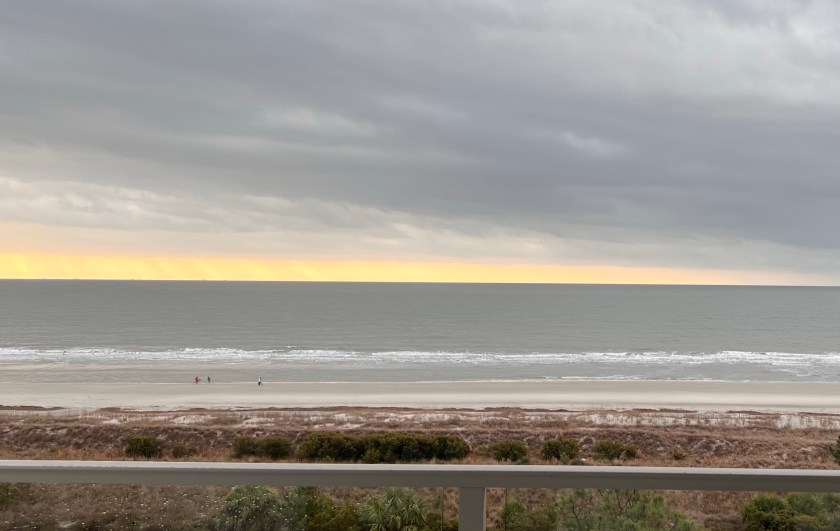
I may have done less today than I have any day since visiting my dad and just sitting around with him. I got enough movement in, but barely. Every time I went to go outside, a band of showers passed through, but that’s okay, because the clouds were pretty. I’ll miss beach clouds.
Looking north
Luckily, I got on a roll with the ole technical writing, so I got a lot done as I looked outside at rain. I enjoy those breaks I take to help with eye strain. I looked up one and there, practically motionless outside my window was a beautiful osprey. I guess it was the same one I saw before, but it was so close I could see its feathers.
Looking east. No osprey picture available since I was working.
I had plans to go see the Barbie movie, but we are now going tomorrow, since tickets are half off. That sounds good to me, so instead I finished last night’s movie and watched two more.
Me all night.
My “cinema” friends like Anita will probably enjoy picking out themes and cinematic techniques in the documentary I watched about two women who fell in love in a concentration camp and found each other afterwards. Nelly and Nadine (also the film’s name) were very interesting women, and the super 8 home movies they made showed glimpses of a 50s gay and lesbian world few knew about. I was proud that I made it through the concentration camp parts.
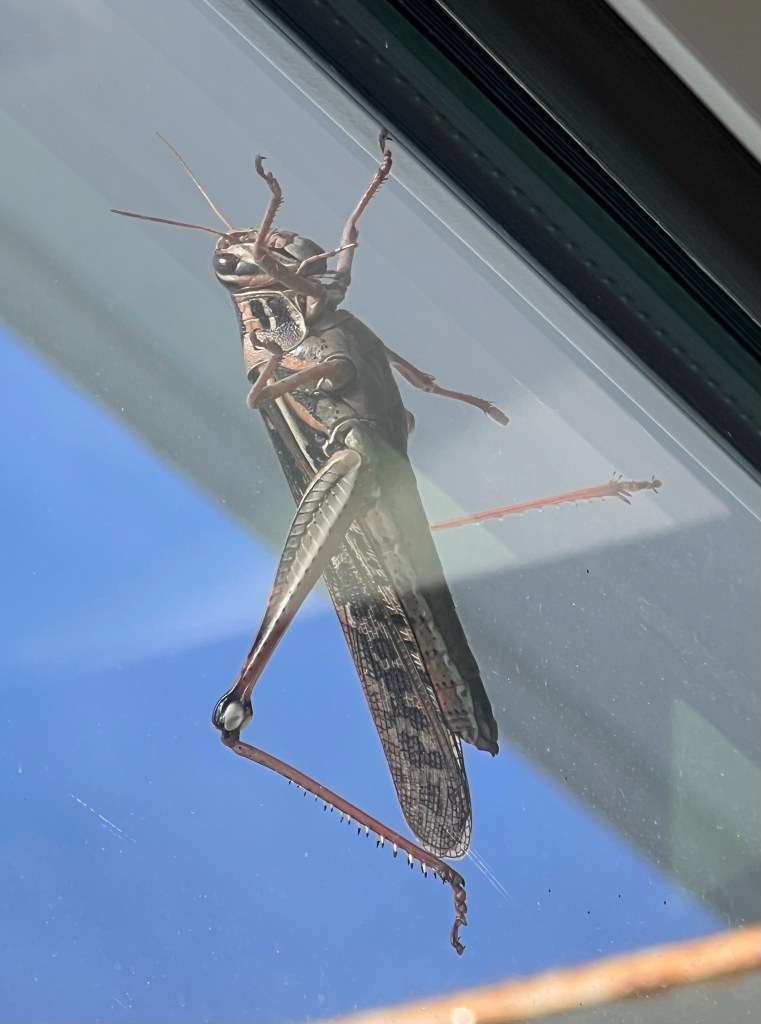
I promised creatures of the sky. Here’s a 27th floor bird grasshopper.
I then switched gears and saw Are You There, God? It’s Me, Margaret, which was as good as I’d hoped it would be. The movie was set at very close to the time I was Margaret’s age, so everything was eerily familiar. The sets were 70s fun.
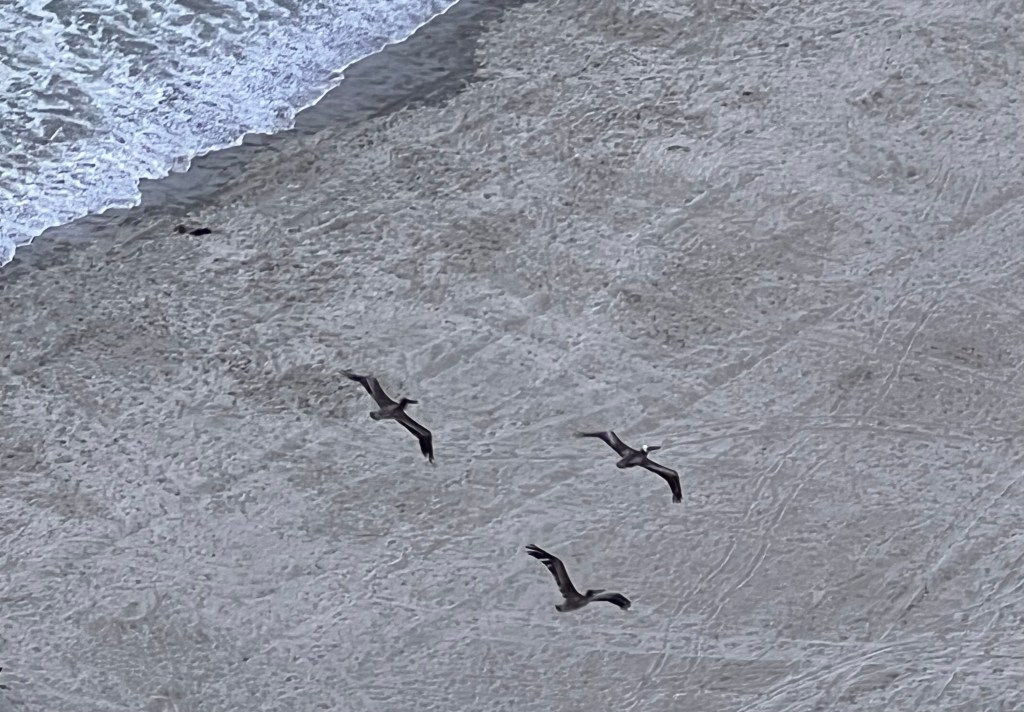
And here are low-flying brown pelicans
I couldn’t find the other movie I was looking for, so I watched Somewhere in Queens. The New York Italian culture is like visiting a foreign land to me, but I enjoyed glimpsing into Ray Romano’s vision.
These guys enjoyed peanuts again. I had three at once.
I guess I’ve gotten enough out of Amazon Prime on this trip. I wish I could use it more at home. Bandwidth. Ugh.
By the way, I haven’t been eating out. I’ve made myself weird dinners out of the supplies Lee and I bought when we got here. I’d sure be cheap to feed if I lived alone, since in addition to cheese, I could live off Tasty Bite curry packages, rice side dishes with vegetables thrown in, hummus, and Progresso soup. Throw in cans of tuna and I’m set.
More than you wanted to know, but it was a slow Suna news day.
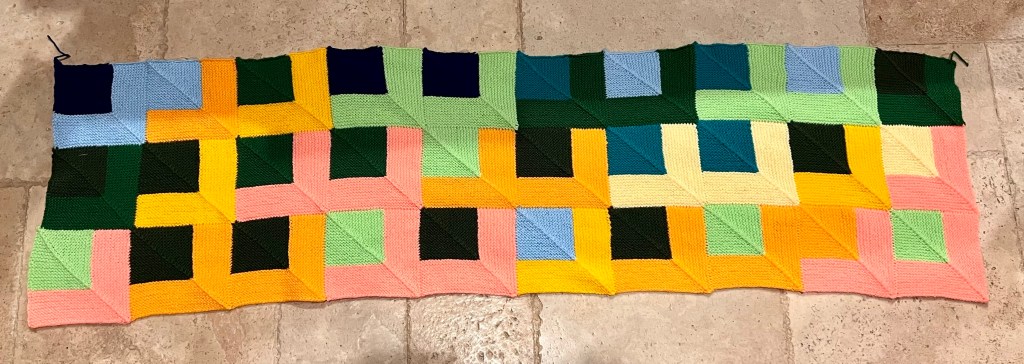
I ordered more yarn for the popular colors in my temperature blanket, and while on the Knitpick website I saw two books that looked interesting. First, let’s see how the blanket is coming along.
Third row, finished March 13
You can definitely see that the third part of January cooled off. The dark blue where it’s 30-35 degrees showed up and there’s even an all-blue day at the end (by the way, the dark blue is way prettier in person than in the photos where dark blue and green look black).
Better view of Celestial Blue First two rows of the blanket. Finished March 4.
The first twenty days were pretty warm, into the 70s (bright yellow and the lightest yellow). It’s going to look interesting as time goes on. Next row will go into February. I decided to make the square between months solid black at first. But now I think I’ll make it’s center the most popular temperature range of the previous month. That’s Alfalfa, the light green that represents 55-60°.
Books
So the books I got were mostly motif based. The first one is Colour Crochet Unlocked, by Jane Howorth and Dawn Curran (2023). As the title implies, it’s British. Luckily, I can translate their stitch names into American.
The cover shows projects, which are quite nice, but the part I liked best were all the interesting and not-too-hard motifs the authors share.
The back of the book. Look at those ideas!
I kept coming up with things to make with each new pattern. This book is worth owning, plus it was on sale at KnitPicks. The only part I didn’t like was the long discussion of color theory. That’s because I’ve read so many of those in various books. It’s fine for a beginner though, and quite clear.
If you need inspiration for blankets, pillows, and such, this will be a fantastic reference book. They do have garments in the pattern collection, but I like the home decor options.
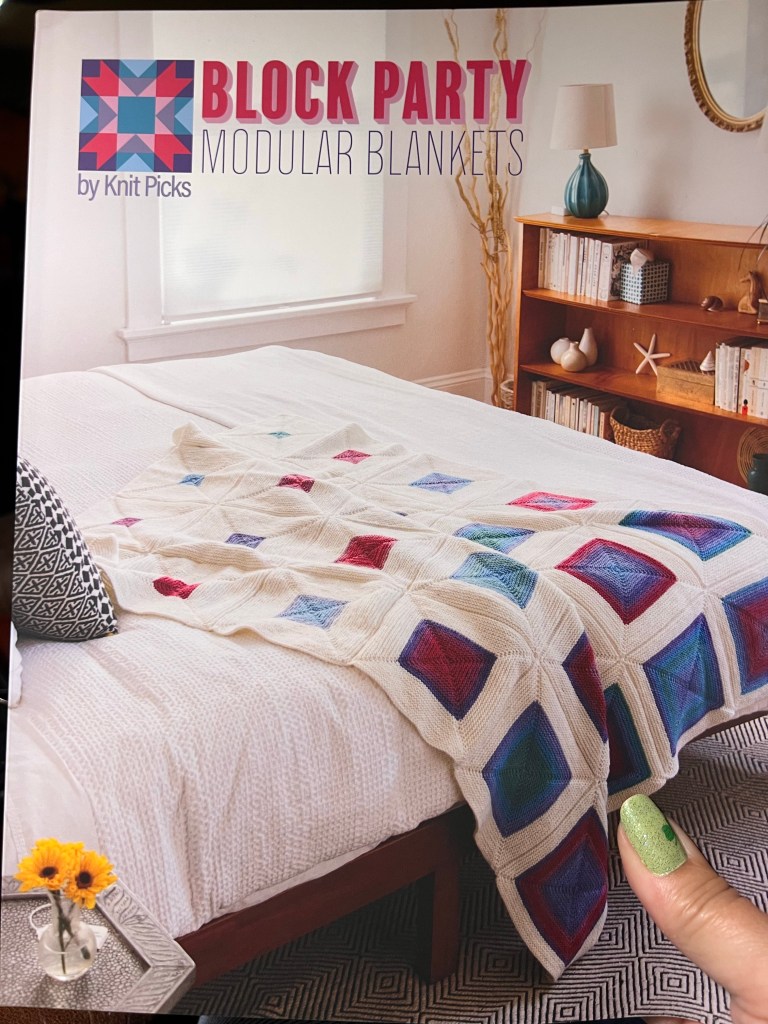
The second book is from KnitPicks, Block Party: Modular Blankets (2020). You can probably guess why I got this one. I do love modular projects. Yum. The cover drew me right in.
That’s a cute blanket
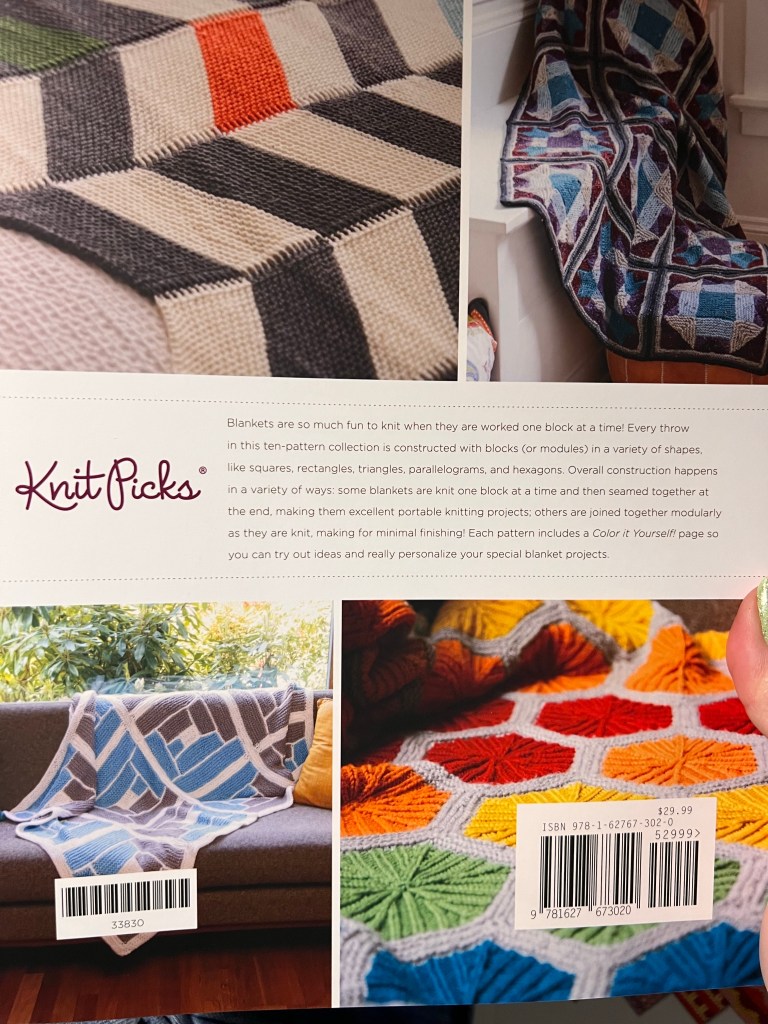
There are only ten projects in this one (all knitted), but it was inexpensive. I think there was only one pattern I wasn’t interested in making, but I think I might even like it done in other colors (it was solid gray). The book is thicker than you’d think, though, because there are many, many photos of each one, including extreme closeups. I enjoyed looking at them, but if you just want patterns, it’s sort of overkill.
Back of book with more projects.
I will certainly find my next project in one of these books!
By the way, I’ve had a really good blog week. Yesterday was by far my most popular single day on this blog. Thank you all for the stories you shared about your family’s naming traditions both here and on Facebook. It was nice to write something cheerful that was popular, for once. So, here are flowers to thank you all.
Pink evening primrose Future thistle Bonus buckeye butterfly Prettiest Indian blanket Delicate dewberry Good ole bluebonnet Stork’s billRagwort
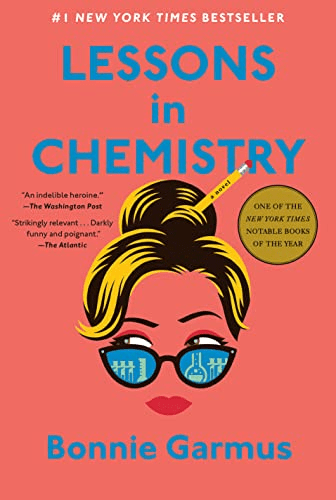
This is the book everyone seems to be reading. I wish I’d loved it more than I do, but I don’t. Lessons in Chemistry, by Bonnie Garmus (2022) is full of varied characters and has great intentions. Garmus obviously put in a lot of work learning facts that make the novel seem realistic to fans of chemistry, cooking, live television, and rowing (yes, there’s a rowing subplot). I just wish she’d taken a little more time to not have every single character by a caricature of themselves and their role in society.
I have to salute any book that makes a big deal about the lack of opportunities for advancement for women in the last 1950s and early 1960s. So, hooray for that. This book makes no bones about it, smart women got a raw deal back then. But did every patriarchal and misogynist character HAVE to spew forth such predictable things? And why does every book-smart person have to be socially inept?
It got to be every time a new man showed up, I just waited for him to put the main character down, lie to get their own way, or try to assault some woman or another. And the female characters are no better. They are portrayed as gossips, nags, women in unhappy relationships, and whatever other sixties stereotype you can come up with. I’m giving myself the impression that I don’t really like anyone in the book, and that actually may be true. They just aren’t very nuanced. I was fond of the minister who was the protagonist’s genius husband’s old pen pal, though. He was thoughtful and kind AND didn’t end up marrying the heroine. There, one cliche avoided.
Sadly, I also guessed all the plot twists before they happened, as well. You can’t love them all.
But if you are a major fan of speeches about the inequality of women, like to talk about food in terms of its chemistry (I liked that part), socially inept geniuses of all ages, or rowing, you might enjoy this more than I did. I was pleased to not see any typos, too.
It’s a good thing I have a book report for you today, because I wasn’t in a good mood and was pretty down. But forget about that! Let’s talk about my most recent book, The LEGO Story: How a Little Toy Sparked the World’s Imagination, by Jens Andersen (2022). The translator was great, too (it was originally in Danish, as are all things LEGO).
This book is both a book about how a business was born and nurtured and a story of a family and their relationships with each other. The same family has run the company that makes LEGO for five generations, which is pretty impressive.
The Christiansen or Kristiansen family (they spelled it different ways) seem to all have had a creative genius to them. I enjoyed reading about Ole Kirk Christiansen, who founded the company that made innovative wooden toys, to Gotfred Kirk Christiansen, his son who grew the plastic bricks we’ve come to know and love, to Kjeld Kirk Kristiansen, and on to Thomas Kirk Kristiansen, who is apparently still in charge.
One of the themes of the book is the strong Christian faith of the family (ironic, given their name). They were members of a group of Danish Christians who stuck together and from what I can tell were darned cheerful and practical. Ole Kirk got through THREE fires that burned down his factory and many other challenges by just declaring he’d be fine, because the Lord would provide. I’m sure hard work and perseverance had a little to do with it, too.
That Ole Kirk was both talented and resilient. He had a vision of what LEGO could be and nothing was going to stop him! He, and his son and grandson, are examples we can all follow, in that they were willing to try new things and if they failed, regroup and use what they learned to try again. As well as LEGO has done in the long run, they had some big failures and challenges. Interestingly, they kept their headquarters in Billung, Denmark and are still there today. That’s consistent.
It is a lot of fun to see how the LEGO brick concept grew and changed. The key was putting those circular tubes on the bottom that hold them together. Before that, you could stack them, but they couldn’t be picked up. Genius. Another genius idea was the LEGO figures of people. They were so carefully designed to be able to move and to be very versatile.
The final things I got out of the LEGO story were a lot of ideas about business management practices and philosophy. They tried many different techniques from very lax to top-down management, to a blend. No matter what they did, though, they respected their workers and encouraged their creativity.
The company philosophy has also been laser focused on the needs of children to play and learn. Even when they made all those commercial connections to Star Wars, Harry Potter and all that, LEGO philosophy never wavered and still hasn’t. That makes me feel good about the hours and hours my brother and I spent building towns from our bricks, and all the things my own kids built.
Just as much as I enjoyed the positive aspects of the company and the family who runs it, I enjoyed learning about their disagreements and squabbles, because they also learned a lot from that and ended up creating a company and subsidiaries that respected their individual needs and talents. As a member of a family-run company, I got a lot out of how they divided responsibilities and shares. They were kind, fair, and good to each other, even when they disagreed.
This isn’t the usual kind of book I read, but I sure learned a lot and I must have liked it, because I keep telling poor Lee about it. Now, go introduce your children and grandchildren to LEGO blocks!
Whew, did it rain a lot for the past few days. There’s not much a person with no car can do in a downpour, so I did the thing I’d say I’d do and found myself a plan B. I had Wi-Fi, and the condo place had a DVD rental station, so I’ve taken a few days to be introspective and do something I rarely do: watch a lot of movies.
That puddle had dried up, but not any more!
Why, you ask, don’t I watch a lot of movies very often? Well, this goes back a long way, maybe 50 years or so, when I fell hard for my high-school crush (also my college and most of grad school crush). He was laser-focused on cinema studies, even in high school. He was going to follow in the footsteps of his older brother, who majored in filmmaking at USC. But he wanted to write.
Have some warm beverage while I ramble.
I, too, wanted to write, though I really didn’t care about what. Combine that with friends like Anita, who was also a writer type, and you can imagine how creative and eloquent the notes we passed around in school were. They were also very funny, since we also had cartooning skills in the mix.
Anyway, I figured the way into that guy’s heart was to love what he loved, so I watched lots and lots of movies. When we started dating, pretty much all we did was go to movies. No, not to do a lot of smooching, but to watch and analyze those films. We were fans of ci-ne-ma. You didn’t just go to a movie and enjoy it. Au contraire, you had to analyze the themes, dissect the camera angles, and make sure to note any editing flaws or continuity issues. This was serious business.
For those of you who are bored by my reminiscing, look at this cloud beauty.
It didn’t get any less serious throughout college. He majored in English, with a concentration in cinema studies, and I majored in linguistics with concentrations in cinema and Japanese. Japanese cinema, that was my ticket to academic glory, apparently.
Well, by the time I got partway through my dissertation, which happened to use Japanese movies as its data source, and that relationship ended when I realized I was trying way too hard to mold my life after whatever that other person wanted, leading to regrettable rebellions…let’s just say I was done with the ci-ne-ma. I was over the dolly shots and the search for Marxist themes in every film (to this day, I could not tell you one thing about Marxism, even though I had a child who followed the same philosophical path).
It did finally get more sunny later today.
Sadly, I also could not watch a movie without analyzing it. I’d see one thing that triggered my urge to analyze and I could no longer just be moved by immersing myself into the world of the film. That was not fun. So, I really don’t enjoy movies much anymore, especially old ones where I feel compelled to compare each film to its director’s “ouvre.” Poor Anita. She just wanted to watch Turner Classic Movies and I couldn’t look. High School Boyfriend had not ruined her ability to do ci-ne-ma.
Sun!
Back to today, I guess all that introspection and shedding of old traumas has gotten me past some of my issues. I do better now, and try to watch movies with Lee. I’m just not good with horror and overly realistic violence, which cuts out a lot of the current movies out there.
Here, alone in my little space, I went out and rented every single rom-com, comedy, and wimpy family movie I could, and I watched them. I let myself get immersed in the story, the music, and the visuals and just had fun. What a gift to myself! I do have a couple of comments on some of the films I watched, though, in case you’re considering any of my wimpy choices:
Jerry and Marge Go Large: I’m not sure if I mentioned this one before, but it’s a lot of fun and based on a true story about people who figured out a lottery loophole. Any story featuring real-life mathematical geniuses and genuinely likable secondary characters is okay with me. ****
Addams Family 2: The animation was great, and the attention to detail in the scenery was wonderful. But that was one predictable plot. **
Jungle Cruise: I had low hopes for a movie based on a theme park ride, but I ended up enjoying all the references to the ride and the cheerfully campy plot. The stunts were fun, too, and it was nice to see the female lead portrayed as competent at jungle skills. The gay brother character was fun, too, as he reminded me of many people I know AND was a badass. This one’s worth watching if you want to just relax and watch something. ***
Elvis: GEEZ the guy who played Elvis nailed it. I love how this movie was made and edited (sorry, getting ci-ne-ma on you), and the soundtrack that mixed music from all eras was inspired. You literally see and hear the history of music since the 1950s in this one. Tom Hanks was creepy, though, as Col. Parker. But the rest of the cast, including the portrayals of influential black musicians, was inspired. The Little Richard guy was riveting. ****
The Lost City: This was way better than I thought it would be from the previews. It’s pretty similar to Jungle Cruise, so don’t watch them together. But this one’s one-liners were way more clever, and I found myself chuckling aloud at some of the asides. Sandra Bullock sure can do comedy. I had a blast watching this. *****
Marry Me: I watched this one with Lee, but I just wanted to say this was charming, sweet, and a perfect rom-com. *****
The Good House: Here’s when I ran out of big hits to watch. This one has nice actors and beautiful scenery, but the plot is a heavy-handed tale of a woman who’s an alcoholic and keeps reciting all the typical thing alcoholics tell themselves. It came out well-intentioned but a bit preachy. Kudos for showing realistic sex between older people. ** 1/2
Walking with Herb: This was literally the last film I could get that wasn’t a cartoon or part of a series I wasn’t interested in. Highlights of this one are the great scenery of Las Cruces and Palm Springs and the golf humor. I like golf humor, which is good, because it balances out the Christianity theme (as a non-Christian, I had to suspend my beliefs). Well, it was a sweetly Christian theme, and it was nice to see the Latino lead characters in a mainstream film. I did tear up at some points, so hey, it was okay. ***
I talked about King Richard, the film about Serena and Venus Williams’s dad in an earlier blog. But, I liked it a lot. ****
My solo time is coming to an end, though, because I’ve got my owl necklace (it’s a Superb Owl) on and plan to go watch the Superbowl with other folks at the little cabana bar downstairs. Then, if I can find transportation, I will head home tomorrow. All cabs are booked. Great. Uber is NOT cheap in advance, so I’m hoping tomorrow morning it will be better.
One of the main things I’ve been doing while in Hilton Head is read. My crochet project really isn’t working out. I think I’ll try it with different yarn and do something else with the yarn I started on. Anyway, I just read The Dictionary of Lost Words(2022), by Pip Williams, an Australian novelist.
I was probably doomed to love this book, because it’s about words and touches on topics I’m fond of, like women’s rights. Of course, it would need to be written well, and for sure, this book had some beautiful writing. My friend who had already read this book got a look on her face like bliss when she described how much she enjoyed Pip Williams’s writing.
One of my favorite aspects of the book is that, while it’s fiction, its plot is woven around real people and real events. The novel follows the progress of the Oxford English Dictionary‘s first edition and the dedicated lexicographers who put it together. What a monumental undertaking THAT was. I was fascinated to learn how Dr. Murray and his team compiled words and definitions. Ooh, so much intrigue went into all that editing and defining.
The most important thing that Williams does by sharing her writing with us, though, is highlight the contributions that women made to the dictionary, which (naturally) was overlooked at the time. She winds information about the state of women in the late 1800s and early 1900s, including how different the lives of women are from different social strata. I was impressed at how respectfully Williams treated women of all classes and brought them to life. I loved how the elderly former prostitute with a salty vocabulary is also depicted as a skilled woodcarver who is wise in ways that are helpful to the protagonist, Esme.
Esme isn’t real, but her story resonates with anyone who’s led a life as a woman today. I could easily see myself dealing with the problems and dilemmas Esme faces, as well as how she learns about life, love, and death. Williams doesn’t sugarcoat the hardships women endured in the days before women had the right to vote, to contribute to work, even to be a “scholar.”
Sadly, I see some of the issues the women in The Dictionary of Lost words face are still facing so many women today. As we lose our reproductive rights, we need women like the former prostitute, for example. The societal information about how life was during my grandmother’s youth was sobering, but the ways that women worked to contribute to society and make things better ring true today.
And as for the words, oh, it was my idea of a good time to see how Esme collected women’s and common people’s words, the ones that were deemed too coarse for the OED. She was a linguist after my own heart (I did research on the language of Japanese women when I was an academic).
This book makes you wish it would never end, because you end up very fond of the people you meet there, like Lizzie the servant who Esme relies on her whole life, or Ditte, the aristocratic academic who contributes hundreds of definitions to the dictionary (she was a real person). And yes, the men in the book were also well rounded and enjoyable to read about.
I read this in the Kindle app and finished on my new Kindle Scribe e-reader, which I’ll review after I’ve used it more. It takes a while to get used to this way of reading, that’s for sure. And setting up the new device at the hotel was challenging. But, I enjoy the size, quietness (I hate phone noise and computer fans), and lack of reflections in the Kindle. It’s much easier to carry around than books. Don’t get me wrong. I like books. No, I love books. But at my age, I’ve pretty much filled up my house with books. I’m hoping to be able to upload my knitting PDFs to the Kindle and mark where I am on them. That would be oh so great.
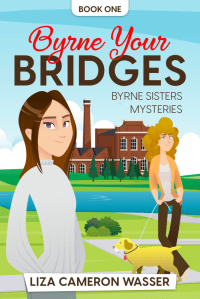
Oh look, a book report! Since it’s been foggy for two days, I’ve been reading books on my beach trip. The first one is Byrne Your Bridges, by my friend, Liza Cameron Wasser, who lives in Germany. That explains the .de extension on her website, which is where you can buy this book if you would also like to read it.
Liza’s been writing ever since I’ve known her (which is since my children, who are well into adulthood, were small; we met on an email list for feminist mothers who were at home with their children, which is still going strong through all our lives’ ups and downs). I’m very happy Liza took the plunge and sent her first novel in the Byrne Sisters Mysteries series out into the world!
There’s lots to love in this book. Liza is really good with character development and dialogue. There are some funny lines you’ll enjoy, which sure sound like Liza’s clever sense of humor. You’ll get to be fond of the two sisters who are the “detectives” in the series. You will also get hungry while reading it, because nearly every scene includes cooking or eating something prepared by vegetarian chef Maggie.
There’s also an incredible amount of coffee preparation and drinking. One of my minor issues with Byrne Your Bridges is that people drink so much coffee late in the day that I wonder how they EVER get any sleep. Of course, though, Liza slips in ways to flavor your coffee with spices. Tricky. I do think they could have switched to herbal tea or something in the evenings!
The mystery part of the book was enjoyable, and if you’re a fan of mysteries, I predict you’ll want to read this and grab the future installments as well. All the characters are fun, too.
Bonus! At the end of the book, you will be happy to find the recipes for all the things Maggie Byrne cooks during the process of solving the mystery. And I assure you, Liza is a great cook and a fine recipe writer (that’s as much of an art as writing novels).
Editorial Notes
You know, I’m an editor. That’s one reason I don’t usually read things written by my friends and family. Little things irritate me. I’m happy to say that, other than all the coffee, there wasn’t much to complain about in this novel, even for me! Here are a few notes, more to show how I think than to criticize the book.
There is a distinct lack of typos. Liza had lots of pre-readers and it shows. There were no distracting issues with this one. Kudos!
I found one distinctive phrase that repeated. All writers have pet phrases that they like to use (me included, as any reader will agree). In this book, people shrug off their coats twice. Shrugging off is a cool phrase, but it’s so distinctive that I noticed it appearing twice. Maybe the second time, the person can shake it off, slide out of it, hang it on a chair…I don’t know, I’m NOT a novelist.
I noticed that the characters seem to all have magical ways of obtaining money that lets them live lives of leisure. Maggie got a ton of money in her divorce, the lady across the street can afford someone to care for her household so all the has to do is play with her kids (wish I’d had that), etc. The ones who do work have inherited money or businesses or something. The book needs more poor people (OK, the dead person was deep in debt, though). Maybe that’s just how it is on the east coast.
The writing is exactly what I like. There are occasional clever turns of phrase, but there isn’t so much descriptive exposition that I get bored, and there aren’t zillions of distracting details. I do like writing that just tells you enough to keep you interested.
I encourage you to get this book, which is reasonably priced and lots of fun. It’s digital only, but since most people seem to read on their computers, e-readers, or tablets, this should not be a problem. I’m staring at screens so much during the day that I enjoy reading physical books and magazines, but I think I’m a minority.