Doug Tallamy: Incredibly Inspiring

Wow. Just wow. My life is now so much better, having heard the amazing Doug Tallamy speak at the Texas Master Naturalist meeting. He’s just about as inspirational as a speaker gets, and I now have my answer when people ask what famous person I’d most like to have dinner with. I could talk to him for hours, or more likely, listen.

I recently read and reviewed his book, Nature’s Best Hope, and once again I must encourage everyone to read it. It’s one of the few books I’ve read lately that made me feel empowered to go out and actually make the world a better place, right on my own property.

Listening to him speak to us, sounding just like some nice guy you’d talk to at your meeting, but with an amazing wealthy of information, was a mind-blowing experience. And the information he shared about how he and his wife turned their property into a place that is both beautiful AND attractive for natives was nothing short of inspirational.

Tallamy reminded me WHY I don’t want all the land around the ranch scalped into a beautiful monoculture lawn and why I ask that the wildflowers be allowed to grow, bloom, and seed each spring. They support so much of the diversity of animals and insects that we are rapidly losing.

When he shared how many different moths grow on the goldenrod on his Pennsylvania property, my heart swelled, since you may recall just yesterday I wrote about how much I saw growing on goldenrod plants (and I skipped a wasp that I couldn’t get a clear photo of). I feel like at least some parts of our ranch are helping the earth heal itself, while still providing food for people. I think it’s a win-win.

He provided lots of useful links, but I was too enthralled to take many screenshots. But here’s something you might be interested in, which is the keystone species that support the most insects, birds, etc.

The Hermits’ Rest has lots of these! Just not many maples.

I’m not going to write down everything Tallamy said, but I hope you will go to his website to learn more. There’s TONS of fascinating stuff there. This one point he makes sums it up for me:

From the Bringing Nature Home website

We ARE part of nature and need to live with it, wherever we are. I’m going to hold that in my heart and work as hard as I can to help Professor Tallamy achieve his goals.

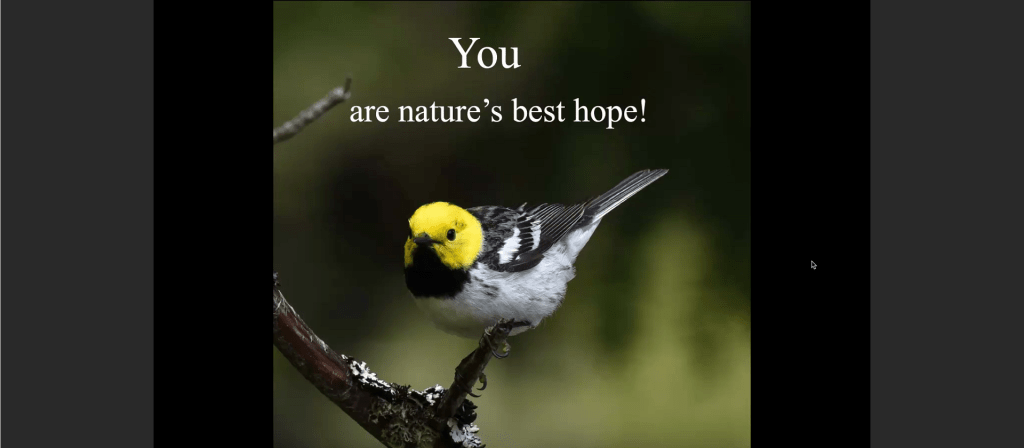
His final slide.

I encourage those of you who want a better world for the children who are around today to read his books and take action. It’s awfully easy to plant some native plants. Many of them just show up, after all (“weeds”). And as soon as you have them, insects will follow.

Even if all you have is a balcony or some space outside your office, you can make the world a better place. Now, that’s awesome.

Books I Will Never Read Again

Are there any books, movies, or other media that you made it through once but just NEVER want to go through again? Last night my sister asked me about the handmaid costume she saw somewhere. I told her about The Handmaid’s Tale book, and that it had been made into a series. I read the book when I was in graduate school, and probably lost a lot of popularity as a professor by making a class full of engineering students read it and write a report.

Protesting handmaiden. Image by @straubmuller via Twenty20.

But right now, I could not stomach that book, nor could I bring myself to watch the Hulu Series. It seemed eerily possible in the 1980s, and today I could see women becoming property again, just like in the book. Shudder. I have had many nightmares brought on the The Handmaid’s Tale.

Please. Image by @jenni.heller via Twenty20.

In fact, many of the books I don’t think I could take reading again are in a similar vein. You are NOT going to see me cracking open 1984 or Fahrenheit 451 any time soon, either. I think those books have already come true, and not in a good way. Yeah, the whole dystopian novel genre isn’t good for me.

Neither are books or movies about Nazi Germany. No, thank you. A couple of movies in that genre have scarred me for life, including Julia (a beautiful film, but gave me bad dreams) and Seven Beauties (eww, ick, yuck, don’t watch it). I realize now that I watched way too many of these really sad movies during my most impressionable late teen years. I STILL have Apocalypse Now nightmares, too. I wonder if High School Boyfriend knew what a pacifist he was creating by taking me to all these violent and psychologically terrifying movies?

As I have mentioned before, I’m one of them there Highly Sensitive People, which means media violence and cruelty really get to me (as well as teasing, bullying, name-calling and putdowns). I pay attention to violence warnings on books and movies for good reason!

Oh and for goodness sake, I don’t want to ever see that damned Red Pony book again (curse you, Steinbeck, and curse you, school librarian who gave it to me to read in the THIRD GRADE). Graphic descriptions of the deaths of beloved pets, innocent wild animals, and other harmless creatures aren’t for me, either. I managed to get through that book about the dog that keeps dying over and over (The Art of Racing in the Rain), because I knew all would end well (and I didn’t want to look like a wimp in front of book club).

Oddly enough, I can watch Dr. Pimple popper and shows about surgery just fine. I just don’t like violence and loss.

What are your topics you just don’t want to read about or watch these days? (I realize for many of you it may be politics, but I’m not here to encourage bashing of anyone’s views, just wondering what turns you off.)

Book Report: The Trouble with Goats and Sheep

Rating: 3 out of 5.

The book I’m talking about today is next month’s topic for the cul-de-sac book club in Austin. The Trouble with Goats and Sheep was Joanna Cannon’s first novel, which came out in 2015. Since I wasn’t reading novels five years ago, I’d never heard of it, but dutifully ordered it when it was decided upon by the group.

I even read a paperback. Wow!

I got it on Monday, and finished it last night. It was a nice respite from the more solemn reading I’ve been doing lately, but it doesn’t mean that Cannon didn’t sneak in some messages, some of which are quite current today.

I’d say almost anyone would enjoy reading this, though it helps a LOT to be familiar with the everyday items in England in 1976. I know what Fairy Liquid is, thanks to spending so much time in Ireland, but do you? (It’s dish washing soap.) And candies are very important, at least to the main characters, so it would help to Google those as they come up.

The fun thing about the book is that it’s about a cul-de-sac and the varied characters who inhabit it, which of course reminds me and my neighbors of OUR little Bob Cat Run, with its fascinating cast of characters. We will have to decide who is the “Walter Bishop” of our street (he’s the one everyone has a bad opinion of). Oh wait, I think I already know, ha ha. It’s not me or Anita, either!

Much of the story revolves around two young girls who are best friends, Grace and Tilly. They are the junior detectives in the mystery aspect of the book, who, after one neighbor disappears suddenly, decide to find God in the neighborhood. Eventually Jesus shows up, which is a fun twist (I won’t tell you how that happens). All the neighbors get their chance to shine, too, and you eventually learn all their secrets. That’s the fun of the book.

You’ll love the woman who wears a bikini and tans in her front garden every day, the couple with the very nervous wife, Grace’s parents (and her very odd mother), the guy who lives with his elderly mother well into his forties, the friendly widow, the refreshingly rational gardening guy, the exotic new family, etc.

What really makes the book special, though, is how gently Cannon weaves lessons about honesty and lies, ignorance and enlightenment, and most important to me, about how each and every one of us has secrets we think will be ruinous if revealed, but are probably worse being hidden. It’s a fun read with interesting characters, but it also makes you think about morality and judgment. That’s what elevates The Trouble with Goats and Sheep from a pleasant escape to a book that will live with me for a long time.

By the way, it’s also really funny. I had to read passages aloud to Lee. I think I laughed the hardest when Grace’s father tries to convince the new neighbor he’s a worldly, tolerant guy by repeating racist stereotype after racist stereotype. I was happy to see the two of them actually ending up talking to each other from the heart and becoming friends. That’s what we all need to do when confronted with “the other,” I think.

I have a nice stack of books on my shelf, so I’ll start another one while patiently reading a chapter a day in Caste.

Book Report: The Overstory

Rating: 5 out of 5.

If you know me or have read this blog a few times, you won’t be surprised to learn this, but I’ve always been a tree hugger, and I mean always. My poor mother (happy birthday wherever your spirit is) used to find me as a toddler wandering around the yard talking to the huge oak trees on our property. When I moved away, I mourned the loss of my tree friends around the town, and even now, when I go back I make sure to check in and see who’s still around and who’s gone.

That may explain why I have been reading so many books about trees, forests, and how they work for the past few years. It may explain why I became a Master Naturalist. It certainly explains why I have a hard time with cutting down trees for human convenience, though I am trying my best to be cooperative with other folks’ agendas in that respect. It explains why I bought the parts of the Hermits’ Rest ranch that I did – there were lots of trees, not a monoculture of non-native grass. I was born an annoying hippie tree hugger!

Of course you use your Sierra Club bookmark on the tree book.

So, then, why did I wait so long to read The Overstory, by Richard Powers? It won a Pulitzer Prize last year and everything! And it’s about trees! Anita and I both ordered it this time last year and planned to read it, so I had good intentions.

But, the first chapter was so sad it made me cry. And the second chapter had nothing to do with the first chapter, so I got confused, put the book down, and read all those other things I keep writing about (of interest to no one but me).

I ran out of books I hadn’t read last week (at least ones I could easily locate). I gritted my teeth and picked up The Overstory again. This time I looked at the table of contents, which was quite helpful. There, I saw that the first chapters were all about different people. I figured I’d just need to hold my horses through those first chapters and it would all come together in the gigantic middle section. Spoiler: it does.

Table of contents that makes reading the book easier!

By the way, they aren’t kidding when they say this is the greatest novels ever written about trees and perhaps one of the greatest about anything. There’s nothing I like better than a complicated plot that weaves new knowledge and a much-needed perspective on how to change the world. No, make that a much-needed perspective ON the world, one I share.

That Richard Powers. When I was in grad school, he was already a legend, the topic of many a conversation in the English department. He left just a semester before I got there (I was in another department, but many of my friends were in the English department with my brilliant boyfriend). Probably because I got sick of hearing about him, I didn’t read his first book. I got bogged down in The Gold Bug Variations (about music and genetics) but should probably go back and find that one to read.

Because Powers is such a polymath and so incredibly gifted, he crams a lot into a book. It’s not one of those quick summer novel kind of things. It’s more of a book to read when you are all alone, overwhelmed by real life, trapped by a pandemic, surrounded by people who don’t want to talk most of the time. Hey, that’s ME! I was in the right situation to immerse myself into the interwoven plots, make it through the deep despair the novel can raise in a tree hugger, and come out of it with my personal beliefs validated.

I sort of needed “Do Not Disturb” signs when I was trying to finish The Overstory, because it came right when Lee was in one of his talkative moods. My sometimes elusive goal is to stop what I am doing when he starts talking, so I had to re-read a lot.

Maybe that was a good thing; maybe it drove the message home. I’m finding it very helpful and very comforting to take that message to heart. We are not in charge of the earth. There are other minds and other forces at work, ones our perception of time makes it hard to notice. I take comfort that no matter what crazy Armageddon humanity is hell-bent on driving itself toward, Gaia, the trees, and the deeper consciousness will heal and persevere. It gives me the grain of hope I need to keep a-going.

Anyway, yup, good book. Read it.

Book Review: Liberty

No, this isn’t a book about the second amendment to the US Constitution; it’s a book about Liberty DeVitto. Who’s that? He was Billy Joel’s drummer for the longest time (Billy Joel lyric humor, there). I always really admired the drumming in Billy Joel’s band, because there were always so many creative percussion techniques, but the drumming never stole the show–just drove the music.

I do like the cover!

Liberty: Life, Billy, and the Pursuit of Happiness, by Liberty DeVitto, did a great job answering my questions about the percussion in my favorite Billy Joel songs (admitting here that I got less and less fond of Mr. Joel as he sounded more and more like a lounge singer to me). My favorite part about this book was that he told the story about every single song on every album up until the time Billy dumped him from the band. But, that’s decades of albums! I got to found out who did the castanets on “Say Goodbye to Hollywood,” and other important (to me) musical nuggets. It’s a real musician’s book, for musicians, which makes sense, since it was published by a musical publisher (Hudson Music – I’ll talk about that later).

I’m glad I heard DeVitto talking about the book on NPR one afternoon, or I never would have bought it, or probably heard of it. I really learned a lot about how the generation just before mine grew up, and even got some insight into why some folks love New York. And, DeVitto is brutally honest about his upbringing, his own mistakes, and his very dark side. I’m glad he had drumming, or he probably wouldn’t have made it past his 20s.

He sure wasn’t very good to women through most of his life. He barely even gave women he was in relationships with names, and had a deep sexism and disrespect for women that turned me off a lot. The good news is that he grew, eventually, and thinks his current wife is actually a fellow human being worthy of respect, not an annoying object.

So, basically, he’s not a particularly likable guy, but he probably figured that out, himself. I do give him props for naming every single person he did music with, saying how they influenced him, and giving credit where it is due. Thank goodness he had nice things to say about Karen Carpenter and Ronnie Spector, even though they were women, or I’d have quit reading!

Enough about good ole Lib. Let’s talk about the book. Whoever designed it got a D+ at best in their book design class. More probably, they didn’t take one at all, and instead someone took a Microsoft Word file, added table of contents tags, and printed that mother out. They could at LEAST have turned on widow and orphan control, though. The headings at the bottoms of pages with no words under them, combined with the single lines at top and bottom of pages, made me shudder.

Also the fonts and tiny margins. Oy. They sure chose some inelegant fonts. I’ll spare you. And TYPOS. The name of a town in Italy is spelled two different ways on the same page. Pity a poor proofreader!

Leland, you took a great picture, and Mike, the cover is nice. Joe and Rick, don’t give up your day jobs.

I’m guessing that whoever printed the book charged by the page, because there is exactly ONE blank page in the book, other than the ends pieces, which are on thicker paper. That’s right. It just marches right along from title, to a quote, to copyright (on the wrong side of the page and where, OMG, people admitted to design and typography), to a dedication, to the table of contents (crammed onto one page with some crazy tabs), to acknowledgements, the foreword by Billy, to a prologue, and finally to the book. No blank pages to rest your eyes on here! Keep moving along, folks! The text is also crammed in, since it’s both justified and sans spacing between paragraphs. That makes it dense. Thank the Maker for the rather large asterisks that separate sections. Ahh, breathing room.

I did look up Hudson Music, and they are a company that specializes in drums and drumming. They have a biography series on great drummers, of which this is one. They probably do a way better job on music instruction and such, and I salute any publisher who supports musicians, no matter how critical I may get. Still…

…Okay, this was obviously a labor of love and as close to vanity press publishing as it can get, but I want to point out to any of you who want to be authors that making your book look like a professional book is important, at least to many of your potential readers. I don’t mean just publishing snobs, but people for whom reading a book is an aesthetic as well as intellectual experience. Take the time and effort to make the book look good and showcase your words well.

And Liberty, enjoy your happy ending. I’m glad you got to publish your book. You worked very hard on it, and it shows.

Book Report: Wonder

Rating: 4 out of 5.

Even though practically no one reads my book reviews, I have another one already. That’s what you get when you pick up a Young Adult selection; they go fast.

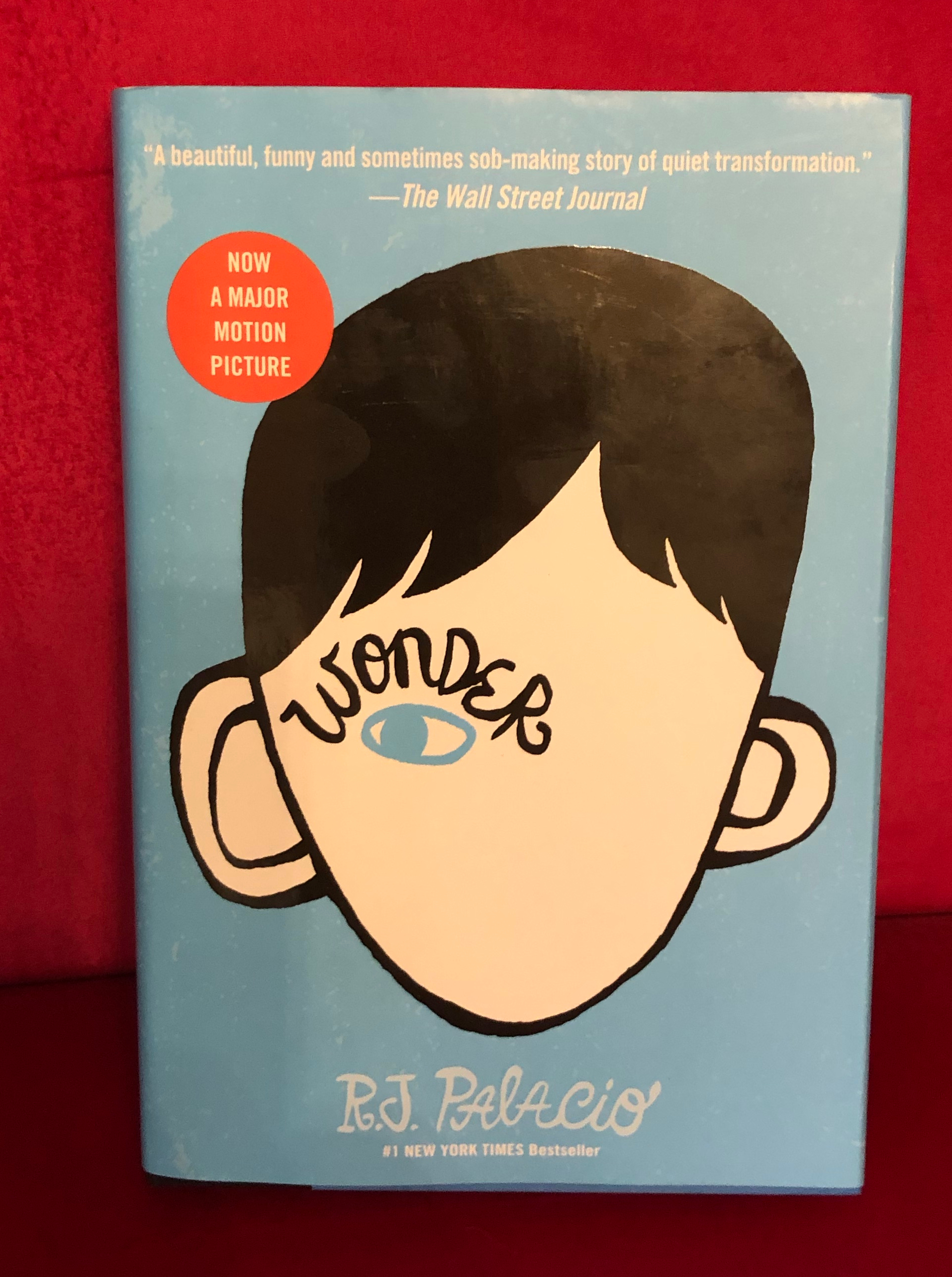
The Wall Street Journal is right! The cover does not lie.

Oddly enough, I am not sure where this book came from. Maybe someone loaned it to me? Maybe I bought it that last, wonderful time I went to Barnes & Noble and got it on sale? Anyway, I’m glad Wonder, by R.J. Palacio (apparently a pseudonym) showed up magically in my stack of books to read. I needed something uplifting and cheerful, in which everyone learns from their mistakes and grows.

I can see why Wonder was a best seller and why lots and lots of adults read it. All the characters in the book were interesting and fun to learn about. It made you want to follow them as they go through the rest of school. It’s great to see how people learn and screw up and keep learning, including the adults in the book.

Also, it’s just funny, and I think that’s important, since a book about the trials of a child with facial deformities going to school for the first time could be mostly heartbreak, otherwise. Instead, you empathize along with everyone as the hero, Auggie, shows how much of a normal (and resilient) kid he is and makes it through the ups and downs of his first year in a school.

Lee and Penney patiently waited for me to read the book aloud, but I told them I’d do it later.

If you have a child who’s “different” in any way, this would be good to read along with. And if you were a “different” child, you’ll enjoy rooting for Auggie and his family. I’m glad I had parents who were supportive like his, since I played the role of Auggie’s big sister in protecting my younger brother, who wore an eye patch and got picked on when he was little. We both ended up fine, or at least survived to adulthood!

I promise I’ll write something on another topic later. Until then, enjoy the new week.

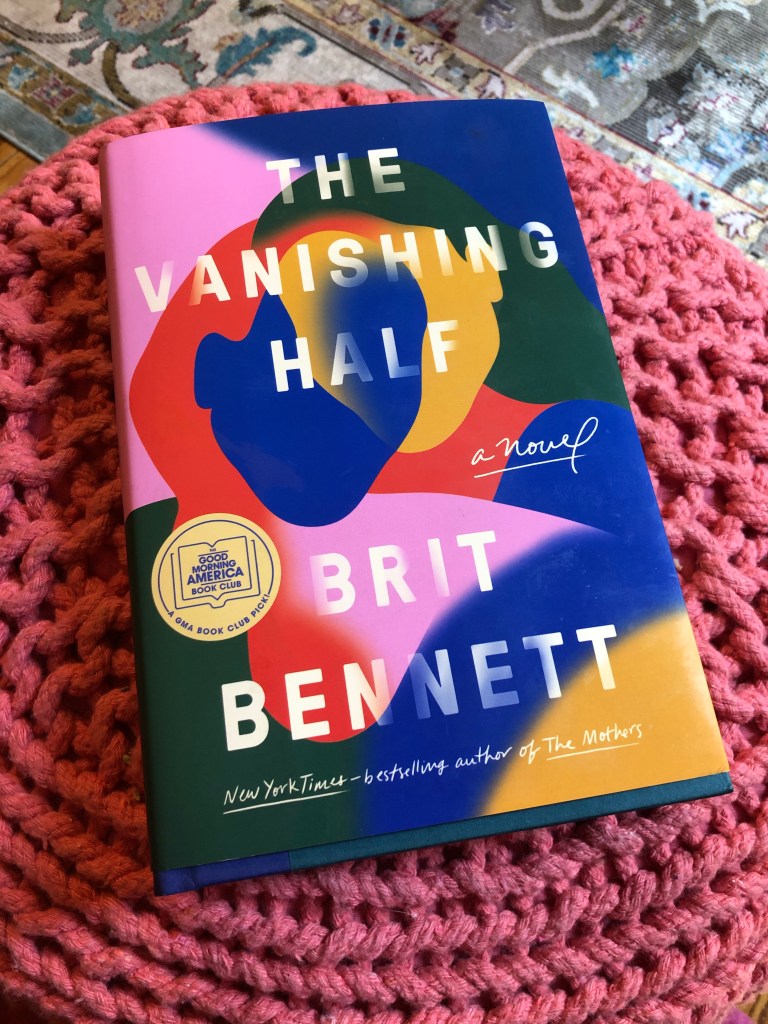
Book Report: The Vanishing Half

Rating: 3 out of 5.

Been wondering where those book reports went? I had to take some time off while reading The Vanishing Half, by Brit Bennet, because at some point, my dislike of almost every character in the book made me not look forward to picking it up again. I was also disappointed that I’d scheduled a trip to Austin just to attend book club there, and they moved it to next week, when I have to stay in Cameron to attend all-day meetings that would drive Anita nuts.

I didn’t figure out that the cover art was anything more than blocks of color until five minutes before I started writing. I’m not sure if that’s good or bad.

In the end, I came to appreciate how everyone in the book constantly lied to themselves and each other, because it became clear that the theme to the Bennet’s story was that we are both tied to the labels we are assigned at birth, but we are also free to move away from them, when we are seeking our true selves. More on that in a bit.

The Vanishing Half was chosen by the book club members, and I wasn’t there for the discussion, so I knew nothing about it until I opened it up. I was hoping for something less intense than How to Be an Antiracist. Imagine my surprise when I found out the symbolism-laden Louisiana “town” the book centers around is populated exclusively by light-skinned Black people. It was a chance to explore race in a fictional context. Serendipity!

This skin color thing was a source of great pride in the community, which consisted of people with freckles, red hair, hazel eyes, and other combinations of superficial markings of White people. But, the surrounding area deemed them Black, and they worked at jobs that Black people in the South used to be stuck with. They were proud of being culturally Black, but also looked down at darker-skinned people. As you can imagine, that can complicate things.

Eventually, the very light twins who are the pivotal characters end up exploiting all the possibilities you can imagine for people like themselves. One stays home, and one vanishes. They each have daughters, one very light, one very dark. The daughters meet, and all sorts of racial stereotypes get twisted, turned, and explored.

Every single character you run across is very human, capable of truth, lies, devotion, desertion, prejudice, and acceptance (which explains why, at some point, I really didn’t like some of them). The only character I didn’t feel like I got to know well was the husband of one of the twins, but maybe it’s good that the stereotypical White business dude is the one who’s not worth fleshing out. At least it’s a nice change.

I liked how the daughter of the twin who lives an entirely new life after disappearing becomes an actor, herself, and feels most comfortable when playing a role. It’s all acting, for them. They fluidly go from identity to identity.

And I liked how Jude,the daughter of the twin who stays and plays the role tradition assigned her, knows who she is and what she wants to do, despite hardship and prejudice. She never doubts herself, just her confusing family. She never doubts the love of her life, Reese, sticking with him as he transitions his external appearance to match who he is inside.

I hope the world comes to accept everyone like the characters in The Vanishing Half. Be who you want to be. Love who you want to love. Cherish your roots, however tangled they may be.

Book Report: How to Be an Antiracist

Rating: 5 out of 5.

Have you ever read a book and wanted to start over immediately after finishing it? Have you ever wanted to make everyone you care about read a book? Have you ever wanted to give a book a big hug and thank it? I have. And this is the book: How to Be an Antiracist, by Ibram X. Kendi (2019). I am so grateful that I saw an interview with Kendi by Stephen Colbert that convinced me to stop procrastinating and get this book!

How to Be an Antiracist
My beloved copy of this book!

You see, a lot of books, films, journal articles, etc., on racism have annoyed me, but I never could quite put my finger on why. Thus, I was reluctant to read this book, even with all the great reviews and recommendations from people I respect. But, ha! Now I know why I was so annoyed! My internal definition of racism, though not very well thought out and rather ineffable, was more like Kendi’s definition. And I didn’t have his term for antiracism in my vocabulary, but the ideas were back there, churning away, making me feel like I was missing something.

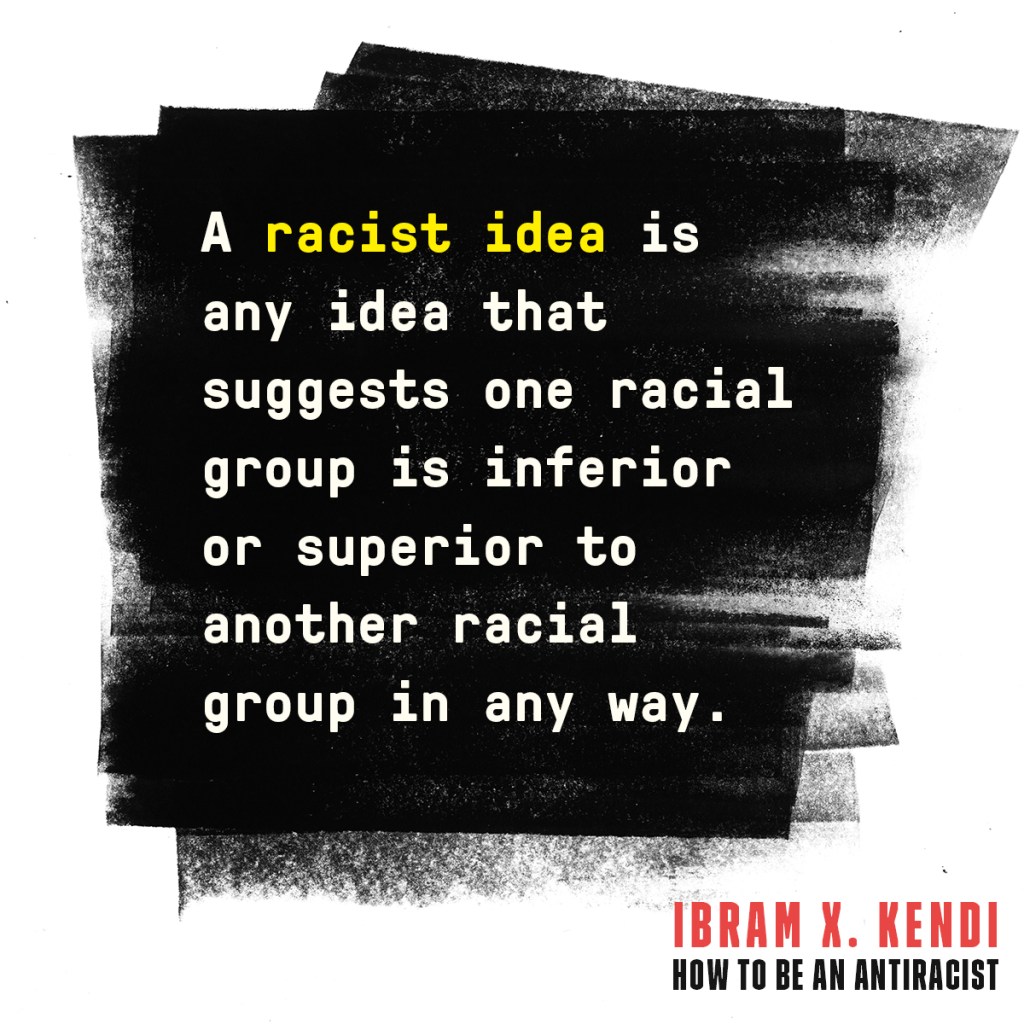
I was glad the publisher shared these images.

I was missing the ideas in this book. As I read through each chapter, I learned more and more about how the times I lived in shaped my views, and WHY some of the things I kept hearing bothered me (things like Black people can’t be racist). Now it’s clear that anyone can express racist ideas or do racist things. People aren’t racist, ideas are. And people who have done racist things in the past can do antiracist things, even before they know what those are in Kendi’s definition.

My favorite assertion he makes, though, is that we all will have both racist and antiracist thoughts. We can’t help it, living in this society. Kendi brings this home with a vengeance as he talks about his own journey and attitudes toward race in the US. Some of the most powerful parts of the book are where he breaks down his own mistakes and shows that he learned from them and moved forward with new knowledge. We ALL can do that.

Kendi thanks his editor for his help with the way the book is organized. I thank Chris Jackson, too. The structure of the book is complex, as it interweaves stories of Kendi’s life with research and analysis. Here’s how Kendi put it:

“This book was quite difficult to wrap my head around and write–the chronological personal narrative interspersed with a series of connected chapter themes that build on each other like a stepladder to antiracism.”

How to Be an Antiracist, p. 239

This writer and technical editor was very impressed with every bit of the structure of the book, and how well the content flows. Dang. Life goals.

But, if the book was written like a textbook, I’d still have lapped it up like someone thirsty for a concoction they didn’t know existed. I just kept repeating, “yes, yes,” to myself with every page. I saw my own mistakes, I saw where my instincts were good but my actions weren’t, I saw areas for growth, and I saw things I could be proud of in my past.

Like Kendi, I got most of my ideas about racism and antiracism in graduate school, where I was surrounded by a mini United Nations of people from all over the world (I studied linguistics at the University of Illinois, which had a large program and did a lot of research on languages from Africa and India). When you work closely with people from different cultures, religions, and backgrounds, you quickly learn that there are people you like and people you don’t like in every group, but MOST IMPORTANT you end up losing the idea that YOUR culture is better than anyone else’s. I got an early start on realizing that no culture is without flaws and sad histories, but that no culture is without beauty, joy, and precious traits that should be treasured.

However, Kendi put these ideas into words way better than I ever could, so I’m grateful to him for giving me words and concepts to express my beliefs and goals.

I’m putting this book right next to The Color Purple and Where the Crawdads Sing among my favorites, ever.

Stuff I Learned

I want you to read this book. Still, I want to share a couple of the things I learned, having read way too much history from the perspective of the dominant culture, and being totally unaware of a few important ideas (to me, at least).

  • Race as a concept didn’t exist until 400 years ago! How did I now know THAT? It was invented to support the slave trade from Africa to Europe and later the US. Before that, people identified themselves by their cultural groups (tribes, kingdoms, etc.) not skin color.
  • The combinations of racist ideas with sexist, homophobic, and other ways of dividing people can lead to an entire system of X is “better” than Y (meaning they have more opportunities for education, jobs, and safe places to live).
  • All that stuff we tried to do in the 70s and 80s, with integrating schools by busing Black kids for hours to give them “equal” education was misguided. What we really need is for everyone to have the same opportunities right where they live. Black neighborhoods, Hispanic neighborhoods, Asian neighborhoods, and others are no better or worse than each other. Given equal access to power and influence, we could all thrive equally.
  • And this: racism is not about ignorance and hatred; it’s about power and influence. Power is what needs to be equally distributed among all of us. And that, my friends, is why I identify so strongly with social democrats, as does Kendi. If we all share, we can all thrive. And we can still have free markets and all that, just without one group having all the power.
  • See the quotes in the images for other gleanings.

I wax political. And I note, as Kendi does, that getting to the place in our society that I outline here (from him, sorta), is not likely. He likens racism to a Stage 4 cancer in our society. It’s one that is growing and growing. But some of those cancers can be eradicated by hard work and a multi-factored approach (chemo, radiation, diet, attitude). Maybe racism can be eliminated if we work from an antiracist perspective to deal with the actual causes of the problem, rather than applying bandages.

A Summary

Since summarizing books is not my best skill, I wanted to share this nice summary from the publisher. I hope it will encourage you to take a chance on being made uncomfortable sometimes, but go ahead and read How to Be an Antiracist so you can help build a just and equitable world where we can respect each other as we are.

Antiracism is a transformative concept that reorients and reenergizes the conversation about racism—and, even more fundamentally, points us toward liberating new ways of thinking about ourselves and each other. At its core, racism is a powerful system that creates false hierarchies of human value; its warped logic extends beyond race, from the way we regard people of different ethnicities or skin colors to the way we treat people of different sexes, gender identities, and body types. Racism intersects with class and culture and geography and even changes the way we see and value ourselves. In How to Be an Antiracist, Kendi takes readers through a widening circle of antiracist ideas—from the most basic concepts to visionary possibilities—that will help readers see all forms of racism clearly, understand their poisonous consequences, and work to oppose them in our systems and in ourselves.

DOWNLOAD AND SHARE QUOTE CARDS FROM HOW TO BE AN ANTIRACIST BY IBRAM X. KENDI

Does Anyone Read Magazines?

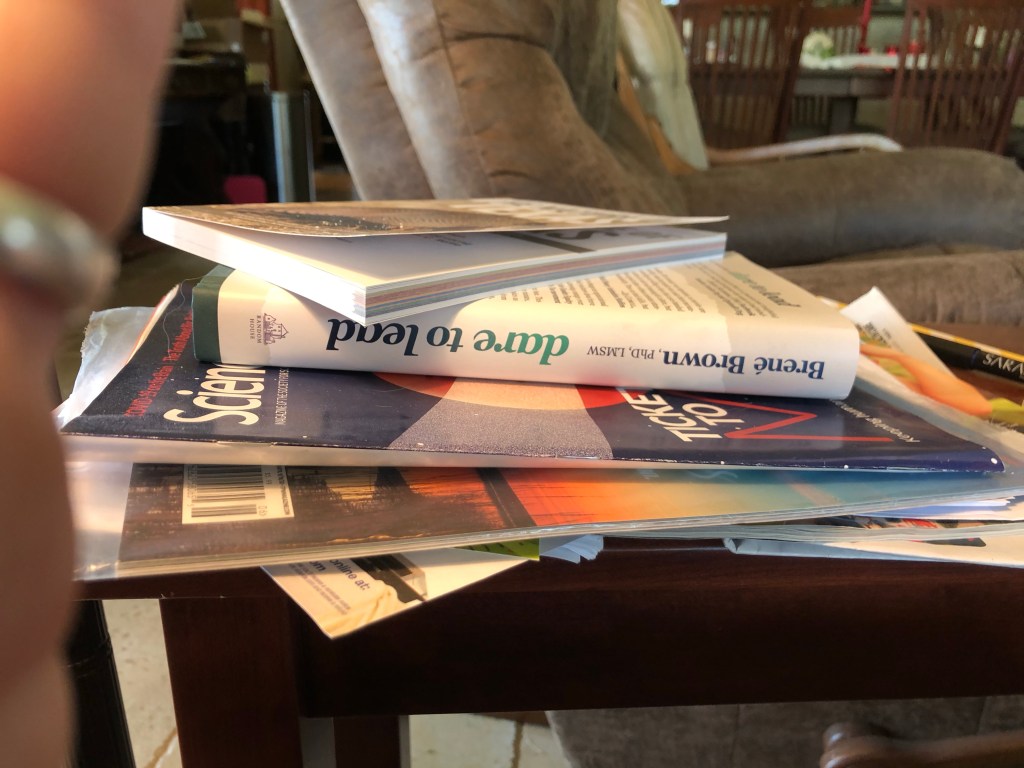
The answer is yes, Suna loves magazines. The view from either side of “my” chair at the ranch house will tell you so.

That’s Western Horseman, Interweave Knits, and New Scientist. And a book.

I’m worried that they will all go away, though. They get thinner and thinner. Then they go quarterly. Then they’re only online (bye Newsweek).

That’s Science News, Texas Parks & Wildlife, and books. Hmm. And my hand.

Sometimes I feel like I’m keeping the entire industry going. But I like them. They’re a happy surprise when I check the mail. I never know what I’ll get to learn about. And, in some cases, they’re something pretty and harmless to take my mind off real life.

I just love the variety of writing styles and topics. And I have so many interests. I wish I had a magazine for each of them! But I’d have no time to pursue those interests if I did.

Believe it or not, I’ve cut down lately. Some for financial reasons, some for the aforementioned trend of magazines folding. But here are some I read, and why:

  • New Scientist: it’s a weekly from the UK. I like it’s perspective. But once my inexpensive first year is over, it will go.
  • Science News: Lee has subscribed for decades. It summarizes research for lay people, but has no agenda. It’s weekly and US focused.
  • Interweave Knits. Most wonderful knitting magazine left. We almost lost all the Interweave publications. I had to cut a couple others, but I still get this one. Great writing.
  • Knitter’s. Basically I like the folks who run this and want to give them money. Benjamin Levisay is a great human. I hardly knit anymore but want to support the industry.
  • Texas Parks & Wildlife. I volunteer for them as a Master Naturalist. Plus they deserve my support. Also great photos and articles by people I know.
  • Texas Highways. Used to be for ideas of places to go. Now for info on places I miss.
  • Western Horseman. Best horse and western lifestyle magazine. Fantastic writing. Great photography. I learn so much history and horse lore. They have a wonderful monthly feature on women of the west.
  • Horse and Rider. I think. This used to be two monthly magazines and is now one quarterly one. Lots of horse health information and at least some of the horses aren’t quarter horses.
  • Equus. Okay I like to look at horses.
  • InStyle. I’ve read this since it started. Fashion stuff but pretty darned feminist. Escapism.
  • HGTV. Well, I renovate houses. It’s practically work related. Rather lightweight and overly trendy.
  • This Old House. See above, but more practical information and less trend-focused.
  • Architectural Digest. Not what it used to be. I miss the really long articles on architecture. But I love all the interesting buildings around the world.
  • Psychology Today. I just love it. It’s fun and often helpful. Not all that scholarly, but at least it has references.
  • Lion’s Roar. Buddhist stuff. You learn a lot about the different traditions and get good ideas for personal growth.
  • Mother Jones. To get me all riled up about stuff. Hard to read sometimes. Makes me sad.
  • Condé Nast Traveler. It comes for free. Too many expensive places I’ll never get to go to.
  • Woman’s Day and Good Housekeeping. For recipes and silly craft ideas. Relaxation reading.
  • National Geographic. I love all the biology, botany, geography and other research they share. Still informative after all these years.
  • Southern Living. This used to be more interesting, but I still like to learn about different places, and see more interiors. And there are recipes.
  • Veranda. No idea why I thought I needed another home decor magazine. I guess I like to look at houses.
  • Living Bird. This comes from my Cornell Labs membership to support their work. I like it better than other bird magazines.
  • AARP. I don’t ever get to this, though there are occasional articles I like. Still loathe to admit I’m in the demographic.
My view while reading. Pond, birds, dogs (beside me) and clouds.

See, I’m supporting an entire industry. At least it keeps me off Facebook, so people will stop looking down on me for it. Too bad. I also like far-flung friends.

The canine companions. Harvey hates heat.

So, any recommendations? What periodicals do you enjoy? Do you read on paper or online? Do you save any? So many questions. Gotta get back to reading.

Book Report: Too Much and Never Enough

Book reports are not the most popular of my blog posts. The one from yesterday got 9 whole hits. But, if I ever need to know what books I was reading starting in 2018, I know where to look!

I had a feeling I’d read Too Much and Never Enough: How My Family Created the World’s Most Dangerous Man, by Mary L. Trump all in one sitting. I came close. Was it some sort of morbid curiosity? I guess so. But I have always wondered how the bellicose and supremely self-confident persona of the person currently serving as US President came about. I figured he must have had a really weird family.

I cut off his face. You’re welcome.

Yes. He had a really weird family. The fact that his father was a gen-u-ine psychopath and narcissist and his mother was emotionally (and physically) not there during his formative years explains a lot. Also, you know, genetics probably played a role; he seems to have gotten more of his dad’s stuff than some of his other siblings, who each didn’t fare well in their household of origin to varying extents.

You can read Mary Trump’s assessment for yourself, so that’s enough about him for me. I was more interested in Mary (forgive me, but I’m not good at typing her last name). When a family member writes a tell-all, you tend to think, hmm, what is their agenda here? What’s their beef? And Mary, to her credit, completely admits she has a beef or two, like how her father was treated by the family patriarch, how no one did jack shit to help the current President deal with any of his issues and learn that anything whatsoever counted other than himself and looking good, how any disagreement with the family’s current lies about itself was punished incredibly harshly (like not mentioned in obituaries, written out of wills, etc.).

She’s NOT an impartial observer, but only someone who has been IN the family could write about it, thus, we get her viewpoint. I think she does a pretty good job at being fair, and you can see she loves many of her family members.

While acknowledging her part in the family drama, Mary kept me riveted while laying out the series of events that got us to where we are today, and like one of my friends who has also already finished the book, you almost feel sorry for young DJT. He didn’t stand a chance. I just wanted to know what horror that family would perpetuate next as I sped from chapter to chapter.

Two of my favorite bits in the book come toward the end, so let me share:

“Nobody has failed upward as consistently and spectacularly as the ostensible leader of the shrinking free world…Donald today is as much as he was at three years old: incapable of growing, learning, or evolving, unable to regulate his emotions, moderate his responses, or take in and synthesize information.”

p. 197

Happy days. I read this just before reading about Federal troops continuing to detain peaceful protesters around the country, just before reading that some random angry dude in Austin shot and killed a protester who was trying to stop him from driving into a crowd that included his paraplegic wife, just before reading about yet another party full of mask-less people hugging and celebrating in my town. Yow.

It’s frequently suggested that we just look for the good in life right now, and not worry about things beyond our control. And I’m all for remembering that it’s not all bad, I have amazing friends and family, and the universe is amazing. However, not to acknowledge what is going on, to hope it will all go away (like so many people are doing with respect to the Narcissist in Chief) seems to me like fiddling while Rome burns.

Hey, look, actual tweet.

If everyone sticks their heads in the sand, we’ll suffocate. Mary Trump’s book begs the people of this country and the world to actually DO something to help us get leadership with a focus on making life good for all, not just looking good for one’s long-dead father.


PS: These are my opinions and interpretations. I have no intentions of trying to change anyone’s minds on any political topic. Everyone makes their own decisions based on their upbringing and values. It’s okay.