I felt like I needed something pretty to balance the content. Read on.
I just can’t stop laughing, so I have to share. This will be brief. I went to Amazon to write a review of the Dare to Lead workbook I “read” yesterday. Of course, I had to read the other reviews. That started my day off right. There was ONE positive review, and it was written in exactly the same psueudo-English that so many of the spam comments that come into our blogs show up in. Let me get you an example:
Magnificent beat ! I would like to apprentice while you amend your website, how could i subscribe for a blog site? The account aided me a acceptable deal. I had been a little bit acquainted of this your broadcast offered bright clear idea
The rest of the folks join me in universal rejection of this poor little booklet, which by the way was “Independently published (January 18, 2020).” AHA! I shall never again overlook those words!
Reviewer Kevin agreed with me: “It is chock full of misspellings and grammatical errors so much so that I believe an 8th grade English teacher would give this paper an ‘F.'”
This review is my favorite, so I screenshotted it:
Be very careful what books you order, especially if you haven’t heard about them. Remember that some self-published books, like my future series Suna Blathers On, will be just fine. Many are scary. Also, read the reviews. That can be quite entertaining for bad books and enlightening for good ones.
Want the real resources for Dare to Lead? You can find them right here, a read-along guide and a glossary. Oh boy, I hope “rumble” and “lean in” are in the glossary! (That was sarcasm folks; I’m steeling myself to wade through the jargon to find the good parts in Dare to Lead.)
*This is a chapter title in Workbook for Dare to Lead.
We all make mistakes, right? Well I’m about to admit to making a big mistake. I spent $8.99 on a “book” that is only a book by virtue of having pages, a cover, and some printing. I had good intentions!
Classy cover art.
The work book club is going to read Dare to Lead, by my buddy Brené Brown. When I went to pick up a second copy (because I hid my first copy when I pitched a fit about how many times she said “lean in”), I saw there was also available a study guide for the book. I thought it would be great to have some questions and ideas to talk about when we have our meetings.
Today the books showed up. Coworker Maggie said, “Hey that’s a printout of a PDF; they always have those ugly rectangles on them.” I told her to check out the inside. There’s no author (unless the Review Press is a person), little publishing information, and no blank pages. You just jump right into a table of contents.
Cringing yet?
Then you keep going, or you try to. OMG, the whole thing is in “books for the visually impaired” size type, and it’s conveniently both right AND left justified. And because the huge print makes the lines quite short, the gaps between words can create not rivers, but entire seas within the paragraphs.
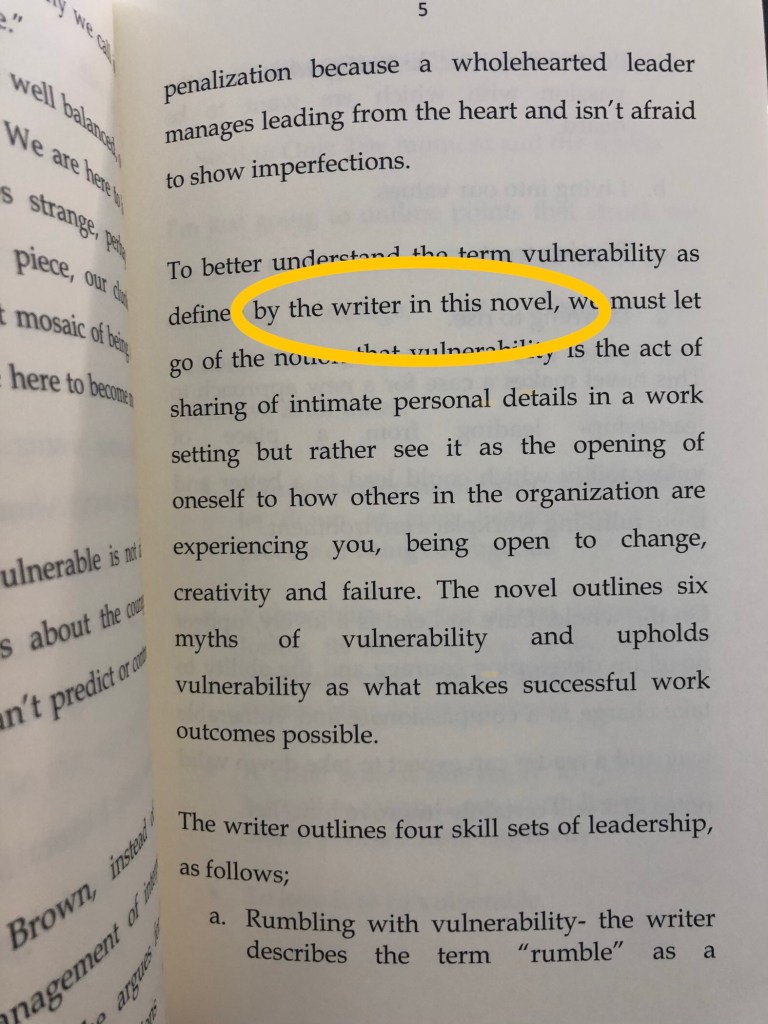
As I read the first part of the book, it because clear that it is a book report penned by a 14-year-old in the UK (there’s a “Lessons Learnt” chapter) trying to get the paper long enough to fit the teacher’s requirements. Poor Brené is referred to as “the writer” endlessly, and poor Dare to Lead is repeatedly called a novel. If it’s a novel, the character development and plot both suck.
But Wait, There’s More
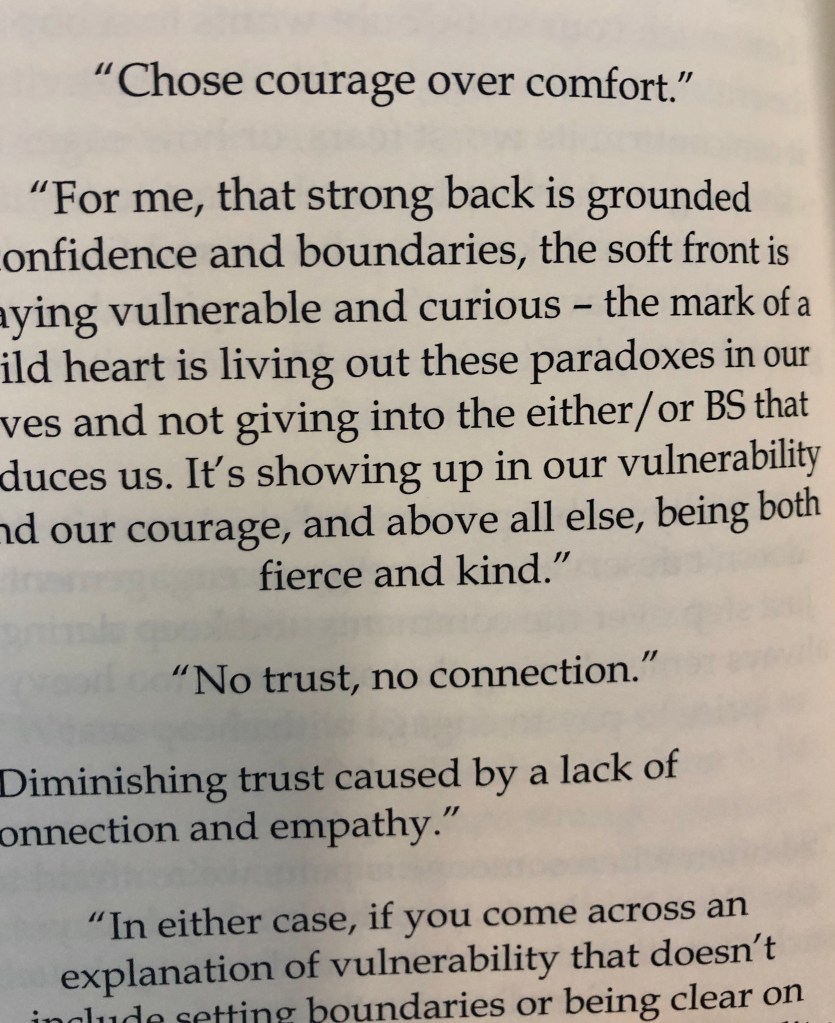
The book report, replete with listings of the names of each section and verbatim content from Dare to Lead, mercifully ends after 22 zippy pages. Then ten pages of quotes from the book are kindly shared by, um, let’s call them “the author.” These are dizzily presented centered, but still full of huge gaps. And for fun, one’s occasionally left aligned. (I’m a hack writer too, though, how many adverbs ending in -ly were necessary in this paragraph?)
It’s centered! Mostly…
I guess “the author” got tired after picking out those quotes, because the “Conclusion” section slides into a description of the organization of the book and the names of chapters. Riveting. After carefully detailing Part 1 (though alternating on using and not using quotation marks around chapter/section titles), everything comes to a screeching halt:
“Haven discussed all the sections in part one, the writer further divided the book to part two, three and four and termed it living into our values, under section two the writer stated that giving and receiving feedbacks is one of the biggest fears at work…”
the author, Workbook for Dare to Lead
They then finally take a breath and give one sentence for each of the rest of the sections Brown so carefully put LOTS of concepts in. It’s okay, the author had to save space for the lessons learnt and workbook pages. I don’t think I’ll be using any of the workbook questions in the book club, though I could play connect the dots using the dotted lines between pages.
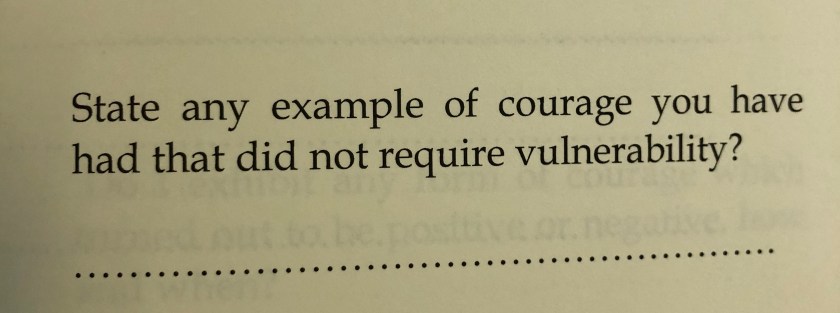
That’s an imperative, my friend, not a question.
To Conclude My Most Excellent Review
I actually hadn’t intended to write a book report of this book report, but it just came pouring out, and was probably good for me in a cathartic sort of way. I realize someone wrote the study guide quickly to get something out there to make money. I was silly not to look carefully and see that it was from a self-publishing purveyor.
Mainly, I want to beg and plead with any of you who plan to self publish books or know someone who does:
Please, please, please have someone look over your content before you send it in.
Amazon is NOT gonna do it. They’re going to print copies of your PDF on demand and send them to innocent people who want to read an actual book.
Really, it does?
At least glance at other books and see how they are set up. Large print and small pages are not a good combination. Most important, while Microsoft may say what appears at right about justified text, it helps to have professional typesetters and to use hyphenation. You might want to take note, too, that centering works best in very small doses.
Of course, you or someone else should proofread; “have4” is not a word, but it’s in the study guide. I forgive using semi-colons for colons in introducing lists, since whoever wrote this was trained in the British style.
One More Thing
Say, let’s look at my pretty flowers and my breakfast, to cleanse our minds.
Some very good books have started out self published. I am proud of some of the people I know who wrote them. Not all self published books are embarrassingly bad, but caveat emptor and all that.
On the other hand, I wonder if I should just PDF up every year’s worth of my blogs and offer them for sale? Suna Blathers On, Volume 1, and so forth. I could use some money, and I did write this all by myself, errors and repetitious phrases and all. I guess I’m a writer after all! Maybe I’m creative!
I’m gonna do the whole thing in Comic Sans! That’s pretty!
Time for another good ole rant. It’s about names. Names seem to have a magical quality to them. People become very attached to their given names, or they change them to show they have created a patriarchal family unit for tax and procreational purposes (just kidding, marriage). Other people go right out and choose all-new names when the one they started out with doesn’t seem to fit (I chose Suna at some point as a young woman, for long-obscure but spiritual reasons).
Here I am, not happy with the carwash people, who call me Sue.
Throughout the history of the people I mostly descend from (ye olde English, Scots, Irish people) many names have shortened or informal versions, which we are all aware of: Bob for Robert, Bill for William, Meg for Margaret, Kate/Kathy for Katherine, etc. This is just dandy for anyone who likes to use these time-honored naming conventions.
Now, naming conventions do change, even among us English-American types. There are many people whose parents name them the shortened version of a name. I know folks named “Bill” who aren’t Williams, for example. Other people do NOT like the shortened versions, like my late friend Robert, who only let immediate family and close friends call him “Bobby.”
What to Do?
Really, Herbie. Really Danny Boy. Really Johann Sebastian. Get my name right and maybe I will connect with you.
Well, my general guiding principle is to call people by the name by which they are introduced to me. I’m gonna call Pamela that, not Pam (which will make IRL friend Pamela-not-Pam very happy). If someone introduces themselves as Robert, I’m not gonna gush, “Hi Rob, nice to meet you!” I met a Burton a while back, and there was no way I was gonna Burt him until I found out it was okay with him.
This shouldn’t be controversial. People deserve the respect to be called the name they prefer to go by. This has been true for years and years, and is not some new-fangled concept like asking people their pronouns. (I’m she/her.)
What’s Bothering You, Susie?*
Well, what’s common sense to me, and what’s worked most of my life has recently stopped working well. Normally, I introduce myself as “Sue Ann” and depending on the context, I’d say, I also go by Suna. Lately, more and more, the response to that it, “Great! Nice to meet you, Sue!”
DID I SAY MY NAME WAS SUE?
No. I did not.
I do not identify as a “Sue.” When someone calls for Sue in a crowd, I never think it might be me. Or Susan. Or Susie. I am just a non-Sue. I think I’m a little different, and so is my name, I guess.
Nonetheless, every single new coworker that’s shown up in the last couple of months has begun calling me Sue. Master Naturalist Students? 50% Sue. Folks around Cameron? Yep.
Hey, bot., my name’s not Sue and you screwed up my car wash.
And woe is me, even when I fill out my whole name in online forms, it’s Sue Sue Sue Sue. All these texts trying to be all chummy with me from a certain annoying presidential candidate, as well as the car wash people who screwed up so badly that they should literally be groveling…greet me with a chipper, “Hi Sue!”
By the way, for people I meet in person, I do say, when I can get a word in, “I go by Sue Ann.” I sign every blasted email I send with Sue Ann. If someone did that to me when I called them the wrong thing, I’d notice that signature and fix it.
I know others who have it worse, like my husband Lee whose real first name is Ernest (of Earnest as the local newspaper calls him). But he knows to expect that, as did my whole family of origin, who went by their middle name, except for me, the two-word outlier. Once they explained it, people called them the right thing.
It used to be that I knew a phone call or email was from someone who didn’t know me if they addressed me as Sue. But now people who do know me keep doing it. And I hate to say it, but it makes me like a person less when they do that, even when they are otherwise fine.
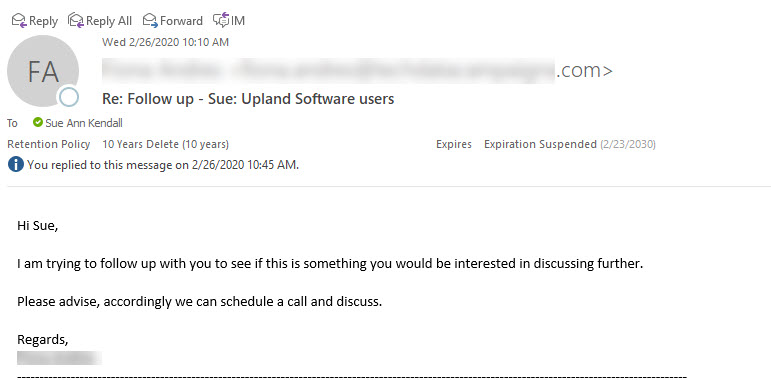
Nope. Not gonna chat with you, cold emailer.
I’m attached to my name. I like it. It’s been me over 60 years (other than two years in my first marriage). When I get postal mail addressed to my spouse and me, I get an irrational response when I see something like “Suna and Lee Bruns, Jr.” as I got just last week. Who are those people?
Concluding Remarks
I guess everyone has their hot buttons, and now you know one of mine. I’m not like the great poet, the unwashed phenomenon, who once said,
You may call me Terry, you may call me Timmy You may call me Bobby, you may call me Zimmy You may call me R.J., you may call me Ray You may call me anything but no matter what you say Still, you’re gonna have to serve somebody…
Gotta Serve Somebody, by Bob Dylan
Call me Sue Ann or Suna. I’ll call you whatever you would like to be called. I think that’s respectful. Names matter. We all deserve the respect to be called the name we want to be called.
You got any stories?
*There are about three people who can call me Susie. Dad could, but he’s not available to talk anymore.
I’ve been quiet (for me) about political leanings since before the last US Presidential election. I find that people who call other people names don’t convince anyone to change their views. And I find that, depending on where you get your information, the same events can be interpreted in astonishingly different ways (Roshomon, anyone? Look it up.)
So, I’ve been trying to live my life according to the principles I believe in, and I have freely shared those. Basically, I want to live in a world where ALL people can eat, learn, love, practice their beliefs, and feel safe. That’s apparently scary to some people. But I’m not trying to push my beliefs on anyone. (And I LIKE many people who view things differently.)
Not something I usually write about.
I would like, though, to try to just ONCE share my beliefs about the policies and programs of the United States. If you read them, you might disagree on some points, or feel more strongly about one thing than another, but really, they are not all that frightening. They are, for the most part (dare I say) reasonable.
Actually, at least at one point in my life, there was a fairly reasonable explanation of what a more conservative viewpoint would propose on these topics, but I haven’t seen it in a while, just finger pointing, name calling, and jumping to irrational conclusions. I think a lot of people on all sides are, like me, keeping quiet and letting the name-callers just do their things.
I IMPLORE EVERYONE to step back, breathe, and work together to make the US a place where we can all live together without fear, despite our differences. And now, I will cease to write about my political thoughts until after the NEXT election, in which I shall indeed vote for someone.
Here’s what you can do, regardless of whether we agree or not.
The copied post from Facebook is below the read more.
Many times, I write about how the passage of time and the learning opportunities I’ve taken advantage of have led me to be more content. And it’s true. I’m handling life’s ups and downs fairly well right now. That doesn’t mean I don’t notice what’s wrong in the world, though.
Frosty sunrise.
All day today, I’ve been reading about Martin Luther King, Jr. and the things he said and did. (His actual birthday was last week, but the US loves Monday holidays.) I also listened to a lovely song imploring us to listen to what John Lennon said, give peace a chance and all that. Today, I’m reminded that King said:
“Call it democracy, or call it democratic socialism, but there must be a better distribution of wealth within this country for all God’s children.”
I came of age in the 1970s. It wasn’t a perfect time, but to me it seemed like things were going in the right direction. Women were working toward equal rights in all ways. Black people could marry white people. Gay friends were emerging hesitantly from their closets. People talked so much about peace, love, and equality.
Now that I’m over here, looking back from over 60 years wandering our poor beleaguered planet, I think I was quite wrong. By surrounding myself with my “tribe” of people like me, I was blissfully ignorant of much of US society, and certainly VERY naive about how businesses and capitalism worked.
I know there are still people out there like me, working to improve the environment, feed the hungry, bring peace and understanding among our fellow humans, and all that. I see that in my volunteer work every day. But, I no longer have confidence that we have the numbers or the strength to accomplish much. (I’ll still keep doing my part.)
Really, stop reading if rants bore you like they do me.
Here’s Why (Or Stop Reading Now)
The heart of my sadness is this: I once believed people were basically good and kind, just sometimes they were confused or misled. I now see too many people taking pleasure out of harming others, spurred on by their own “tribes.”
Gee, Suna, what are you going to rant about today? Maybe you can complain about something, and by doing so, do the thing you are complaining about. We used to have a word for that in linguistics, but never mind. At least you are presenting both alternative pluralizations of doofus, to please your friends.
From the 2016 article by Alex Miles
You know how you ignore things and ignore things, then one day your tolerance dips or something, and you suddenly get really annoyed? Today that happened. I saw just one too many vague, passive aggressive Facebook meme about how “some people” just don’t do the right thing. I just shouted aloud in the parking garage, “If you have a problem with someone, TELL THEM.”
I then ran off and found a fine article to back up what I was feeling: How Facebook is a Weapon for Passive-Aggressive Destruction, by Alex Miles. Three years ago, she was also getting sick and tired of people who would rather fire off vaguely worded barbs at “someone” than talk to whoever it is about what’s bugging them. “Someone” is just supposed to KNOW the barb is about them, and learn from the helpful advice and turn their lives around. HA. Nope.
Myles points out:
The classic method of passively displaying aggression on social media is via quotes and memes that say something, often seemingly politely, gracefully or even cryptically, but the intent behind the message is condescending, patronizing and deliberately posted to make a definite point. There is a degree of separation in this method as the person sharing them is not the one who wrote the words originally.
This one stabbed me right in my highly sensitive soul. And who among us has not dealt with this:
…if the passive-aggressive one is confronted and questioned they may downplay the situation by reverting to denial and manipulation. They might even send smiley emoticons to make it seem as though they are perfectly at peace and then turn everything around to make the person questioning them appear over-sensitive, paranoid and as though they are overanalyzing or imagining things.
Same source
Or need some good old-fashioned therapy, a thing you do not obtain on Facebook.
Go ahead and read the article, which does provide some insight into how people end up doing this stuff, and ideas about how to nip it in the bud. I give Myles credit for thinking people just might be able to actually talk to others about their behavior, discuss whatever brought it on, and come to a mutual understanding and trusting relationship. That sure would be nice!
Am I wise or what?
My favorite solution for doofuses or doofi I know who engage in this behavior is to ignore it, and then send some invisible love rays out to them, because they obviously need it. Doesn’t that make me seem saintly.
Look at that. I called people doofuses. Shame on me. That’s about the worst thing I like to fling around, though.
This is me, talking to my friend.
In our current troubled times, I see (and read) a lot of nasty name-calling going on. I know it’s not new, because I’ve read some doozies in old letters to the editor, which were at least more creative than some of the 2020 ones. I read something on Facebook today, written by J., a minister friend of mine, too, that got me going:
People don’t have to agree with me politically to remain my Facebook friends. People may also criticize people whom I like and won’t get deleted. However, calling me or anyone else a snowflake or a libtard seems to make me press delete every time. Lack of kindness, not content, is what I gauge.
I just don’t like name calling. One thing I’m proud of in my child-rearing is that my kids didn’t call each other names or engage in derogatory name calling toward other kids. I admire them both for their adult selves staying that way, too (as far as I know).
Yep. I’ve found another gap in the skill set needed on my path to serenity.
I have got to learn to go with the flow
I go with the flow, sez Fiona
Today I was supposed to stay at the ranch so we could work on the chicken coop. It’s nearly sunset. I got in a whole day of Planview work. I fed the horses. I walked the dogs. I’m worried Carlton has been killed by a cow, because I tried twice to get him to come home but he kept going back. Then it got silent.
Whew. I hear him again.
The chickens still aren’t dead either.
But, no chicken coop material is here. See I thought there was a plan. I stuck to it. I did NOT go with the flow and accept that by the time the day was over, many new plans, distractions, and duties would come up.
Just like yesterday when we went to get coop material and ended up with a mattress.
Chill Suna
It’s no big deal. The coop will happen. I just might have done something else with my day. Some people are planners. Some are spontaneous. I’m in with a spontaneous group right now.
I’m not dead
What a perfect time to learn to understand that plans are just possibilities. I’m going to go back and breathe some more and greet my dirty cattle-chasing dog. He still has plenty of energy.
Caveat time: I am aware that classism is a fact all over the world. Today I focus on small towns and use Cameron as a specific example. This doesn’t mean I think less of its citizens. It’s a great place full of many kind, caring friends and with much warmth.
Yesterday I talked about how my father came up from poverty thanks to hard work and talent. Yet, you couldn’t take the Chattanooga out of the boy; he had a rather intense (and sometimes incomprehensible) accent, and his broken nose and funny ear testified to his past as a boxer. He didn’t always look middle class.
The moon was lovely last night. I’m grateful for its calming energy. All pictures in this post are designed to make me remember good things in my life.
But, he was allowed out of the shackles of his past by kind friends, coworkers and others who saw his kind heart, great humor, and intelligence. He was lucky. He also moved away from his hometown where the Kendall boys had quite a reputation for mischief, from that I hear.
What If You Aren’t So Lucky?
While I’m noticing many newcomers to down, Cameron is a place where many of the families have been there long, long time. There are surnames in this town that I see in the newspapers from the early 1900s (by the way, this includes Mexican names whose families were here before this was the United States and long-time black residents). Some families have done well, and are the scions of the community, populating all the right churches, the right organizations, the country club, etc. Others are respected business owners known for their charity and work for the community. Many are successful ranchers and farmers who live outside of town behind gates proclaiming their ranch names and fencing that costs more than many homes.
Ah, trees shining in the winter sun. I love going for walks on brisk meteorological winter days.
The children of these families are beloved by their school teachers, who come from the elite families or are their friends. These children dress well, participate in the important clubs, win dozens of 4-H ribbons, are in the prom court, play on the football team, are cheerleaders, etc. Nice kids. They also enjoy some leniency at school, since everyone knows they are good kids from good families. Sound familiar? Sound like where you came from? Sure! This is the norm in the US, especially in small towns.
What about the others? Some of the surnames in town have different reputations. They are assumed (because of how their parents, grandparents, or distant relatives were troublemakers, lived in the “bad” part of town (literally on the wrong side of the tracks in Cameron), or had other nefarious connections) to be the kind of folks you don’t want to associate with. These kids may not have parents who can afford all the activities. They are the ones who get picked on because they smell funny, live in an ugly house, have parents with drug or alcohol problems (or their relatives do). They go to the churches who dare to accept everyone, no matter what their family history. This, too, is not surprising.