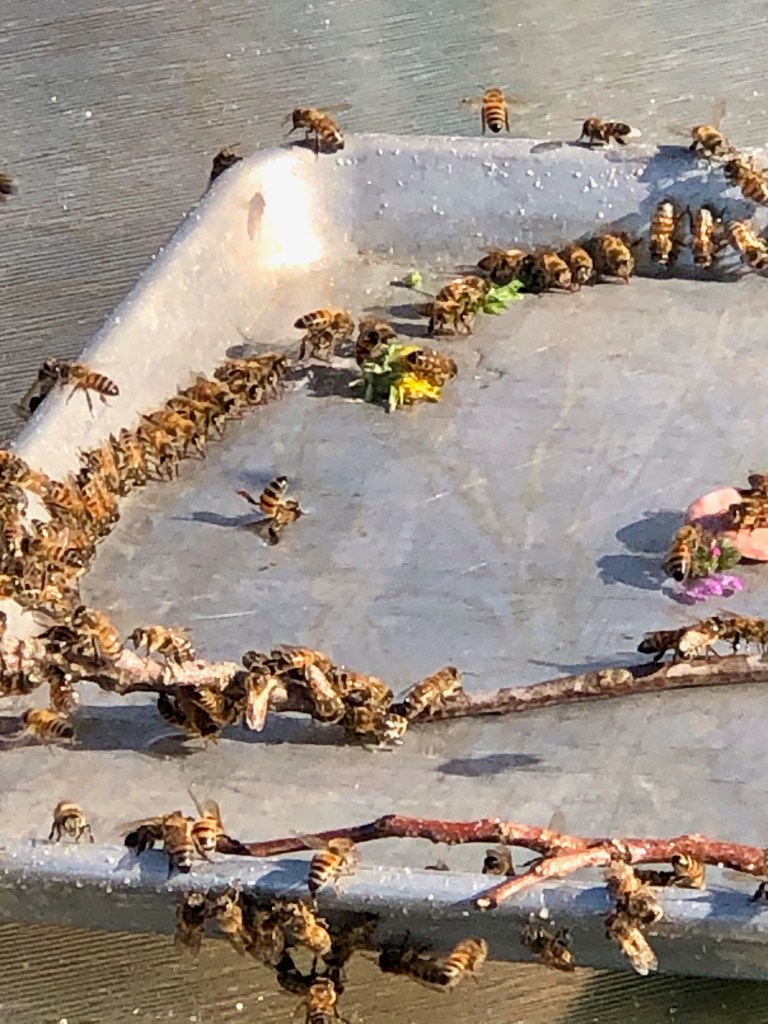
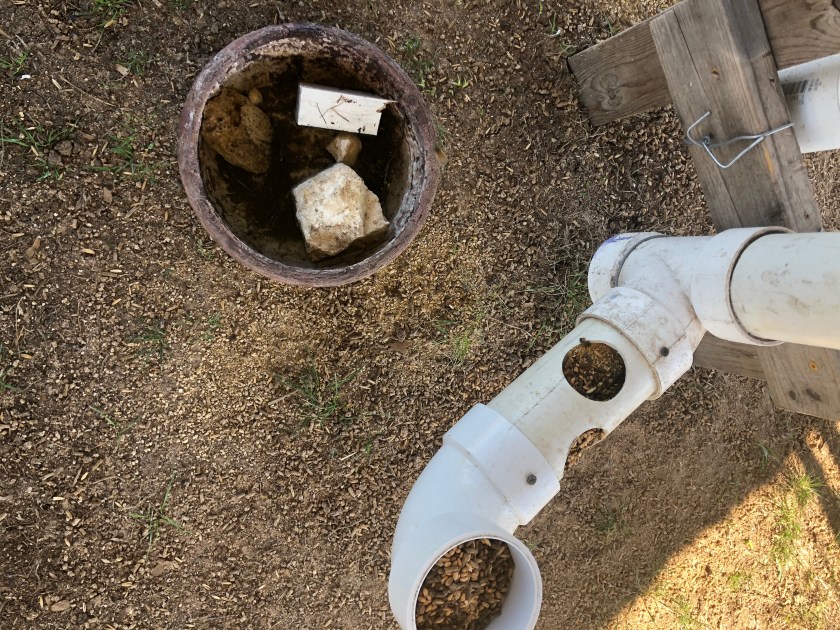
Oh my gosh, y’all. I think I got the best birthday present EVER when I went out to check how the bee feeder was doing. Last night I checked it, and it was totally dry, with no bees. I was worried a dog had drunk all the sugar water, so I moved the feeder to a higher spot, added more rocks, and replenished the water. This morning, I saw THIS!
Now, THAT is a lot of bees.
There is some mighty buzzing going on around the chicken coop! There are still plenty of them at the chicken feeder, too, and they don’t seem to mind me adding food, or the chickens coming over and eating it one bit. They are busy bees. I discovered they are thirsty, too, because they are all over all the water sources, as well. You just have to listen to them! Check out this tour (bonus chicken footage).
Suna’s birthday bees
That’s all for now. I just wanted to share that helping bees is making me very, very happy. I needed that!
The situation in this area with regard to the effects of the bad weather incident is pretty dire. I don’t think I realized how bad it was until I read the documentation encouraging people to participate in a project to track the state of pollinators and pollen sources here. Dr. Chip Taylor of Monarch Watch, wrote:
The 11-day cold spell (10-20 February) in Texas was a disaster. Freezing temperatures covered the state and extended well into Northern Mexico. While many of the immediate effects of the freeze are clear, season long and multiple year effects may linger. The damage to the flora was extraordinary, and it is likely that nearly all above ground insects died over a wide area. Plants already in flower may have been so damaged as to not flower this year.
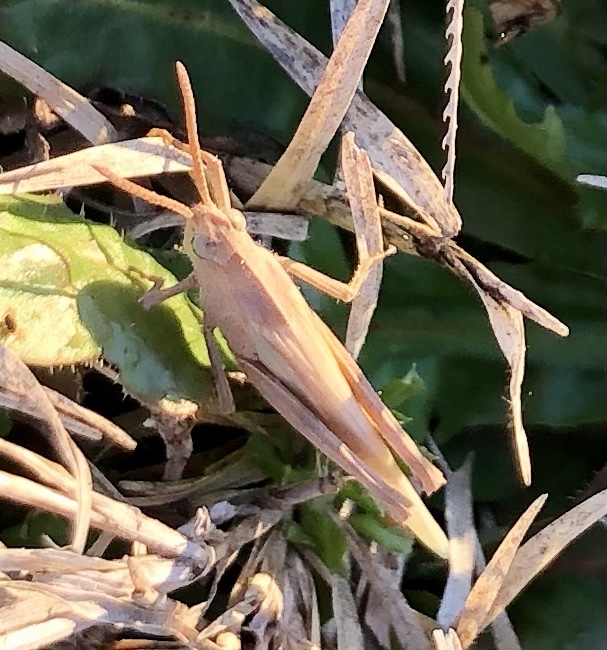
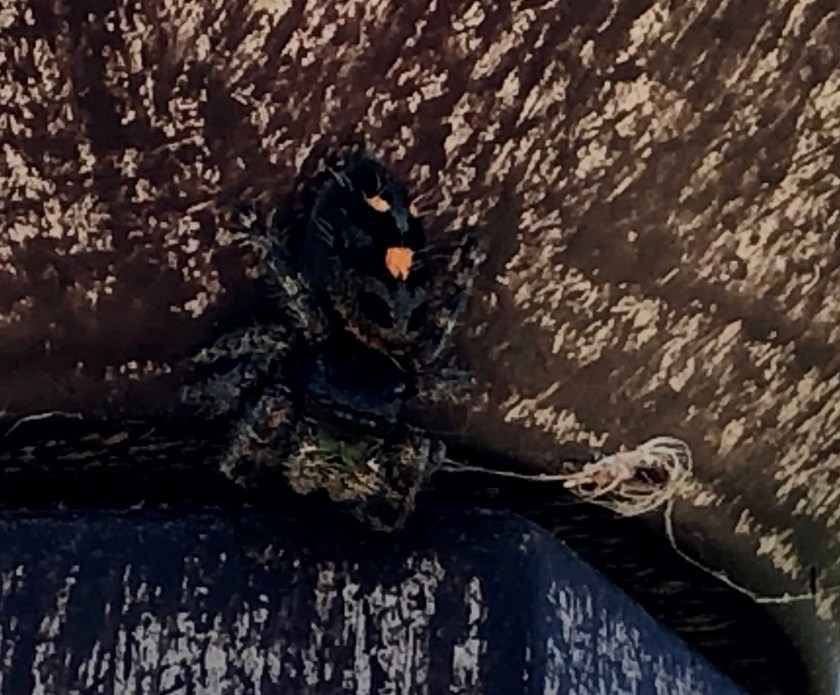
Nearly all above-ground insects died! Now, every time I see an insect, I’m thrilled, and must record it. Yesterday I spotted a young grasshopper and a jumping spider, and if I could have hugged them, I would have.
Look at those cute antennae
It IS a jumping spider!
A few of my friends have been mentioning that the bees are everywhere right now, and they don’t have much to choose from for nectar sources. As I showed you yesterday, I mostly have henbit and dandelions for them, along with a very few white clover blossoms (I think I saw six blossoms between my house and the horses, which is a half mile in distance).
Henbit deadnettle
Dandelion
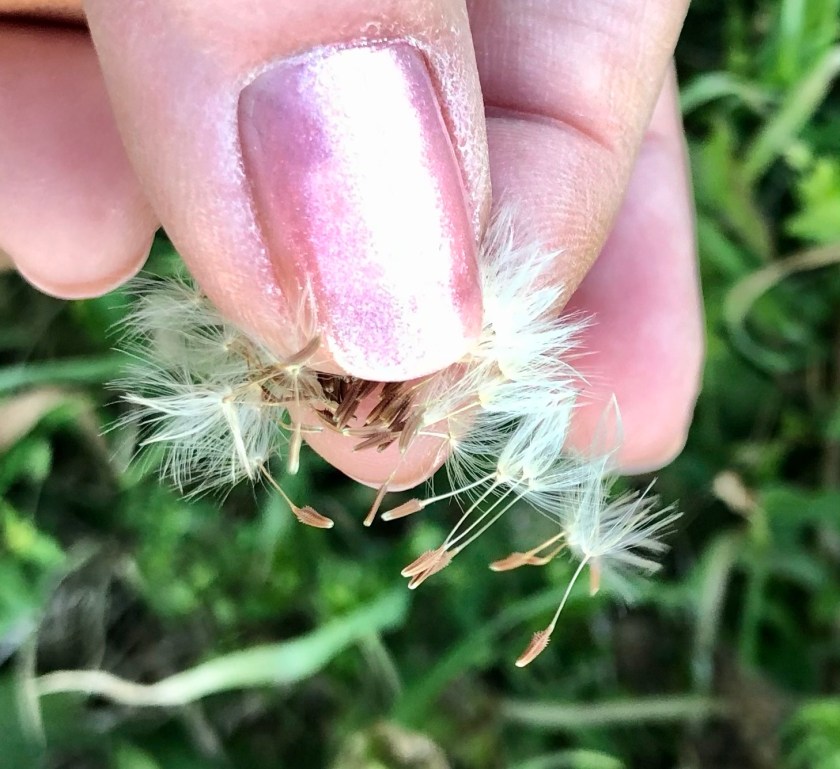
Dandelion seeds are so pretty
Pitiful clover
Food for our bees
I’ve been seeing photos of home-made bee feeders, which seem to mostly be pans with some gravel in them, filled with honey water. My friend, Pamela, had a lot of success with using a cookie tray and a simple plate!
Pamela’s bees like her feeder.
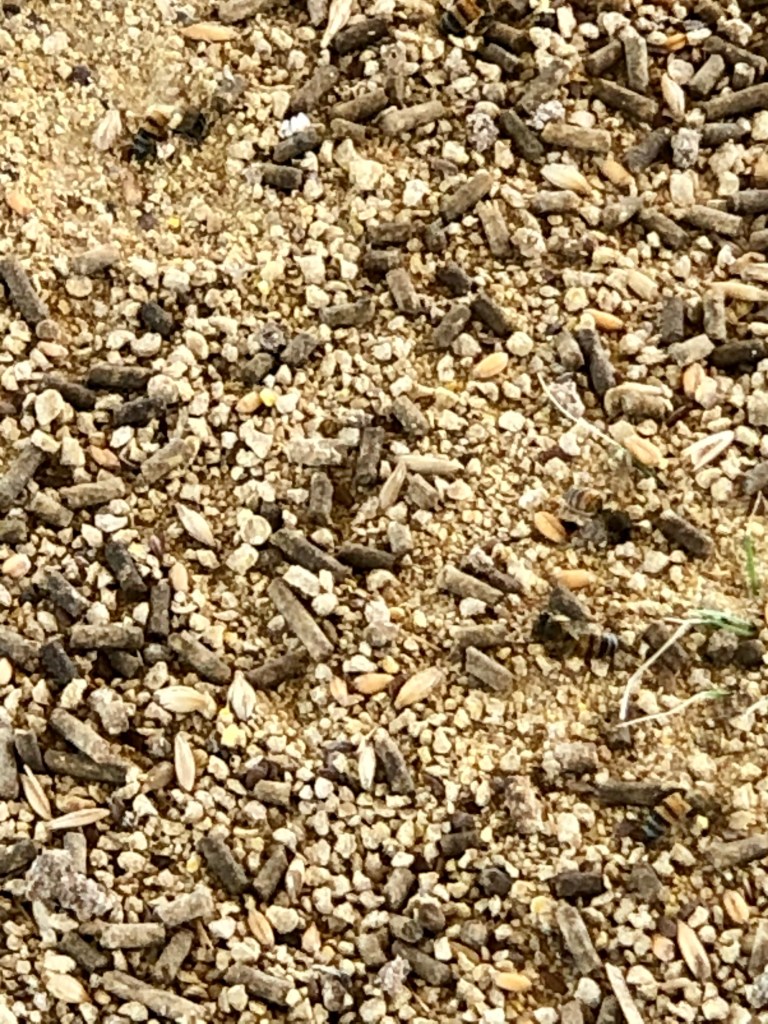
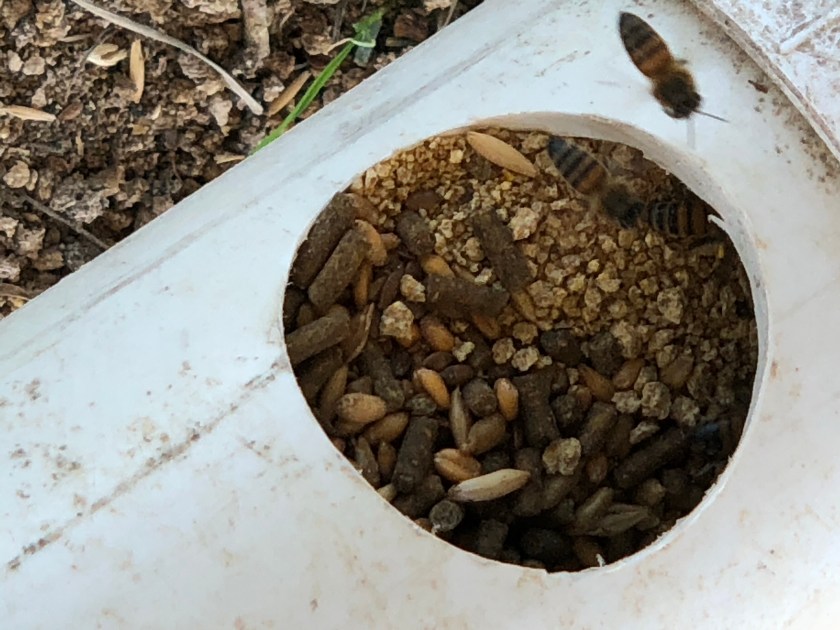
I wasn’t sure if I needed to do that, since dozens and dozens of bees have been sampling the chicken feed, which makes me worry about how much sugar must be in there!
Click on the images to see them larger and count the bees.
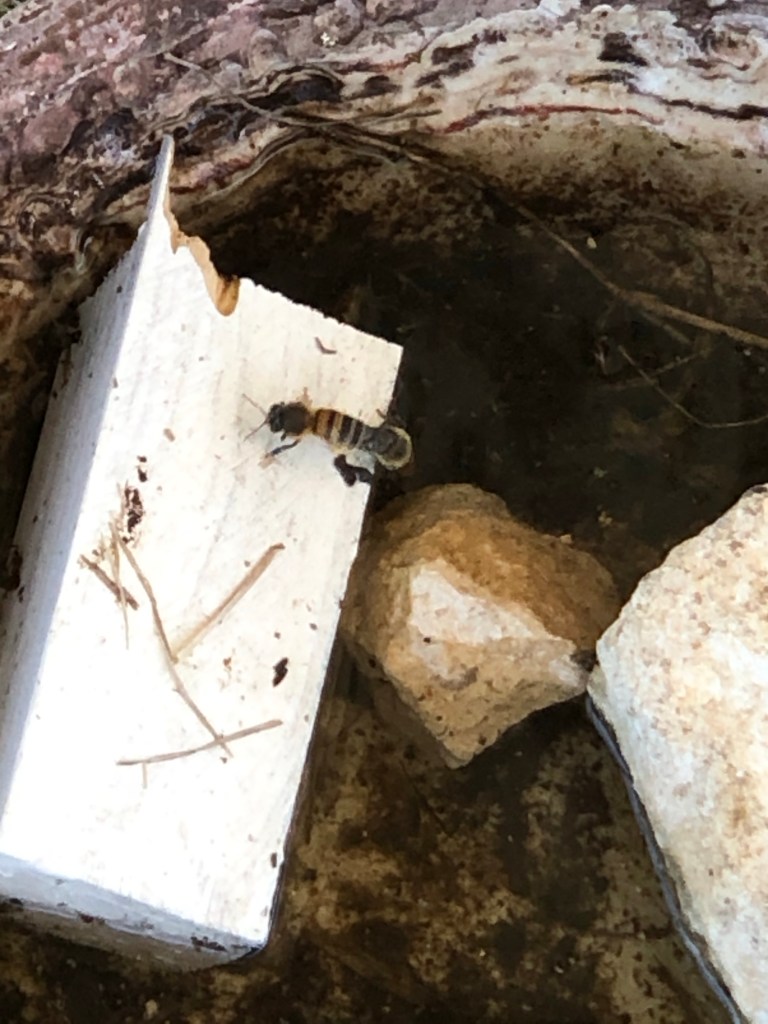
But, I figured it couldn’t hurt. I already had a nice shallow dish over by the chickens, but I don’t have any gravel, so I found a few rocks that look like reasonable perches. I poured some honey water in there (same stuff I make for hummingbirds) and waited.
Yeah, well, we don’t like this.
I guess I haven’t waited long enough, because I have only seen a couple of bees check out the water, and there are still very many on the chicken feed. I think I’ll go out and put in some sticks and flowers and the things Pamela had. It’s an ongoing experiment.
Zero bees at water station. Many bees in and on the food.
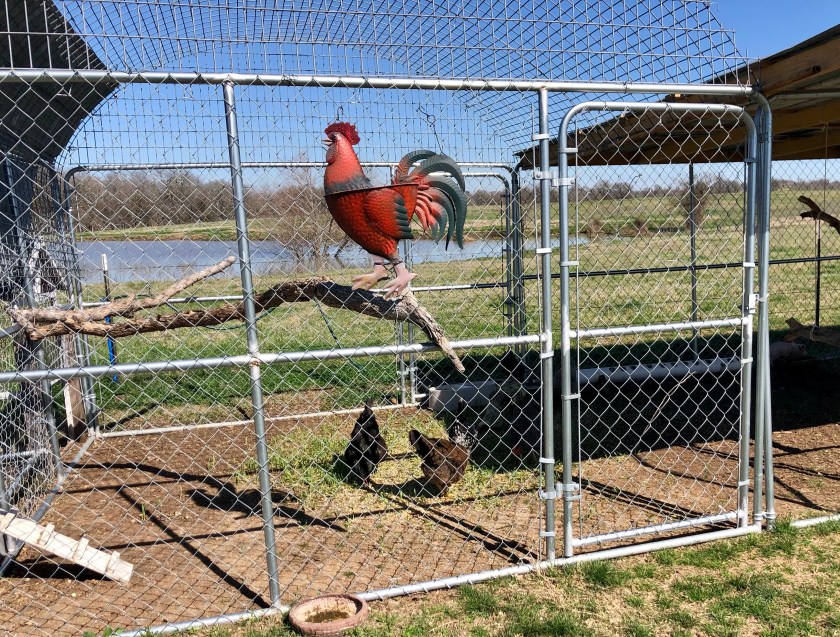
As an aside, I have to laugh about my chicken yard. It now feeds not only chickens but many wild birds. I’m always startling doves and meadowlarks in there, plus many sparrows. That’s fine with me. They’re all my avian buddies!
No, I’m your avian buddy!
No, we’re your avian buddies.
I have a lot of love to go around.
I do hope all the feeding of the bees helps. We need them, the native bees and the honeybees.
Update!
When I went out to check the mail, I took a detour by the chickens to see how the bee feeder was doing. I was happy to see that they found it, and could tell I made the liquid too deep. So, I added some flowers and sticks they can hold onto. Immediately the bees started using them, and more arrived. My heart is full.
I started out my morning nature break trying to find pollinators and check for damaged flowering plants for a survey of pollinators and plants used by monarchs on iNaturalist. I was very happy to have found bees and a butterfly, and was watching the water flowing in the stream with the dogs.
Drinking from the spring water
Checking out one of the springs
Jumping the flowing water
Coming to see his mama
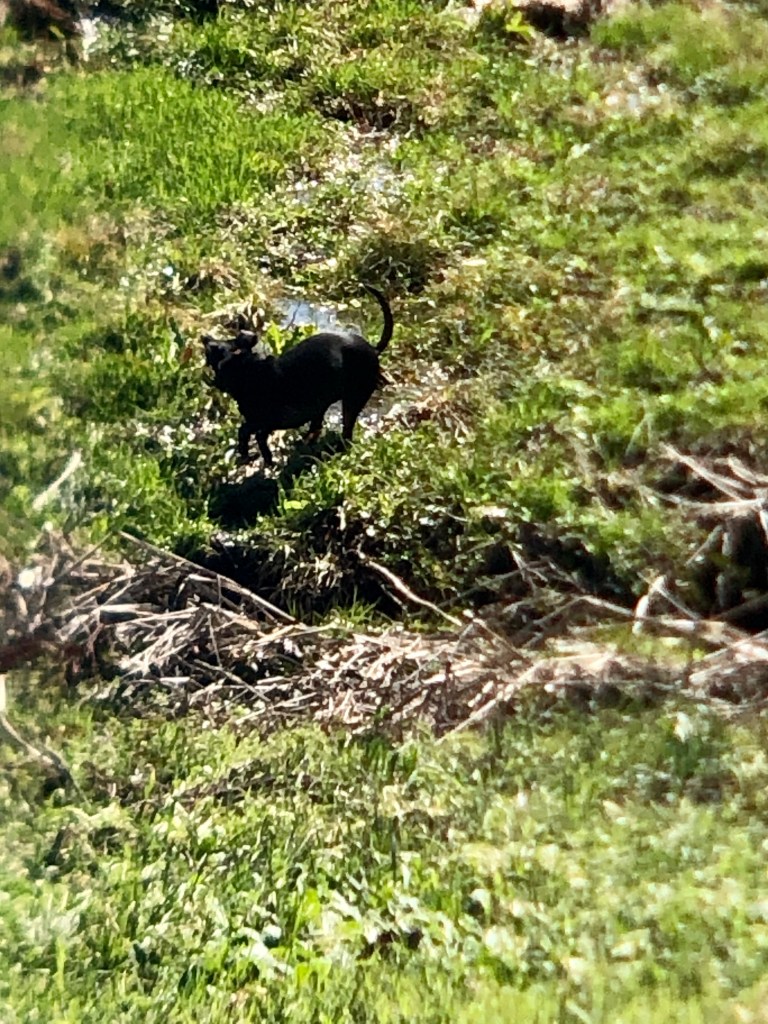
Dogs having morning fun. Yes, I am aware I didn’t get photos of ALL the dogs.
Then, Lee showed up, wanting me to help get the dogs back up so he could feed them. I said, okay, but look how well the stream is flowing! He noted that the runoff from the pond did not seem to be flowing, but the place where it dumps into the stream WAS making nice little waterfall sounds. So, where was the water coming from?
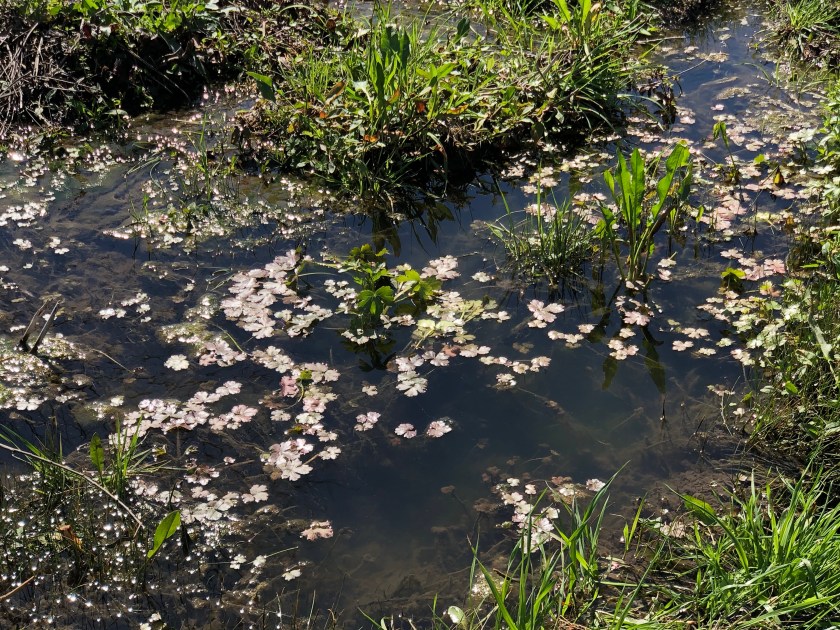
The stream is flowing so nicely and consistently that actual aquatic plants are growing.
Lee pointed out to a new puddle or marshy area that seems to have (no pun intended ) sprung up since the snow event happened. I’d been meaning to check on it, too.
The newly wet area. You can see it doesn’t have any water plants yet, so it’s new.
The puddle was very full, not like all the other ones that have dried up. Then, lo and behold, I spotted a little hole. That little hole was full of clear water, and it was bubbling up! I finally found the source of one of our intermittent springs! I was pretty excited.
Not much to look at, but it is full of bubbly water!
So, water is coming up from this hole (perhaps from the pond, who knows?), then flowing to the marshy puddle, then heading to join the pond runoff water, and on into the big hole that starts the stream.
I labeled the new spring’s path, since it’s hard to see for the grass.
Yay! Farther down, the water is running really fast, thanks to at least two other springs. We had heard that there have been springs all through that area, but most of them have not flowed since we got here, which was when the big drought of 2011-12 happened. I guess the aquifer has finally recovered! Wow!
This springy area has been holding up since last year.
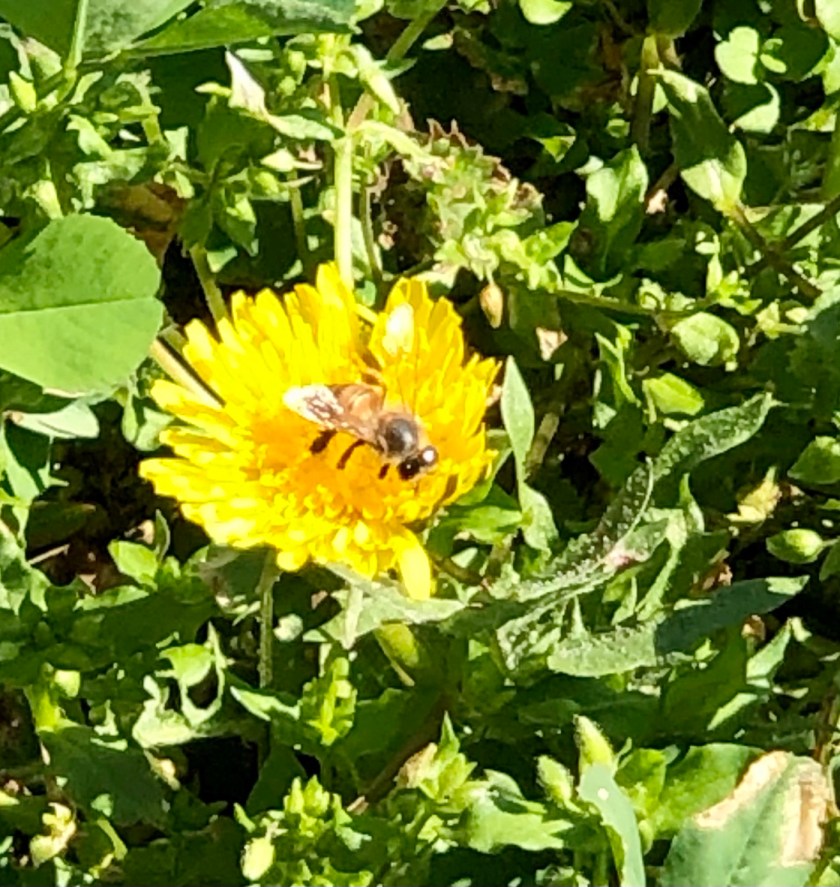
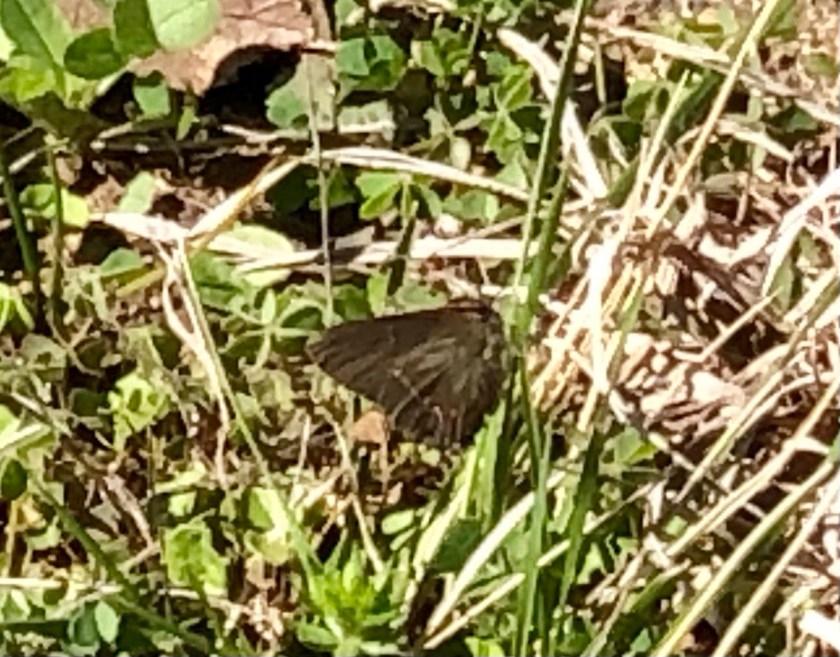
Anyway, I was happy to find a Sulphur butterfly, a hairstreak and lots and lots of bees outside. They were pollinating the henbit and dandelions.
Hairstreak butterfly
Bee and dandelion
A small bee or wasp, a calligrapher wasp?
Orange sulphur butterfly
Bee and henbit
ha ha, not wildlife
Pollinators
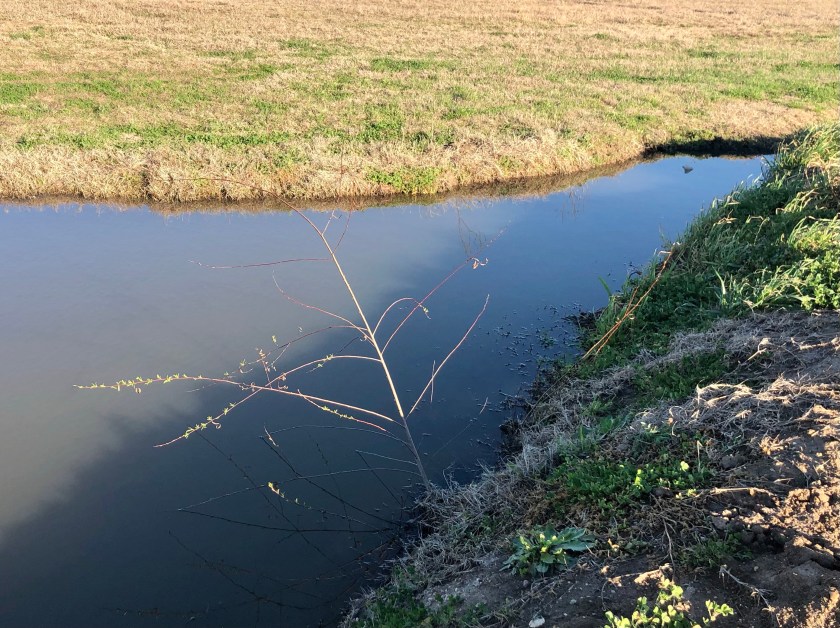
Also, one of the young willows in the small pond has started sprouting, plus I saw a bullfrog in that pond (and heard another one jump). I found one wolf spider and another insect that got away. That means some of them lived. This all makes me very happy.
Frog is peeking from the center of the pond shore
Can you see the little leaves?
Hidden wolf spider
I do hope to see turtles soon. I am worried about them. But, wow, so happy to have found a spring!
Wow. There are so many things to say about this book that I’ll never get them all said! After I read All My Puny Sorrows, I wanted to read more from Miriam Toews, and selected this one, Women Talking, after reading the intriguing reviews. I said All My Puny Sorrows was a jewel of a book. Well, this one is like the Hope Diamond or something. There are so many aspects of it that are just…perfect…that it’s hard to find a place to start.
If this is soon to be a major motion picture, I think I’d have a hard time watching. It’s intense.
Well, I do know where to start, which is with the content warning. If you can’t handle books where there is discussion of rape, you’ll need to pass this one by, because the premise of Women Talking hinges around the effects of women of an entire community dealing with the consequences of it. It’s based on a true story, but the dialog and such are imagined.
The protagonists are a group of women in a Mennonite community isolated somewhere in South America, who at first thought they were being attacked by ghosts or demons in the night. The entire plot takes place over two days, as they decide how to deal with the men in their community who actually perpetuated the crimes.
None of these women have been allowed to learn to read or write, and very few of them have ever left their small compound. They have been trained to obey the men, never offer an opinion, and to simply do their jobs (cook, clean, farm, and reproduce).
They hold a series of secret meetings, when the men have gone to try to bail out the rapists, and they ask the one educated person in the community, the teacher, who’s an outcast, to take minutes of their meetings. August is not sure WHY they asked, but he is willing to do it.
Through his notes (and his unexpectedly complex asides and insights into his own history), we learn what a fascinating group of people these women are, gain many insights into the beliefs of their Mennonite community (by the way, NOT like all Mennonite communities…it’s a bit cultish), and see how brilliant, brave, compassionate, and feisty they can be.
When they start planning, reasoning, discussing theology, and supporting each other, you can’t help but be in awe. Toews shows how resilient the human spirit is, and truly draws you into their culture and concerns. There are so many details I’ll never forget, such as conditions they have to deal with all alone, with no real medical care (edema, fainting spells, pregnancy and childbirth, loss of eyesight, loss of limbs, etc.). And there are little things like how one of them manages to be a smoker, or how the two youngest women braid their hair together, or jauntily remove their head coverings and roll their socks down in rebellion.
You eventually see that everyone in the book has suffered, has tenuous connections to sanity, but have strengths, the depths of which they don’t always realize. And to get to that realization you get to enjoy the privilege of Towes’s spare dialogue, her knack for expressing things in ways that people from another “world” would say them, and her true love for marginalized people.
I admired the women in this book deeply. They stuck to their principles as I could only hope to do if I was challenged to fundamentally. And I admired August the note-taker, too, poor tortured soul.
This book affected me as deeply as The Handmaid’s Tale did way back in the 1980s. That means it will stay with me forever. Please read it.
Every once in a while, a subject gets into my head and just stays there, gnawing away at my free time and causing me to think and think. The topic of how often we refer to negative things in terms once used to describe people living with disabilities or mental illnesses just won’t go away. Now that I am aware of how often these terms are used, I see (or hear) them everywhere, especially in casual conversation, but sometimes even in more serious speech and writing. This has led me to a loose collection of not-all-that-related thoughts.
So much negativity! Image by @kelsen28 via Twenty20
Where do we see these terms?
I do NOT see these pejorative terms used (often) in the news, magazines, or academic books. That’s a good sign I guess. The one exception seems to be the “crippled economy” and the like. I am wondering of that persists because circumstances actually can cripple concepts like economies, degrees of debt, etc., by causing metaphorical injuries to them. Perhaps that word can be seen as more neutral, then?
I can see how people can easily get confused until they practice using alternate ways of referring to people. The subtle nuances of finding neutral ways to refer to people dealing with various challenges can take some time to sink in. Luckily, there are plenty of resources to guide you (but don’t read too many, because they can start to conflict). I’m just glad to see there seems to be at least some effort made in new media and places like that.
I want my talking heads to leave the name calling to the people they interview. Image by @amauritorezan via Twenty20.
Who’s most likely to use these terms?
Another understanding I’ve reached is that it’s no wonder people use these disability kinds of terms to put others down; as a whole, people are still pretty ignorant about actual facts about disabilities of all kinds. I found an interesting article from the UK about the language of 14-year-olds for putting others down about disabilities.
The authors found five themes in the data.
Popular derogatory terms (nuts, psycho, crazy, loony)
Negative emotional states (disturbed, depressed)
Confusion between types of disability (disabled, spastic, dumb)
Actual psychiatric diagnoses (depression, schizophrenia)
Terms related to violence (scary) (I admit, I didn’t see this as violent)
There are lots of lists of words in the article, but the authors concluded that, for the most part, the young people didn’t really know what the words meant and were just using words for emphasis, especially the popular derogatory terms. They were surprised that actual diagnoses weren’t used much, and concerned that the violence words appeared as much as they did (though they were the least used).
We’re just kids, mimicking other kids. Cut us some slack. Or educate us! Image by @lelia_milaya via Twenty20.
The article cited above inspires me to cut folks some slack. How many people know where the words “loony” or “spaz” come from? I sure didn’t until I was a lot older than a teen. Many really hurtful utterances probably come from folks just picking a word they’ve heard others use that sounds sufficiently negative to emphasize a point.
I come to the conclusion, based on that emotional maturity stuff I talked about yesterday, that people who are still muddling along at the adolescent stage of emotional maturity, at least with respect to labeling others, are more likely to engage in using disability terms to insult or put people (and ideas) down.
Now I’m back to name calling
On the other hand, name calling, in general is one of my least-favorite human proclivities. It’s something I worked with my children to eliminate (fairly successfully, for the most part, though we did love the word doofus for gently chiding ourselves for making simple errors). People just LOVE labels. And so many people define themselves by the labels others (and they, themselves) assign to them. That’s why I don’t like name-calling and that type of put-downs. They can mess a person up.
Labeling Exercise
So, here’s something to think about. How many labels have people put on you, or you have put on yourself, throughout your life? I’m thinking both positive and negative, by the way. Here’s a list for me, with my internal labels in italics. (note that some of the items in the left column I don’t personally find negative, like sensitivity and agnostic, and some of my positives are negatives for others.)
Negative
Positive
Fat
Smart
Ugly
Talented
Talkative
Good listener
Stupid
Patient
Unlikeable
Hard worker
Unfriendly
Empathetic
Sensitive
Generous
Unpopular
Kind
Goody-two shoes
Brave
Heathen
Feminist
Agnostic
Spiritually open
Femi-Nazi
Liberal
Libtard
Well read
Intellectual snob
Altruistic
Hysterical
Centered
Nervous
Open minded
Self centered
Look, I made the columns kind of equal, though it was easier to think of the items on the left
As I look at my own list, I can see that some of the labels that have been applied to me sunk in and were very difficult to shake off. Others didn’t bother me at all. I’ll have to ponder why that’s so, but as a first stab (aha, a war metaphor), I’ll guess that labels that point to my insecurities (fat, unlikeable) stuck longer than put-downs that I’m actually proud of (feminist, agnostic).
So, I challenge you to see if you can come up with a list of the things people label you (or you label yourself with). Are they accurate? Have you glommed onto inaccurate ones and believed them at some point in your life? Have you broken away from some labels?



















 The Hermits' Rest