I’ve been meaning to write about the latest Elizabeth Strout novel, and since I was wrong about going camping this afternoon, I suddenly have time. I guess I should have asked someone if we were leaving the day we originally planned. That’s what you get for making assumptions. I make an a** out of me. And, sigh, we have to leave a day early because I have jury duty Monday, I’m a bit pouty. I really want to go camping. We haven’t been in so long.
Must deal with these results of the investigation into why the bedroom slide won’t move. It needs professional help.
However, I did read this book, so let’s talk about Tell Me Anything (2024). As soon as I realized there was a new book in this series (I’ve reviewed them all on this blog, so you can search for Strout and find them), I ordered it. I was very interested to find out what was going on with the characters in Crosby, Maine, since the pandemic, so I dove right in. I was happy to see that this installment concentrated on good old Lucy Barton and her friend Bob Burgess, as they cope with a local murder.
As with most of Strout’s books, the plot is secondary for me. I just enjoy how she tells stories. Her style is so spare, and her use of repetition and the narrator jumping in with bits of information, just enough information. And as always, you get insights into how people think, act, and work from points of view you’d never considered before. I just love the pithy parts.
An imaginary Maine coastline.
I underlined and marked many passages that I can no longer see, but my favorite one was this part of a conversation about the meaning of one of the stories two characters shared with each other:
That was about the same thing that every story Lucy and I have shared is about. People suffer. They live, they have hope, they even have love, and they still suffer. Everyone does. Those who think they have not suffered are lying to themselves.” p. 315.
Actual small town in Maine. Photo by Leah Newhouse on Pexels.com
The people in the book are also fun for me. They are all so fully formed, with wonderful features and fatal flaws. They are real in the best way. I love how married couples are treated here. They have days where their spouses get on their nerves, then days where they don’t know what they’d do without them. And there are divorced people who don’t hate each other, but are glad to no longer be married. It’s refreshing to be able to feel empathetic with human beings who can be inconsistent, think judgmental things about others, but still be doing their best. I feel less alone.
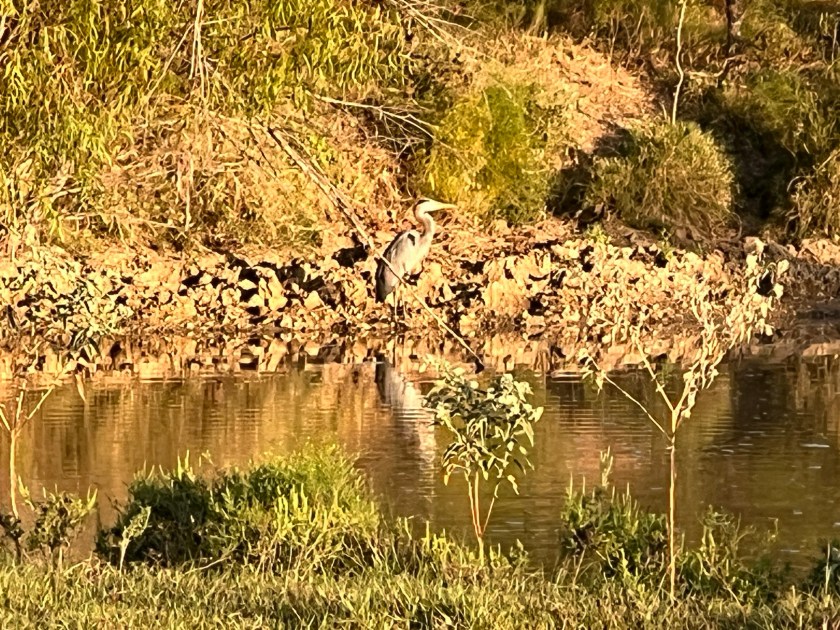
There’s always time for reflection, like the heron is doing. These books inspire you to reflect on universal truths and intimate insights.
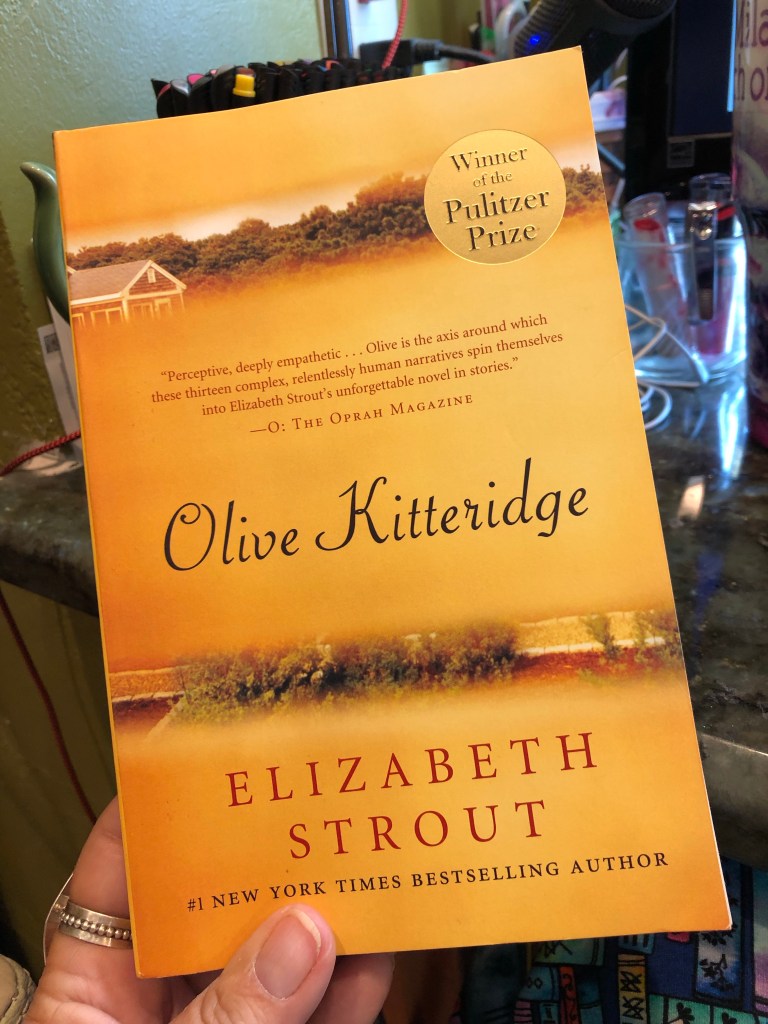
One more thing is that I was glad to see that Strout introduced a few new characters, since the “old” ones are mostly getting old. Olive Kitteridge is now 93! I can’t wait to see how she weaves them into the continuing saga as she follows them on through the scary 2020s.
What? A book report? I know, I haven’t been writing many of these lately (for all two of you who read them). But, between all the crafting and horsing, there hasn’t been much reading other than the huge number of magazines (mostly about horses and houses) that I devour every month or week. For some reason, I subscribed to People when it replaced a magazine I liked that went out of print and finding out what is happening to the same small group of “famous” people each week takes a LOT of my time. People seems compelled to tell me who this Pete Davidson person is dating every week, which, I must admit, is a new person most weeks. Why anyone should be so interested in a not-that-funny comedian is beyond me, but hey, at least he isn’t tweeting swastikas.
This woman can WRITE
And now let’s talk about the book I did read, which is Lucy by the Sea, by my current favorite author, Elizabeth Strout. You may recall that I have read a lot of other books by her, since the old book club read one of her novels a year or two ago, before I became an outcast (which may explain why I haven’t been reading many novels–there’s no one to encourage me, and novels remind me of being rejected so resoundingly by “friends” from my old neighborhood).
I need to be more like Lucy Barton, the protagonist in this book, who was raised outside of society, so misses social cues a lot. In some ways, that can be a relief. Anyway, this book covers recent years in the life of Lucy, during the pandemic and the previous US President’s time in office. Her ex-husband takes her to Maine to escape New York City just before the really bad COVID outbreak hit there.
Strout shares Lucy’s impressions of the ensuing events in her gloriously spare style, where you sometimes have to sit there and think about a sentence for a few minutes, because there’s so much implied but not stated. And because of Lucy’s unconventional upbringing, she is able to see some of the events of the past few years differently than folks like me would see them, which led me to think hard about some of my prejudices against people of different backgrounds from mine. This pleased me. I think many of my friends ought to read this book just for the chance to get a glimpse into how another person thinks.
Lucy is not someone who’d probably be my friend in real life, but she’s someone who can teach me a lot, and that’s better, I think. The way she sees the world clarifies my own world view (I’m not being too specific so you can read the book yourself and have your own “aha” moments.) But, here’s something I enjoyed, when Lucy is talking about God to a friend:
It’s our duty to bear the burden of the mystery with as much grace as we can.
p. 150
That sums up God for me.
One more thing Lucy thought of that rang true was when she talked about people you meet being like ping pong balls bouncing into each other, and how inevitably, you will bounce back a little. But you never know who the ball will next bounce into, even briefly, and have an effect. (She says it better than that.) (pp. 186-7)
If you are my friend or are experiencing life these days as confusing, I think you should get this one and read it slowly, savoring it, as a lot of people I know have been doing. It will stick with you! (And PS, Olive Kittredge, from the first book, shows up in the periphery, so this book nicely ties in the whole Olive and Lucy series.)
Another Elizabeth Strout book is now under my belt. I started it a while ago, then a few other things pushed their way into the queue. I was also savoring it. I do love to read the words of the fictional Lucy Barton, and that’s what all of Oh, William! is.
I love the white tulips on the cover (which are a part of the book)
Elizabeth Strout could make Lucy Barton walk across the room to go to the toilet and I’d find it poetic and striking. That’s just how Lucy’s thought processes come across to me. Even though Lucy doesn’t stray from her theme that you can really never know what’s going on in anyone else’s mind, it’s great to see her come to that conclusion over and over again, especially when it comes to her first husband, William.
Lucy has always felt like an outsider from the rest of the world, thanks to have been brought up in an isolated setting with no media or other outside influences besides school. William was, in her view, a safe haven. The plot, such as it is, revolves around Lucy slowly realizing he actually never was that.
The contrast between William and Lucy’s second husband, David, could not be stronger. David was warm, loving, and comfortable, while William was one big, scary (but fascinating) mystery to Lucy. I had so smile as I realized that Lucy just could never shake William out of her system.
William had a glamorous mother who it turned out, was not from glamorous roots at all…much like Lucy. The other subplot had to do with this woman, Catherine, who abandoned her first child…much like Lucy felt she had abandoned her daughters (but really hadn’t).
Enough about the plot. You read these books more for the way the plot presents itself and the language Strout uses to express the ideas in Lucy’s head. It’s just so, so wonderful.
Now. After I finished the book, I began wondering why I feel a kinship with Lucy and how she relates to the men in her life. It then dawned on me. I’ve had my own William and David. I literally worshipped my high school boyfriend, but in the end I had to get away to be myself. And he was much like William. And his mother was exactly like Catherine (from poverty in Mississippi to a glamorous adulthood).
But it was how Lucy felt about men that struck me. She viewed love like I did much of my life, and I never realized anyone else was like that. I always thought I was very odd. But, certain circumstances where love is sort of withheld from you can lead you to not trust yourself to really love people, so you sabotage relationships. Huh. I’ve done that. Repeatedly.
Stopped now.
Gosh, I’m glad Lucy is seeing things clearly, now that she’s my age. I hope I am, too. And if this review doesn’t make sense, well, it’s because I don’t make sense, either. Do any of us? I’ll ask Lucy in the next book.
Here’s one more Elizabeth Strout book. This is not exactly a sequel, but it builds upon the events and actors in My Name Is Lucy Barton. Anything Is Possible impressed me, because it has the same people in it, but is a completely different type of book than the book about Lucy. Here, you hear about all the folks she encountered in her book and insisted she didn’t know anything about or understand.
And it quickly becomes clear that Lucy was right. Each of the people you learned a few facts about from Lucy or her mother before has a complex and interesting story to tell, with their own deep regrets, shame, and accomplishments. I was surprised over and over at how the people I encountered in the first book changed as they aged and had experiences.
There’s a theme of people surviving the loss of their mothers, many by having their mother just up and leave, others by having them pass away young. That made me empathize a lot, since I always felt like my mother was never really all there the whole time I knew her, even though I loved her an all her flaws. The same seemed to be true of almost everyone in Anything Is Possible, too. It warmed my heart to see estranged siblings realize their love for each other and estranged children realizing they love their parents (even the ones who were unacceptably eccentric, bordering on abusive). That gives me hope for my own situations, and that’s a thing that makes me really careful.
My view while reading.
Strout is right, anything IS possible. You also can’t predict what’s going to happen with people. Even the most broken of us can rise above early experiences, but it’s not guaranteed, either. Strout did a masterful job of showing us that “stuff happens” to everyone, but we will all learn, grow, and remain able to love.
Anything is possible. I am happy, content with my life situation, and no longer dwelling on my own shame, doubt, or eccentricities.
I hope you get a chance to read both of these books, and read them in close succession. You’ll experience complex emotions, but in the end, you’ll be realistically optimistic about humans and their resiliency.
I’ve been knitting a lot in my spare time, but I need a break sometimes. Good thing I brought a bunch of books with me to Colorado. At least three of them are books by Elizabeth Strout, who wrote the Olive Kitteridge books I enjoyed so much. The first one I read is My Name is Lucy Barton (2016), which is apparently going to become a major Broadway play.
The book looks much more substantial than it actually is. That’s because it starts out with eight pages of praise for the book and ends with a book club guide and an excerpt from another book. Why did they need to pad it out so much? And my suspicion is immediately aroused when they spend so much paper on telling you how great the book is, rather than letting you figure that out for yourself by actually reading the darned thing. And check out the cover, which tells you how much the NY Times, the Boston Globe, and the Pulitzer Prize committee love the book and the author.
Now, I did enjoy this book very much. The writing is as spare and open as the other books I’ve ready by Strout. And the story, which revolves around a writer reminiscing about a long visit from her estranged mother, while she was hospitalized with mysterious complications from surgery. You get hints of an abusive past and damaged family members, but a lot is left to your imagination, because as Lucy points out she really can’t know what anyone else thinks, felt, or experienced. I loved that part.
And I really like some of the other themes that Strout repeats throughout the book. One is that people really seem driven to find ways to make themselves feel superior to others, even those at the bottom of the social hierarchy (which is where Lucy comes from – an entire family who lived in an unheated garage for many years). Lucy spelled it out this way:
I have said it before: It interests me how we find ways to feel superior to another person, another group of people. It happens everywhere, and all the time. Whatever we call it, I think it’s the lowest part of who we are, this need to put someone else down.
page 95
If you know me at all, you know that this is one of my big areas of concern, too. I like the way she talks about it at an interpersonal level rather than a cultural level. Lucy appears to remember every single person who ever looked at her as an equal or treated her kindly, having experienced so little of it as a child.
The other theme that gets repeated often (and by the way, Lucy is very explicit in her repetition, as in the above quote, where she reminds us that she’s repeating herself) is our inability to know what other people are thinking or feeling. Heck, she often points out that she is not sure what she remembers or what happened. This is so true, and if we are honest with ourselves, we will take this lesson to heart. I mean, I have had conversations with people from my past where our memories don’t even sound like memories of the same events, they come out so different. Lucy knows that, explicitly.
And because Lucy doesn’t really know what’s going on with other people, her readers don’t get a lot of information about any of the other characters in the book, like her mother, husband at the time she was hospitalized, neighbors, and siblings. You just find out how they affected Lucy. That’s an interesting perspective to me, and I liked it more than I thought I would.
Strout does an excellent job of showing how Lucy Barton is like a stranger in the society she lives in, often just with subtle word choices. And Luvy often shares that she has huge popular culture gaps, due to never experiencing things like television shows, movies, and the world outside her Illinois farm community (which she also portrays well – those cornfields and views resonated with my time in east-central Illinois).
But, sometimes I get to wondering how Lucy did all the things she did with such limited life experiences. Of course, she was smart, read a lot, and, as her truly weird mother would say, she just went and did things. She knew she had to get out of her abusive home environment, and she did. But how did she deal with college roommates, traveling, and things like that? How did she go from not understanding shopping to spending so much time in Bloomingdales? How did she manage to raise her daughters?
A final thought I wanted to share is that I admired how Lucy owned being “ruthless” as a friend of hers termed it. Sometimes she had to do things, even if she knew it would hurt others. I see that in myself a lot, especially when it comes to people in my family. Lucy knew that having to leave her husband was right for her, but perhaps not right for her daughters. This paragraph hit very close to home for me, and I see both my child self and my own children here:
Do I understand that hurt my children feel? I think I do, though they might claim otherwise. But I think I know so well the pain we children clutch to our chests, how it lasts our whole lifetime, with longing so hard you can’t even weep. We hold it tight, we do, with each seizure of the beating heart: This is mine, this is mine, this is mine.
p. 190
I had to suspend my logical mind’s questioning during My Name is Lucy Barton, but that was okay. And if you think of the book as more of a Zen Koan or a spiritual guidebook than a novel, you will come away with a lot of insight to think about later.
I didn’t think I’d love the writing in a book as much as I loved Olive Kitteridge, but here I am, prepared to gush over Olive Again, by Elizabeth Strout, the woman of the bestest words ever. I keep reading paragraphs over and over, just marveling at how Strout manages to capture the inner lives of her characters so succinctly, yet evocatively. As I read her work, I am constantly seeing vivid scenes and smelling all the smells of Maine, yet she doesn’t write long, descriptive paragraphs full of endless adjectives and adverbs. Nope. She uses just enough words to do the job. That’s a writer, all right.
As always, Olive appears in each chapter, though she is often not the protagonist, and most chapters aren’t from her point of view. You get to meet many new people, as well as some of the folks from the previous book, and see how small things affect their lives so profoundly.
You learn that people really, really, don’t understand what’s going on in other people’s lives, and especially in their minds. I really needed some of this knowledge this week, as I come to grips with the fact that there are people I have known all my life who live in an entirely different reality from mine, and for whom the facts as I see them just aren’t relevant to them. It’s the same in Crosby, Maine.
Thanks to Strout, I learned many new definitions of love, too, and how it fits into people’s lives and fills the gaps in their loneliness. The point in both the Olive books seems to be that bad things happening isn’t the worst part of people’s lives, it’s a lack of connection to others. I think she’s absolutely right about that. Here’s what the character Bobby says in the “Exiles” chapter:
And it came to him then that it should never be taken lightly, the essential loneliness of people, that the choices they made to keep themselves from that gaping darkness were choices that required respect.
p. 195
If I were writing an actual book report, I’d cite Bobby’s musing as Strout’s “thesis statement.” That’s the essence of both the Olive books.
And what fills my heart with comfort is that each individual you glimpse in this book finds their own reason to keep going and to figure out their path in life. I’m going to borrow the reason that Suzanne states in the chapter called “Helped.”
I think our job – maybe even our duty – is…to bear the burden of the mystery with as much grace as we can.
p. 116
This type of spirituality permeates Strout’s writings. She sees the divine in Nature and never lets the reader forget it for one second. I’ll see her sparkling waters and intensely yellow autumn leaves often in my own mind.
This was the book I needed to be reading right now, today. I hope you pick it up and it speaks to you, wherever you are on your life’s path.
A friend recommended I read the books by Elizabeth Strout on Olive Kitteridge, because I said I was interested in good character development. I ordered them, and just finished Olive Kitteridge. It’s a quiet masterpiece.
The book is a series of short stories, sort of, though the same people in a small Maine town appear and re-appear. Olive, a large sorta grumpy woman is the pivotal character who appears in each story. It’s fun to wait and see how she turns up and how the other people perceive her.
I love how normal and real the people in the stories are, but also how they each have personal tragedies that shape them. One theme I detected in the book was of people daring to do something unexpected or out of character. It usually works out well, but not always. It reminded me of my own attempts to get out of my shell, tell my truth, or speak up. Only mine tend to backfire. Never mind…
I did find many beautiful phrasings and observations about daily life, beauty, and appreciation of your current moment. But mostly it was about feeling lonely.
When he was in town, it seemed he saw couples everywhere; arms tucked against each other in sweet intimacy; he felt he saw light flash from their faces, and it was the light of life, people were living.
Starving, p. 99
And she has an amazing way of showing how disconnected and lonely people can let themselves be. I felt like framing a couple things Strout has her characters think or say.
It’s just that I’m the kind of person that thinks if you took a map of the whole world and put a pin in it for every person, there wouldn’t be a pin for me
Criminal, p. 236
What I get from Strout’s interrelated tales is that we can all feel our separateness deeply, and we all seek intimacy in our own ways. I’m grateful for all the glimpses into everyday intimacy that the stories in Olive Kitteridge provide. I will probably turn to this book often just to re-read some of the words and slip back into the feelings they elicit.
Great book. Thanks so much to the friend who recommended it!










 The Hermits' Rest