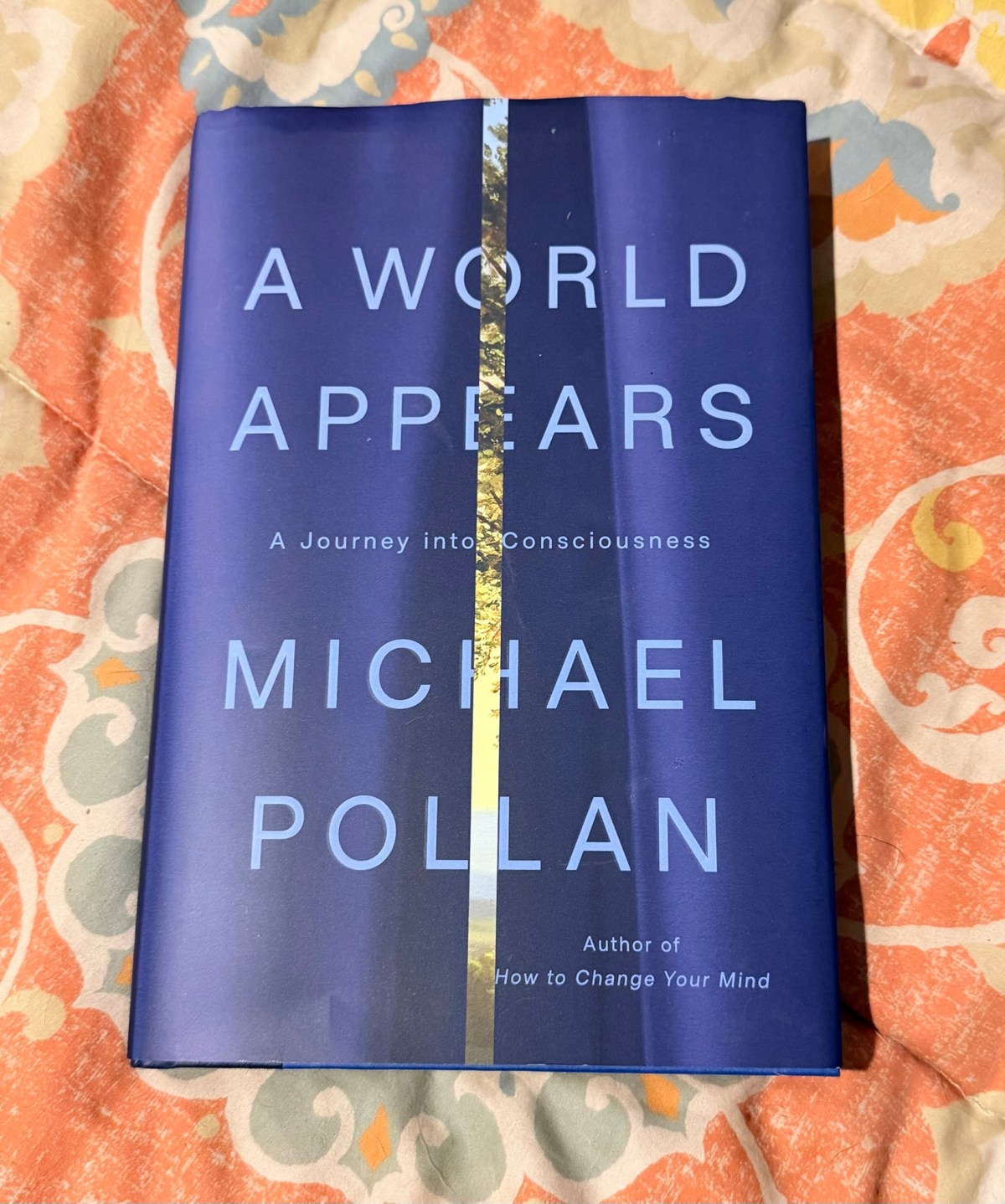
It’s no secret that I’m a big fan of Michael Pollan. He fearlessly investigates what makes us human and is delightfully unafraid to test out his own ideas and find them wrong. A World Appears (2026) is his latest, an exploration into what it means to be conscious, and for that matter, what exactly consciousness is.
The title refers to what happens as we open our eyes from sleeping. A world appears. How does that work? Hint: the answer to the consciousness question is not really the goal of the book. The goal is to explore various ways of addressing “the big question” and how close they come to an answer.
Pollan interviews a wide range of fascinating scientists, deep thinkers, academics, and spiritual leaders in his quest. Some think they have the answers, some think they’re getting close, and others doubt we’ll figure consciousness out.
Mostly, Pollan drinks a lot of tea. If you listen to the audiobook you can make a drinking game where you down a shot of an interesting beverage every time he sits down with a pot of tea to interview someone. I guess consciousness scholars aren’t coffee drinkers. (Aside: Lee and I have a drinking game for every time an HGTV host says “pop of color”.)
Other than that quirk, I enjoyed reading along as Pollan thinks about what the experts tell him and points out where he thinks they have a point or are a little off. I was fascinated by the idea that consciousness is controlled by the cerebellum, not cortex, and I loved learning how many other living things may well be conscious, depending on how it’s defined.
Other parts of the book delve into whether machines can be conscious. All sorts of conflicting ideas come up in this part of the book. I will say I’m hoping Pollan’s conclusions on this one are right.
Fans of Pollan will not be surprised that psychedelics come into play when trying to figure out how to escape consciousness. Meditation is also invoked (and I’m more familiar with the brief flashes of transcendence from this method—brief—that’s why it’s a practice). It’s all fascinating.
One thing missing from the book is what happens when we are asleep. Are we completely unconscious? What do dreams have to do with our stream of consciousness? Maybe that’s another book.
All in all, this was a fun book that gave me much to think about and more tools in my toolbox to figure out what “I” am. It’s deep!