Book Report: A Hundred Suns

I gobbled up this novel, which I found via my usual method of discovering books, an interview on NPR (National Public Radio in the US). I figure anything Scott Simon likes, I’ll like. I encourage you to read or listen to the interview about A Hundred Suns, with the author, Karin Tanabe.
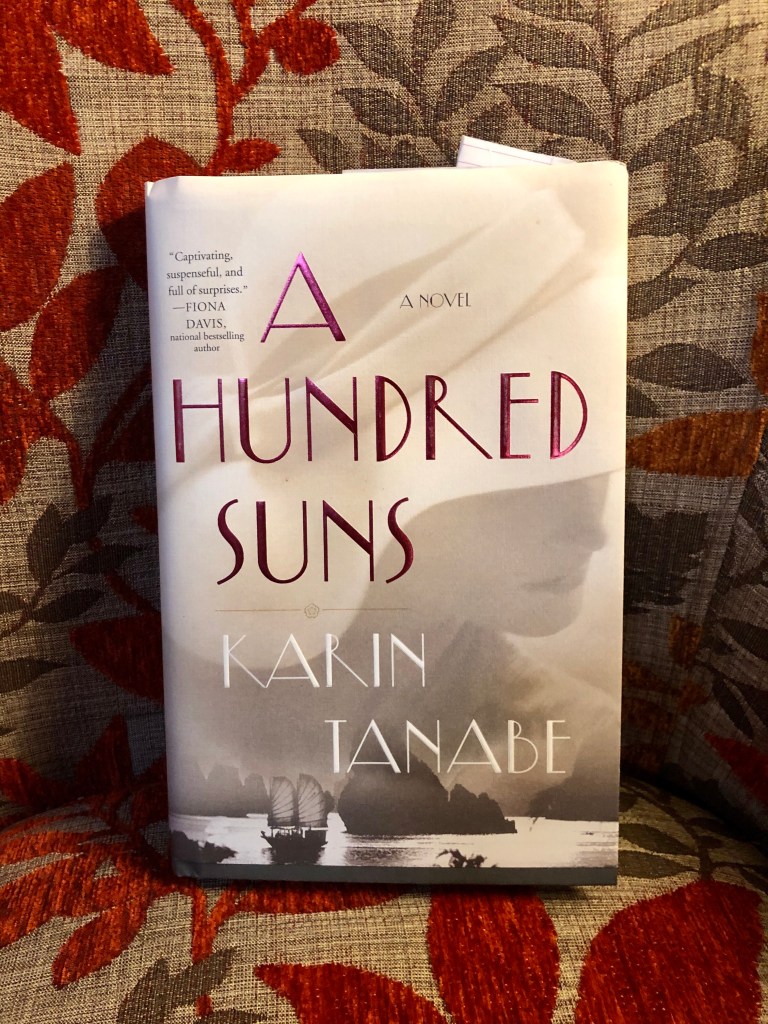
Nice font on that title, huh?

Tanabe is known for writing historical novels, and this one’s about Vietnam before it was Vietnam, in the 1930s when it was still French Indochina. It’s a period and place I’m interested in and wanted to learn more about, so why not learn history through a novel (it’s how I learned when I was young; those novels about Queen Elizabeth I sure were more interesting than history books, even if they weren’t 100% accurate; after all, neither are history books).

There is so much to like about the book, and I especially liked how each and every character in the book (French people, Americans, and Annamites (what Vietnamese people were called then)) had a fully developed personality. Like real people, each of them had admirable aspects and made plenty of mistakes. Each had prejudices but learned not to be so confident. You end up empathizing with each major character, even though they do some pretty icky things.

Ah, let us pause to enjoy some sedge seeds with curly tendrils. Also enjoy my lack of nails. I miss certain Vietnamese friends, who happen to also do my nails, a lot.

Tanabe, of course, weaves a lot of history into the narrative. You get to see the country from the eyes of the French colonists (ooh, la la, they were fancy), local people who tried to assimilate into French society, wealthy communist sympathizers, grass-roots communists, and of course, random mercenaries. I found it easier to understand the Vietnamese point of view on communism from this book than I did in books I read when I was younger, which all took the capitalist viewpoint exclusively (one character in the book was like me, neither colonial nor communist nor really capitalist…just wanting the best for everyone).

One thing I really liked about the book is how Tanabe portrays relationships between people of different cultures and races. As someone who’s enjoyed being close to Asians in the past and remembers how people STILL looked askance at it in the 1980s, I appreciated how the relationship between the characters Marcelle and Khoi in the 1930s was depicted. I’m so glad that people are much freer to love whoever they want to now.

I actually liked how she portrayed all relationships. She made arranged marriages make more sense, yet showed that both friendship and true love that can grow and change as people mature, as well. Here’s my favorite quote, from Khoi, the rich and handsome silk merchant, talking about two friends:

“We are not perfect people, you and I,” he said, “No one is. Even Anne-Marie and Sinh. I know we hold him up on a pedestal now, but he wasn’t perfect. We all have moments of weakness, of strength, of stupidity. But if we’re lucky, we’ll have even more moments of love.”

A Hundred Suns, page 340.

There were a couple of things that bugged me about the writing style of Tanabe. Sometimes she gets a little didactic and seems to be giving a history lesson rather than letting it come out through the characters. But, there IS a lot of historical context about rubber plantations and such to get through.

And she has a writing style that sometimes bothers me, where at the end of any utterance she inserts some bit of physical description of the character’s eyes, or skin, or something. I have no idea why that style annoys me, but it always seems like the author couldn’t find any other way to add these details, so they get stuck into the dialogue. And I always wonder if whether someone’s skin is tanned or not matters to the story (in this case, I’ll assume the main character’s deepening tan symbolizes her growing understanding of the Asian culture she finds herself immersed in).

Shoot, I’ve totally forgotten to say what the book’s plot has to do with. You see, there’s a nice social-climbing American woman named Jessie who gets her wealthy family sent to Indochine to escape her past. They are a part of the Michelin family, and the husband wanted to do more with tires and rubber and less with writing tour guides. Jessie meets up with locals, both French and Annamite, deals with her servants (fascinating in their own right), travels through the country, and gets drawn into intrigue as she begins to doubt her sanity. Mayhem ensues.

Wow, can I summarize a book, or what? Anyway, I’d say A Hundred Suns is worth getting a hold of. It will take your mind off the present, and you’ll get to meet a lot of fascinating people in an interesting historical context. You might as well learn something!

What? I Should Look at the Calendar More Often

Aha! I’ve been so busy dealing with the state of the world and the state of my job that I forgot to look at the calendar to see that I totally missed our “blog-a-versary” on April 11! While I’ve been blogging a LONG time, off and on, it’s just TWO YEARS for The Hermits’ Rest blog.

Be glad this doesn’t have sound. I can’t play piano and I can no longer sing!

While I’ve not become a super influencer or celebrity blogger, I’ve enjoyed creating a community of frequent readers and have enjoyed getting to know some fellow WordPress bloggers, which has been a surprising benefit. Enjoy some stats:

We’re coming up on 27,000 hits in the past two years. Not a lot, but not bad.

Followers, explained

According to the stats in the sidebar, 933 people follow the blog. I did not believe that until I finally figured out where all those people came from, which is social media. I figured out that Social is a combination of my Facebook and Twitter followers. Ah.

Continue reading “What? I Should Look at the Calendar More Often”

Book Report: Restoring Your Historic House

I saw a little blurb in This Old House magazine, saying this new book is a “must-read” for anyone restoring an old house. Why, I’m renovating an old house, which is close. So, I ordered two copies, one for me and one for Kathleen, of Restoring Your Historic House: The Comprehensive Guide for Homeowners, by Scott Hanson (2019). At 720 pages, it has a good chance of being comprehensive, anyway!

This post will have two parts, one in which I review the book, and the other in which I talk about the choices we have made on the Pope house that do or don’t follow Hanson’s recommendations.

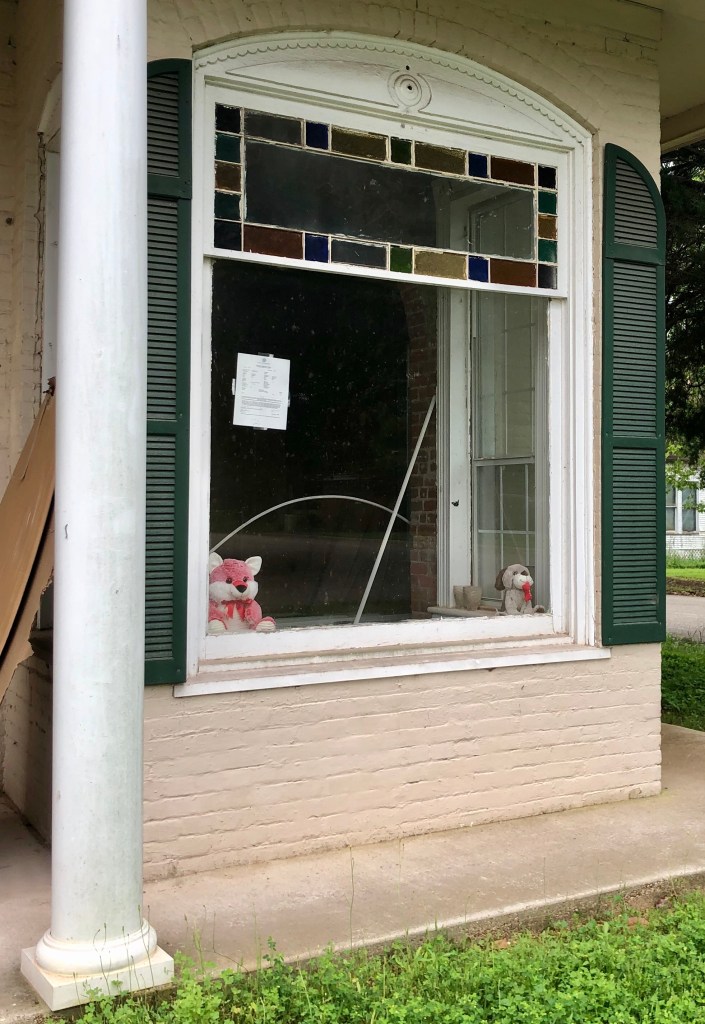
By the way, we now have TWO stuffed animals for kids to find, and we’re going to put Easter eggs in the window, too. Look at that original stained glass! Look at that trim! Let’s keep it.
Continue reading “Book Report: Restoring Your Historic House”

Book Report: Talking to Strangers

Another book finished, and I’m impressed that I got this one done in less than a week, since I’m also trying to knit some every day now. I bought Talking to Strangers: What We Should Know about the People We Don’t Know, by Malcolm Gladwell, because I really wanted some insight into how to communicate with people from different communities, cultures, social groups, etc.

Hey look, you can buy it, too. Trying a new embed format.

It turns out that the famous Mr. Gladwell (he wrote Blink, a book I didn’t like much at the time it came out) wasn’t exactly writing about what I thought he would, but I found the direction he took pretty interesting, anyway.

The question he really seemed to be asking was more like why do we let assumptions about other people, based on appearance, blind us to their real motives or intentions? He talks about cases we are all familiar with, like Bernie Madoff, who fooled all kinds of rich people into believing his really ridiculous Ponzi schemes and the pedophilia scandal at Penn State University, where Jerry Sandusky’s purported actions were dismissed until everything blew up and all sorts of people lost their jobs.

Don’t talk to strangers, said so many mothers. Photo by @tonyturretto via Twenty20

Spoiler alert: Gladwell says all of the misinterpretations of others’ motivations boils down to two main things: one is that we all assume that people we don’t know are telling us the truth. It takes lots and lots of evidence that something’s amiss to change that assumption. So, good ole Bernie M. was such a nice guy and friends of so many smart people, of course he was telling the truth! Gladwell points out that the assumption of truth is actually a good thing almost all the time. It certainly would slow down social interactions if you questioned everything anyone said to you, right? That lets skilled liars, or even unskilled liars, as he shares with a story about a Cuban spy in the CIA, keep doing what they’re doing.

Here’s one way to not read people’s motivations from their faces, right? Photo by  @pprevost via Twenty20

The second thing that makes knowing what a stranger is really up to hard is the assumption of transparency. This means how we expect that we can read people’s motivations from their appearance. As long as people act like our cultural norms predict they should in a situation, it goes well. This refers to looking afraid when you are scared or acting solemn when someone dies (Amanda Knox in an Italian murder case didn’t act sad enough when her roommate died, but really she was just socially awkward, not a killer). People who, like Knox, don’t telegraph their internal states can get away with lying or not be believed when they are telling the truth. In the end, that is one thing that caused that poor Sandra Bland woman to end up dead in a jail cell: she acted nervous when a police officer pulled her over and didn’t grovel properly, in his mind.

The other part of Talking to Strangers that I enjoyed a lot was a discussion of the concept of “coupling,” where Gladwell makes a strong case that inexplicable things you do are tied strongly to location and opportunity. Sylvia Plath’s suicide happened because gas ovens in England still had carbon monoxide in them. If she had tried to do it a year or two later, they’d have switched to natural gas, and she would have just gotten a headache. Another poet, Anne Sexton, killed herself by locking herself in the garage and turning her car on. This was just a short time before catalytic converters showed up in American cars, so this method wouldn’t work. Um, did you know that the profession most likely to commit suicide is poets?

That’s right. Don’t do it.

The point is, though, people think that if your chosen method won’t work, you go try another method, but the research on coupling has shown that isn’t true. When nets were put on the Golden Gate Bridge, people didn’t march off to another bridge to jump off. The motivation is tied to the place.

I haven’t explained that well. The section on coupling is the main reason I encourage people to read Talking to Strangers. I kept reading sentences aloud to Anita, because I was learning so much. The section about “pockets of crime” blew me away.

Photo by @yournameonstones via Twenty20

Now that I write this all down, it’s clear that Gladwell made a big impression on me with his viewpoints and the research that backs them up. It’s fun that he weaves recent events (and Hitler) into the analysis, because you always want to know how the heck these implausible events actually go down the way they do (why did Neville Chamberlain like and believe the words of Hitler?). I have a new perspective on why people just don’t “get” each other so often. Learning is good!

Sadly, I still don’t think I’m any better about talking to strangers. I think I’m even more cautious about it than I was before. Maybe that’s a good thing. Assumptions about other people tend to bite you in the…butt.

Highs and Lows of 2019

Questions!

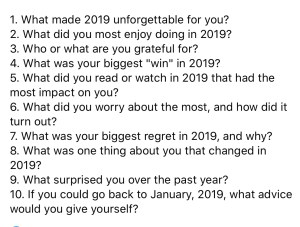
Yeah, so I said I wouldn’t be posting about goals for the year, but I didn’t say I wouldn’t pause to reflect a bit. I finally have a few minutes to actually do that, so I’m going to answer some questions originally shared by my friend (and brilliant writer) Teresa Pitman. I will also add some cheerful flower photos to prove it’s still colorful, at least among the tiny flowers outside our former church building!

What made 2019 unforgettable for you?

The most unforgettable thing is that other than one sentence when we ran into each other in the summer, my older son didn’t speak to me in 2019. I’m still at a loss about what the reason is, but I’ll never forget 2019 for that very unexpected turn of events. I honestly thought we had a good relationship and could discuss any issues that came up. It’s a mother’s nightmare, but dwelling on it and going through possible scenarios won’t help. I’ll keep waiting and sending love.

Common storksbill

What did you most enjoy doing in 2019?

There’s no one answer to this one! I crammed a lot of good stuff into the year. Here are some of my favorite things:

  • Riding on Apache and exploring the ranch
  • Playing with the dogs
  • Walking in Austin and at the ranch
  • Attending book club
  • Learning from Master Naturalists
  • Writing
  • Brainstorming in all my jobs
  • Traveling to beautiful places
  • Spending time with my family
Continue reading “Highs and Lows of 2019”

Book Report: Ragtime

I didn’t buy a hardback copy. But, it was a well-constructed paperback.

Proud of myself, I am, for finishing the latest book in the neighborhood book club series, especially since this is not something I would have picked out for myself. But, the assignment was Ragtime, by E.L. Doctorow, so I read it!

As someone interested in history, I did enjoy all the historical references and real people who came and went throughout the book, some of whom happened to be favorites of mine (like Emma Goldman, the anarchist). I think it helps to have some clue as to what was going on around the beginning of the twentieth century, though I guess you learn a lot even without any helpful background knowledge. This great review by the late John Brooks said it really well:

This mixture of fact and fiction may confuse or mislead the unwary or historically uninformed reader, and it suggests a projection onto the past of the suspect techniques of the New Journalism. I, for one, although no friend of that aberration, am willing to forgive any historical novelist who makes his flights from historical fact as funny and pertinent as Doctorow makes his. Like Houdini’s audiences, I am made to enjoy being fooled. As to the topical descriptions, they appear to be accurate enough to satisfy an exacting student of Americana. Certainly they are alive enough never to smell the research in old newspaper files that they must have required.

John Brooks: From the Archives: A review of E.L. Doctorow’s ‘Ragtime’, Chicago Tribune, March 05, 2015 (Suna’s birthday)

Now, as much as I enjoyed getting to know some fun details about historical figures, especially the imagined inner thoughts of Harry Houdini, the ground-breaking way the book was written seemed a little contrived and sometimes annoying. Here’s how John Brooks (a man of many more words than Suna) put it:

Continue reading “Book Report: Ragtime”

New Orleans. Old. Less Tacky Than I Feared.

Not a lot of time to write today. I’ll share that I am more charmed by New Orleans than I anticipated. And it’s not just noise and drunk people. Whew.

Random parades were fun. Someone is making a lot of money doing these.

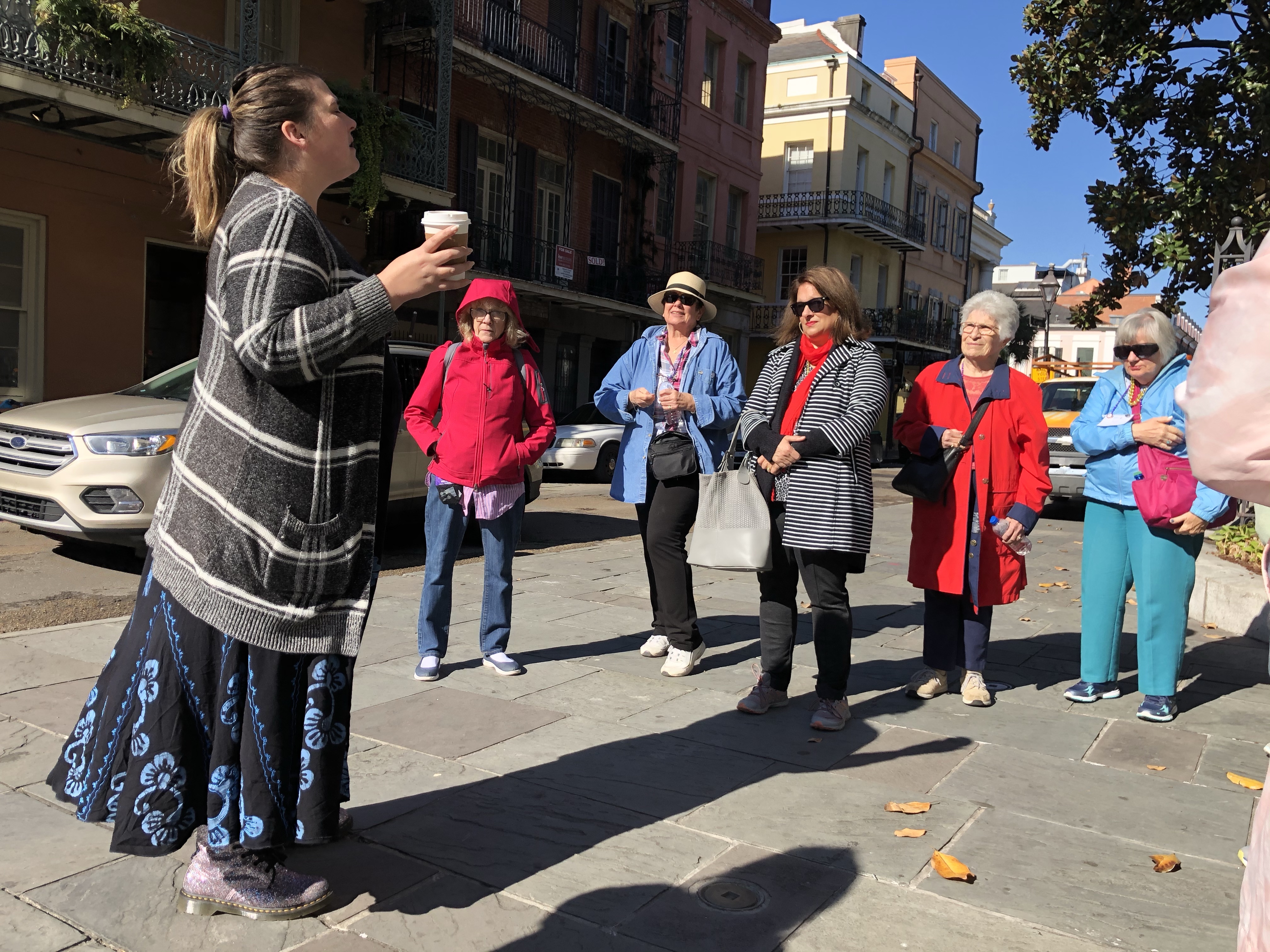
We went on a walking tour of the French Quarter today. Our guide was great and we learned a lot from her.

Stacy the tour guide entertaining our group.

But, no time to go into details. Just enjoy all these buildings. More later. Hope you’re having an okay weekend!

Continue reading “New Orleans. Old. Less Tacky Than I Feared.”

More Gentle Memories, Why?

Surprisingly, at least to me, I had a really had time dealing with the flood of memories that came up when I opened that box of letters Monday night. I had a huge reaction where all the things I used to feel about myself and other people whomped me but good. I really had boxed those events and emotions up in my mind as well as the actual box!

As I blurted that all out to my therapist yesterday (good timing, that was), she was able to identify what was happening. That always helps, when I know what the heck is going on in my brain. She said I was having an emotional flashback. That made a lot of sense. She then explained the stages of it, which include numbness, re-feeling all hte feelings and their accompanying negative ickiness, and moving toward forgiving yourself and others, which lets you remember that while we all do things we regret or that aren’t really the kinds of things we prefer, we’re all human and doing our best, at the time.

So.

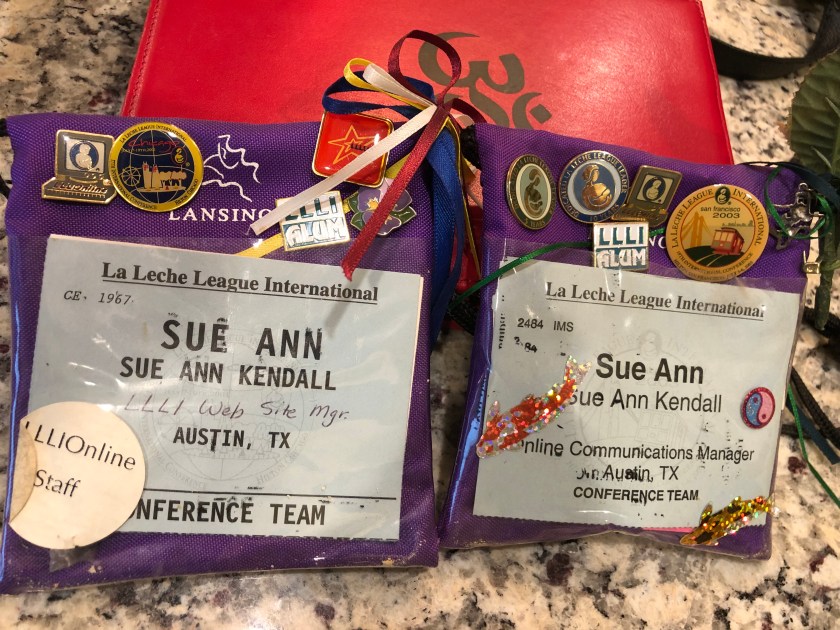
Also among the things I found were mementos of my time volunteering and working for La Leche League (breastfeeding support organization). I know I’m doing better about THAT time, because I no longer call it “a large, international nonprofit organization.” For a while there, I got sick when I said the name.

Oh heavens, look at all those memories! There are pins for each conference (2001 and 2003), our beloved LLLOnline pins (snazzy PCs in them!), LLLUSA (a quite dead organization I tried real hard to get to work well), the Alumnae organization (now Friends of LLL), and of course pins for how many years I served as a volunteer Leader. I’d really hoped for more years.
Continue reading “More Gentle Memories, Why?”

Memory Lane Is Very Dusty

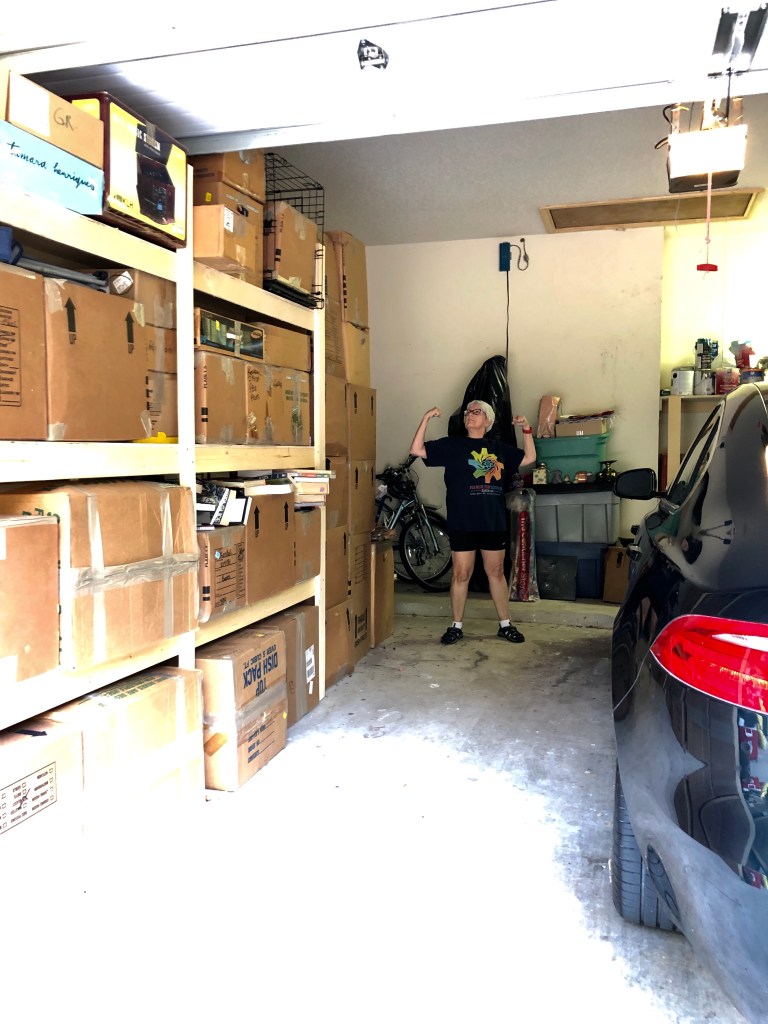
I thought my son who’s still speaking to me was coming over this evening, but when we realized he wasn’t coming, Anita and I had only one thought: let’s unpack more boxes! Sure, it was over 100 degrees again, but we hydrated and got to unpacking.

Anita is very proud of her hard work. Now we can park n the garage and be able to open doors on both sides!

Unfortunately, the first box we went after contained a faux flower arrangement that had been sitting in the “art niche” at our Braesgate house for close to 20 years. I’m thinking it hadn’t been dusted very often ever. I think we lost a couple of years of lung health as we picked up fake flower after fake flower, trying to find what was at the bottom of the box.

So much art on my art shelves now!

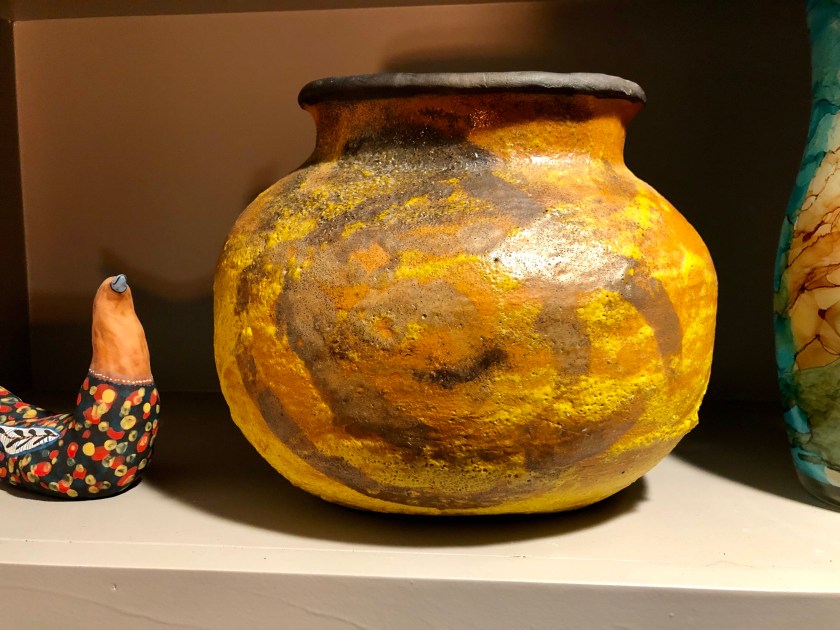
I’m certainly glad what was at the bottom was my Charlie Brown pottery vase. (He was a relative on my mother’s side who used clay from near the St. John’s River to make raku ware, which it turns out was a little brittle, so the top of my vase broke.) By the way, somewhere around the house is a Christmas ornament he made – the article I linked to above said Vice President Mondale had one in his house, too.

Continue reading “Memory Lane Is Very Dusty”

I Deserve an Award

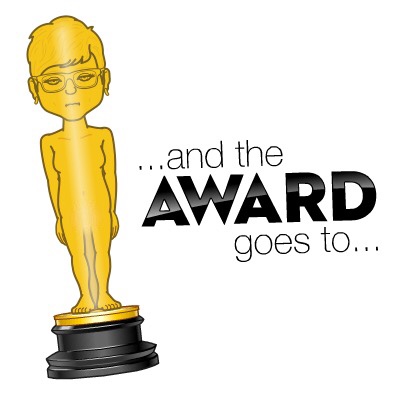
I don’t look thrilled to be a statue.

This whole unpacking of boxes in the garage and general removing unnecessary stuff from my house thing is not becoming easier for me. However, I am still doing it! Yes! And that’s why I honestly think someone should give me a gold star or something. So, I made myself an award on Bitmoji. I’m very proud of this award.

What keeps me going?

Certainly the lifting of heavy boxes of books and empty CD cases (Lee’s) is not a motivating factor. The heat isn’t helping (though it isn’t bad in the garage). Yeah, having more space in the garage is nice, but the real thrill is…

Continue reading “I Deserve an Award”