
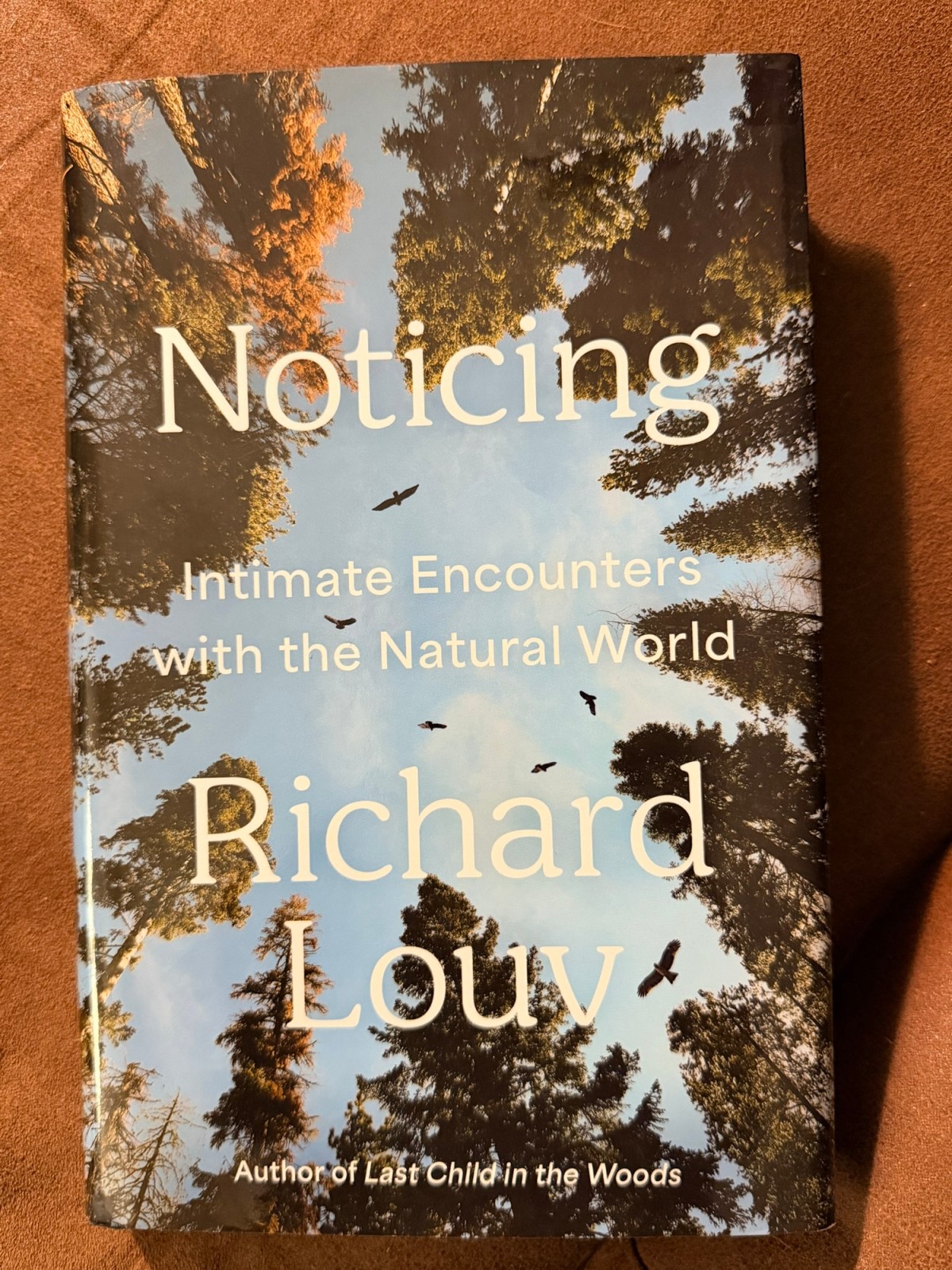
I’m on a real streak of fascinating nature books these days. Noticing, by Richard Louv (2026) is no exception. Lee found it in a bookstore and rushed it to me. Louv also wrote Last Child in the Woods a decade or so ago, which led many educators to try to get more natural world experiences into the curricula for young children.
Admittedly, most of the topics in Noticing are familiar to me, since I do spend a lot of my time, well, noticing. What I enjoyed were the interviews with researchers, artists, and philosophers about how being around nature affects us humans for the better. It gives me hope that humanity won’t completely lose its connections to the world of which we are a part–just a part, mind you.
Another reason I enjoyed going through this book is that it fulfilled my oh-so-human need for confirmation of my biases. Nothing is more soothing to me than going through hundreds of pages of discussion with people I completely agree with and who help me feel like I’m on the right track in how I live my life. It’s too bad there are so many folks out there who will go, huh? (I had a long talk with an old friend last night who literally shuddered at the idea of a life not surrounded by people and full of bugs and weeds.)

One of my favorite concepts Louv brings up in Noticing is that of having a First Place, which is where the book starts out. It rang so true to me. The first place you explore, get to know, feel grounded in, and feel a part of is your first place. Louv says:
Through the years, we live in newer places, and if we’re lucky, we bond with them. All these places become the geography of our lives. But there is only one First Place.
p. 13
My early memories of the first home I remember, in Gainesville, Florida, are very strong. I remember the plants, the insects, the heat, the wind, and the smell of camellias. I’ve written before about the fact that I am overcome with a profound sense of peace and “home” whenever I return. I think I’m attuned to the ley lines or some magnetic something that vibrates correctly with me.
I have not bonded with every place I lived. My last house in Illinois, the Bobcat house in Austin, and this ranch are the ones I feel most at home in. I find it a bit sad that I never could attach myself to the house in Round Rock where my kids grew up. I was interested in all the plants and animals in the surrounding area, but the crowded suburbs were too full of “noise” for me. Hmm.
That’s what the stories and science that intermingle throughout this book will do for you–send you off on tangents about your own experiences. If you are not someone who practices the art of active noticing, I hope you will read this book and give it a try. Your life will be enriched, you will feel more connection with the unity of the consciousness around you, and you will feel less alone. As the review on the cover by Carl Safina says:
This book is a how-to manual for getting back to your soul.
If nothing else, it’s important to remember what Louv shares in the future, which is we don’t necessarily have to fix things or bring them back to some ideal state. It’s also okay to simply observe how nature changes and adapts over time. That’s what it is supposed to do!

