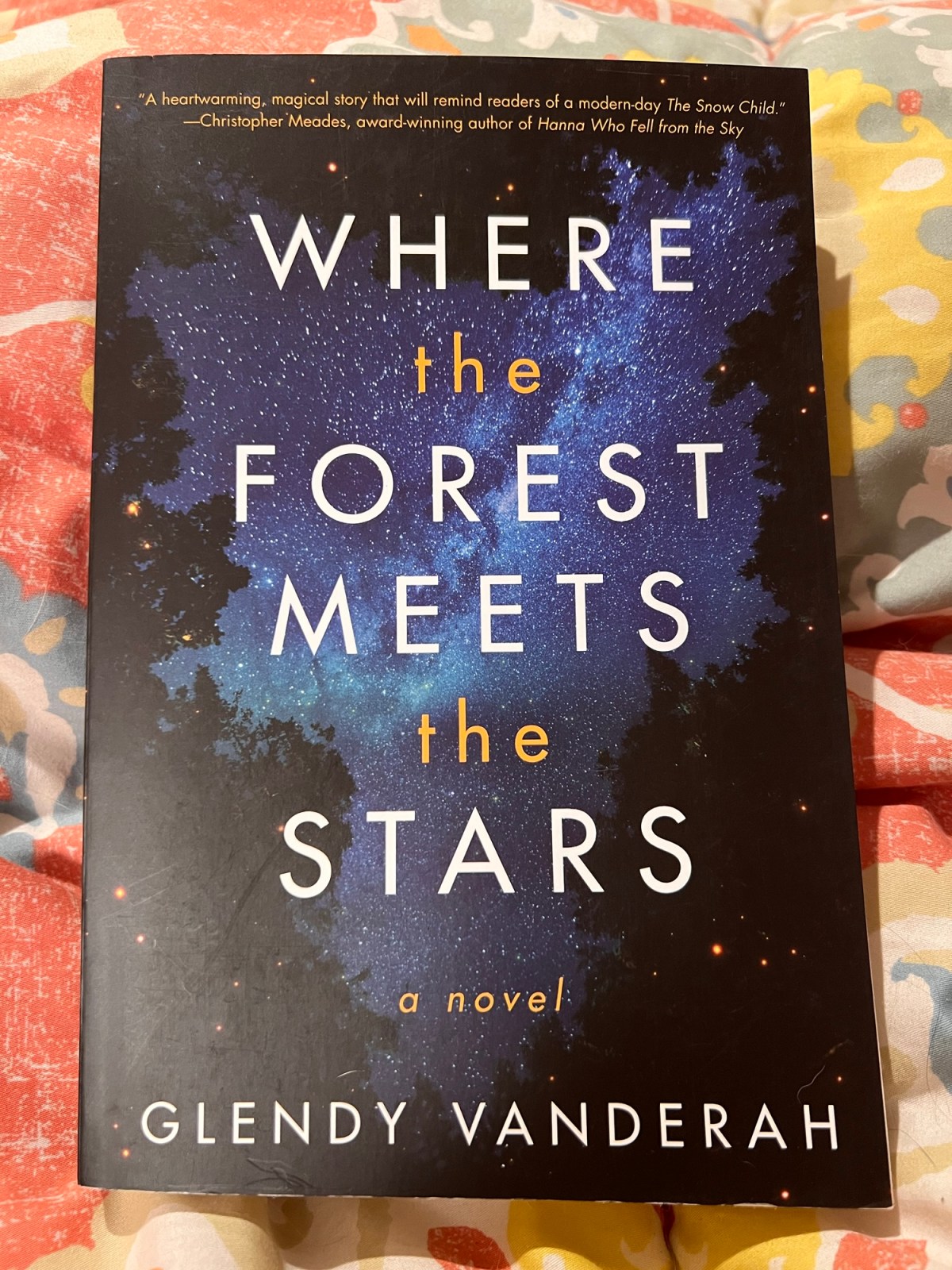
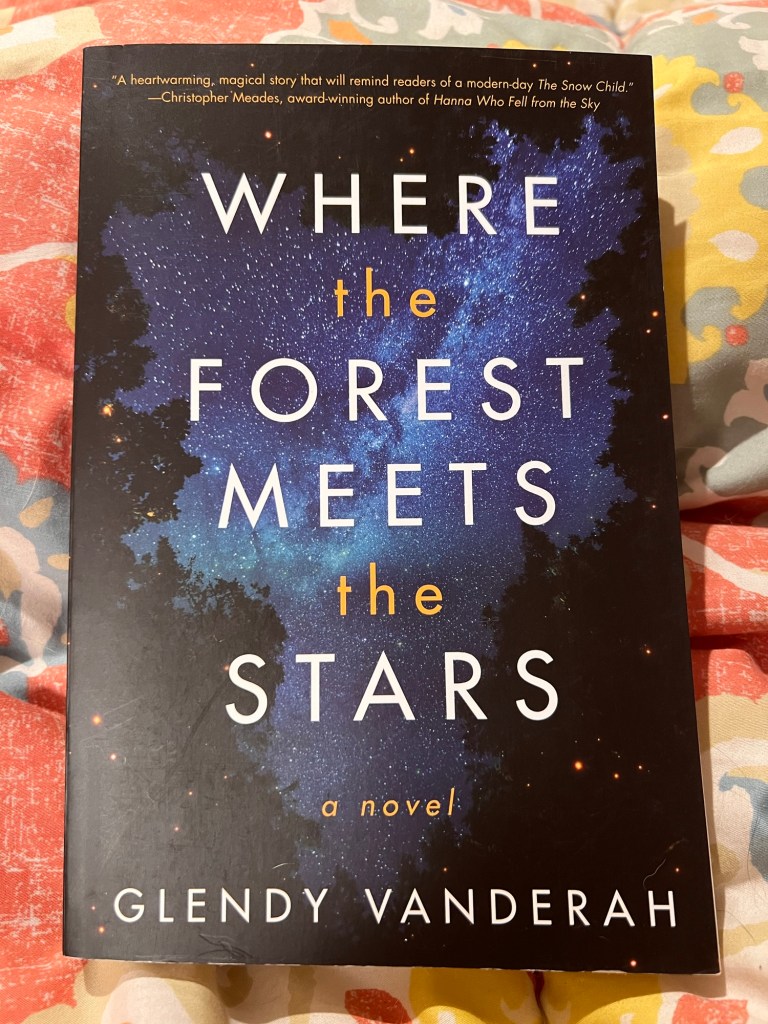
My friend Carolyn M recommended this book to me, because she said I had so much in common with the protagonist (and with the author). I’m glad she did, because the book is very sweet and took me down some literal memory lanes.
Where the Forest Meets the Stars (2019) is the first novel by Glendy Vanderah. She worked as an endangered bird specialist and apparently attended the same graduate school I did, in Champaign-Urbana, Illinois. This also describes the book’s protagonist, Joanna. That’s where the memory lanes come in. I was taken back to my twenties when I, too, traveled up and down Interstate 57 and wandered Urbana’s “state” streets, admiring the gracefully aging Tudor-style homes of my professors.
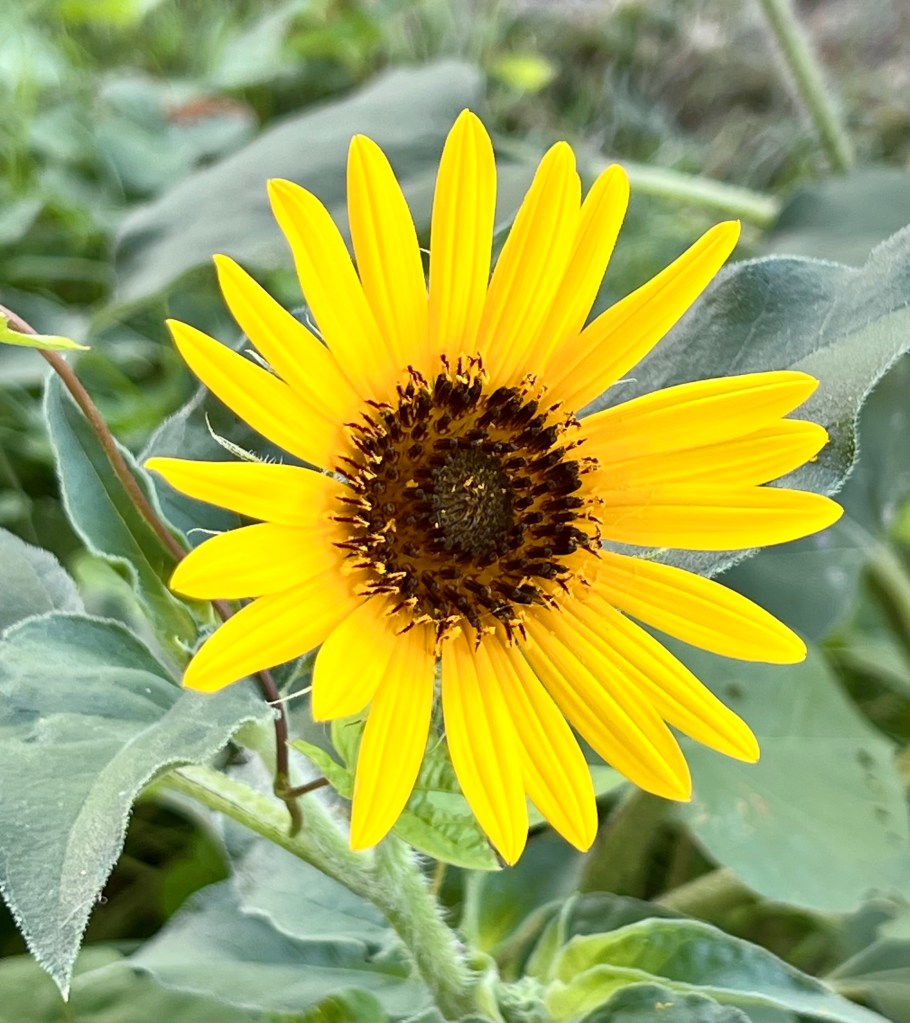
Illinois, too, has sunflowers on the roadside, out of the reach of pre-emergent herbicides.
The novel isn’t entirely about driving through east-central Illinois and its endless miles of corn and soybeans, though. There’s a mysterious young girl who claims to be from another galaxy, Indigo Buntings, cancer survival, and (of course) a love interest.
No, this isn’t the greatest novel ever, but it’s an enjoyable read and the plot twists are fun. It was perfect for making a long plane flight feel short! And I have to say I ended up fond of all the characters, both major and minor.
I’m happy to share this book with someone local, but it would cost less to order a used copy than for me to mail it. You might find that the little girl from space provides a nice respite from whatever is burdening your mind, plus you’ll get a glimpse into the place I lived from 1980-1998.
I’ve been meaning to write about the latest Elizabeth Strout novel, and since I was wrong about going camping this afternoon, I suddenly have time. I guess I should have asked someone if we were leaving the day we originally planned. That’s what you get for making assumptions. I make an a** out of me. And, sigh, we have to leave a day early because I have jury duty Monday, I’m a bit pouty. I really want to go camping. We haven’t been in so long.
Must deal with these results of the investigation into why the bedroom slide won’t move. It needs professional help.
However, I did read this book, so let’s talk about Tell Me Anything (2024). As soon as I realized there was a new book in this series (I’ve reviewed them all on this blog, so you can search for Strout and find them), I ordered it. I was very interested to find out what was going on with the characters in Crosby, Maine, since the pandemic, so I dove right in. I was happy to see that this installment concentrated on good old Lucy Barton and her friend Bob Burgess, as they cope with a local murder.
As with most of Strout’s books, the plot is secondary for me. I just enjoy how she tells stories. Her style is so spare, and her use of repetition and the narrator jumping in with bits of information, just enough information. And as always, you get insights into how people think, act, and work from points of view you’d never considered before. I just love the pithy parts.
An imaginary Maine coastline.
I underlined and marked many passages that I can no longer see, but my favorite one was this part of a conversation about the meaning of one of the stories two characters shared with each other:
That was about the same thing that every story Lucy and I have shared is about. People suffer. They live, they have hope, they even have love, and they still suffer. Everyone does. Those who think they have not suffered are lying to themselves.” p. 315.
Actual small town in Maine. Photo by Leah Newhouse on Pexels.com
The people in the book are also fun for me. They are all so fully formed, with wonderful features and fatal flaws. They are real in the best way. I love how married couples are treated here. They have days where their spouses get on their nerves, then days where they don’t know what they’d do without them. And there are divorced people who don’t hate each other, but are glad to no longer be married. It’s refreshing to be able to feel empathetic with human beings who can be inconsistent, think judgmental things about others, but still be doing their best. I feel less alone.
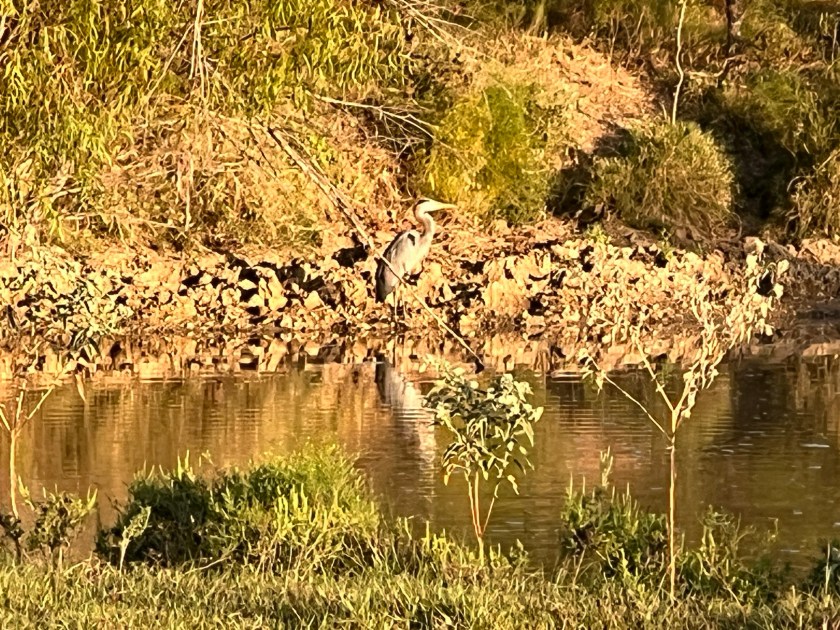
There’s always time for reflection, like the heron is doing. These books inspire you to reflect on universal truths and intimate insights.
One more thing is that I was glad to see that Strout introduced a few new characters, since the “old” ones are mostly getting old. Olive Kitteridge is now 93! I can’t wait to see how she weaves them into the continuing saga as she follows them on through the scary 2020s.
I wanted to finish this book before I went on vacation next week, so I indulged myself and spent much of the day today finishing Weyward, the debut novel by Emilia Hart (2023). My local friends who are in a book club together kept talking about “the book” and how they knew I would like it, so eventually it got passed on to me.
Of course I liked it! If a book had “Suna Shoukd Read Me” on its cover, it would be this one. It’s even set in the area from whence my ancestors came (Cumbria). And there’s a Viscount of Kendall hereditary title in the novel, which is totally made up.
But it’s the women who are linked by strong blood ties as well as ties to nature that draw you into the story. Like many novels, there are parallel plots in different timelines that eventually come together. And there’s a thread of the supernatural that’s not over the top.
Basically, I enjoyed Weyward because it felt like it could depict a distant branch of my own family. I just have to root for a bunch of dark-haired, dark-eyed, weird women who understand nature better than those around them. They are just like me, only more so.
I recommend this book to anyone who likes strong female characters, fantasy novels that aren’t over the top, and clean, consistent writing. Of course, I think a large percent of my friends have already read it!
Now I can give the book back to Ann, who can return it to her son, who kindly embossed his name on page 100, like I used to do.
One of the main things I’ve been doing while in Hilton Head is read. My crochet project really isn’t working out. I think I’ll try it with different yarn and do something else with the yarn I started on. Anyway, I just read The Dictionary of Lost Words(2022), by Pip Williams, an Australian novelist.
I was probably doomed to love this book, because it’s about words and touches on topics I’m fond of, like women’s rights. Of course, it would need to be written well, and for sure, this book had some beautiful writing. My friend who had already read this book got a look on her face like bliss when she described how much she enjoyed Pip Williams’s writing.
One of my favorite aspects of the book is that, while it’s fiction, its plot is woven around real people and real events. The novel follows the progress of the Oxford English Dictionary‘s first edition and the dedicated lexicographers who put it together. What a monumental undertaking THAT was. I was fascinated to learn how Dr. Murray and his team compiled words and definitions. Ooh, so much intrigue went into all that editing and defining.
The most important thing that Williams does by sharing her writing with us, though, is highlight the contributions that women made to the dictionary, which (naturally) was overlooked at the time. She winds information about the state of women in the late 1800s and early 1900s, including how different the lives of women are from different social strata. I was impressed at how respectfully Williams treated women of all classes and brought them to life. I loved how the elderly former prostitute with a salty vocabulary is also depicted as a skilled woodcarver who is wise in ways that are helpful to the protagonist, Esme.
Esme isn’t real, but her story resonates with anyone who’s led a life as a woman today. I could easily see myself dealing with the problems and dilemmas Esme faces, as well as how she learns about life, love, and death. Williams doesn’t sugarcoat the hardships women endured in the days before women had the right to vote, to contribute to work, even to be a “scholar.”
Sadly, I see some of the issues the women in The Dictionary of Lost words face are still facing so many women today. As we lose our reproductive rights, we need women like the former prostitute, for example. The societal information about how life was during my grandmother’s youth was sobering, but the ways that women worked to contribute to society and make things better ring true today.
And as for the words, oh, it was my idea of a good time to see how Esme collected women’s and common people’s words, the ones that were deemed too coarse for the OED. She was a linguist after my own heart (I did research on the language of Japanese women when I was an academic).
This book makes you wish it would never end, because you end up very fond of the people you meet there, like Lizzie the servant who Esme relies on her whole life, or Ditte, the aristocratic academic who contributes hundreds of definitions to the dictionary (she was a real person). And yes, the men in the book were also well rounded and enjoyable to read about.
I read this in the Kindle app and finished on my new Kindle Scribe e-reader, which I’ll review after I’ve used it more. It takes a while to get used to this way of reading, that’s for sure. And setting up the new device at the hotel was challenging. But, I enjoy the size, quietness (I hate phone noise and computer fans), and lack of reflections in the Kindle. It’s much easier to carry around than books. Don’t get me wrong. I like books. No, I love books. But at my age, I’ve pretty much filled up my house with books. I’m hoping to be able to upload my knitting PDFs to the Kindle and mark where I am on them. That would be oh so great.
What? A book report? I know, I haven’t been writing many of these lately (for all two of you who read them). But, between all the crafting and horsing, there hasn’t been much reading other than the huge number of magazines (mostly about horses and houses) that I devour every month or week. For some reason, I subscribed to People when it replaced a magazine I liked that went out of print and finding out what is happening to the same small group of “famous” people each week takes a LOT of my time. People seems compelled to tell me who this Pete Davidson person is dating every week, which, I must admit, is a new person most weeks. Why anyone should be so interested in a not-that-funny comedian is beyond me, but hey, at least he isn’t tweeting swastikas.
This woman can WRITE
And now let’s talk about the book I did read, which is Lucy by the Sea, by my current favorite author, Elizabeth Strout. You may recall that I have read a lot of other books by her, since the old book club read one of her novels a year or two ago, before I became an outcast (which may explain why I haven’t been reading many novels–there’s no one to encourage me, and novels remind me of being rejected so resoundingly by “friends” from my old neighborhood).
I need to be more like Lucy Barton, the protagonist in this book, who was raised outside of society, so misses social cues a lot. In some ways, that can be a relief. Anyway, this book covers recent years in the life of Lucy, during the pandemic and the previous US President’s time in office. Her ex-husband takes her to Maine to escape New York City just before the really bad COVID outbreak hit there.
Strout shares Lucy’s impressions of the ensuing events in her gloriously spare style, where you sometimes have to sit there and think about a sentence for a few minutes, because there’s so much implied but not stated. And because of Lucy’s unconventional upbringing, she is able to see some of the events of the past few years differently than folks like me would see them, which led me to think hard about some of my prejudices against people of different backgrounds from mine. This pleased me. I think many of my friends ought to read this book just for the chance to get a glimpse into how another person thinks.
Lucy is not someone who’d probably be my friend in real life, but she’s someone who can teach me a lot, and that’s better, I think. The way she sees the world clarifies my own world view (I’m not being too specific so you can read the book yourself and have your own “aha” moments.) But, here’s something I enjoyed, when Lucy is talking about God to a friend:
It’s our duty to bear the burden of the mystery with as much grace as we can.
p. 150
That sums up God for me.
One more thing Lucy thought of that rang true was when she talked about people you meet being like ping pong balls bouncing into each other, and how inevitably, you will bounce back a little. But you never know who the ball will next bounce into, even briefly, and have an effect. (She says it better than that.) (pp. 186-7)
If you are my friend or are experiencing life these days as confusing, I think you should get this one and read it slowly, savoring it, as a lot of people I know have been doing. It will stick with you! (And PS, Olive Kittredge, from the first book, shows up in the periphery, so this book nicely ties in the whole Olive and Lucy series.)
It’s been a while since I did a book report, but no, it’s not because it took me that long to read The Lincoln Highway, by Amor Towles (2021). I spent the last number of weeks knitting and reading magazines (and I admit, not reading very much of Oh, William, by Elizabeth Stroud, to savor it). This big, fat book of 500+ pages took me only three days to read, because once I started, I kept saying, “One more chapter…” many chapters in a row. Yeah, it was a good book.
Maybe there will be a volume 2 and they will finish going down the highway.
Once again, I am grateful to the Bobcat Book Club for deciding on a book that I’d never have chosen for myself based on its description. But y’all, if you want to take some time away from your troubles and go on a Heroic adventure about Heroic adventures, here’s a book for you! I can easily see this book becoming part of undergraduate humanities classes where you assign The Odyssey and every other epic journey…then conclude with this book and tell the kids to go write their term paper on the themes therein.
I give Amor Towles a lot of credit for building out the many heroes, both tragic and triumphant, who flow through the book, weaving and interweaving their stories and adventures into a big ole bundle of enchantment. You just can’t wait to find out who does what next or to fall deeply into the backstory that makes you think you’re suddenly in The Canterbury Tales. Geez, this book really IS like a long demo of all the forms of storytelling in Western Civilization, all presented in modern language. I’m glad Towles didn’t try to shorten the book by skimping on any of the stories. Stories are important, all of them, and that’s what he tried to convey in this book!
This is one of those kinds of books where you find yourself growing so fond of the characters that you don’t want it to end. They are all so multi-faceted, and of course, each hero has his or her own fatal flaw. You can draw a lot of lessons from them, too, like how people who are labeled “criminals” may well not be and people who label themselves as “good guys” may not be. A little bit of humanity makes a story a lot of fun and will get you through any overly contrived coincidences and improbably good timing.
I invite you to sit down and get to know Emmet, Billy, Duchess, Woolly, Sally, Sarah, Ulysses, Pastor John, the nuns, and of course, “Dennis,” the only completely unlikeable character in the whole book, who is never without his quotation marks. Adventure awaits!
(And hey, thanks to all of you who were so fascinated by photos of an old cabin that I had my biggest day of blog stats ever yesterday. I do know book reviews are not the big hit generators.)
This is certainly not the kind of book I usually read, but it’s what the Bobcat neighborhood book club chose, and I want to stay in the book club, so I read it. As many of you who read this book years ago already know, A Year in Provence, by Peter Mayle, came out in 1989 originally. The copy I have contains an update from ten years later.
Much wine and pastis are consumed in this book. And why is that doomed fox smoking?
This would not be a beloved best-selling novel if it didn’t have its charms, and Mayle most assuredly can paint a picture of a culture in just a few words and a few bucolic tales of the neighbors and neighborhoods. I think any Francophile would just love the little vignettes and word portraits of the people in a remote area of Provence and how their activities and non-activities change from season to season.
There’s the problem. I’m not, alas, a Francophile, even though I once married one and have beloved friends who adore France. Too many years of watching French cinema could be a cause. Or it could be the particular set of grumpy, chain-smoking French people with strong superiority complexes I’ve known. (Before you rebuke me, I realize there are plenty of people in this continent who could be characterized similarly.
I didn’t find the way the contractors working on the house just disappeared for months with no warning nor any explanation (this may be because our pool workers have done the same). I didn’t find the smelly, mean-spirited neighbor, who Mayle seemed totally enchanted with, at all fascinating. He reminded me of half of Milam County, Texas.
And I know he was a sweet old man with much going for him, but Mayle came off to me as someone with more money than he knew what to do with, and no ability to make his own decisions. He just went along with everyone else and their ideas and timetables. Oops, I hope I didn’t just describe myself. I may have described how I must come across sometimes (I assure you; I do NOT have more money than I know what to do with–each horse and swimming pool expenditure comes with sacrificing something else and with the sad bonus of annoying my dear spouse).
This book review is not about me, it’s about Provence, an area of France where it gets quite hot and is often very windy…much like Milam County. Maybe I found too much of my own life in this book to find it a real getaway.
Oui, c’est un gros trombone – I did not know paperclip was “trombone” in French.
And also, I’m a linguist and all that, but I didn’t know what a lot of the words in the story meant. I’m not ignorant in French, but I wish more context from which to figure out the meanings of some of the liberally sprinkled French words and phrases had been included. Some of us studied Spanish, you know.
Still, anyone will enjoy some of the little bits you learn about Provence, the stories of grapes and mushrooms, and learning about how hunters of over thirty years ago a lot like the ones are today (they need their modern conveniences!). At least there is a lot less trash on the side of the road after hunting is over in Texas. You can enjoy a few days with this book and not get upset, angry, or bored, so it’s worth a shot.
Monsieur Renard is not happy about what is happening to the fox on the book cover.
My favorite part of reading A Year in Provence, though, was that I got to use my new bookmark that I got in Breck. It’s a cool fox, or dare I say, renard, on it. Its little face looks “très amusant” peeking out from the top of a book. I can’t wait to use it again.
I didn’t think I’d love the writing in a book as much as I loved Olive Kitteridge, but here I am, prepared to gush over Olive Again, by Elizabeth Strout, the woman of the bestest words ever. I keep reading paragraphs over and over, just marveling at how Strout manages to capture the inner lives of her characters so succinctly, yet evocatively. As I read her work, I am constantly seeing vivid scenes and smelling all the smells of Maine, yet she doesn’t write long, descriptive paragraphs full of endless adjectives and adverbs. Nope. She uses just enough words to do the job. That’s a writer, all right.
As always, Olive appears in each chapter, though she is often not the protagonist, and most chapters aren’t from her point of view. You get to meet many new people, as well as some of the folks from the previous book, and see how small things affect their lives so profoundly.
You learn that people really, really, don’t understand what’s going on in other people’s lives, and especially in their minds. I really needed some of this knowledge this week, as I come to grips with the fact that there are people I have known all my life who live in an entirely different reality from mine, and for whom the facts as I see them just aren’t relevant to them. It’s the same in Crosby, Maine.
Thanks to Strout, I learned many new definitions of love, too, and how it fits into people’s lives and fills the gaps in their loneliness. The point in both the Olive books seems to be that bad things happening isn’t the worst part of people’s lives, it’s a lack of connection to others. I think she’s absolutely right about that. Here’s what the character Bobby says in the “Exiles” chapter:
And it came to him then that it should never be taken lightly, the essential loneliness of people, that the choices they made to keep themselves from that gaping darkness were choices that required respect.
p. 195
If I were writing an actual book report, I’d cite Bobby’s musing as Strout’s “thesis statement.” That’s the essence of both the Olive books.
And what fills my heart with comfort is that each individual you glimpse in this book finds their own reason to keep going and to figure out their path in life. I’m going to borrow the reason that Suzanne states in the chapter called “Helped.”
I think our job – maybe even our duty – is…to bear the burden of the mystery with as much grace as we can.
p. 116
This type of spirituality permeates Strout’s writings. She sees the divine in Nature and never lets the reader forget it for one second. I’ll see her sparkling waters and intensely yellow autumn leaves often in my own mind.
This was the book I needed to be reading right now, today. I hope you pick it up and it speaks to you, wherever you are on your life’s path.
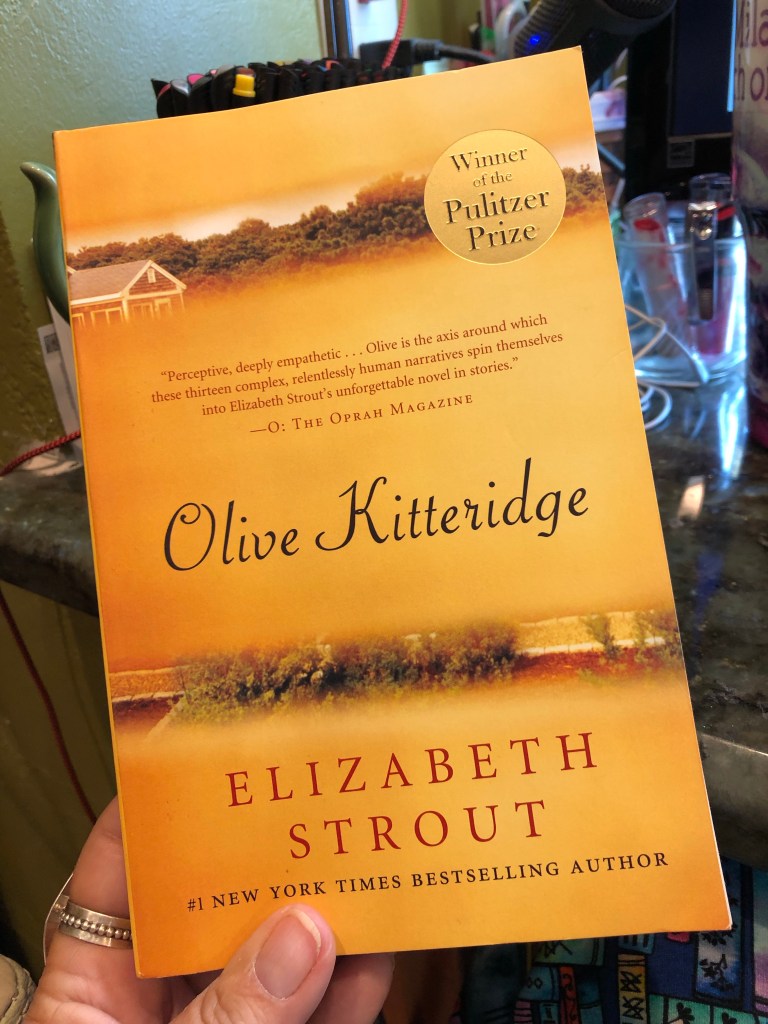
A friend recommended I read the books by Elizabeth Strout on Olive Kitteridge, because I said I was interested in good character development. I ordered them, and just finished Olive Kitteridge. It’s a quiet masterpiece.
The book is a series of short stories, sort of, though the same people in a small Maine town appear and re-appear. Olive, a large sorta grumpy woman is the pivotal character who appears in each story. It’s fun to wait and see how she turns up and how the other people perceive her.
I love how normal and real the people in the stories are, but also how they each have personal tragedies that shape them. One theme I detected in the book was of people daring to do something unexpected or out of character. It usually works out well, but not always. It reminded me of my own attempts to get out of my shell, tell my truth, or speak up. Only mine tend to backfire. Never mind…
I did find many beautiful phrasings and observations about daily life, beauty, and appreciation of your current moment. But mostly it was about feeling lonely.
When he was in town, it seemed he saw couples everywhere; arms tucked against each other in sweet intimacy; he felt he saw light flash from their faces, and it was the light of life, people were living.
Starving, p. 99
And she has an amazing way of showing how disconnected and lonely people can let themselves be. I felt like framing a couple things Strout has her characters think or say.
It’s just that I’m the kind of person that thinks if you took a map of the whole world and put a pin in it for every person, there wouldn’t be a pin for me
Criminal, p. 236
What I get from Strout’s interrelated tales is that we can all feel our separateness deeply, and we all seek intimacy in our own ways. I’m grateful for all the glimpses into everyday intimacy that the stories in Olive Kitteridge provide. I will probably turn to this book often just to re-read some of the words and slip back into the feelings they elicit.
Great book. Thanks so much to the friend who recommended it!
I was sort of sad to finish my latest relaxation read, A Girl Is a Body of Water, by Jennifer Nansubuga Makumbi, because I sure was enjoying my education in the culture, food, and clothing of Uganda. Basically, all I knew about Uganda before was Idi Amin, and he certainly isn’t something worth representing an entire culture with. Well, and I knew the Gandan people spoke Lagala there (among other languages), from when I studied linguistics. I guess that put me one step ahead of most people in my culture.
I also really like the cover.
Do you have to be interested in the culture of Uganda during the 20th Century to read this book? Absolutely not, because the story is beautiful, interesting, and very captivating. You grow to love the characters as you learn more and more about them, especially Kirabo, the main character, and Nsuuta, the blind woman of mystery who is inextricably linked to Alikisa, Kirabo’s grandmother. You just want to know what’s going on with this fascinating and many-layered family!
But for me, the information about traditional Ugandan culture, how it changed with colonialism, through Amin’s reign, to more modern times, was fascinating. The book does a fantastic job of delving deep into the traditional and modern roles of women in Uganda, which parts change and which parts stay traditional. Many of the women Makumbi writes about were among the first to try to do things differently, and you might be surprised at some of the consequences and who encouraged and discouraged them. The way feminism and traditional roles came together in A Girl Is a Body of Water was really skillful.
Makumbi does a great job of introducing new Ugandan words, ideas, and concepts in the course of developing the plot, so it’s easy to learn as you go. I found it fun to try to figure out what some of the words meant, especially foods and items of clothing. I admit to looking some words up, like luwombo, which is a kind of stew-ish dish served in banana leaves. Some words, though, I waited until I could figure them out from context. That is MY idea of a good time. YOU might want to keep Google handy.
Luwombo, from an online brochure. It can feature any meat.
The culture stuff was really fun to learn, too, like what constituted beauty to them, how who was related to whom was calculated, who counts as “family,” and how the deal about having multiple mothers in households with more than one wife worked. It sounded like a lot of love, actually. It was fun to imagine living in a society so different from mine, with different mores and guidelines, but that made perfect sense in its context.
I’m glad I finally was able to get around to reading this book, which I’d had to put off for a while. If you are like me and enjoy learning history through the eyes of women in a culture, you will enjoy this book very much. It’s going to stick with me, and I’ll always wonder how Kirabo did after the book ended. Hey, a sequel, that would be fine with me!









 The Hermits' Rest