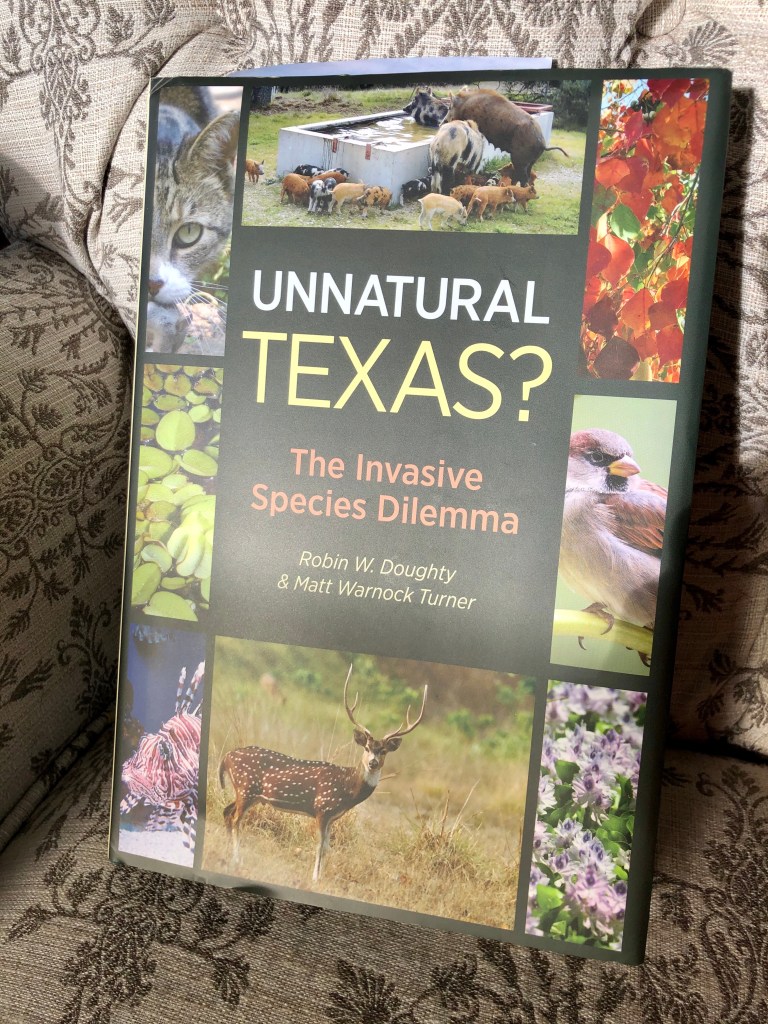
Hey from Austin! You didn’t think my holiday was all traipsing through the mosquito fields and staring at the ocean, did you? Of course not. I also read a lot. Admittedly, I read a few magazines, but I got deeply into this book, which I got at the Texas Master Naturalist Conference a couple of weeks ago. It’s whole title is Unnatural Texas? The Invasive Species Dilemma, and it was written by Robin W. Doughty and Matt Warnock Turner.
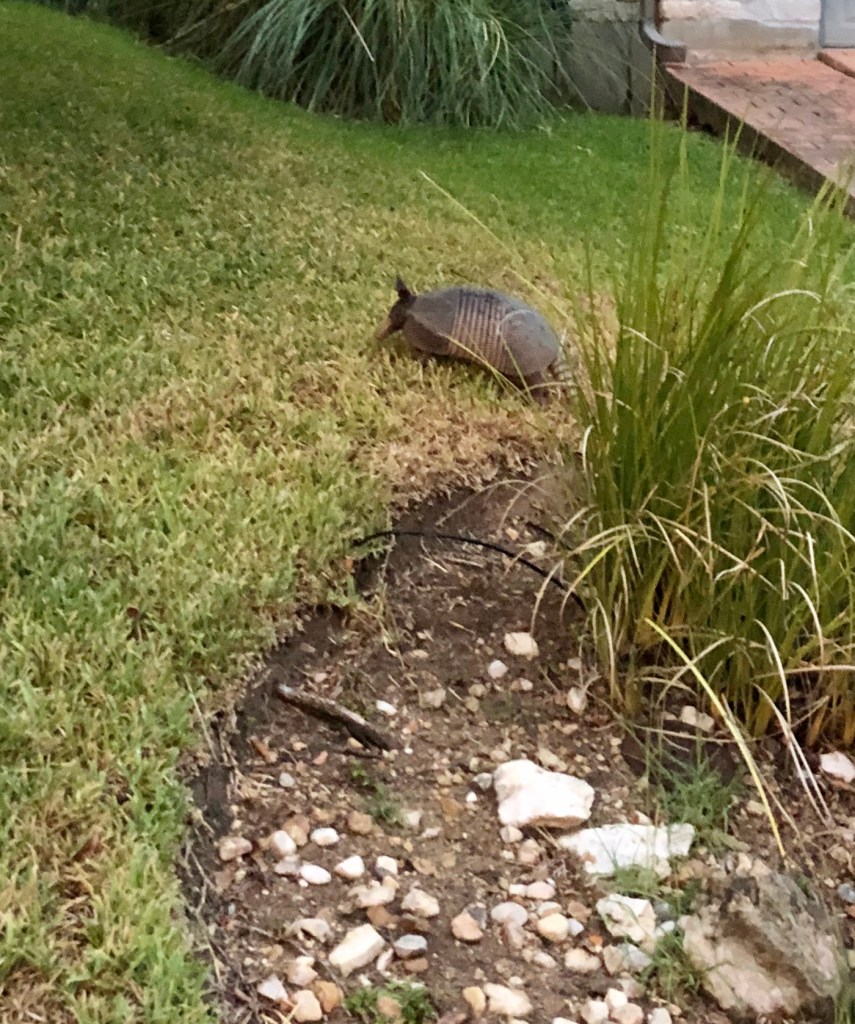
The authors didn’t want to put “invasive” in the first part of the title, because, as they frequently point out, none of the plants and animals they talk about actually invaded in the first place; someone brought them to this continent. In fact, the only animal who’s actually “invaded” that they talked about is the nine-banded armadillo, who’s been going farther and farther northward, on its own, for the past couple of hundred years. (I would add to this list the caracara/Mexican eagle and a couple of other birds that are coming northward since it’s getting warmer).
The book I read all in one day is The Art of Racing in the Rain, by Garth Stein (also a major motion picture, which I did not see). There seems to be an entire genre of books written from the viewpoint of dogs, these days. In fact, here’s a list of them from Amazon, and you will see it includes a book by a human with “dog” in their name.
As for this book, it’s both about racing and being a very intelligent dog observing a life. Like A Dog’s Purpose, this one posits that dogs are put on earth to protect or care for a family. When they are done, they go away and come back as something else. For our book’s dog, named Enzo, he is convinced he will come back next as a human, and he’ll know so much stuff, especially about racing cars.
I can see how this book became a “major motion picture,” because the people in it are not quite as complex as the inhabitants of the last few books I’ve read. The race-car driver dad is just plain good, with just a hint of temptation to be bad. The lawyers are just plain lawyers.
Here’s a random fact about me: I really love to read memoirs, especially of my favorite musicians from the seventies. Some are definitely better than others (like Keith Richards’ memoir, dang that was some good writing). So, I had this book by Elton John pre-ordered and got it the day it was published last week. I’d enjoyed the movie a lot, especially the costumes that were exactly like what he wore in real life, but I was interested to see if his own words differed from the cinematic portrayal.
It matches the movie
Luckily I finished the other book I was reading, so I could delve right into this one. And delve I did. At first I didn’t like the writing all that much, but soon enough, I was trying to keep my eyes open every night so I could read more. Yep, he was an interesting guy. He is also an honest guy. No sugar-coating of his less than stellar qualities for him!
I’ve read a couple of books recently where the author remarks that random decisions or meetings changed the course of their lives dramatically and mused about what would have happened if person X hadn’t been in the shopping center on the right day, or whatever. Elton John does this, too, but I liked his conclusion that all his mistakes, lucky coincidences, and random choices made him the happy man he is today, so it’s all fine by him.
I just thought this was pretty, and it’s here to remind me to tag when I finish writing this.
I have to second that, myself. Every “mistake” contributes to your growth and wisdom.
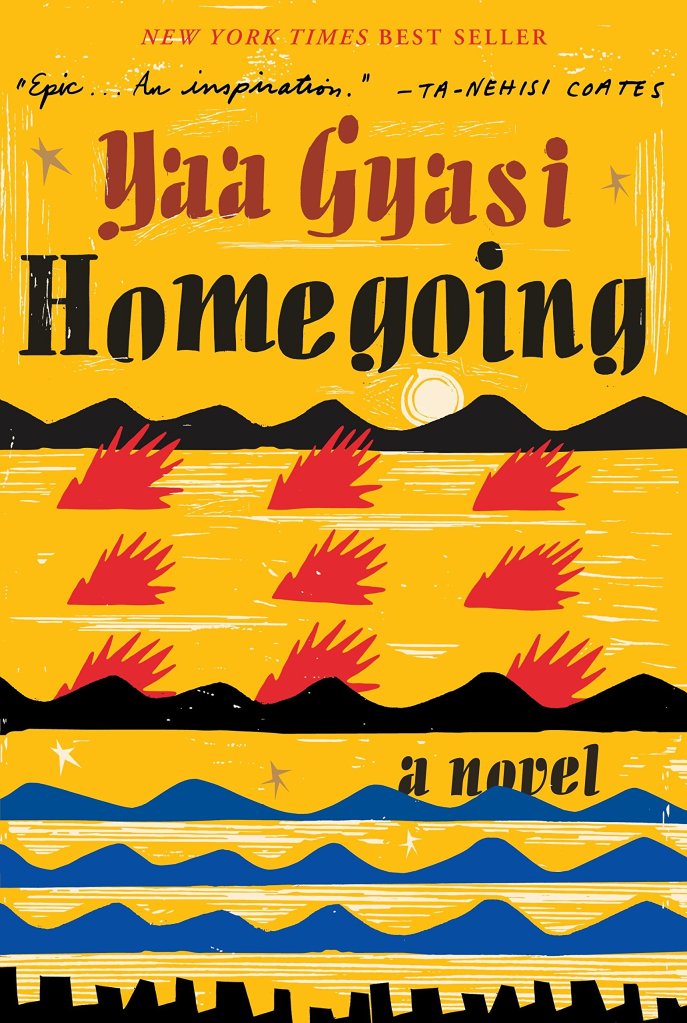
Here’s the latest book I read for the neighborhood book club. I had to read through it as quickly as I could (meaning with all my other stuff, it still took a week), because my queue is full of good stuff (Elton John memoir arrived yesterday!). It’s another first novel, this time by Yaa Gyasi, daughter an immigrant from Ghana and quite a gifted storyteller. See, folks, some of those immigrants do indeed contribute to society. Ahem.
Homegoing (2016) is one of those epic novels (it says so, right on the cover!) that span many years of one family. Each chapter is from the perspective of a different family member, starting from a maternal ancestor in Ghana and ending up at the present day. Luckily, there is a family tree at the beginning of the book.
Hint: Bookmark the family tree. Even though there is a pattern to the chapters, you’ll probably want to remind yourself of who’s who and how they’re related.
I am sharing a book review I wrote for Hermit Haus Redevelopment, because I think some of my readers here would also enjoy it.
The little book I read is called Going Tiny: Failure + Opportunity in the Future of Affordable Housing It’s written by a guy named Davis Richardson, who is apparently the age of my youngest son. But, he’s more ambitious or more lucky. Anyway, his age is a real advantage in this book, and his perspective is just what I needed as I looked for books that gave honest assessments of how tiny homes REALLY would work in communities.
I don’t usually write the same thing in my work and personal blog. This time, yes. Why not?
I really enjoyed this charming and idea-packed little book!
If you are a professional book person, you have to ignore some of the obvious signs of self publishing, like random blank spreads in the middle of chapters, and headings even on the first blank page. I also get a little irritated trying to make out the legends on his illustrations, which are in his charming but hard-to-read handwriting. Really, though, you should focus on Richardson’s words, instead, which are written in a colloquial Millennial style that I enjoyed.
Richardson is an architecture student who decided to build a tiny house on a whim, and learned a lot of lessons about building them and (more important to me) what you can DO with them the hard way, by his own experience. Lucky for us Hermits, he did all his learning in Austin, so the examples he gives actually apply to us. What a handy coincidence!
First, thanks for the good wishes after the flying debris episode yesterday. I still have a mighty headache and a sore neck, but I’m staying home from work, taking ibuprofen, and have a convenient chiropractor appointment already scheduled for tomorrow. I’m not supposed to be looking at screens, so I am typing but not looking up except to fix typos. I am apparently driven to type!
The book
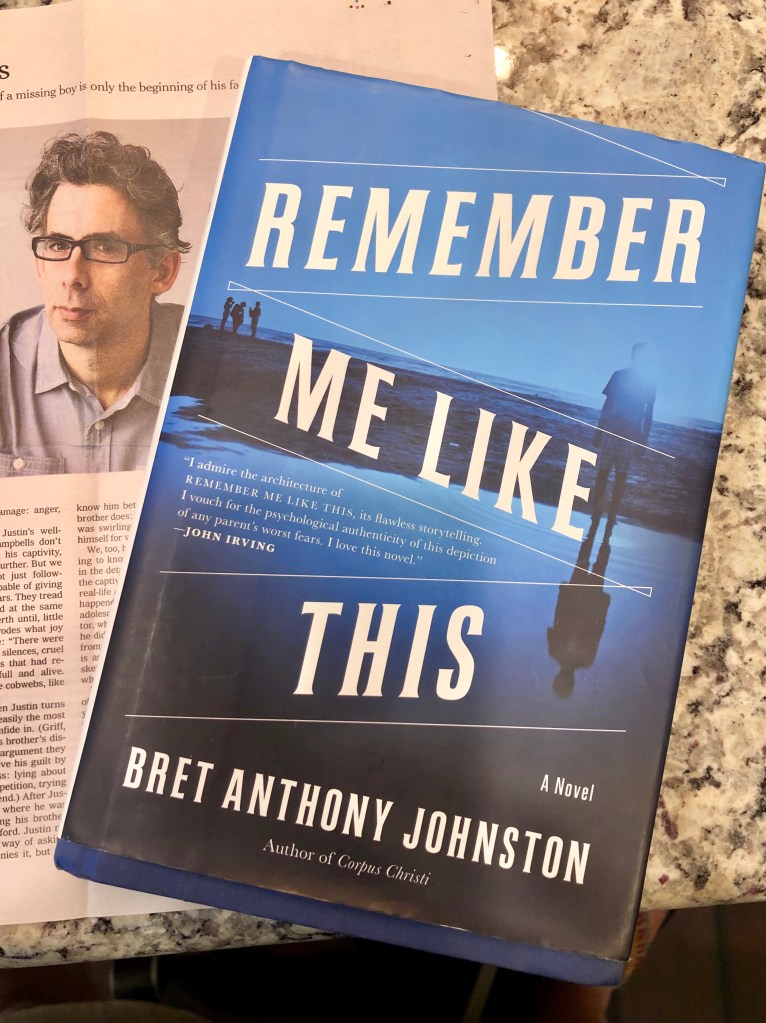
Bret Anthony Johnston is apparently very familiar with the Corpus Christi/Port Aransas area of southern Texas, which made his 2014 book, Remember Me Like This, a lot of fun for me. I used to go to the area every year with friends from my old church, until our Most Toxic Member Ever’s kid broke something and they refused to pay for it. I digress, again.
The other book referred to on the cover is a collection of stories. It won awards.
I’m glad the neighborhood book club chose this one, because it was not too gory or triggering for me (I m not fond of the “tiggering” thing, but that’s what happened in the last book, There There; I got sick to my stomach and could not read any further, even though I’d found it interesting up to then).
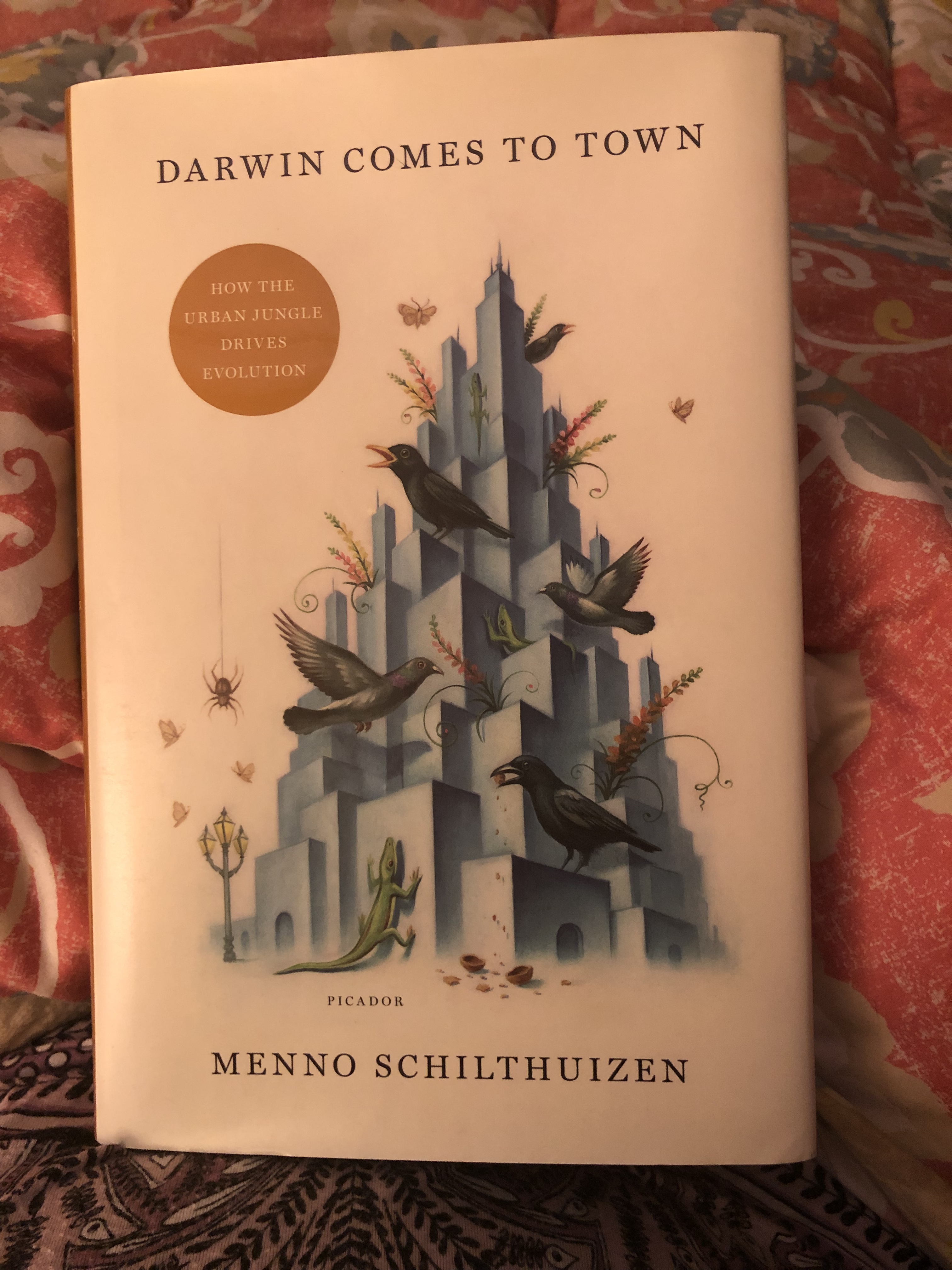
This month’s book club book is so sad I had to take a long break from it, and discovering this book made that WAY easier. I think I just spotted Darwin Comes to Town: How the Urban Jungle Drives Evolution, by Menno Schilthuizen in the new nature books section on Amazon. I loved the cover and was really intrigued by the subject matter: how life evolves in the world’s urban enclaves.
Schilthuizen, a naturalist in the Netherlands and author of many articles in popular science publications, writes really clearly without “dumbing down” the science behind what he talks about. I think his reminder that evolution is not just something that goes on in the forests, oceans, and hidden jungles; it’s going on right under our noses.
I’m very thankful that I have some brilliant people among my Facebook friends and that many of them share what they’ve been reading. In the past couple of days, I’ve read and shared a few articles that I want to talk about today. You might like them, too.
Dogs
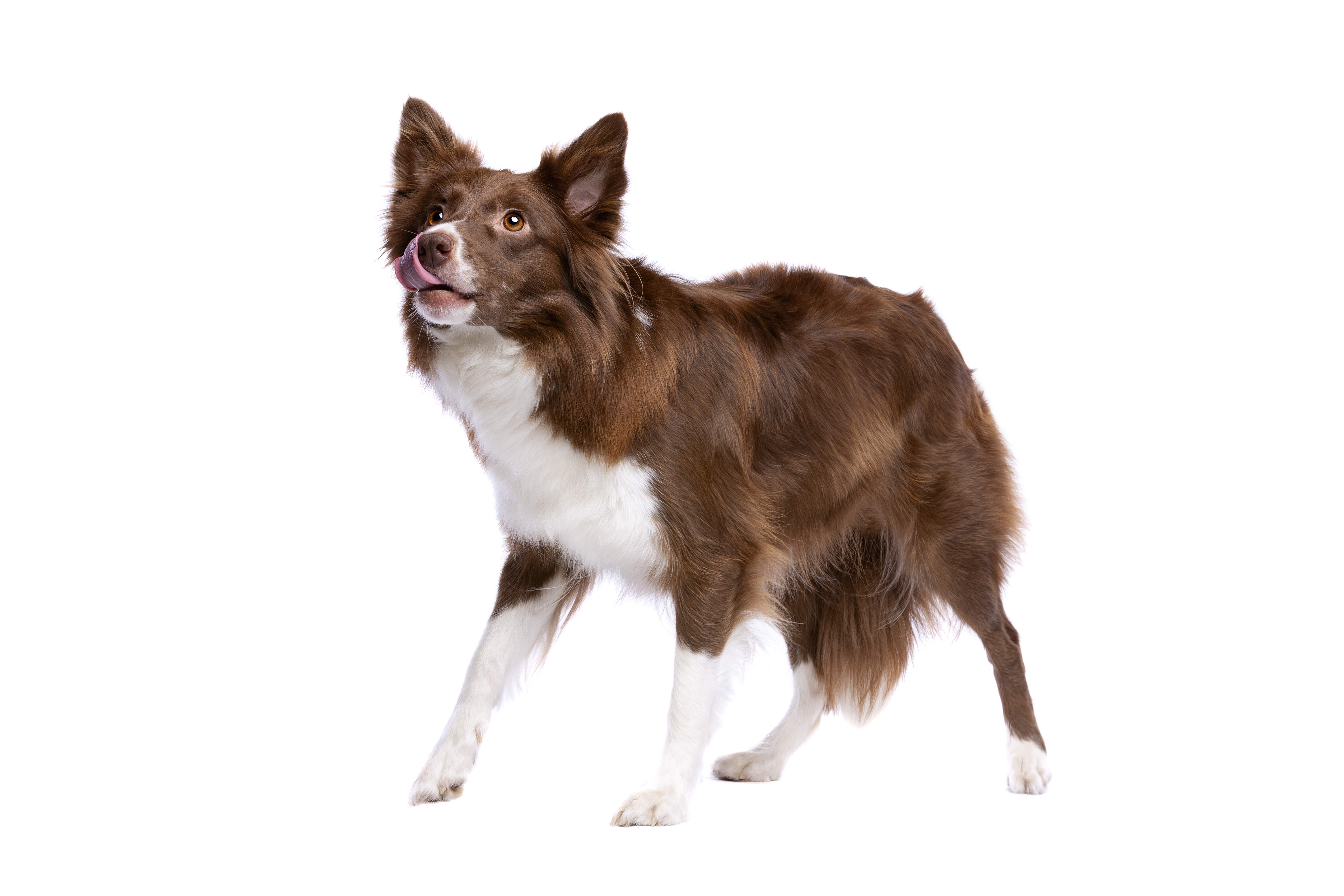
One article was on how we treat dogs we don’t know. Debby McMullen wrote this article on the Positively dog training blog. It’s called Consent: Not Just for People, and I really like how the author puts us in a dog’s position to see how the way we treat dogs might appear to them.
Maybe I want to approach you on MY terms!
Nowadays, the topic of consenting to be touched or approached is popular when talking about people. But, hey, a lot dogs aren’t just sitting around hoping to be bopped on the head by random strangers, either.
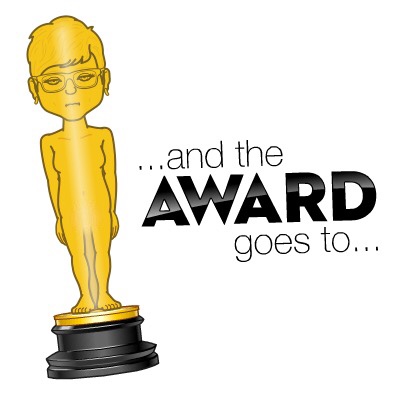
This whole unpacking of boxes in the garage and general removing unnecessary stuff from my house thing is not becoming easier for me. However, I am still doing it! Yes! And that’s why I honestly think someone should give me a gold star or something. So, I made myself an award on Bitmoji. I’m very proud of this award.
What keeps me going?
Certainly the lifting of heavy boxes of books and empty CD cases (Lee’s) is not a motivating factor. The heat isn’t helping (though it isn’t bad in the garage). Yeah, having more space in the garage is nice, but the real thrill is…
Our little neighborhood book group met last night to discuss A Place for Us, by Fatima Farheen Mirza. This is her first novel, which makes it an even more amazing book. I’m glad we chose it! And look, a convenient way to buy it:
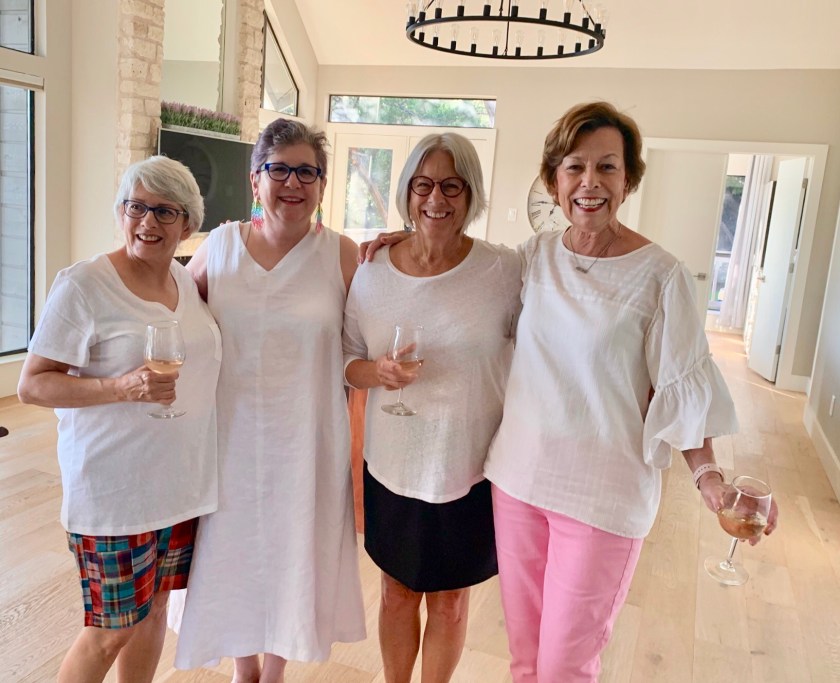
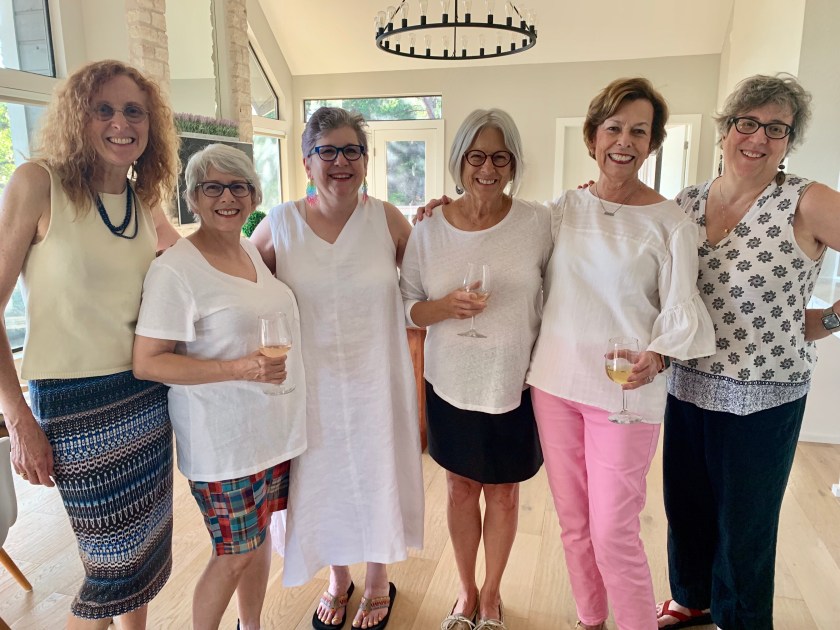
This month, we met at Maria’s house. We all enjoy inspecting each other’s houses for cuteness and signs of the owners’ personalities. I was most impressed that the house was mostly white, even though she has two small children. Many of us unwittingly dressed with a white theme, which made things even more festive than usual.
Anita, me, Gay, and Ruth in our white. I like how the extra cool light fixture looks like we have a halo. And what a nice bra strap I’m showing.
Another fun part of the evening that had nothing to do with the book was that we had a new member, Marilyn, who has just moved here from England. Her perspective was really welcome in the discussion of sibling issues, and she fit in so well!
I just had to stick in another picture. I wish I’d gotten one of Marilyn, though! This one adds Angela on the left and another Ruth on the right.
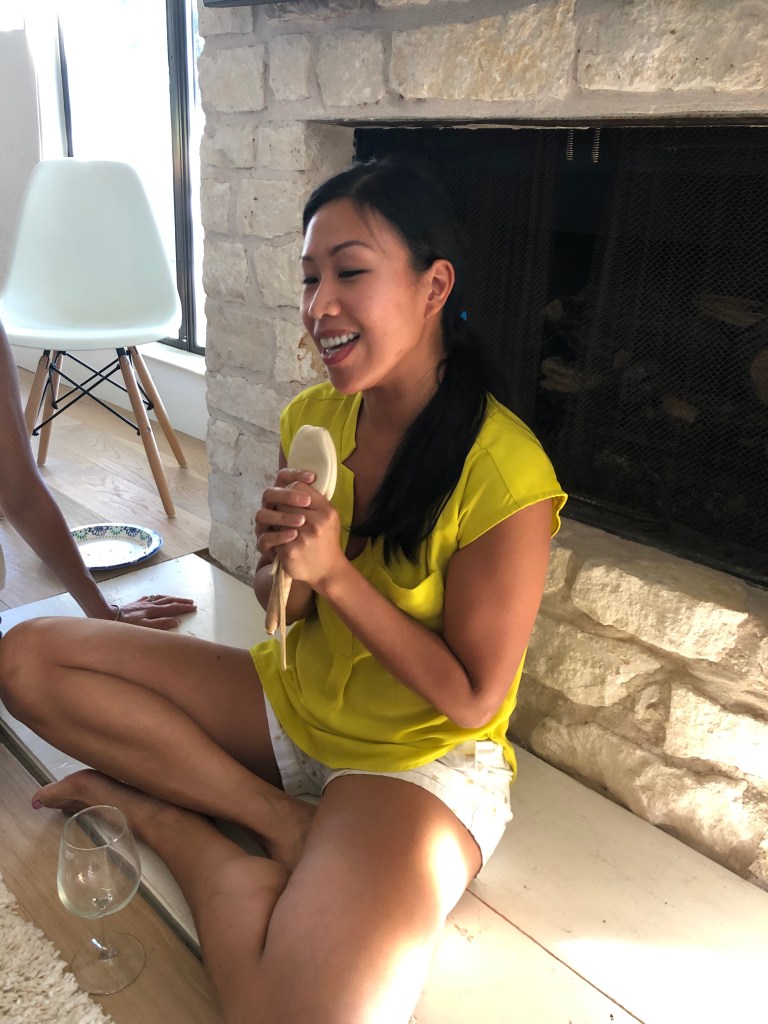
The discussion this month went a little more smoothly, because those of us who need a rational discussion made the effort to come up with a few discussion questions, and I brought a “talking stick,” which was actually a magnifying glass with a deerskin cover. It looks sort of like a microphone, so people kept saying, “Is this thing on?” and talking into it, like it was going to help.
Maria shares deep thoughts with the talking stick.
It did help us keep side conversations down to pretty much zero (that had been the issue last month; everyone talking at once about their own personal topics). When people spoke without the talking stick, the comments were all brief and in support of the main speaker. So, I got a lot more out of our thoughts and feelings on the book. Yay! (And later we got to just do chit-chat and neighborly support.)
Actual Book Report
As for the book, I enjoyed it so much that I took my time reading it, bit by bit, until I had to finish it for the meeting. There are actually a few really different reasons to love A Place for Us. And to me, they are equally important, so I had trouble deciding what to talk about first.
I’ve always been drawn to books about other cultures. I think it’s a great way to learn about how people live in the rest of the world AND enjoy a good story. I loved Maeve Binchy’s Ireland, Amy Tan’s Chinese-American families, and more. With my background in linguistics, I also have fun with learning politeness phrases and common terms in other languages.
This book had all that and more! While I’ve read lots of books about Muslims, most have been about Arab cultures, women in harems, and that kind of Islamic life. This book elegantly weaves normal day-to-day life for a normal Indian/Muslim family living in the US in among the story telling and life lessons.
I was especially pleased at how well Mirza included bits about the spiritual practices of each member of the novel’s family. If you aren’t familiar with the wide variety of practices in Islam (all with a common core) you might feel much more comfortable with Islam when you see how each person chooses what is meaningful to him or her, and the beauty they see in verses, prayers and teachings, just like so many Christians and Jews practice differently.
The story-telling is another thing I just couldn’t get enough of. I’ve always liked novels that present events and ideas from more than one character’s perspective. You really get to know Haida’s family (she’s the main character until a sudden shift in Part 4 of the book), their dynamics, and their virtues and frailties. I had a great time teasing out why each person acted the way they did, and realizing how small things can send a life in unexpected directions.
You pretty much end up liking everyone you encounter in the California community of Urdu speakers, because they seem so human. I drew a lot of comfort seeing how people can learn from their mistakes.
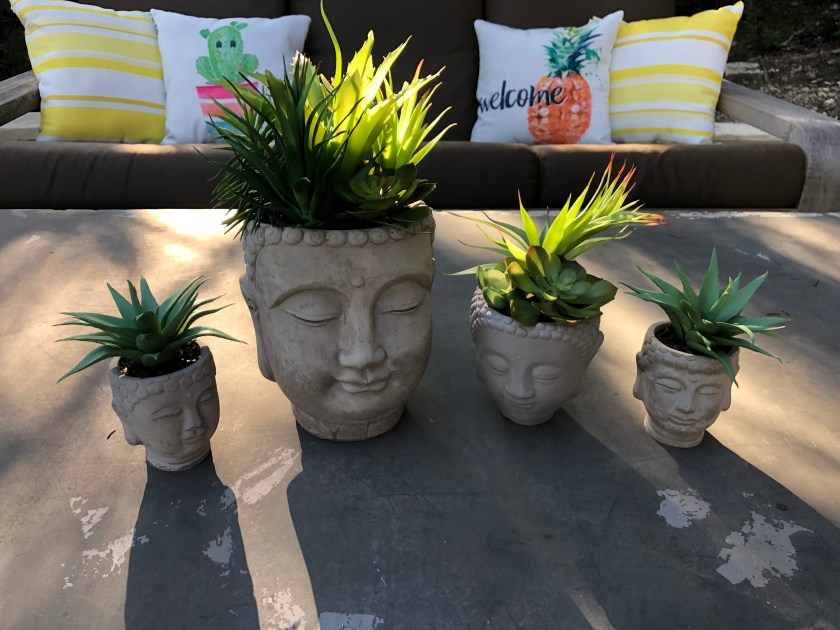
Speaking of family dynamics, here’s Maria’s family as Buddhas with succulents in their heads. Hmm
Our book club talked a lot about the family dynamics, and I enjoyed that older siblings sympathized with Hadia, middle children thought the middle daughter, Huda, got the short shrift, and younger ones had so much sympathy for how the younger brother dealt with what life handed to him.
I do look forward to more books from Mirza. She was born in the same year as my oldest son. Wow. I’ll stop before I give away a lot of plot, but one insight I had was that this actually was a mystery book, only it wasn’t a “who done it” but rather was a “why did they do it?” mystery.





 The Hermits' Rest