Unconscious Bias? Just Ask Marcus Aurelius

My spouse, Lee, has been studying Stoicism for the past year or two. He really enjoys The Daily Stoic podcast, by Ryan Holiday, who happens to be my boss’s best friend. Small world! Who knew? Holiday has a new book of meditations out, with new translations of the Stoics into modern English by Stephen Hanselman. Of course, Lee’s enjoying it greatly. He even got a special journal to record his own thoughts. That man LOVES to journal almost as much as I love to blog!

So, the passage for yesterday was:

Do away with the opinion I am harmed, and the harm is cast away, too. Do away with being harmed, and harm disappears.

Marcus Aurelius, Meditations, 4.7, as quoted in The Daily Stoic, p. 119.

This is one of those topics we linguists love, especially those of us, like me, who are enamored of pragmatics. Not only do words have different meanings in different contexts, but tone of voice and intention can also change meanings. PLUS, the person hearing the words will interpret what is said through their filters. The same sentence with the same intonation can engender a hearty laugh or a world of hurt, depending on how it’s taken.

You have to like a guy who was a good horseman. From Britannica.

Assuming good intent is what it boils down to, right? It’s just like with the Little Free Library story yesterday! Susan could have interpreted the stolen books as an act of aggression or malice, but she instead chose to interpret it as a cry for help. I often find myself interpreting comments that could be taken as mean or passive aggressive as being the result of some issue I have no clue about. Thus, I do away with the harm, and it’s gone. Easier said than done sometimes, I must admit.

Continue reading “Unconscious Bias? Just Ask Marcus Aurelius”
What Have You Made Better?

One thing you can always count on me and my spouse, Lee, for is that we are looking to do better in the world, do better for each other, and do better for ourselves. Lately, Lee has been listening to dozens and dozens of podcasts, and is especially fond of the Daily Stoic. It applies ancient philosophy to today’s world, and has been really useful for Lee. There are books and such, too, which you can find on their website.

Simulated coffee drinking.

Most mornings while we are drinking coffee, Lee asks me some question he found in one of his podcasts, which helps me be more conversational (I’m not a morning person and neither is he, really). One of his questions is where I got the recent topic of saying “I get to” rather than “I’ve got to.”

Today he asked me what I’d done to make something better. He said it could be big or small, for myself or someone else. His answer was that he’d improved a QuickBooks process (which makes things much better for Mr. QuickBooks).

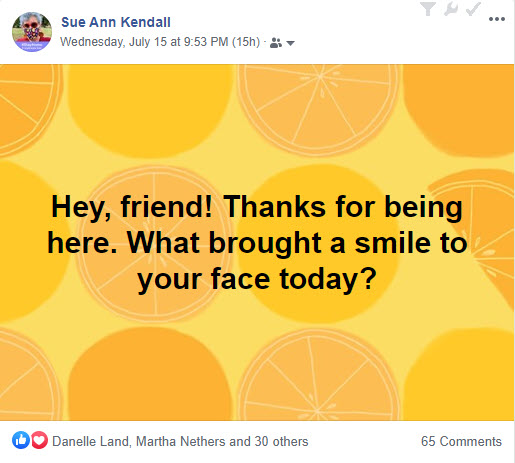
I fumbled around a bit, but then realized I’d posted a status on my public Facebook page last night that asked people what made them smile that day.

I think 65 comments is pretty good engagement!

The answers cheered me up, cheered other readers up, and no doubt helped people who maybe didn’t smile much that day remember something good that had happened. It was a simple thing, just asking a question, but it encouraged conversation and made people’s day better.

I got the idea from Joanna Fontaine Crawford, the minister at Live Oak UU Church, who very often asks questions like this and gets a lot of conversation going. I like it, because the questions come across as genuine, and not like it’s some meme that you are supposed to be guilted into copying and pasted. Asking a REAL question gets real answers!

Let’s see how this one goes over…

So, think about it, what have you made better so far today (or yesterday)? Ask yourself this every day, and your mindset can’t help but shift to a more positive direction. I plan to keep up both the practice of asking good questions and checking on what I did to make something better each day.

We’re a team!

Thanks, Lee!