Book Report: How to Be an Antiracist

Rating: 5 out of 5.

Have you ever read a book and wanted to start over immediately after finishing it? Have you ever wanted to make everyone you care about read a book? Have you ever wanted to give a book a big hug and thank it? I have. And this is the book: How to Be an Antiracist, by Ibram X. Kendi (2019). I am so grateful that I saw an interview with Kendi by Stephen Colbert that convinced me to stop procrastinating and get this book!

How to Be an Antiracist
My beloved copy of this book!

You see, a lot of books, films, journal articles, etc., on racism have annoyed me, but I never could quite put my finger on why. Thus, I was reluctant to read this book, even with all the great reviews and recommendations from people I respect. But, ha! Now I know why I was so annoyed! My internal definition of racism, though not very well thought out and rather ineffable, was more like Kendi’s definition. And I didn’t have his term for antiracism in my vocabulary, but the ideas were back there, churning away, making me feel like I was missing something.

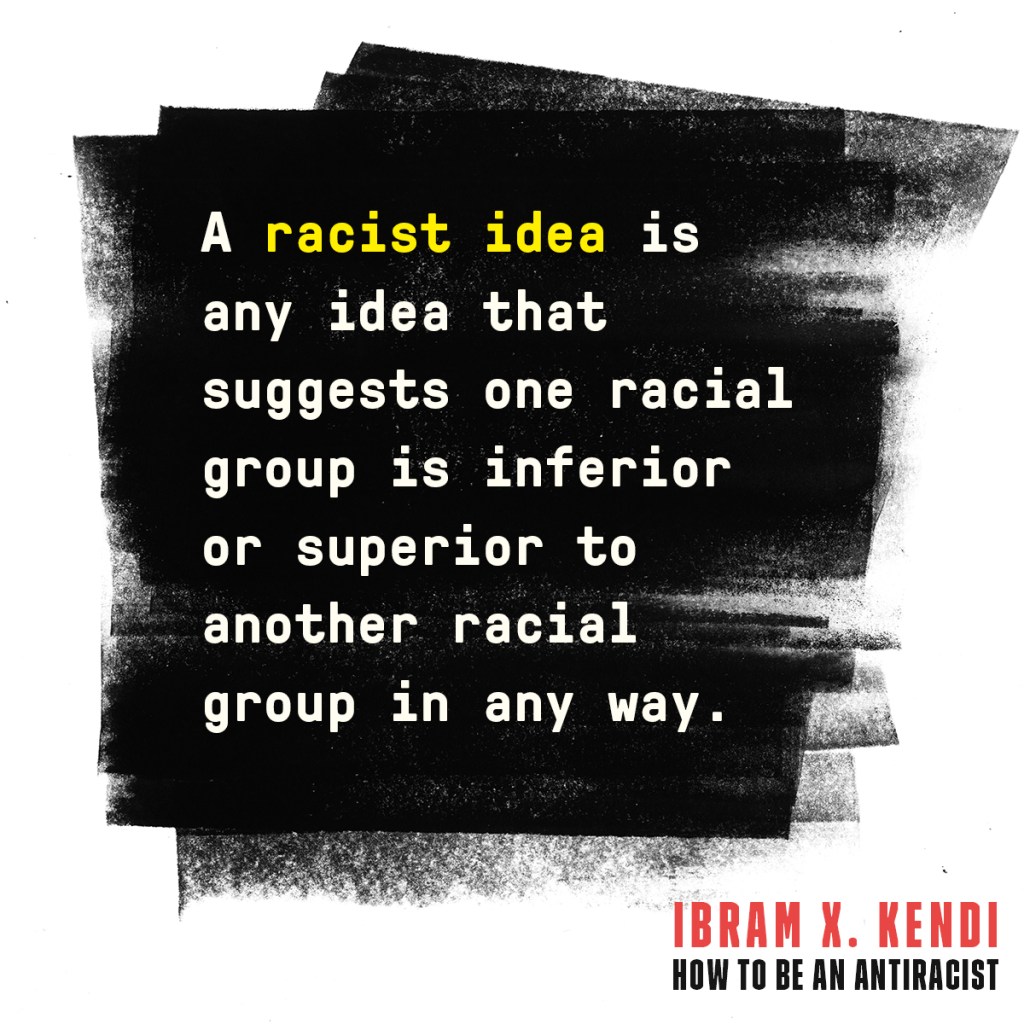
I was glad the publisher shared these images.

I was missing the ideas in this book. As I read through each chapter, I learned more and more about how the times I lived in shaped my views, and WHY some of the things I kept hearing bothered me (things like Black people can’t be racist). Now it’s clear that anyone can express racist ideas or do racist things. People aren’t racist, ideas are. And people who have done racist things in the past can do antiracist things, even before they know what those are in Kendi’s definition.

My favorite assertion he makes, though, is that we all will have both racist and antiracist thoughts. We can’t help it, living in this society. Kendi brings this home with a vengeance as he talks about his own journey and attitudes toward race in the US. Some of the most powerful parts of the book are where he breaks down his own mistakes and shows that he learned from them and moved forward with new knowledge. We ALL can do that.

Kendi thanks his editor for his help with the way the book is organized. I thank Chris Jackson, too. The structure of the book is complex, as it interweaves stories of Kendi’s life with research and analysis. Here’s how Kendi put it:

“This book was quite difficult to wrap my head around and write–the chronological personal narrative interspersed with a series of connected chapter themes that build on each other like a stepladder to antiracism.”

How to Be an Antiracist, p. 239

This writer and technical editor was very impressed with every bit of the structure of the book, and how well the content flows. Dang. Life goals.

But, if the book was written like a textbook, I’d still have lapped it up like someone thirsty for a concoction they didn’t know existed. I just kept repeating, “yes, yes,” to myself with every page. I saw my own mistakes, I saw where my instincts were good but my actions weren’t, I saw areas for growth, and I saw things I could be proud of in my past.

Like Kendi, I got most of my ideas about racism and antiracism in graduate school, where I was surrounded by a mini United Nations of people from all over the world (I studied linguistics at the University of Illinois, which had a large program and did a lot of research on languages from Africa and India). When you work closely with people from different cultures, religions, and backgrounds, you quickly learn that there are people you like and people you don’t like in every group, but MOST IMPORTANT you end up losing the idea that YOUR culture is better than anyone else’s. I got an early start on realizing that no culture is without flaws and sad histories, but that no culture is without beauty, joy, and precious traits that should be treasured.

However, Kendi put these ideas into words way better than I ever could, so I’m grateful to him for giving me words and concepts to express my beliefs and goals.

I’m putting this book right next to The Color Purple and Where the Crawdads Sing among my favorites, ever.

Stuff I Learned

I want you to read this book. Still, I want to share a couple of the things I learned, having read way too much history from the perspective of the dominant culture, and being totally unaware of a few important ideas (to me, at least).

  • Race as a concept didn’t exist until 400 years ago! How did I now know THAT? It was invented to support the slave trade from Africa to Europe and later the US. Before that, people identified themselves by their cultural groups (tribes, kingdoms, etc.) not skin color.
  • The combinations of racist ideas with sexist, homophobic, and other ways of dividing people can lead to an entire system of X is “better” than Y (meaning they have more opportunities for education, jobs, and safe places to live).
  • All that stuff we tried to do in the 70s and 80s, with integrating schools by busing Black kids for hours to give them “equal” education was misguided. What we really need is for everyone to have the same opportunities right where they live. Black neighborhoods, Hispanic neighborhoods, Asian neighborhoods, and others are no better or worse than each other. Given equal access to power and influence, we could all thrive equally.
  • And this: racism is not about ignorance and hatred; it’s about power and influence. Power is what needs to be equally distributed among all of us. And that, my friends, is why I identify so strongly with social democrats, as does Kendi. If we all share, we can all thrive. And we can still have free markets and all that, just without one group having all the power.
  • See the quotes in the images for other gleanings.

I wax political. And I note, as Kendi does, that getting to the place in our society that I outline here (from him, sorta), is not likely. He likens racism to a Stage 4 cancer in our society. It’s one that is growing and growing. But some of those cancers can be eradicated by hard work and a multi-factored approach (chemo, radiation, diet, attitude). Maybe racism can be eliminated if we work from an antiracist perspective to deal with the actual causes of the problem, rather than applying bandages.

A Summary

Since summarizing books is not my best skill, I wanted to share this nice summary from the publisher. I hope it will encourage you to take a chance on being made uncomfortable sometimes, but go ahead and read How to Be an Antiracist so you can help build a just and equitable world where we can respect each other as we are.

Antiracism is a transformative concept that reorients and reenergizes the conversation about racism—and, even more fundamentally, points us toward liberating new ways of thinking about ourselves and each other. At its core, racism is a powerful system that creates false hierarchies of human value; its warped logic extends beyond race, from the way we regard people of different ethnicities or skin colors to the way we treat people of different sexes, gender identities, and body types. Racism intersects with class and culture and geography and even changes the way we see and value ourselves. In How to Be an Antiracist, Kendi takes readers through a widening circle of antiracist ideas—from the most basic concepts to visionary possibilities—that will help readers see all forms of racism clearly, understand their poisonous consequences, and work to oppose them in our systems and in ourselves.

DOWNLOAD AND SHARE QUOTE CARDS FROM HOW TO BE AN ANTIRACIST BY IBRAM X. KENDI

Book Report: Too Much and Never Enough

Book reports are not the most popular of my blog posts. The one from yesterday got 9 whole hits. But, if I ever need to know what books I was reading starting in 2018, I know where to look!

I had a feeling I’d read Too Much and Never Enough: How My Family Created the World’s Most Dangerous Man, by Mary L. Trump all in one sitting. I came close. Was it some sort of morbid curiosity? I guess so. But I have always wondered how the bellicose and supremely self-confident persona of the person currently serving as US President came about. I figured he must have had a really weird family.

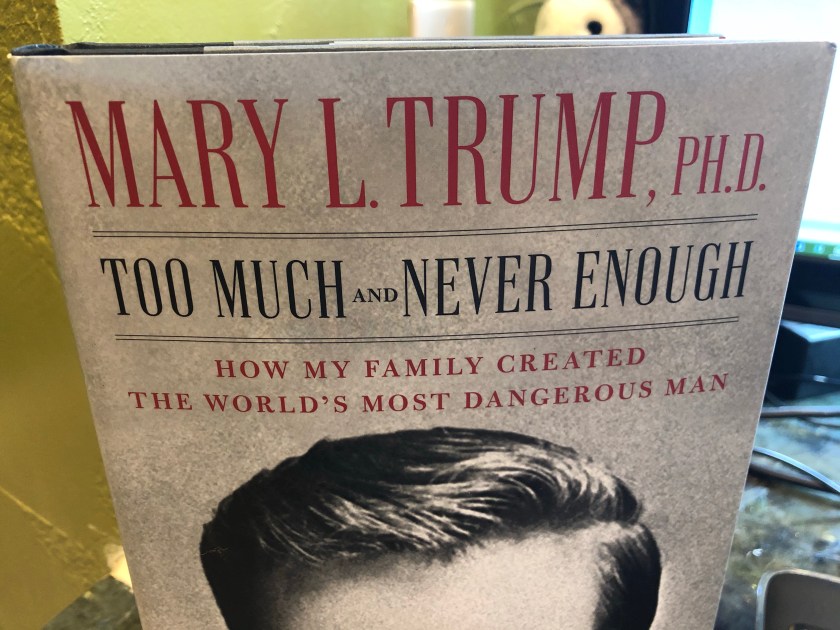
I cut off his face. You’re welcome.

Yes. He had a really weird family. The fact that his father was a gen-u-ine psychopath and narcissist and his mother was emotionally (and physically) not there during his formative years explains a lot. Also, you know, genetics probably played a role; he seems to have gotten more of his dad’s stuff than some of his other siblings, who each didn’t fare well in their household of origin to varying extents.

You can read Mary Trump’s assessment for yourself, so that’s enough about him for me. I was more interested in Mary (forgive me, but I’m not good at typing her last name). When a family member writes a tell-all, you tend to think, hmm, what is their agenda here? What’s their beef? And Mary, to her credit, completely admits she has a beef or two, like how her father was treated by the family patriarch, how no one did jack shit to help the current President deal with any of his issues and learn that anything whatsoever counted other than himself and looking good, how any disagreement with the family’s current lies about itself was punished incredibly harshly (like not mentioned in obituaries, written out of wills, etc.).

She’s NOT an impartial observer, but only someone who has been IN the family could write about it, thus, we get her viewpoint. I think she does a pretty good job at being fair, and you can see she loves many of her family members.

While acknowledging her part in the family drama, Mary kept me riveted while laying out the series of events that got us to where we are today, and like one of my friends who has also already finished the book, you almost feel sorry for young DJT. He didn’t stand a chance. I just wanted to know what horror that family would perpetuate next as I sped from chapter to chapter.

Two of my favorite bits in the book come toward the end, so let me share:

“Nobody has failed upward as consistently and spectacularly as the ostensible leader of the shrinking free world…Donald today is as much as he was at three years old: incapable of growing, learning, or evolving, unable to regulate his emotions, moderate his responses, or take in and synthesize information.”

p. 197

Happy days. I read this just before reading about Federal troops continuing to detain peaceful protesters around the country, just before reading that some random angry dude in Austin shot and killed a protester who was trying to stop him from driving into a crowd that included his paraplegic wife, just before reading about yet another party full of mask-less people hugging and celebrating in my town. Yow.

It’s frequently suggested that we just look for the good in life right now, and not worry about things beyond our control. And I’m all for remembering that it’s not all bad, I have amazing friends and family, and the universe is amazing. However, not to acknowledge what is going on, to hope it will all go away (like so many people are doing with respect to the Narcissist in Chief) seems to me like fiddling while Rome burns.

Hey, look, actual tweet.

If everyone sticks their heads in the sand, we’ll suffocate. Mary Trump’s book begs the people of this country and the world to actually DO something to help us get leadership with a focus on making life good for all, not just looking good for one’s long-dead father.


PS: These are my opinions and interpretations. I have no intentions of trying to change anyone’s minds on any political topic. Everyone makes their own decisions based on their upbringing and values. It’s okay.