It’s a plant, so I guess I should have figured it would bloom. But, I’ve had this thing…ages.
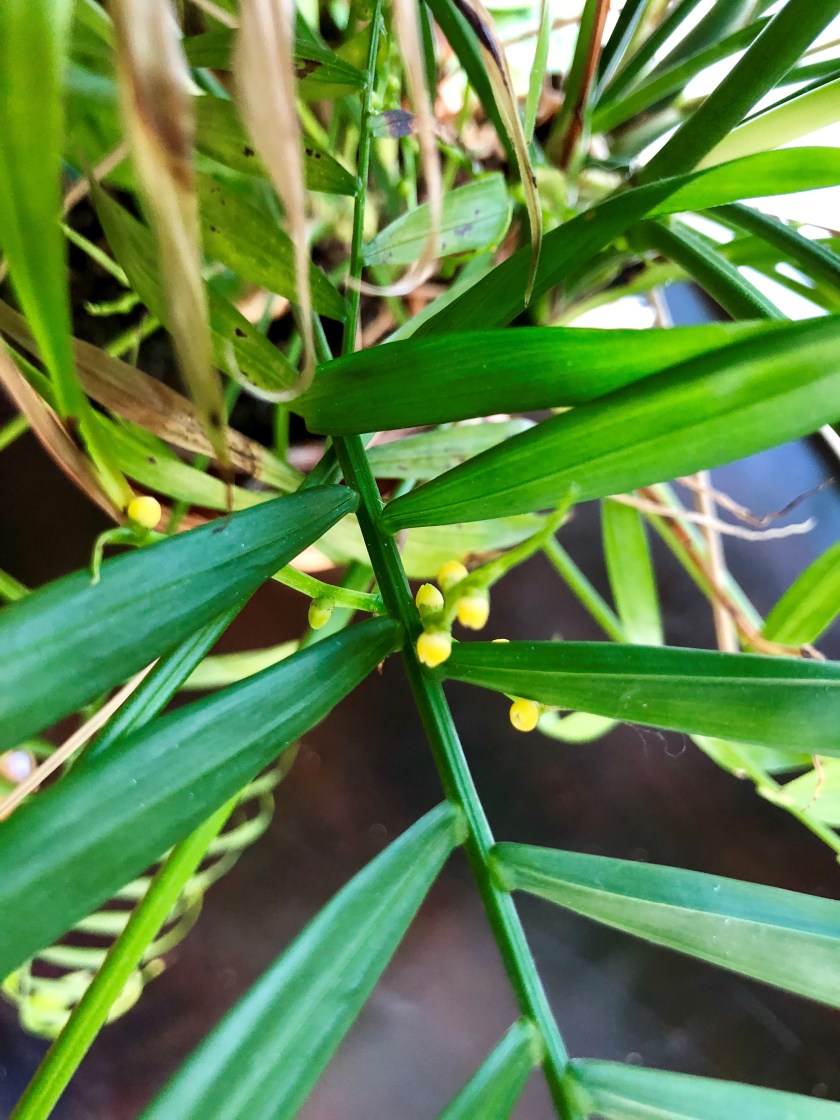
I am beginning to think it’s not some green thumb I have, but more like the windows in that Bobcat Lair house make everything bloom. Case in point is this parlor palm I have had for a long time. I think it came in an arrangement when a family member died. I’m pretty sure someone who has not spoken to me since 2006 sent it, so it’s old. Obviously, it’s happy in this house. It’s grown a lot, andit has these cute little buds.
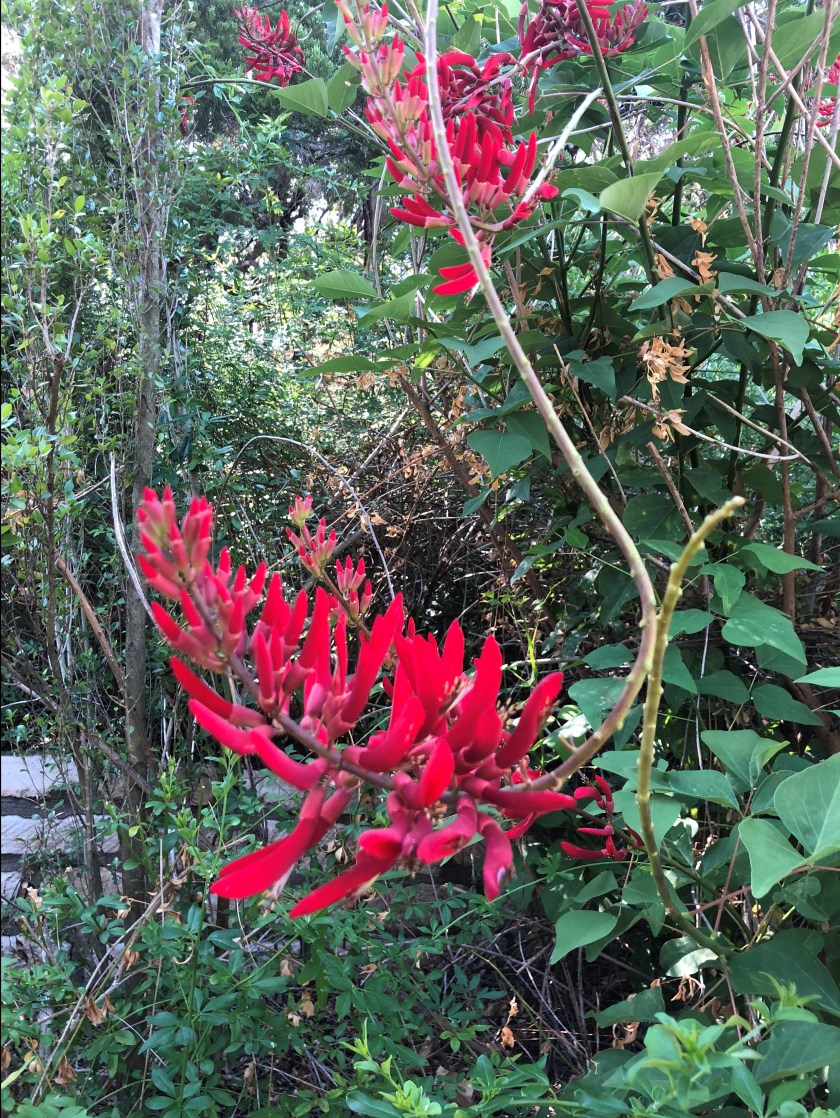
I just had to share that little blossom with someone, so you got it. And as a bonus, here is a pretty plant growing in our Austin neighborhood. I should probably figure out what it is. When I do, I’ll add that. But isn’t it pretty? Probably some kind of “red hot poker” thing.
It looks pretty jungly in this Austin garden. I like that.
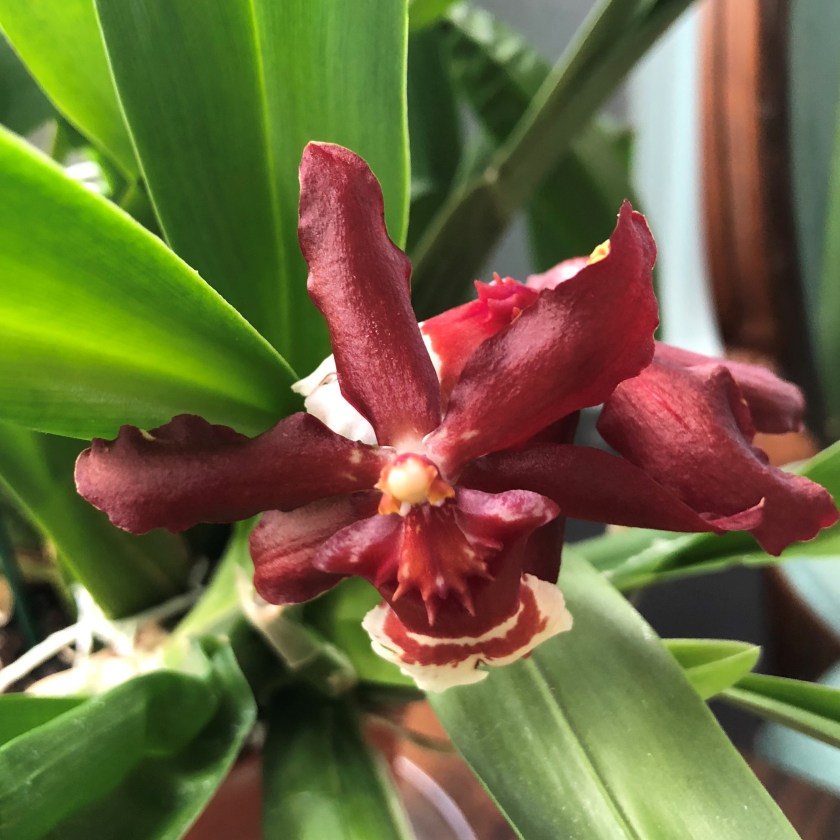
This is a different type of orchid than most you see in stores, but I can’t remember what it is. It’s a big plant with lots of leaves.
One of the hardest things about the Hermits’ Rest is trying to plant things and make them grow. The area is most assuredly difficult for growing non-native flowers or most vegetables. No wonder I concentrate on what shows up naturally!
Ranch plant report
I’m sad to report that the early heat wave has fried my tomatoes and most of my flowers in the raised beds. But, zinnias and a marigold that popped up are fine, as are all the herbs (they look spectacular, actually, especially the bronze fennel). And the sunflowers I planted from last year’s seeds are definitely worth the price. I’ll have to take some pictures soon.
In the bed beside the house, free basil is, as usual, growing away, amid even more sunflowers. Hiding in there is some okra and random lavender that seems okay. At least all the sweet potato vines died out.
This one stays in bloom a LONG time.
Back in Austin
At the Austin house, Anita is having great success on the lower deck with her succulents and cacti. I am having less success on the top deck, which gets a lot of sun, but there are things that are alive, and we did get our bougainvillea to survive the winter. It’s all happy.
This leads me to orchids. I am not the hugest orchid fan on earth (that would be my friend Lynn Molitor). But, I am sentimentally attached to them, because my mother’s main hobby during her last years in south Florida was raising orchids, and I have many great memories of her watering them and naming all the ones that were blooming (after Mom passed away, the orchids went to Lynn’s father, and eventually to Lynn, at least in spirit). So orchids remind me of my mom.
And inside our Bobcat Lair house, we apparently created the ideal location for houseplants of all kinds, especially orchids. I used to always have one blooming on my desk at work, then I’d take it home, so I now have a good number of orchid plants.
Much to my happiness, they seem to like the low-E glass in our windows, and have responded by blooming like crazy, with nothing more than watering and monthly fertilizing. They are all in east-facing windows, which don’t get burning sun thanks to the glazing.
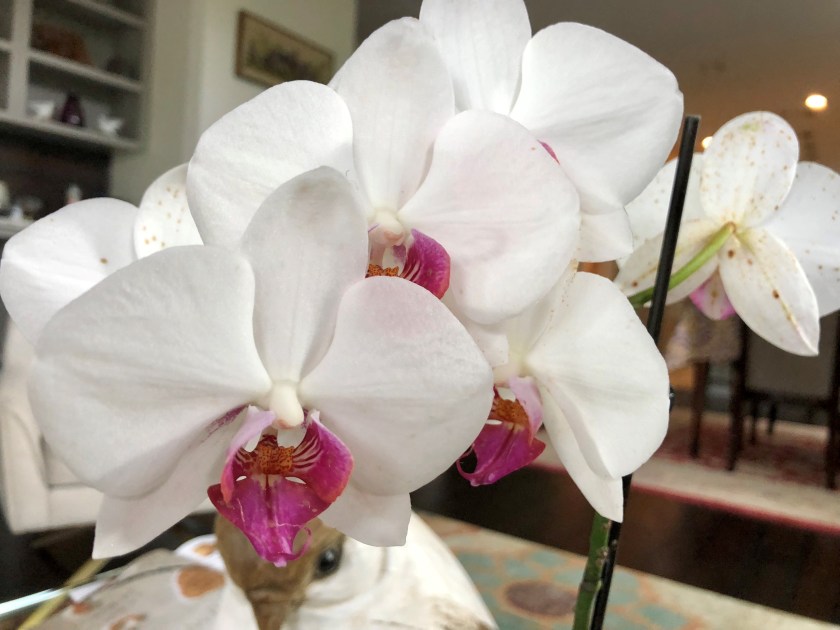
This one was originally dyed some horrid color, but of course comes out nice and white when left alone. It’s been blooming a lont time, so some of the flowers are showing their age.
In addition to the three blooming now (including my favorite, the brown one), there are two more getting ready to bloom, at least if the woman who cleans the house hasn’t watered them to death. I think those are probably the white phalaenopsis ones. We will see!
And yes, I know I need to learn what the danged orchids are called. I hope Lynn reads this and fills me in. Then I’ll update.
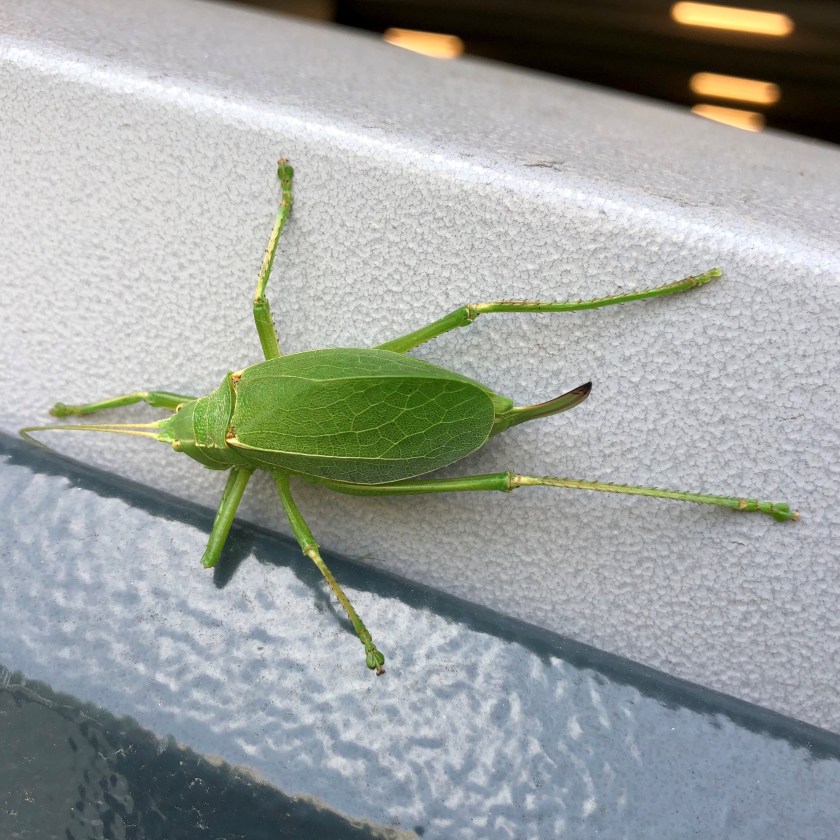
My whole life I’ve heard about katydids but, I guess I’d never seen one in person until yesterday. I was driving into the parking lot at work, when I saw a bright green leaf, but the leaf turned out to be an insect.
I quickly parked my car and went over to see what it was. Of course I took a picture so I could upload it to iNaturalist. What a cool bug it was, too!
When I uploaded the photo, I saw lots of potential katydids, but I figured it was probably the most common one. That turned out to be wrong, as the person who reviewed it for iNaturalist said it was actually a Central Texas Leaf-Katydid, which is more rare and more local. That’s cool!
I also sent up two flowers to be identified after I got to the Hermits’ Rest yesterday. They are two of the more late-blooming wildflowers. I am pretty sure I got the ram’s horn right. That’s one I look forward to every year. We only have a few:
I guess I like these because although the flowers are delicate in appearance, they are really big.
The next plant I am not so sure of. We have quite a bit of it, but when I uploaded it to iNaturalist, there wasn’t much about this one, if, in fact, I identified it correctly. It appeared to be Lady Bird’s Centaury, which must be named after Lady Bird Johnson, right? It said it had not been reported yet. That sounds fishy to me, so I am awaiting a correction from one of the botany experts by morning. It’s great to have the opportunity to learn this way.
It was really windy when I took this, so I had to hold the plant.
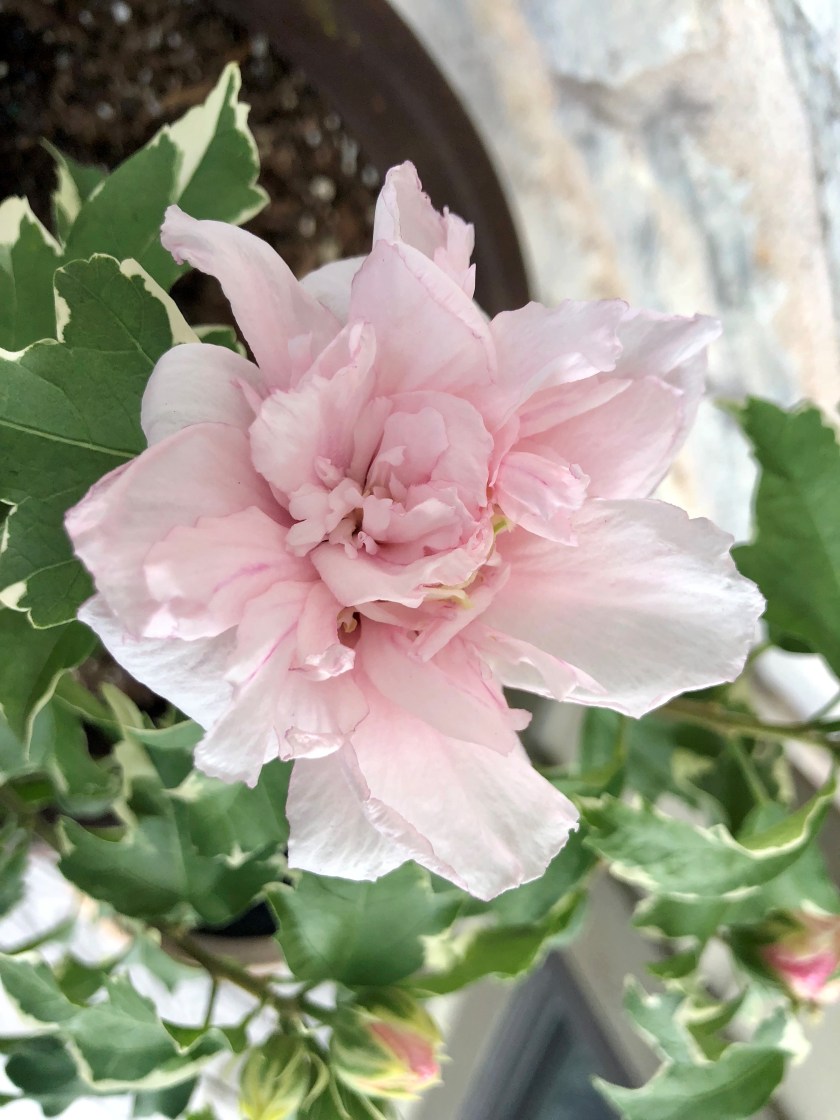
I know what this is! It’s an althea or rose of sharon! Isn’t the color pretty?
A friend asked me to help identify two plants. I must admit that I have failed, which is irritating, since one of them I see all the time, but have no clue for ID. So, I am going to reach out to you, blog readers, for some help.
The first plant is a type of bunch grass. It’s in my friend’s yard in Spicewood, Texas, or thereabouts. The question is whether it’s a good plant, a native one that we want to encourage, or one that needs to go away, because it’s not native or useful in some other way. Here you go:
Yep, it makes clumps. And I don’t have a larger image.
Any of you Master Naturalists or botanists have an idea?
UPDATE: Stephanie Kendall (no relation) posited that it could be Texas bear grass. I’ll go with that until there’s another idea. It’s not growing in its native habitat, but it is on a limestone soil. It looks like it was planted there on purpose as a ground cover, which is one of the uses of bear grass.
The other one I see all the time on 360 in Austin, and anywhere that isn’t overly manicured. I have a close-up of the leaves, which I took. I tried to ID it with the PlantSnap application, but first it said it was a bromeliad, then a rose:
This resembles a lot of things. But SnapPlant said it was a rose flower. That one I know is wrong.
Here’s the photo I got from my friend. Austin residents should find it familiar. But what is it? It’s not the thing with the pretty orchid-like flowers, but it does look like that one (which I also don’t remember the name of and haven’t looked up):
Okay, so what is it?
I hate to admit to being so clueless, but I am. I don’t even have good enough images to see if I can get help on iNaturalist, but I guess that will be next.
Help a gal out. Any clues?
UPDATE: Stephanie Kendall also identified this one. And I am sure she’s right that this plant is false willow Baccharis neglecta. I love the name on that one! It’s because it tends to crop up on disturbed or neglected areas. I’ve been seeing this one for decades and wondered what it was.
Our tenacious native morning glories always make me happy, too. And this is a nicer picture than the one actually on topic for this post.
If you live in the US, you’ve probably seen cardinals (the Northern Cardinal, Cardinalis cardinalis) in your garden, in parks, or in the woods. They are a common bird at feeders, and their coloring makes them easy to spot. Their beautiful songs also pinpoint where you need to look to see them!
The cardinal was my mother’s favorite bird. I can remember sitting on our back porch watching birds at the feeder. My mom told me that if I sat really quietly, “Mama Cardinal” would come right up to us. And she did. Mom liked to point out her pretty coral “lipstick.” I think I know where I got my love for observing birds!
One thing I had not observed until recently was a cardinal nest. I see lots and lots of nests, like wrens, doves, barn swallows, and the big hawks, but I don’t think I ever saw cardinals nesting before (now, I have seen LOTS of juvenile cardinals hanging out with their parents, just not the nests).
So, imagine how happy I was yesterday when I was sitting on the porch at our office in Cameron and saw a “Mama Cardinal” fly to a little tree next to our warehouse. She has a nest! I watched both parents for a while, then went to look at the nest more closely. It’s impressive! There is string and some kind of clothing label in it, but mostly it’s made of sticks and looks almost woven. It’s deep and cup-shaped, not shallow and wide like many other nests I see.
Honest, the nest is in the center of this photo.
Unfortunately, while it’s easy to see with the eye, it doesn’t photograph very well. And I’m not going to climb up a ladder and bug the birds. I look forward to watching the fledglings flying around in a few weeks.
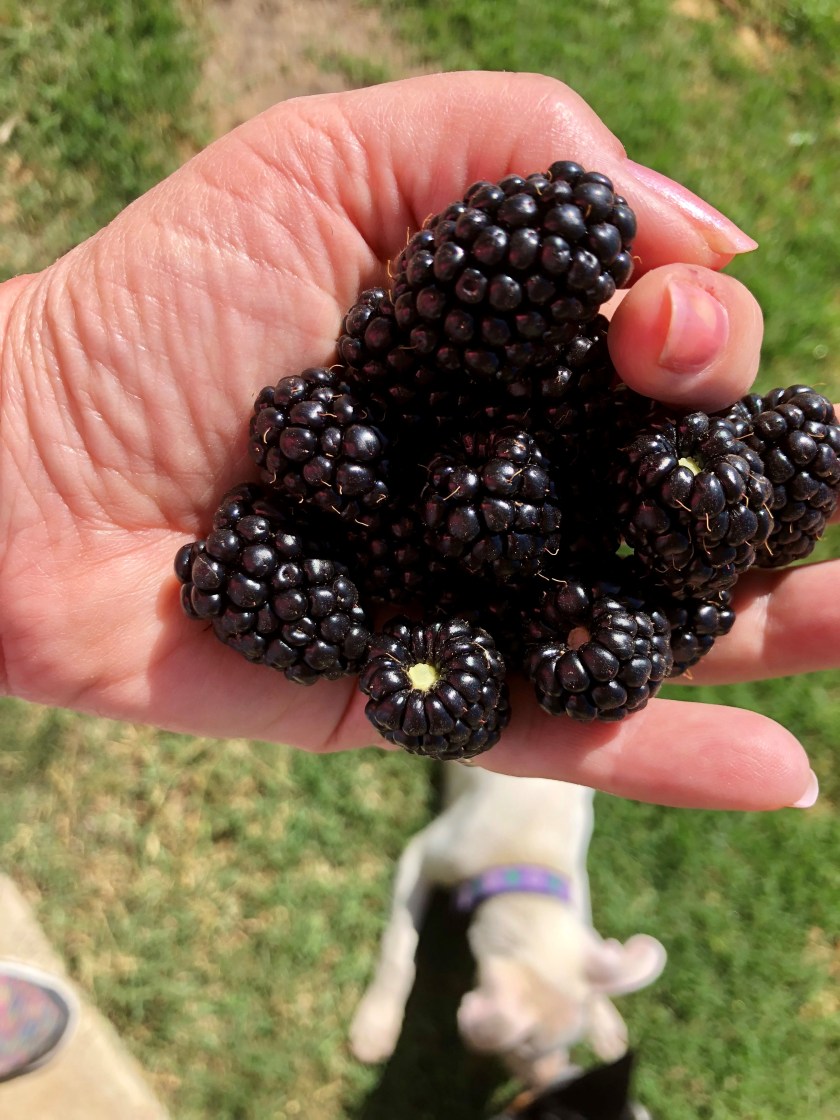
Dewberries are the unofficial plant mascot of Cameron, Texas. They are truly abundant here, judging from all the photos I’m seeing. Cameron even used to have a Dewberry Festival, which featured all sorts of delicious things made with these perky fruits. I miss it.
The dewberries are a group of species in the genus Rubus, section Rubus, closely related to the blackberries. They are small trailing (rather than upright or high-arching) brambles with aggregate fruits, reminiscent of the raspberry, but are usually purple to black instead of red. Unlike many other Rubus species, dewberries are dioecious, having separate male and female plants.
That male and female plant part explains why I keep seeing bushes with no fruit! Aha!
We are lucky to have lots of dewberries here at the Hermits’ Rest, though I’d never really done much with them before, other than snack on them. That’s because I never went out looking for them when they were completely ripe. This year, after all that foraging talk, I vowed to do better.
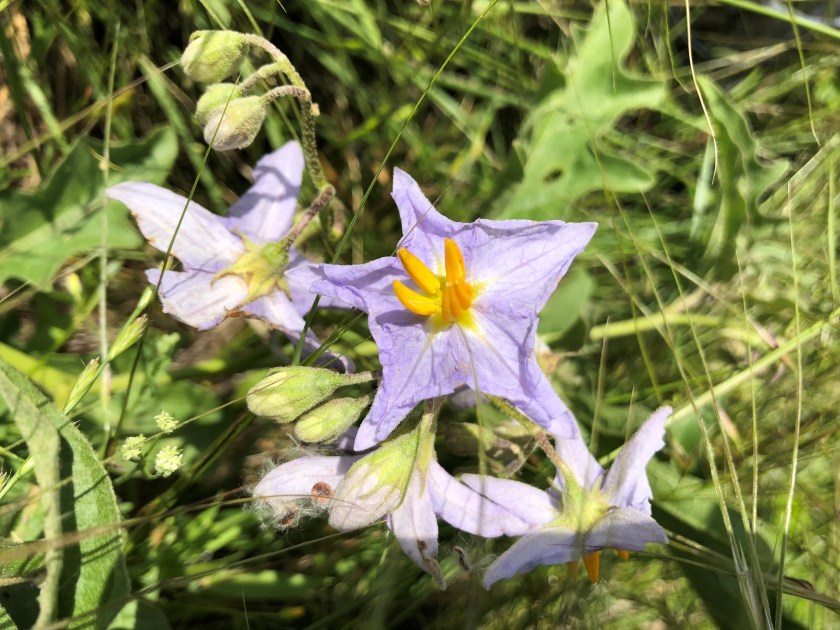
Here is some horse nettle to help you celebrate May Day.
Today is one of my favorite holidays! It’s May Day, or Beltane in the Celtic tradition. It’s a day when traditionally folks left baskets of flowers on friends’ and relatives’ doorsteps. It’s also a day to celebrate all those happy forest creatures out there having babies, birds building nests (hello to our barn swallows), and generally the fertility of spring.
Mockingbird Real Estate Failure
In Hermit’s Rest fertility news, we have been watching some mockingbirds try to build a nest in their favorite location, where they’ve been trying for at least the past three years. Where’s that? Sigh. One of the tractors. This year I think it’s the backhoe. They even follow it when Lee moves it. They like the high part where the bucket bends. It’s not a place that is great for successful bird parenting. We always feel bad for them and hope they eventually find another spot.
News, as in Paper
I did get my first article for the Master Naturalists in the Cameron newspaper last week. They didn’t put in any photos, which doesn’t surprise me, and it was on the back page, but it WAS the article. I think I’m supposed to write another one soon. With all this new puppy stuff, writing is not as easy as I’d like.
And I am sorry about how HUGE this is. There are so many names in the article that it’s hard to read (I was supposed to mention EVERY person who was there. Yow.)
Some new flowers are blooming around our property, and since we have a new puppy, I figured today would be a good day to walk around and check out the area. It brings such joy to walk with the dogs, since they jump in the pond and swim, run around in the tall grass and find dead things, and of course, roll in hog poop.
Alfred the Anatolian shepherd dog, and Carlton the white mutt explore their wild kingdom, also known as a hay meadow.
My mission was to take some pictures to upload to iNaturalist (I am sunasak there) to get some volunteer hours, and add to my collection of plants and animals here at the Hermits’ Rest. I was able to get photos of a great egret and barn swallows, which was good, since I still don’t have a camera with a birding lens.
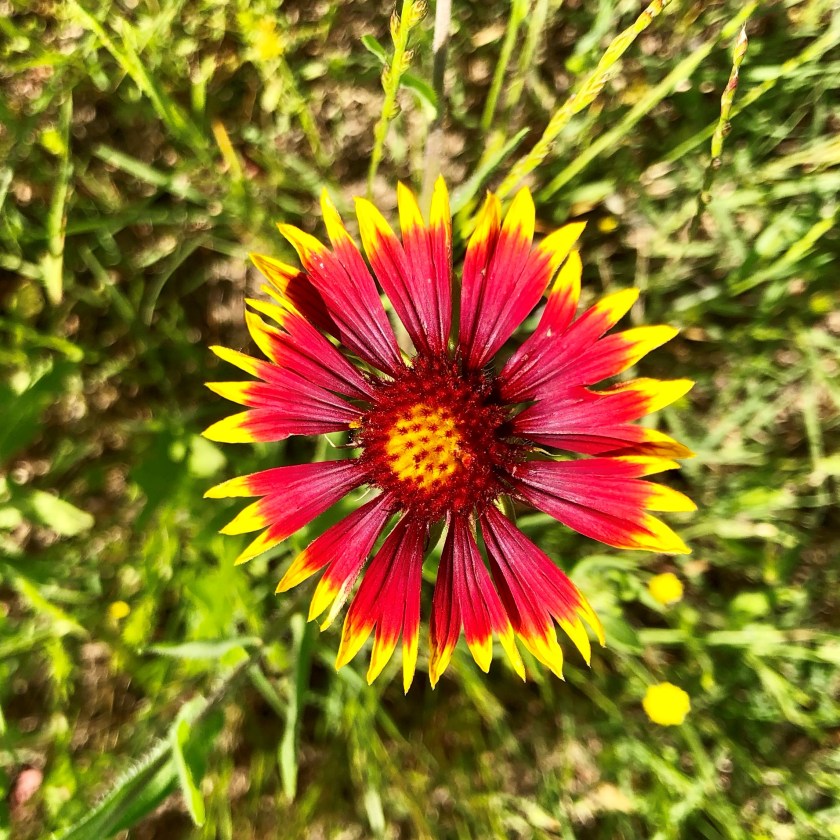
As for plants, I got some nice shots of Indian blanket (gaillardia), Texas thistle, wild garlic, white clover, hedge parsley (ugh), and the pretty curly dock we have with the bright pink seed heads. Sure, these aren’t real exciting, but I do want to record all, not just the showy ones. (There is lots of grass, but I need to get better at grass identification.)
Gaillardia is one of my favorite wildflowers.
I do love walking around here, but I equally love just sitting on the front or back porch and watching the wildlife, dogs, and weather. Spring is pretty awesome at the Hermits’ Rest.
PS: Don’t forget these blog posts always appear on the Hermits’ Rest Facebook page, along with more photos and goofy things. Please “like” us there, too!
I guess I should note what I’ve been seeing and hearing lately. There have been some great song birds at both my houses. There is a Chuck Will’s Widow somewhere near our Austin house, and their call is so cool (they say their name, loudly). You never see the bird, but you sure hear them! Ours are in the greenbelt across the road.
There’s another bird out there I can’t identify. It’s like a louder bobwhite call, without the first note. Bobwites go bob-bob-WHITE! And this bird goes bob-WHITE bob-WHITE! It’s a night-time bird, too. I’ll have to ask one of my birder friends for help with this one.
At the ranch, the prickly pear cactus has started blooming, and some of those supposedly delicious dewberries are starting to ripen. Since Sean Wall keeps saying how good they are, I guess I’ll make a cobbler this year. We certainly have enough of them.
Most of what we see in the pastures and fields are many, many dandelions, along with all the pollinaors thereof. No way am I getting rid of these delicious and useful plants!
The bluebonnets are fading, but the Indian blankets are coming on strong, and some of the Mexican hats have started. Plus, my tomato plants are fruiting. That’s all fine!
Just a blue-eyed boy.
The puppy
Yes, the Dogs of Hermits’ Rest have a new member. I adopted Carlton from the Cameron dog pound, which has to be the nicest dang dog pound on earth. Sandra, the dogcatcher, is a real animal lover and lavishes all the doggies in the pound with love and attention. She even works on training them.
This is a very old jasmine vine, judging from the width of its trunk (which doesn’t show up in this pho! And it sure smells good.
I’ve added flowers to today’s post to make it a little more cheerful. My urban home in Austin is on a hill near Bull Creek, and surrounded by greenbelts. That means there’s plenty of native flora and fauna, plus some darned nice things someone planted once. I’m glad I got to enjoy the scent of the very sturdy jasmine vine behind our house, and the nice collection of cedar sage in the limestone outcropping next to our house.
A lot of people walk their dogs by here, so this lovely planting brings joy to many.
What about the bats?
Well, the guy from the pest control company came by today. At first he thought the scat on my deck was from a rodent, but I pointed out how it’s arranged in a row and encouraged him to look up bat guano on his phone. He agreed we do have bats, and guessed they are mostly hanging out in the cavernous space where nothing else is in the chimney.
I began to imagine a growing smell, so I was pleased when he said they can block the holes in the flashing, put an “exit cone” in, and wait until all the bats have left to finish sealing it. The cone lets bats exit, but not re-enter. That would be nice.
Why so sad?
Unfortunately, when Francisco the bat man was looking for evidence of flying mammals he discovered evidence of burrowing insects that only occationally fly. Dang it, we have termites, and they are in the NEW wood, so they haven’t been there long.










 The Hermits' Rest