You haven’t heard much from us, because we’ve been traveling! We spent two days driving to Hilton Head, South Carolina. It was a glorious two days, too. The first days we enjoyed many small towns in Texas, since the first part of our trip was on state highways. Before stopping for the night, we visited my favorite welcome station, the one on the Mississippi River. I love the two bridges, watching barges, and all the colors. Some day I would love to take a river cruise on this river!
We stopped for the night in Meridian, Mississippi. We had a huge room, but what impressed us the most was that there was tons of food in the lobby when we arrived. It was for all the people who had evacuated from the path of Hurricane Michael and needed a break. There was a real sense of community in the place, and the staff at the hotel was bending over backwards to be kind, including feeding everyone. Made me happy.
The dogs are very impressed with the size of this yello cucumber. It’s um, mature.
It’s a nice October weekend, and I’ve been taking advantage of it by really enjoying the Hermits’ Rest. We’ve had a couple of neat discoveries today.
The first came when my friend Mandi and I were checking the bed with the okra, basil, and peppers in it. Out of habit, I looked in to see if there was any action on the cucumber vine that had really not done a dang thing all season, other than grow and make pretty flowers.
Whoa. What did I see, but a HUGE and very overripe cucumber, just sitting there taunting me. You’d think I’d have spotted that one long ago. It appears that the plant decided it was more of a pumpkin, and put all its energy into this one immense cuke. You’ll be grateful to know I’ve spared you the raunchy photos.
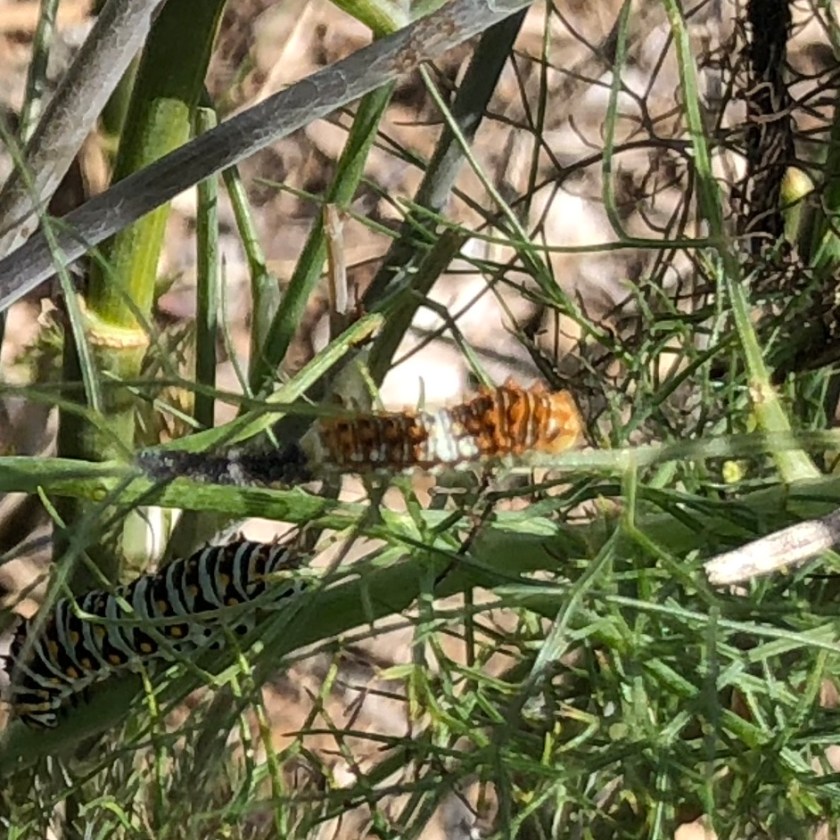
The hungry swallowtail caterpillar.
While laughing at the cucumber, I turned to look at the bronze fennel that is in its second year and going to seed. There I saw at least a dozen lovely caterpillars! They were munching away at an impressive rate.
I wonder what the little one is?
There were two types, and one was easy to identify as a black swallowtail, but the smaller ones I didn’t get. Someone has suggested that they are eastern black swallowtails, but I’m hoping someone can help me get a definitive ID. They are way smaller than the other ones.
Double rainbow, all the way! Mostly.
It was an extremely humid day, and there have been a few brief showers. We truly enjoyed the last one, which came from the shower that got me while feeding the chickens. It lasted at least an hour. You can’t complain when your surroundings are this beautiful.
PS: The chickens are finally making more eggs again. And Mandi and I found a dozen on the horses’ square bales. All were still good!
The summer drought has broken, and it’s rained three weeks in a row. The tanks are full and the ground is saturated. Plus, lawns all over the area are sprouting mushrooms. Lots of them are those somewhat poisonous ones I wrote about in July. But, if you keep looking, you’ll find many others.
Today, Mandi and I have been hanging out a bit on the porch at our office in Cameron. I have found a lot of interesting things to photograph there, and I’ll be sad to no longer have my office there after this month. But, not to worry, we will still own the place, and will have good friends living there who like nature as much as I do!
It just fell down. And though it was not in a forest, no one heard.
Anyway, less than an hour after we were last on the porch, Mandi shouted, “Sue Ann, come look at this!” I ran over, camera in hand, of course. Well, look at that! The very dead tree that we’d been meaning to cut down had broken off at the ground and fallen. I guess it won’t turn into a woodpecker house now! It fell pretty hard, and one branch dug into the dirt. We didn’t hear it, though.
This kind of thing is common after a drought period. The soil loosens up around dead trees, then when it gets all moist, the tree easily topples.
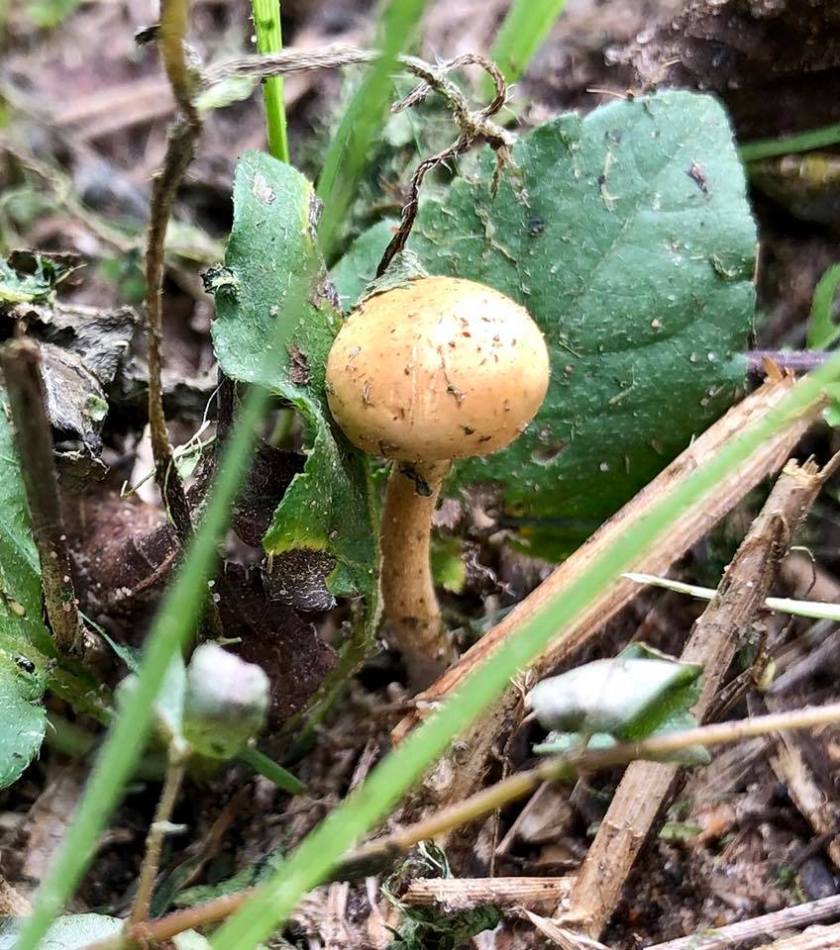
A very small mushroom.
As we were standing around, we continued to marvel at all the mushrooms and other fungi that have been popping up. The tiny fellow above also has a tiny worm buddy, but I cropped it out. Oops. You see so much if you look way down, though!
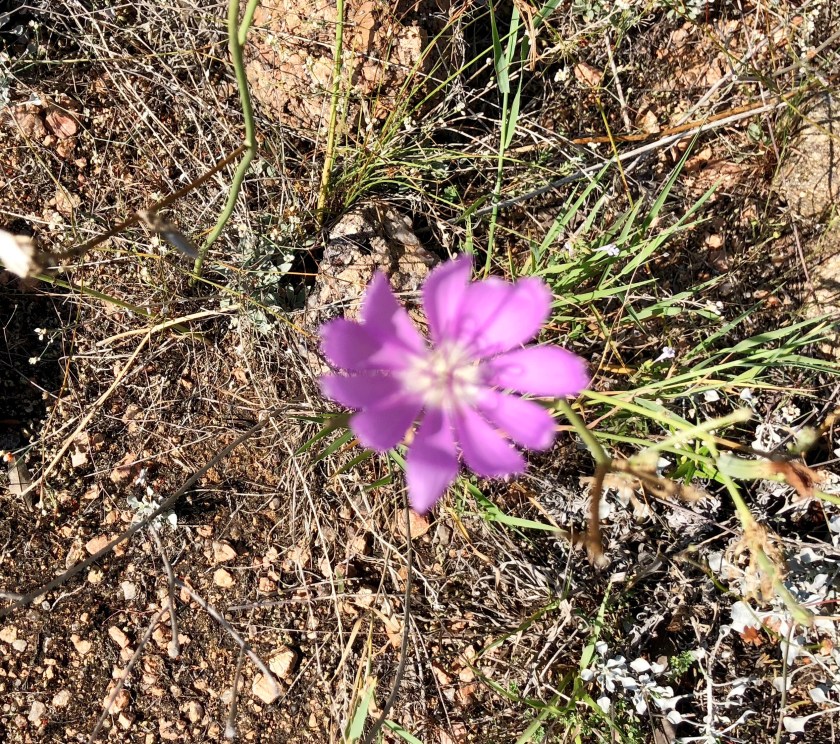
Summer color at Enchanted Rock. A tievine flower and some colorful lichen.
My housemate in Austin, Anita, and I are taking a quick mini-vacation to Fredericksburg, Texas. I haven’t taken her many places since she moved here, and I knew she’d love the Hill Country, even while we are enduring weeks and weeks of incredible heat.
Yesterday, we drove out to Enchanted Rock State Natural Area, a place you should also go, if you’re visiting the middle of Texas. It really is fascinating, especially in the spring or after a rain (due to flowers and little pools of water with tiny shrimp in them).
However, it’s very crowded in the spring and fall, so we discovered the great advantage of heading out early in the morning in midsummer is having the entire rim trail to ourselves (we saw one other hiker). We took Anita’s dog, so we didn’t try to climb the summit. Also, heat.
A Texas Skeleton Plant. That’s a new one for me! Big, pretty blossoms!
What I DID do, though, was put on my Master Naturalist hat (figuratively–I’d brought hiking boots, but forgot my hat), and see what kinds of plants, flowers, and other things I could spot. I’d never been to Enchanted Rock in the summer, so I did find some great surprises! And of course, I entered them all in my iNaturalist observations. Enjoy the photos, while I tell you about some of my favorite discoveries.
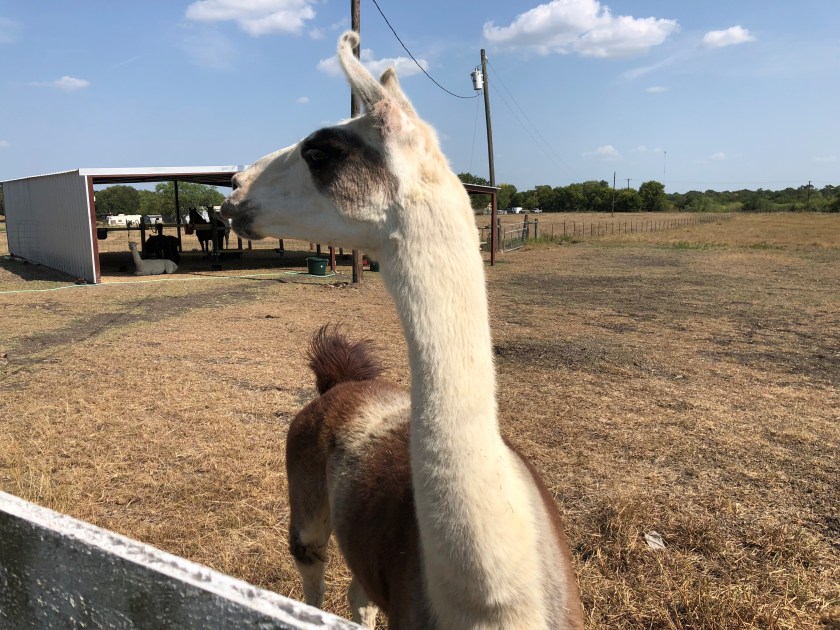
This cute and friendly llama has nothing to do with foraging, other than I met him at the baby shower for my grape-foraging friends Jenecia and Burt! Burt reports he HAS made some wine.
I’ve talked about this before, but I’m still really thrilled with the idea of eating things found right here on the ranch. It started when Sean Wall spoke at the Master Naturalist meeting a while back. I was gobsmacked to know that some of the plants that I saw every day were not only edible, but delicious.
I immediately devoured his book (get it, devoured? edible natives?) and ran around tasting things.
Passion vine is another vine with deliciousness associated with it. I am watching the passion fruit across the road very carefully so I can harvest some. Mmm.
Thanks to what I learned from Monique Reed on our plant identification expedition, I ended up eating a lot of smilax shoots this year. I was a bit irrationally happy that the irritating prickly vine I used to dislike so much was actually delicious.
I’m holding up the big bucket so Burt can concentrate on picking grapes.
After learning all about foraging from Sean Wall in our Master Naturalist training, I’ve been pretty excited to see what we can find around the Hermits’ Rest that we can eat or turn into something useful.
I know I could have done a lot more with all those dewberries besides make cobbler. I just need to be brave enough to try canning. Maybe next year!
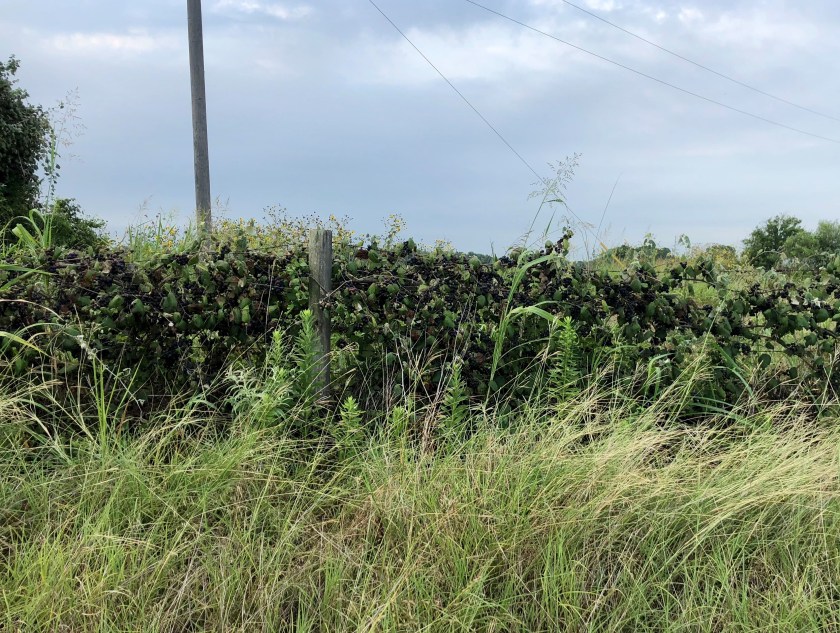
The midsummer bounty that magically appears every year are mustang grapes, which are native to the area and a great food source for animals. We have two trees that are completely covered in grape vines, plus a lot across the road from the gate.
In fact, I thought the grape vines were dying, they looked so black last week. Nope, it was all grapes.
The blackness is all grapes.
Now, I knew my Master Naturalist friend Burt likes to make wine, mead, applejack, and other tasty beverages. And I’d been looking for a reason to invite him and his wife, Jenecia (and their daughter to be), over to see the ranch. So, I announced that I have all the free mustang grapes a vintner could want, for free. (A couple of other folks had lots, too; it’s a great year for the mustang grape.)
They said they’d come by over the weekend, and so they did.
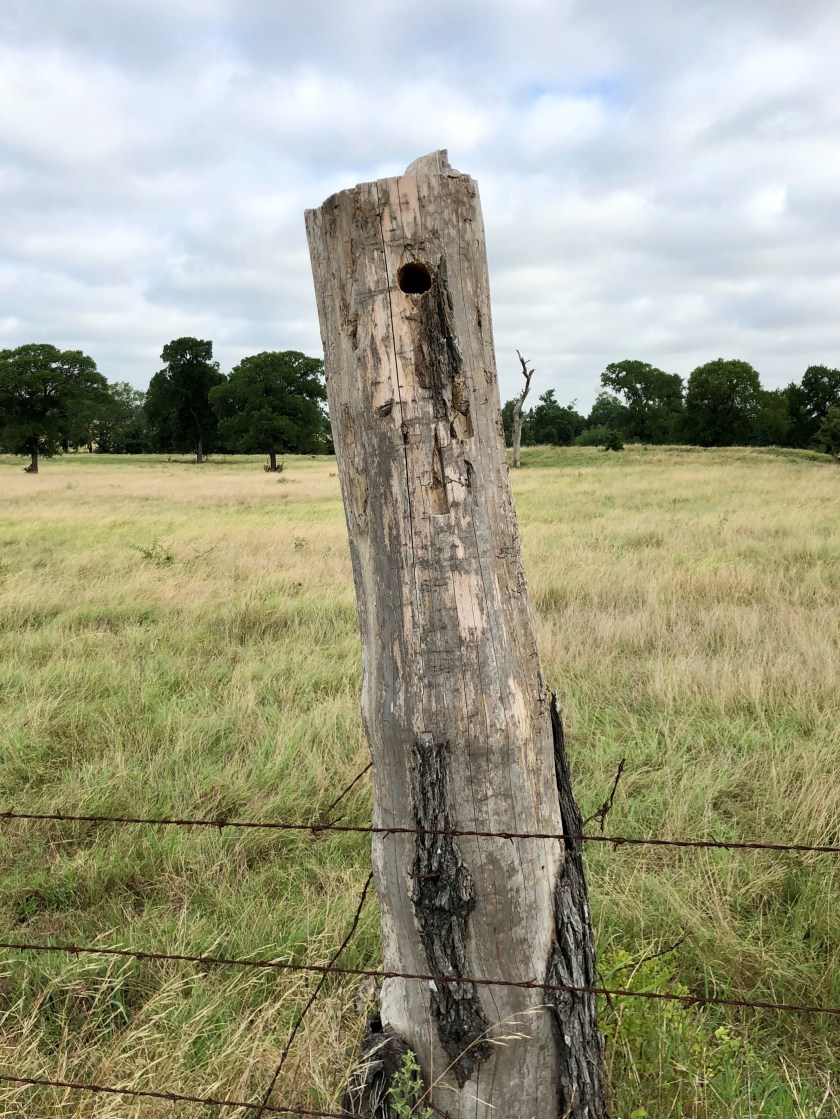
Look at that nice, round hole. There’s a red-bellied woodpecker in there!
It’s been a busy few days of observation here at the Hermits’ Rest. It’s hard to say which of the things I’ve seen has been more interesting to me!
The nest
The first thing I found has been intriguing me for a few weeks. I kept seeing a red-bellied woodpecker on a short tree stump on our property, right next to the road. I figured out why on Thursday when I was driving home and saw the bird entering a hole in the stump. I realized it must be a nest, so next time I drove by I stopped, and I could see “someone” in there, but it doesn’t show up in the photo (sigh, I realize a lovely woodpecker would have made the picture more exciting).
Next time I drove by to show my friends and spouse, and the woodpecker wasn’t home, but there was a beautiful hawk watching us from the next dead tree (which is still there because it was home to last year’s woodpeckers).
The hawk at the top of the dead tree seems to be watching that nest.
That sure teaches us to make sure to keep some of the dead and downed trees around! They make nice homes for beautiful nature friends.
The butterflies
This time of year there are a lot of butterflies around, especially the frittilaries. I got this nice photo of a variegated frittilary this weekend.
This variegated fritillary looks like a stained glass window.
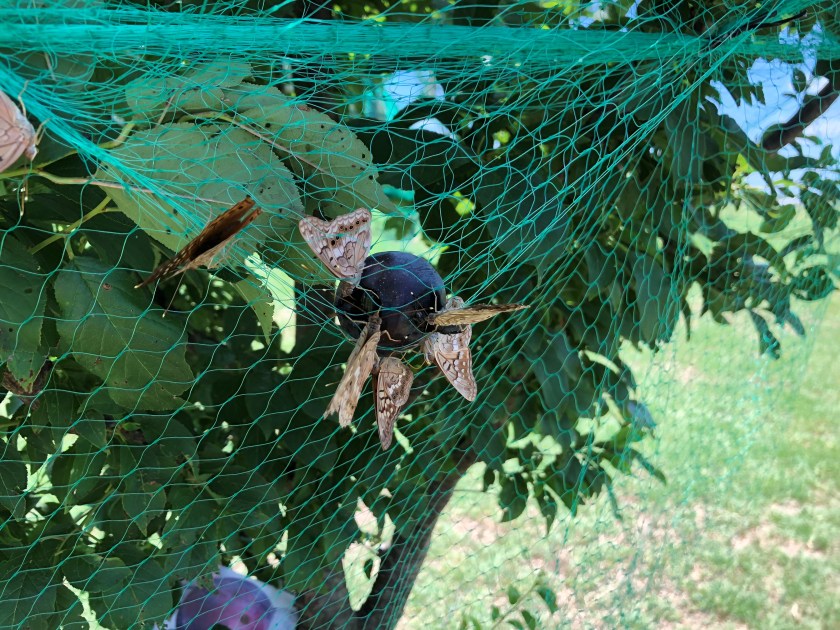
But what a lovely surprise came when I was showing some visitors our neighbor’s peack tree! The plum tree, which is finished fruiting but still has its protective net on, had one overripe plum still on it. This had let to a frittilary festival! There were at least a dozen of them flying around and enjoying plum juice. They landed on our heads and hands, making it seem like we were in a butterfly garden in a zoo. What a great experience
Very happy butterflies enjoying a very ripe plum.
And termites!
That’s right, I am excited about termites. You see, every year we get these interesting tube-like dirt structures on the parts of our property with the heavy clay soil. I always wondered what they were. My spouse said they were made by some kind of termite. I was confused, since they do not appear to be near any wood, which I identify as termite food.
Some of these tube structures are very large and complex. The termites climb up them and eat the grass inside, in safety, unless someone steps on their feeding structure.
So, when they showed up this year, I took some pictures, and uploaded them to iNaturalist in hopes of finding more information. I couldn’t find anything, though. Luckily, my Master Naturalist colleague, Linda Jo Conn, knew what it was (desert termites) and identified it for me. I was surprised to see very few sightings of Gnathamitermes tubiformans in the database.
Linda Jo referred me to her own observation of this very interesting beneficial termite, and there I found a link to a great article all about these fascinating creatures. They build walls around food sources like grass blades (out of clay, spit, and such) to protect themselves while they harvest it. So, all those cool tubes I saw were protective tunnels.
They mostly live underground, and according to the article:
“Their tunneling makes soil more porous. which improves the infiltration of rainfall and can improve plant growth in these arid areas.”
McDonald, A.K., Muegge, Mark A., and C. Sansone: Desert Termites Gnathamitermes tubiformans, 2010, Texas AgriLife Extension.
I am now trying to be more careful not to squish them.
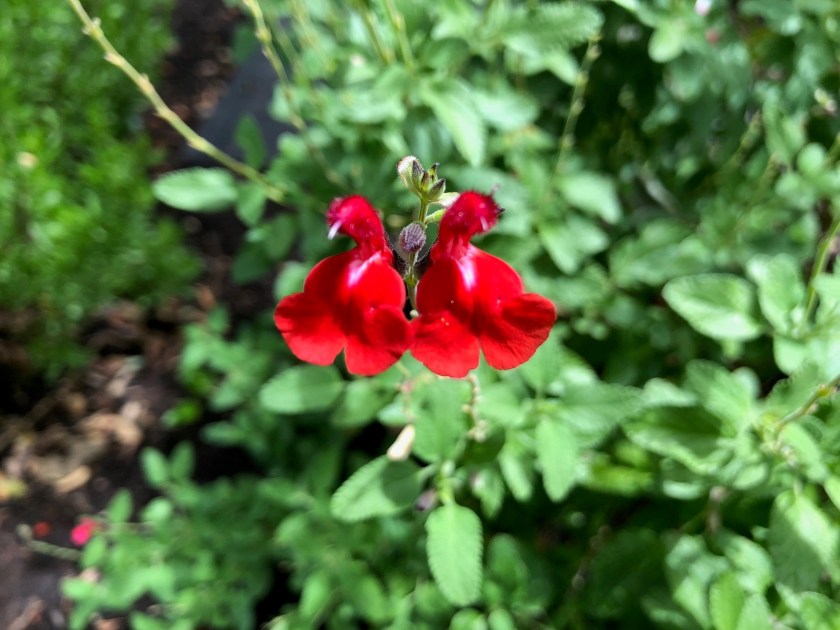
Salvia gregii is a really popular landscape plant. It’s supposed to be native, but I’ve never seen any that wasn’t put there by someone.
During the four days of the week when I’m in Austin, I do yoga three days at lunch. But on Wednesdays, I’m on my own. Sometimes I just work, but often I take a walk around the area, which has some interesting plantings and natural areas as well. The office is on land that used to be full of deer when my kids were little. Now there is a lot more office space and less deer land.
Anyway, I decided to give myself a challenge last Wednesday, which was to see how many new iNaturalist observations I could make during the lunch hour. I wanted to focus mainly on things that were blooming or bearing fruit, but if something else interesting showed up, I’d take advantage of that.
So, off I went with my trusty iPhone X, which takes reasonable pictures, sometimes. I took pictures of the native/nativized plants that had been planted around the buildings first. There were some really beautiful agaves that I just had to record, even though I know they are landscape plants. Look at this Queen Victoria Agave!
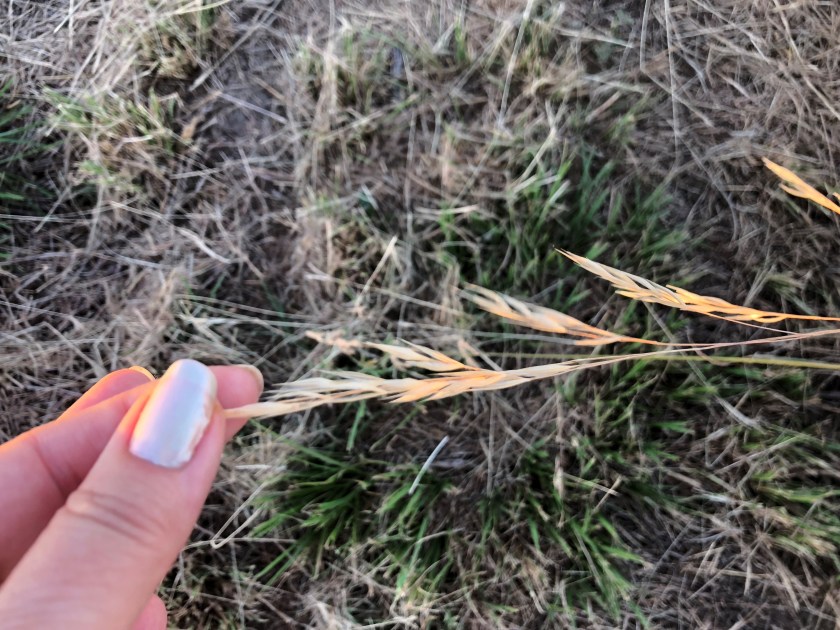
Rescue brome! Cool name, Never would ahve guessed this.
In my zeal to record all the things blooming around the Hermits’ Rest, I’ve been wanting to record all the lovely grasses that are producing their seed heads this time of year. They’re actually just glorious to look at right at sunset, when the silver bluestem practically glows as it waves in the wind. Heck, even Johnson grass (the bane of Texans’ existence) looks pretty that time of day.
I enjoy the grasses, especially since one of our field trips was to the herbarium, where we learned to use the keys to identify grasses by their seeds. Unfortunately, that is not a skill I have. Nor do I have a microscope, or even a really good camera. This means, sadly, that I sort of stink at grass identification.
Still, I throw my photos up on iNaturalist in hopes that someone will know what I am looking at. Sometimes it works, as in that rescue brome up there, but often it doesn’t.
Thank goodness for the helpful naturalists on the site, though. One of the Texas Parks and Wildlife urban wildlife biologists, Sam Kieschnick, has often consirmed my observations. His profile on iNaturalist proclaims his love of the project. The number of contributions he makes confirms his passion. I admire how he helps educate so many peopleand helps them contribute to scientific research along the way.
This is a snake apple, or balsam gourd. You apparently can’t eat it, but it won’t poison you.
I’ve mentioned before that I have been contributing to iNaturalist as part of my Texas Master Naturalist volunteer work. My project is identifying the plants and wildlife I see here at Hermits’ Rest Ranch. It’s lots of fun, and I can upload photos right from my phone. The pictures here are a few things I have seen in the last few days.
I realized I needed to do more to share my information with others, which I hadn’t been doing while I was just trying to figure things out. Thankfully, Linda Jo Conn, a member of our El Camino Real Master Naturalist group contacted me and let me know what project (group of observations) I should assign my observations to so they will all be together. She also suggested that I start my own project about the ranch collection.
A beautiful image of silver bluestem at sunset.
I managed to create a project, Hermits’ Rest Flora and Fauna, though I would rather narrow it down geographically than just have it be my own stuff from Milam County. At least this does leave out my observations in Travis County and elsewhere, though. If you are on iNaturalist, I’d love it if you’d follow this group!
I’m going to try to follow some of my other favorite members and their projects, too.
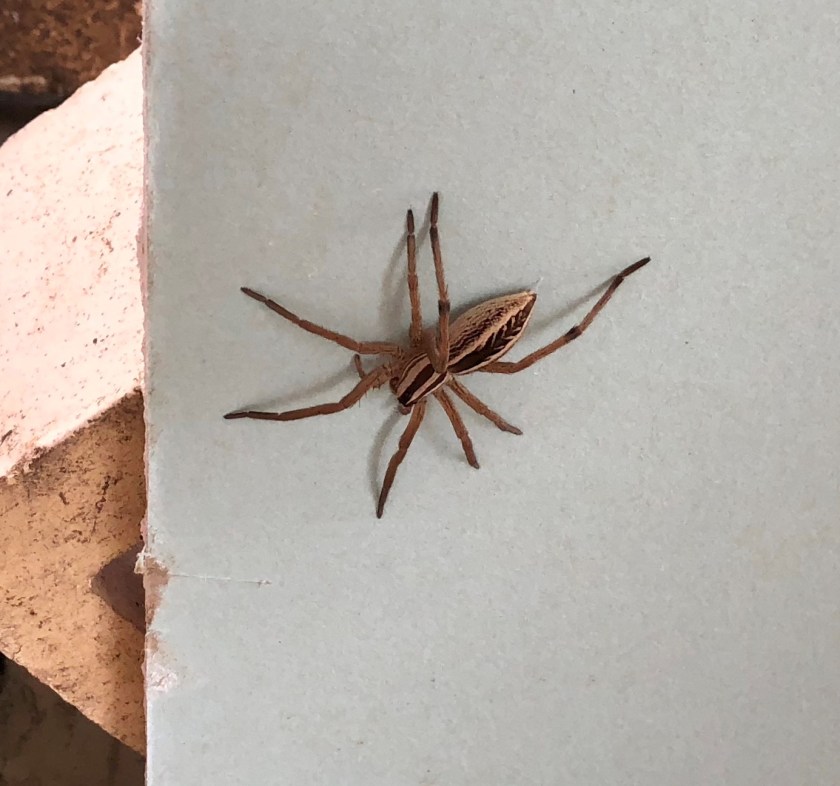
The iNaturalist guesser guessed rabid wolf spider for this one. It’s a big one!
I’m glad I’ll be able to share my findings with others now. I am having so much fun identifying the plants and animals I see around here! I’ve identified a couple of butterflies, too. I just don’t have the right camera to get bird photos. I’ll keep working on it!
Anyway, if you are on iNaturalist, I’d like to see your observations, so let me know who you are!


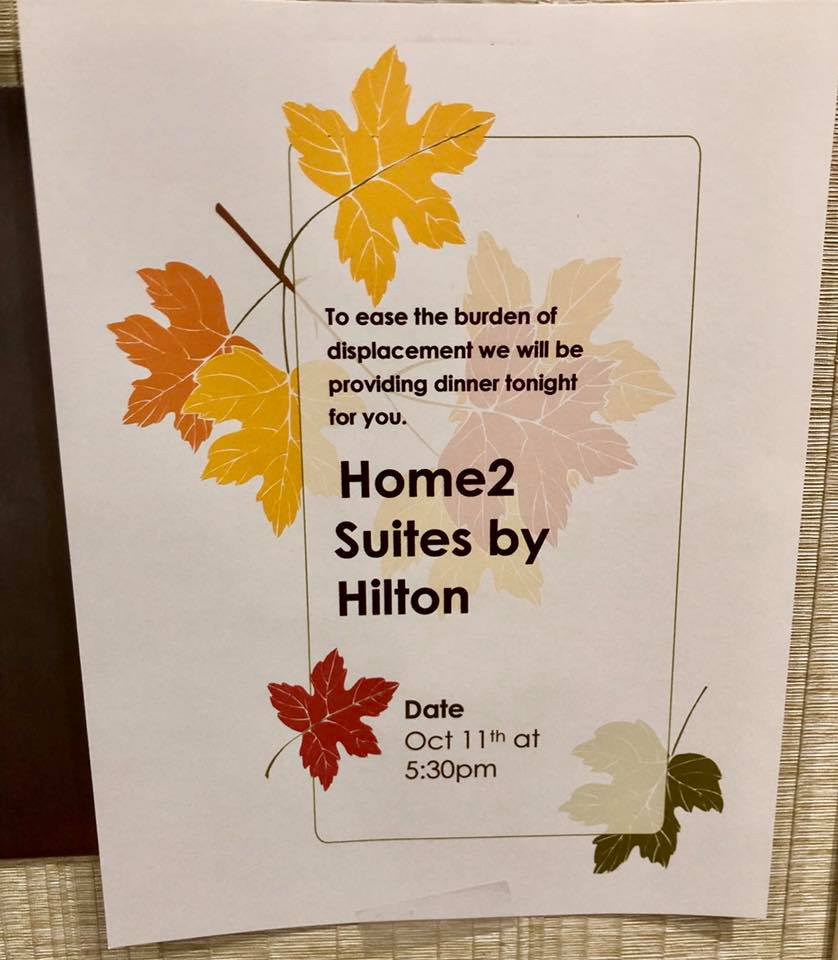 We stopped for the night in Meridian, Mississippi. We had a huge room, but what impressed us the most was that there was tons of food in the lobby when we arrived. It was for all the people who had evacuated from the path of Hurricane Michael and needed a break. There was a real sense of community in the place, and the staff at the hotel was bending over backwards to be kind, including feeding everyone. Made me happy.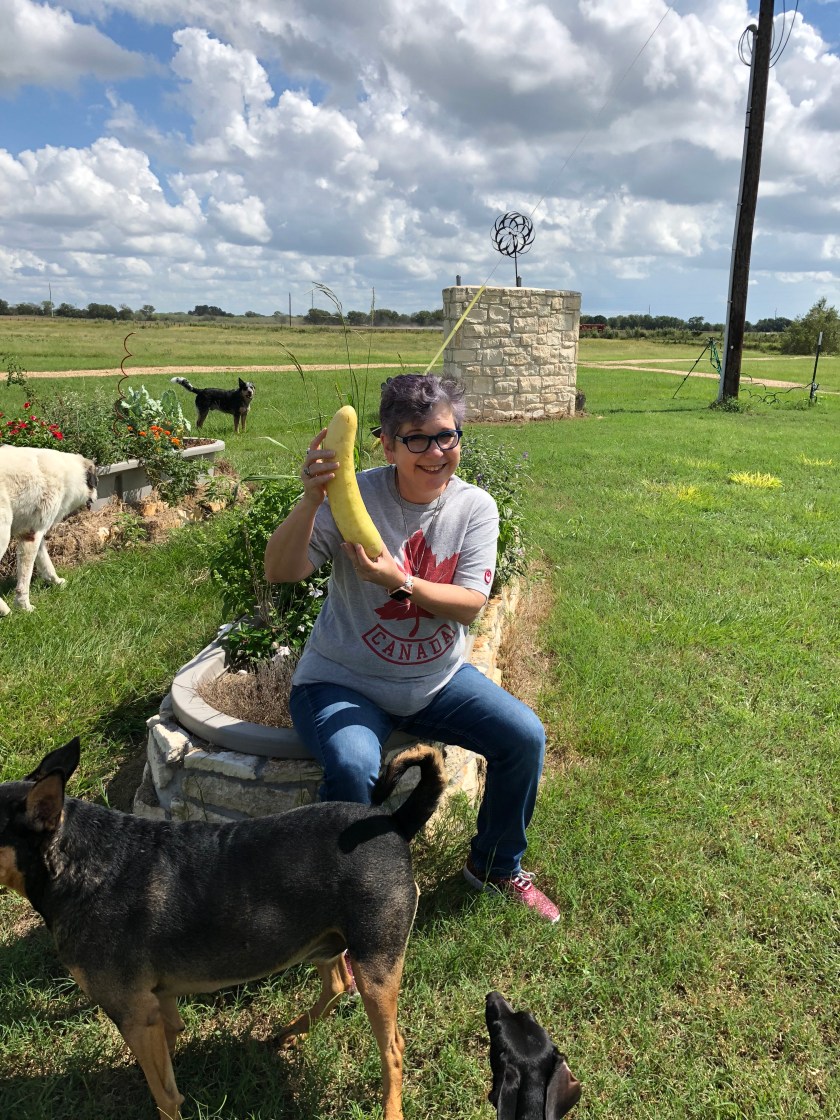












 The Hermits' Rest