This is the first post I accidentally posted as a page, not a blog post.
Hooray! Our little blog is a year old! I’m happy to have over a hundred followers, since so much of what I write is so I’ll remember stuff that happened. It’s been great sharing my nature observations, rants, and thoughts with all of you. Share us with your friends!
What else happened a year ago?
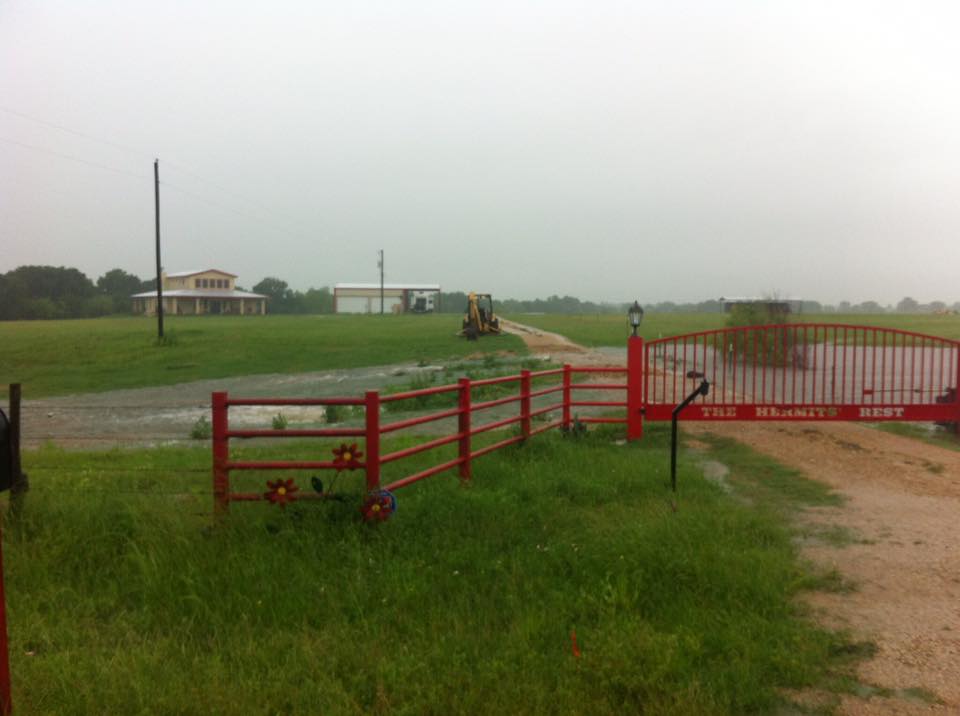
I guess I should not complain about last weekend’s big rain. I was remembering that we always seem to have some flooding in early April, and then, lo and behold, my Facebook memories reminded me that it was a lot worse this time last year.
April 11, 2018. No wonder I started a blog; I couldn’t go anywhere.
The 8 inches we got last year all came at once, which pushed the water over the bridge at Walker’s Creek, and worse, breached our dam. That flooding is what inspired Lee to add a second culvert for water overflow, which may be why we didn’t have a dam breach last week. Hooray for Lee.
The big tractor is just waiting to start digging that new culvert that will prevent us from losing more of our driveway.
PS: My blog interface decided to no longer let me add tags and categories. I’ll fix it eventually.
PPS: The reason it didn’t work because I added this as a PAGE and not a BLOG POST.
Last night I went to the El Camino Real Master Naturalist meeting, as I do most every month. I wrote up a post for their blog with lots of details about what I learned, so here I want to share my deep enjoyment from listening to women who are passionate about birds and birding as they share their passions with others.
Three women from our group spoke about how they engage in bird watching, each with a different perspective and knowledge base. I sat there like a little kid, all enthralled at the details they shared. It was thought-provoking to look at how each of them engaged in their hobby. Here’s what I saw (just using first names here).
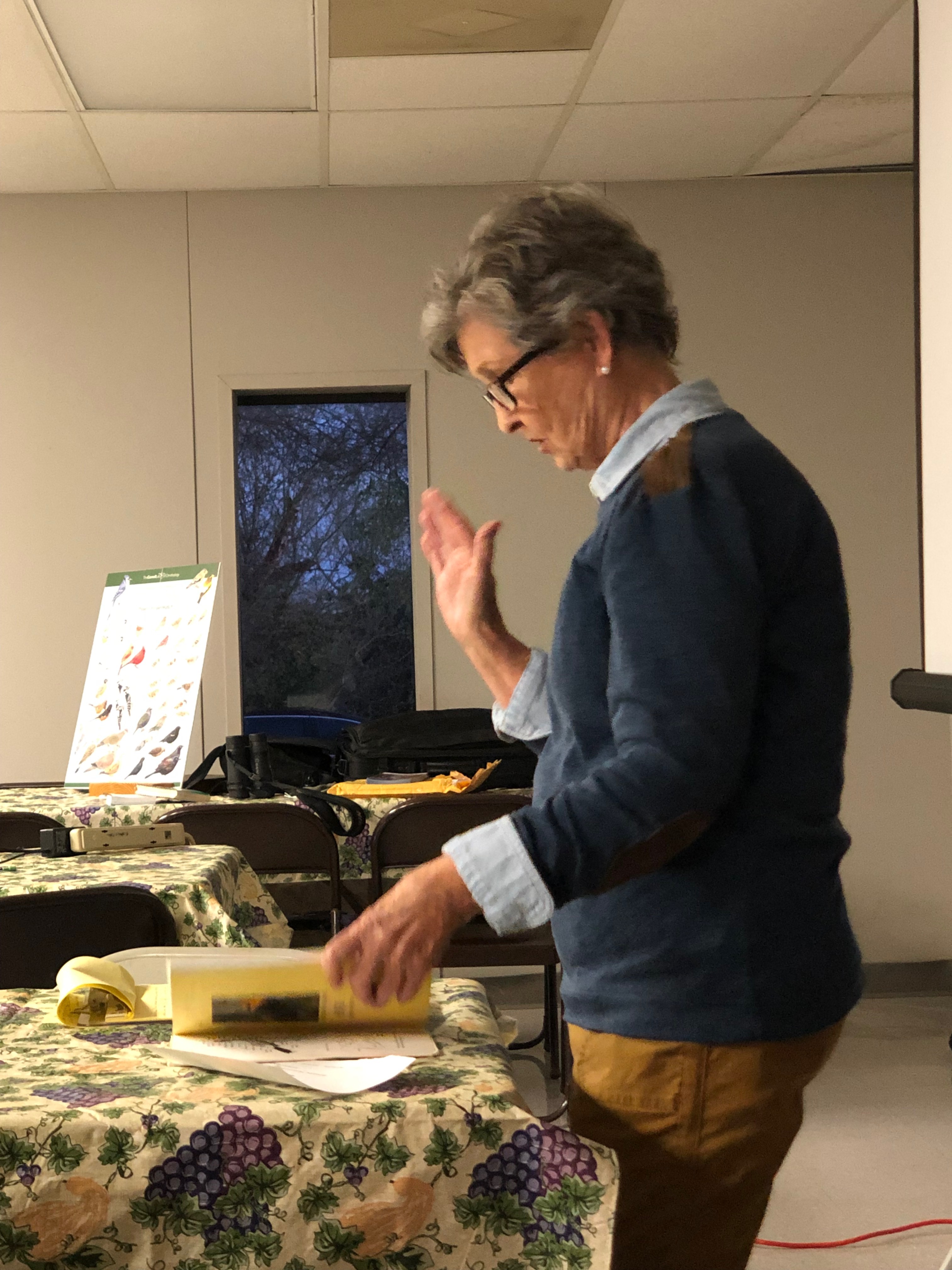
Ann tells us you really, really need a good bird book.
Ann has been birding for many years, and she does it for the same reasons I do: basically, she likes birds a lot. Her passion and enthusiasm for identifying new and unusual birds was very obvious, but she reminded me of my methods for birding. She said if she didn’t know what a bird was from quickly observing it, she’d often just move onto the next, in contrast to her birding friend who just HAD to identify every single bird she saw, in a scientific way. Of course, Ann knows pretty much all the birds you can see around here; she just doesn’t stress over what she doesn’t know.
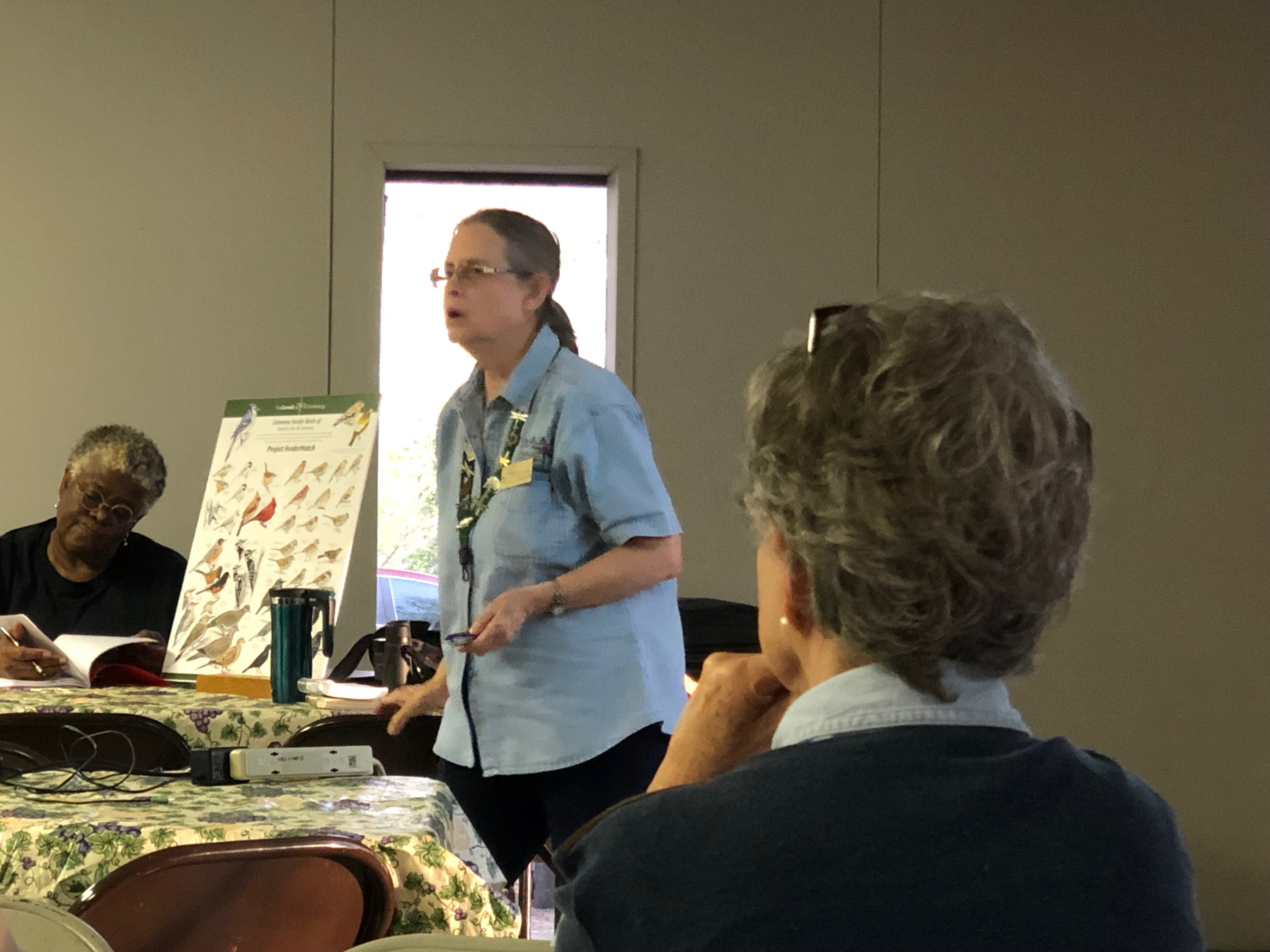
Joyce shares the various ways we can upload our observations to help researchers.
Joyce also loves birds, and watches them in a very accurate and detailed way. She keeps good records of her feeder, counting them carefully, and only identifying the ones that come into her feeder watch zone. There is a great deal of discipline to her approach to observing birds, which goes along with her amazing attention to detail in other parts of her life. We need birders like Joyce, too, to provide accurate data for researchers. (Of course, she’s also having fun.)
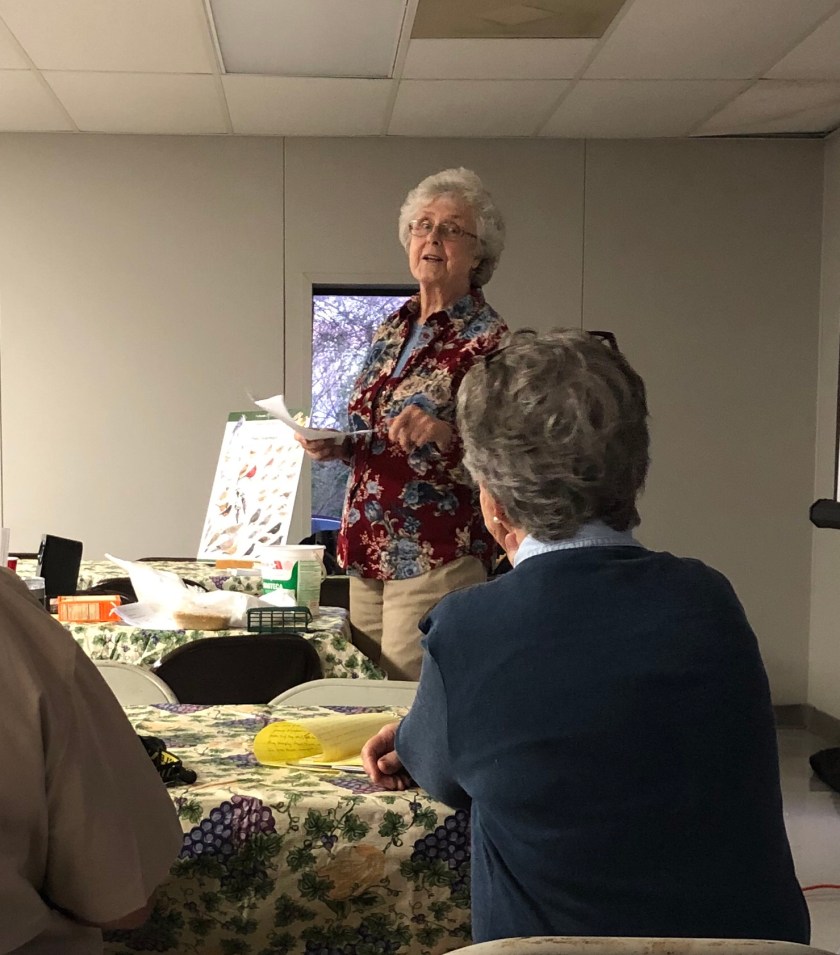
Here, Ann is listening to Cindy tell us her suet recipe. Some samples are on the table.
Then, there’s Cindy, whose approach to birding is to figure out how she can practically help the most birds. She shared with us her recipe for making lots and lots of suet for little money, so that the woodpeckers and other birds that like to feed on trees and eat more than just seed can be satisfied. She’s not there just to watch or count or record she’s there to help the birds thrive.
(All the women also carefully feed and water their birds; I was just contrasting their main styles.)
Another birder style was described by Ann, who talked about a very intense young man who asked to come to her house, because he was on a mission to get three more birds on his Milam County list of 100, and she had some of them in her yard. As soon as he saw one, he went on to look for the next. No lollygagging, watching behavior, or anything. And he didn’t stick around to chat; nope, he had to go to Bell County to work on his count there. These are the kind of birders people often gently poke fun at, but hey, they aren’t hurting anyone, are they?
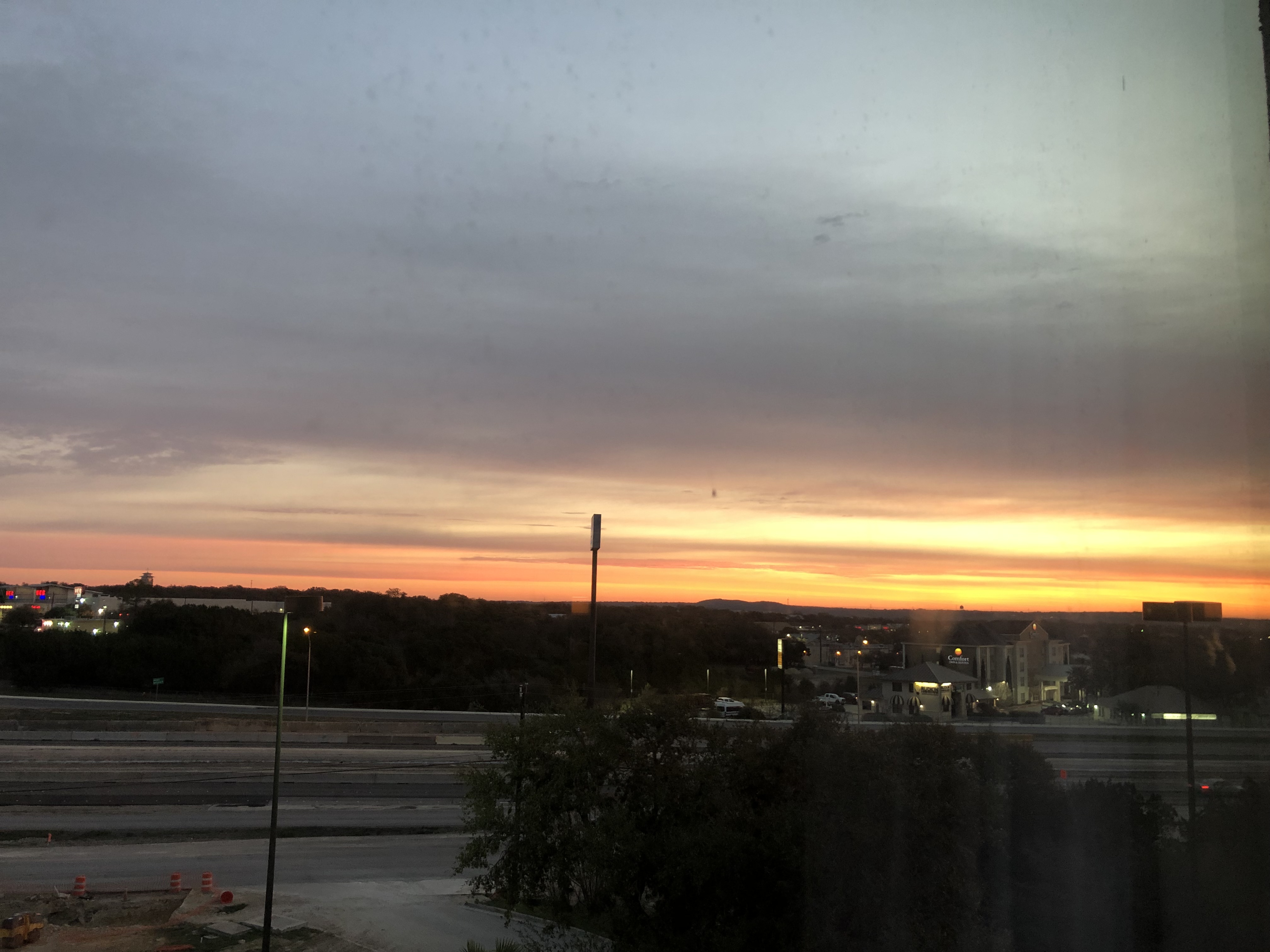
Bonus sinset from the meeting yesterday.
Like any other hobby, there are many ways to enjoy birding (don’t get me started on process versus product knitters). Do you like to watch birds? Do you feel like you need to know what they are? Do you just enjoy their antics? Do you use them to tell what season it is? Share!
Now, that is a yellow flower!
By the way, I was almost late to the meeting, because I had to take this photo of beautiful evening primroses along County Road 140 across from the cemetery.
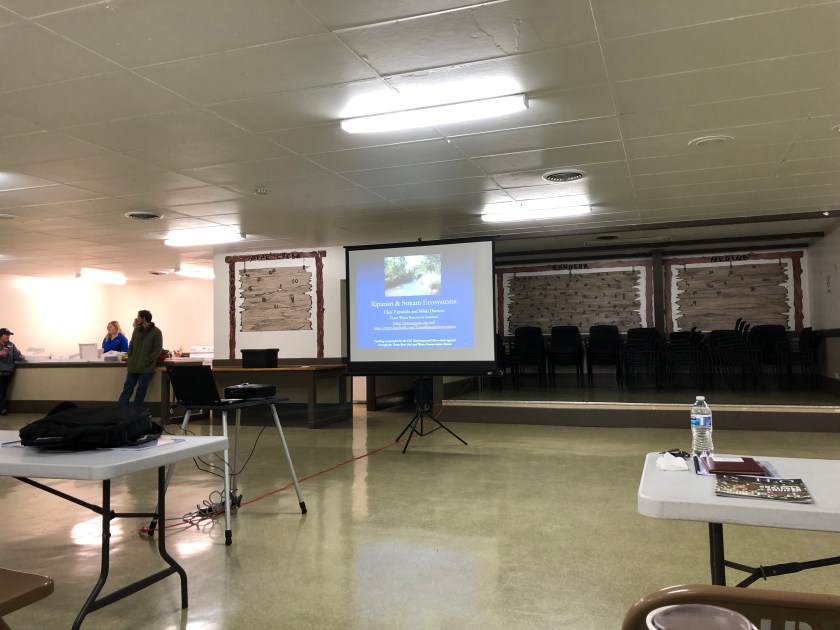
Now that I’ve slept, maybe I can share some of the depth and variety of the things I learned at the Bandera County Watersheds Riparian Training I attended on Wednesday, March 6. The event was held in Bandera (one of the most attractive small towns I ever saw and VERY consistent in its cowboy theme), and the weather improved enough that the outdoo parts were not unbearable. There were at least 30 participants, ranging from fellow Master Naturalists to water management professionals to interested landowners.
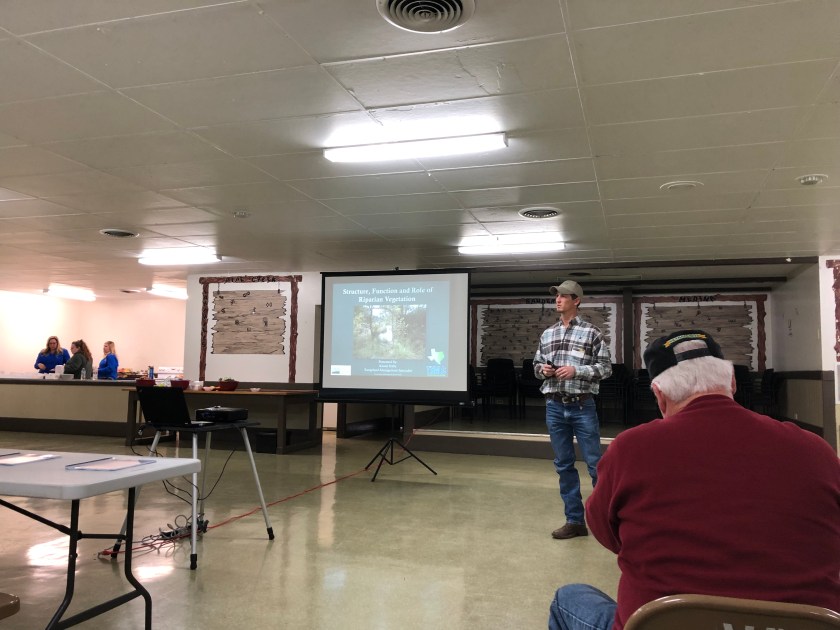
This young man was full of information. I’d love to hear him again.
Much of the day was spent indoors, however, as a team of water management experts from many different agencies shared their knowledge of managing the areas alongside rivers, creeks, and streams. These are called riparian areas, and they are a very important part of water management, but one that has been misunderstood a lot in the past.
Our scenic location.
Sadly, the beautifully manicured lawns and parkscapes we often see, where people walk up and down to admire the view, are not actually what our waterways need. The need a riparian buffer of plants that love water or theive near it and trees that are of various ages, so that when they die or fall into the water, there are future trees to replace them.
Boerne sunrise. I got to drive through the really intriguing city center on my way home. I wanna go back.
I’ll write about my day at the riparian ecosystem workshop I attended when I’m not so tired. But i can tell you why I’m tired.
Traffic jams. Why does anyone live in Austin if they have a commute?
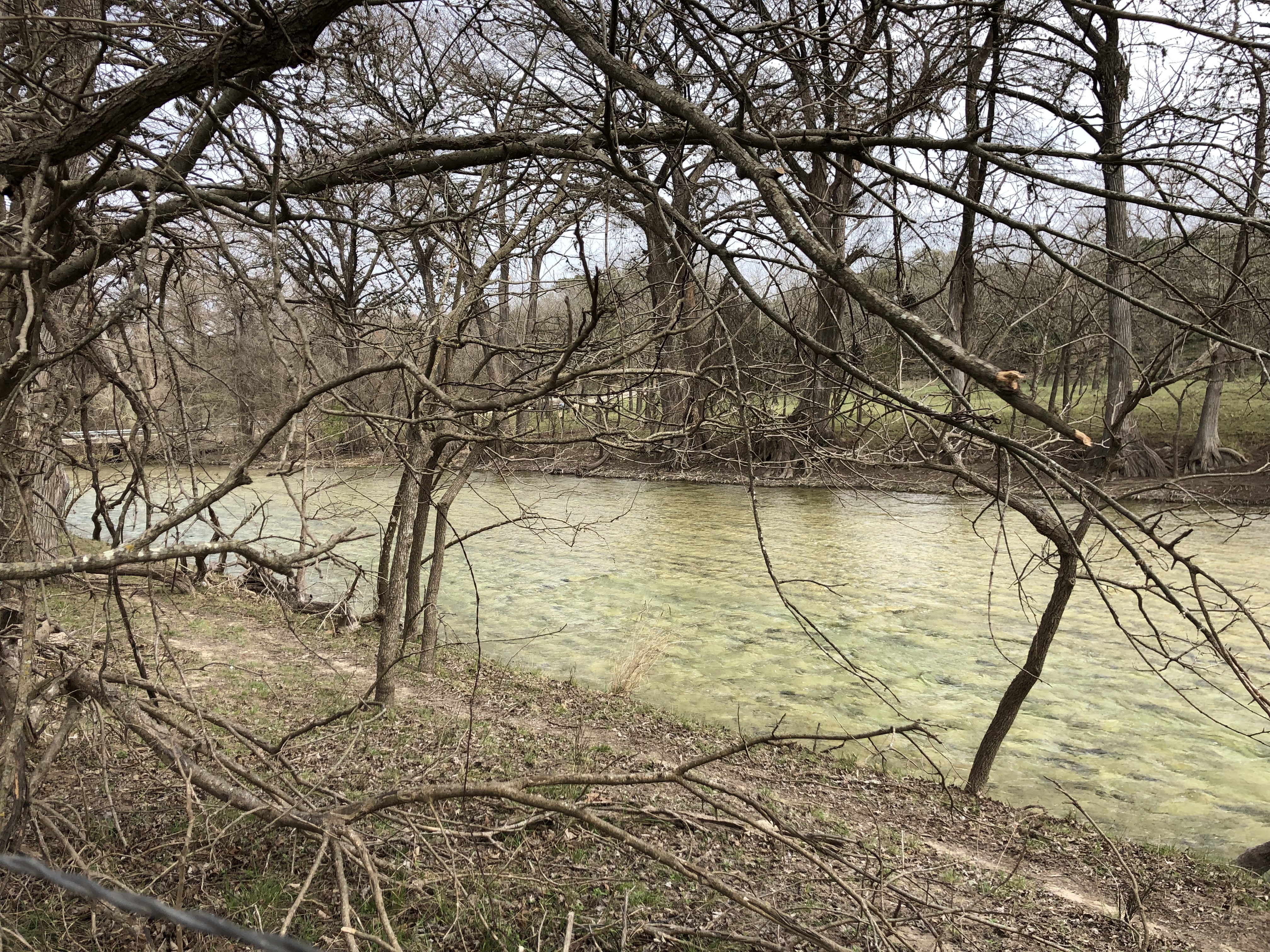
Just one preview of my day. This is a river.
My drive home from Bandera was a lot of fun, or at least two thirds of it was. In addition to enough antelope, gazelles, and other “boingy-boingies” (as I call them) to fill an African safari, I also saw more than one ranch full of little ponies and many show goats. Plus the redbuds were everywhere.
Look. It’s agarita.
Then, boom. I hit Austin. All my relaxation vanished. I did NOT take pictures. Because I was driving. I got home with a pounding head, and I could barely talk to Anita. All I wanted for was to finish my loaf of homemade sourdough bread from my coworker.
Happy Sunday! Yesterday I attended a committee meeting with our Master Naturalist group. Rather than write it up twice, I’m sharing my post on their blog.
I’d like to add that I saw a huge dead feral hog on the way in, and found some Indian paintbrush flowers on the roadside between Cameron and rural Rockdale!
Yesterday, the Environment and Recycling Ad-hoc Committee’s Earth Day subcommittee met to continue to work out plans. I was glad I could finally attend a meeting, because it was fun to see the team at work. I was joined by Ann Collins, Linda Jo Conn, Joyce Conner, Catherine Johnson, Rosie Johnson (guest and helper), Larry Kocian, Kathy Lester, and Donna Lewis (the leader of the bunch).
Nandina and Texas mountain laurel added beauty and scent too the meetiing.
What’s going on with Earth Day?
The El Camino Real Master Naturalist Chapter’s biggest outreach project each year is to host an Earth Day event, to share ways to protect the planet with the community. This year it will be at:
Rockdale Community Center, 109 N. Main, on Saturday, April 20, 10 am – 2 pm.
We were excited to learn about all the planned activities and tables. Our team leader, Donna…
You might not be surprised to learn that I mostly read nonfiction (when not reading my many magazine subscriptions). I do this, because I really love to learn new things, especially how the natural world works and what makes living organisms tick.
For example, two of my past favorite books were an excellent history of the pencil and a book called Salt, which showed the importance of salt to commerce and history.
I also really like memoirs and biographies, so I’m really happy that my book club chose Becoming, by Michelle Obama as our next assigned reading. My quick recommendations for this genre from recent years include the memoirs/biographies of Keith Richards, Warren Zevon, Bruce Springsteen, and Sally Field (see, not all of them are musicians).
What am I reading now?
At the moment, I’m in the middle of the book you see here, Underground. It’s Will Hunt’s first book, but what a fun one! He goes all over the world looking at caves, mines, catacombs, and tunnels. Each chapter is very different, but always fascinating.
I learned a lot about what’s underneath Paris, and right now am learning a lot more about the significance of red ochre to civilizations around the world, while Hunt visits an ancient site in Australia and learns of how holy it is to the people of the region.
If you’re not a sufferer of second-hand claustrophobia, I recommend it!
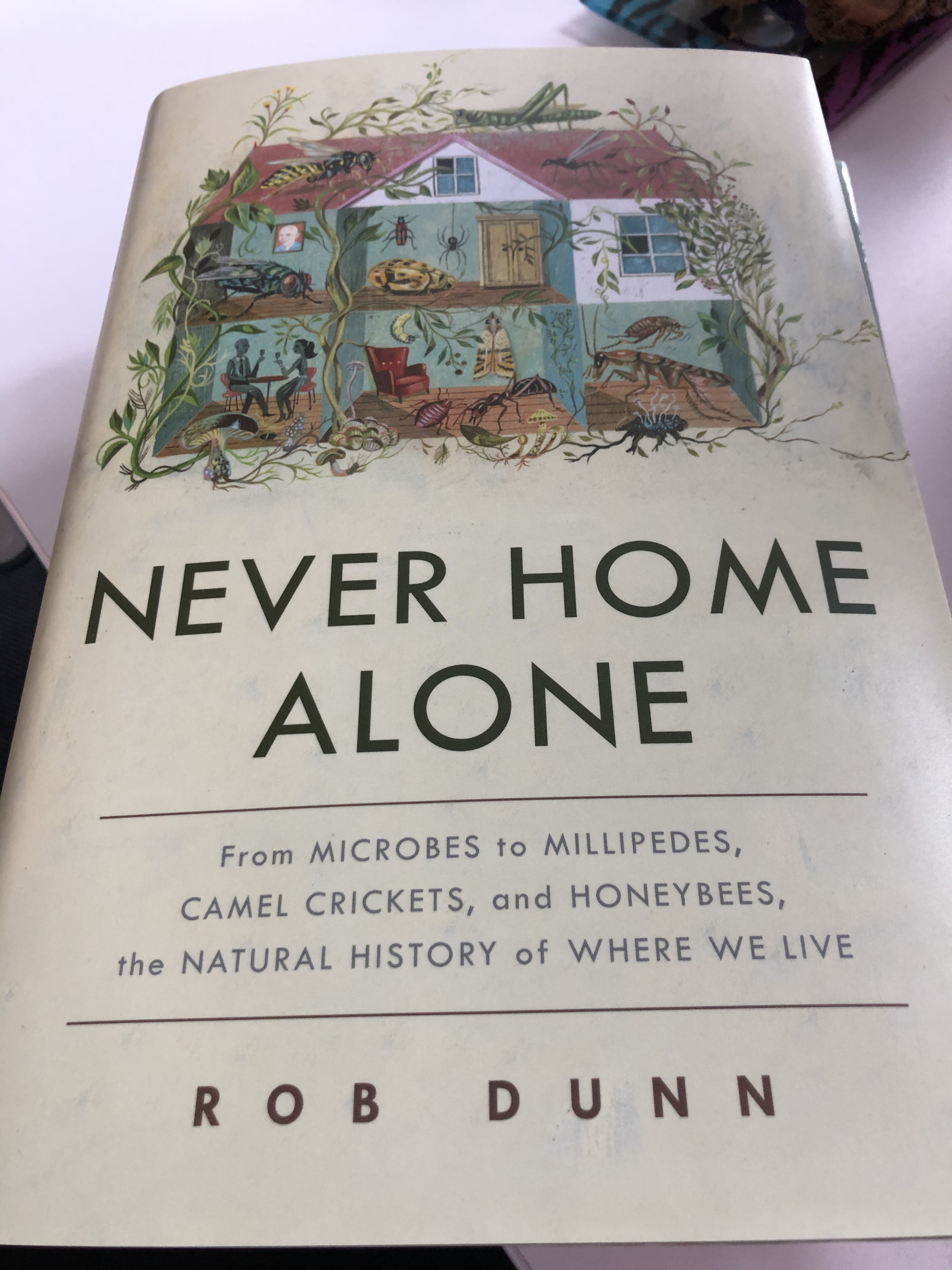
I just received my copy of Never Home Alone, in which Rob Dunn makes it abundantly clear that you can’t clean a house well enough to eliminate all your uninvited “neighbors.” I can’t wait to learn all about spiders, crickets, dust mites, and their teeny-tiny cohorts!
This book really drives home the point that you can’t escape “nature” by staying indoors! It appears quite plausible that there can be “indoor master naturalists” who just focus inside the house. Hmm, with my never-ending battle against the moths in my kitchen cabinets and the yearly cricket invasions, I may already be one of those.
Oakleaf hydrangea. I love the contrast between last year’s purple leaves and the newly emerging ones that are so pale green that they are almost white.
Feel free to add your own favorites in the comments! As a reward, here are a couple of photos of some beautiful new spring growth.
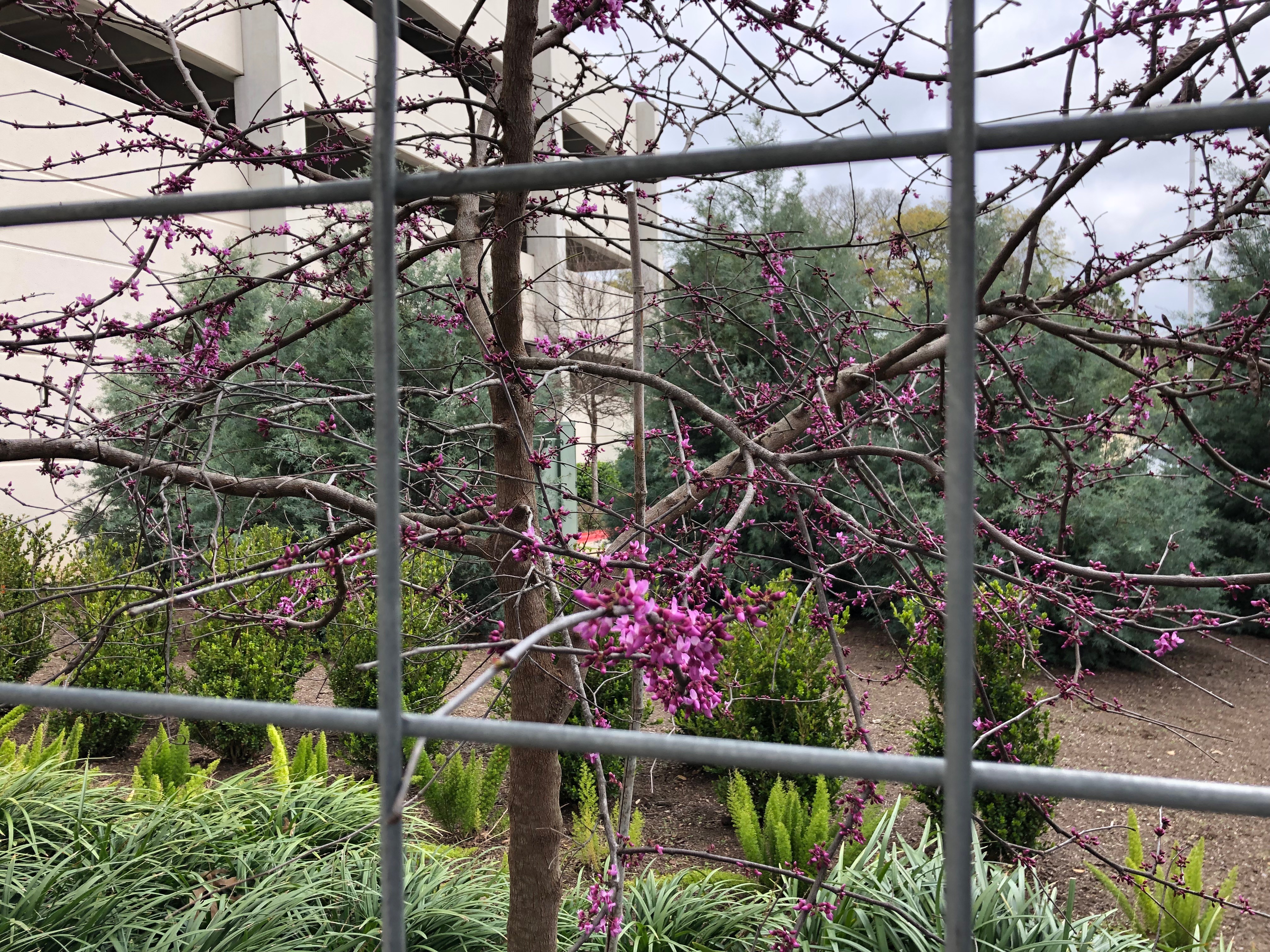
Work redbud. If only you could hear the birds and smell the sweet olive!
PS: Baby hawks should be on the way! Mating was observed. They have no shame. Of course. They’re birds.
It just popped into my head at our last meeting that we had no way to share and archive our nature stories, reports on training, etc. It’s a lot of work to make a paper newsletter, so we haven’t had one in a while, and though we do have a Facebook page, it’s more about news, since member posts don’t show up on the main page. A blog is a great way to share.
Also, blogging is a great way to get volunteer hours. Master Naturalists like those.
How did I do it?
I always forget what goes into setting up a new WordPress blog, customizing its look and feel, and making it do what I want it to do. I like the theme I chose for this one, especially since the top menus stay at the top of the screen as you scroll down. I also think it looks pretty elegant and simple.
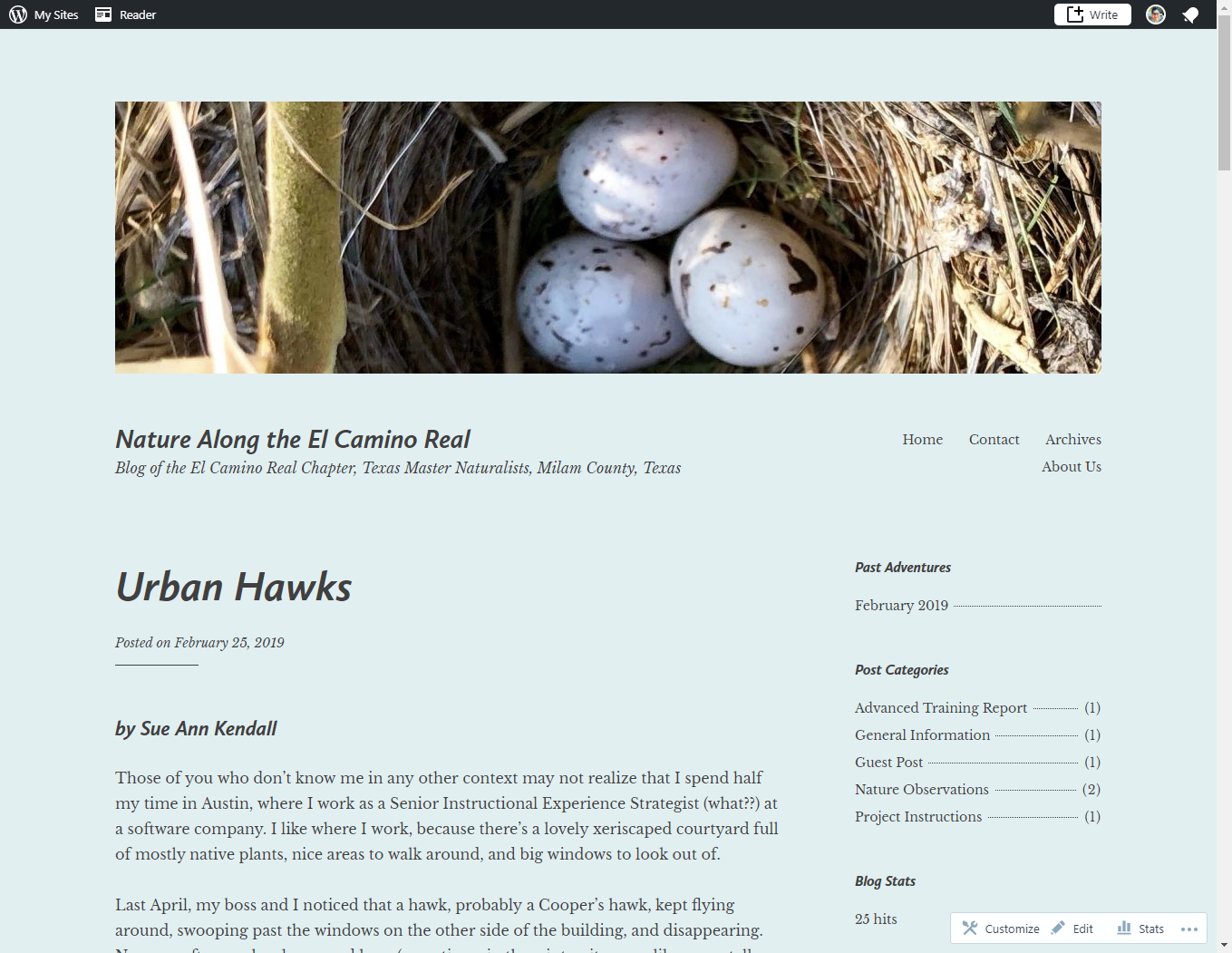
Here’s a blog page. It has a right column with archives, sign-up informatio,n and stats.
What I didn’t like about the theme was that there was no way to put a blog archive on the home page. The home page has no right column, and you can’t easily modify the top. I did put the archives at the bottom of the page, but, who’s going to go all the way down there?
This shows the small top menu that stays when you scroll down. Also, note that archives menu.
So, I made an archive top-level page. Problem solved, I hope.
Off we go
Feedback I got from the small group I ran it by was that it was hard to subscribe to the blog (I made sure to put both the email follow link and the WordPress follow link). And some typos got spotted, which I always appreciate.
I was happy to receive two items to post as soon as the group voted to start a blog. That way not all the articles will be by me! I plan to continue to re-blog my more naturalist-oriented posts here, but am looking forward to seeing lots more from my fellow Master Naturalists.
Admittedly, I was excited to go to Galveston Island, because I had the thought that a lot of the migratory birds would still be hanging around and I could see them. I didn’t count on it being a rather dismal day for photography, in which everything around was the same shade of brownish gray.
We certainly couldn’t see anything from our hotel room other than exotic Beach Pigeons (same as any other pigeon). The birds were probably all frightened away by the belching pseudo-volcano at the Rainforest Cafe that was the primary view from our balcony (we could also see the Gulf, when the fog lifted slightly).
Here I am pretending that the Rainforest cafe is 1) open or 2) fun.
Once we were awake (-ish, since the hotel didn’t have any reasonable coffee), we took a walk on the beach. This proved to us that it doesn’t have to be a warm and sunny day to enjoy the shore.
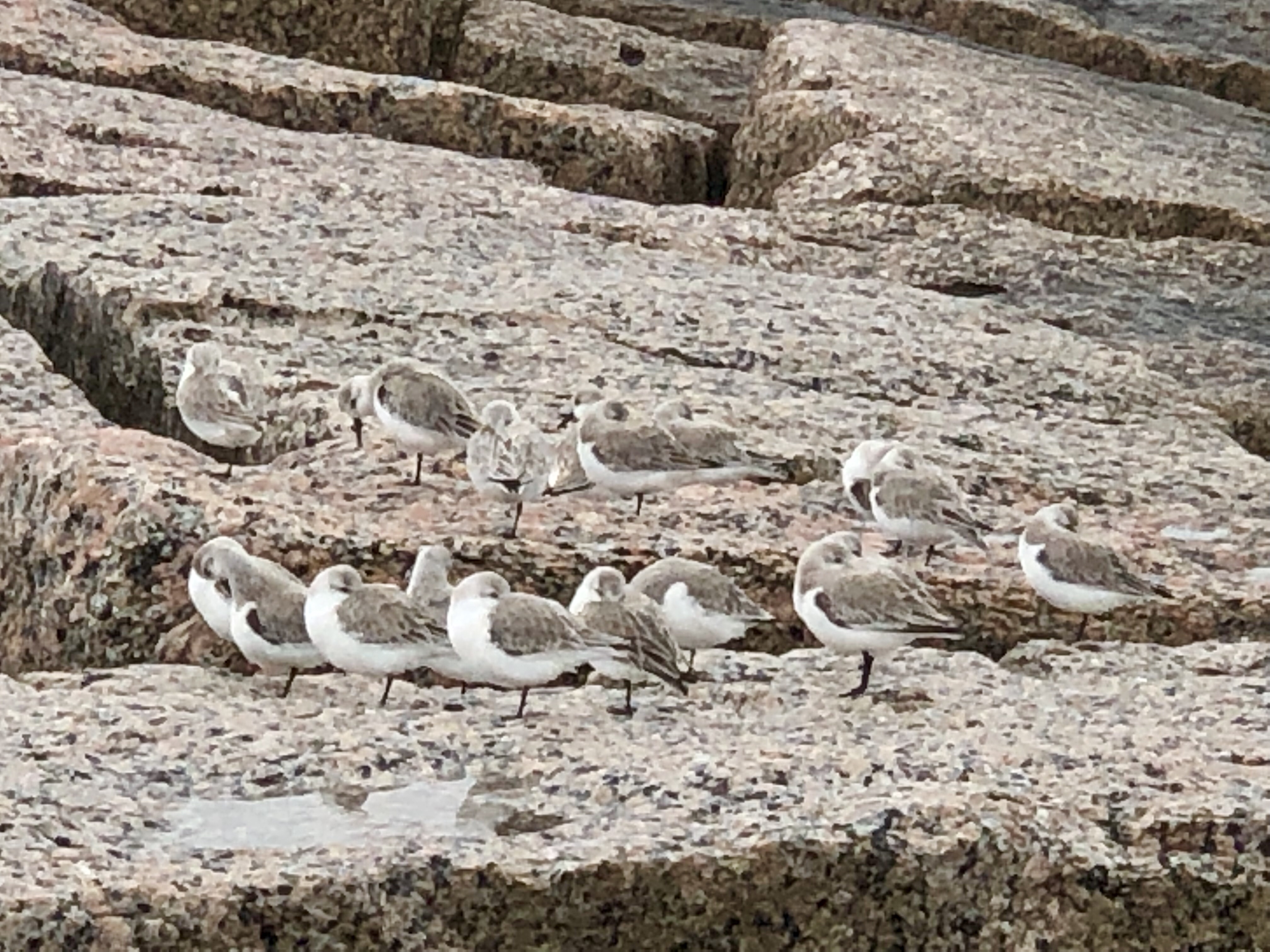
Look how well these birds blend in with the rocks and surf.
At first we didn’t see anything other than gulls, pigeons, and grackles, but once we walked down the jetty, we adjusted our eyes, and boom! There were some beautiful little ruddy turnstones busily picking at the moss and seaweed growing on the granite (from Marble Falls!). They were very industrious and blended amazingly well among the blocks. You really only noticed them when they moved.
Evrybody’s head is all tucked. Nap time?
We kept walking down the jetty until Lee stopped me and said, “Look!” Sure enough, there was a flock of what appear to me to be sanderlings, huddling together to stay warm, or something. They were at least a little easier to spot. They let us get nice and close, so I could get a good photo.
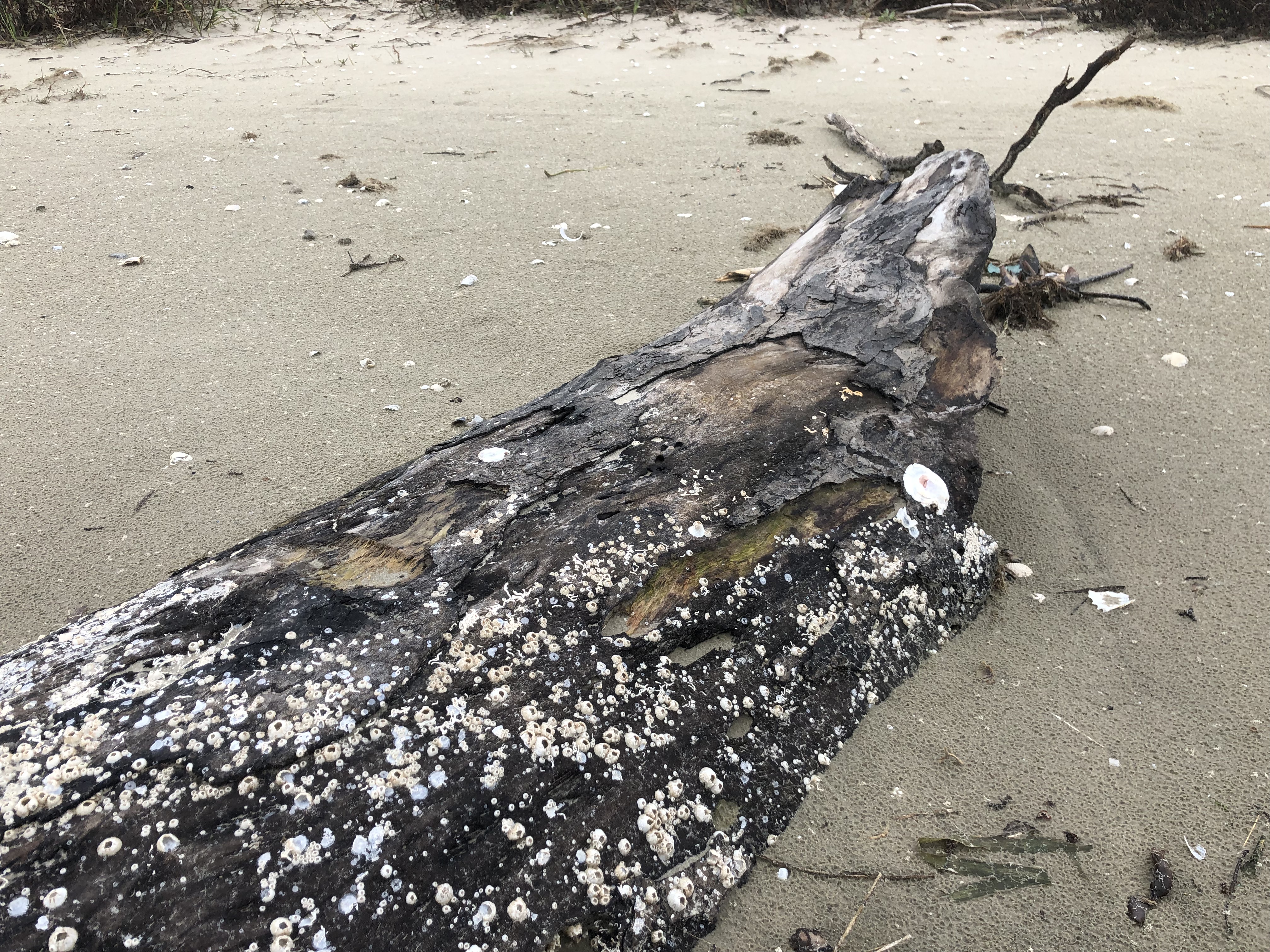
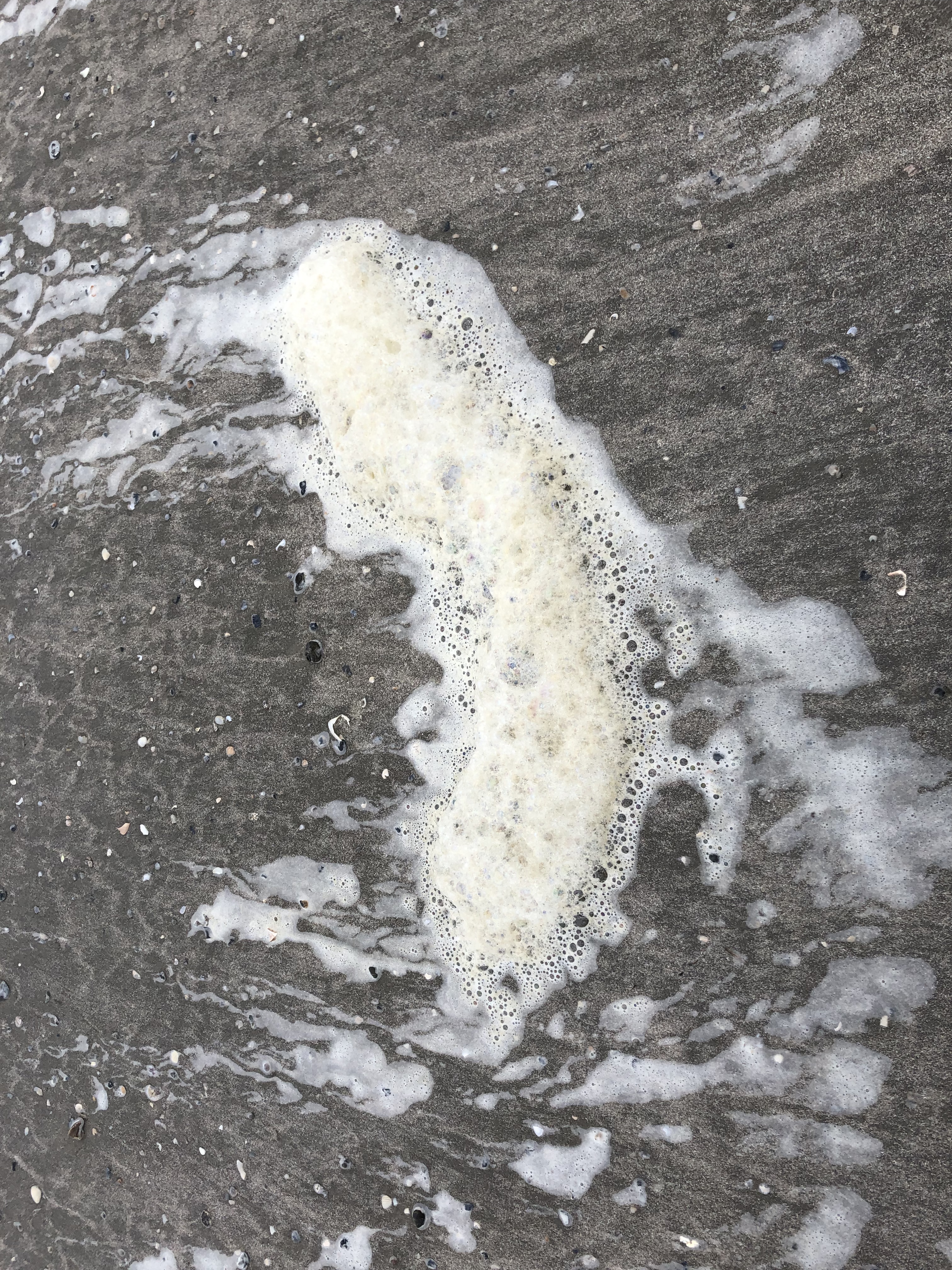
We spent last night in a misty Galveston Island, Texas. I’ll write more about it later, but thought I’d share a few pictures of things I found washed up on the beach.
The tree looks like a whale from this angle.
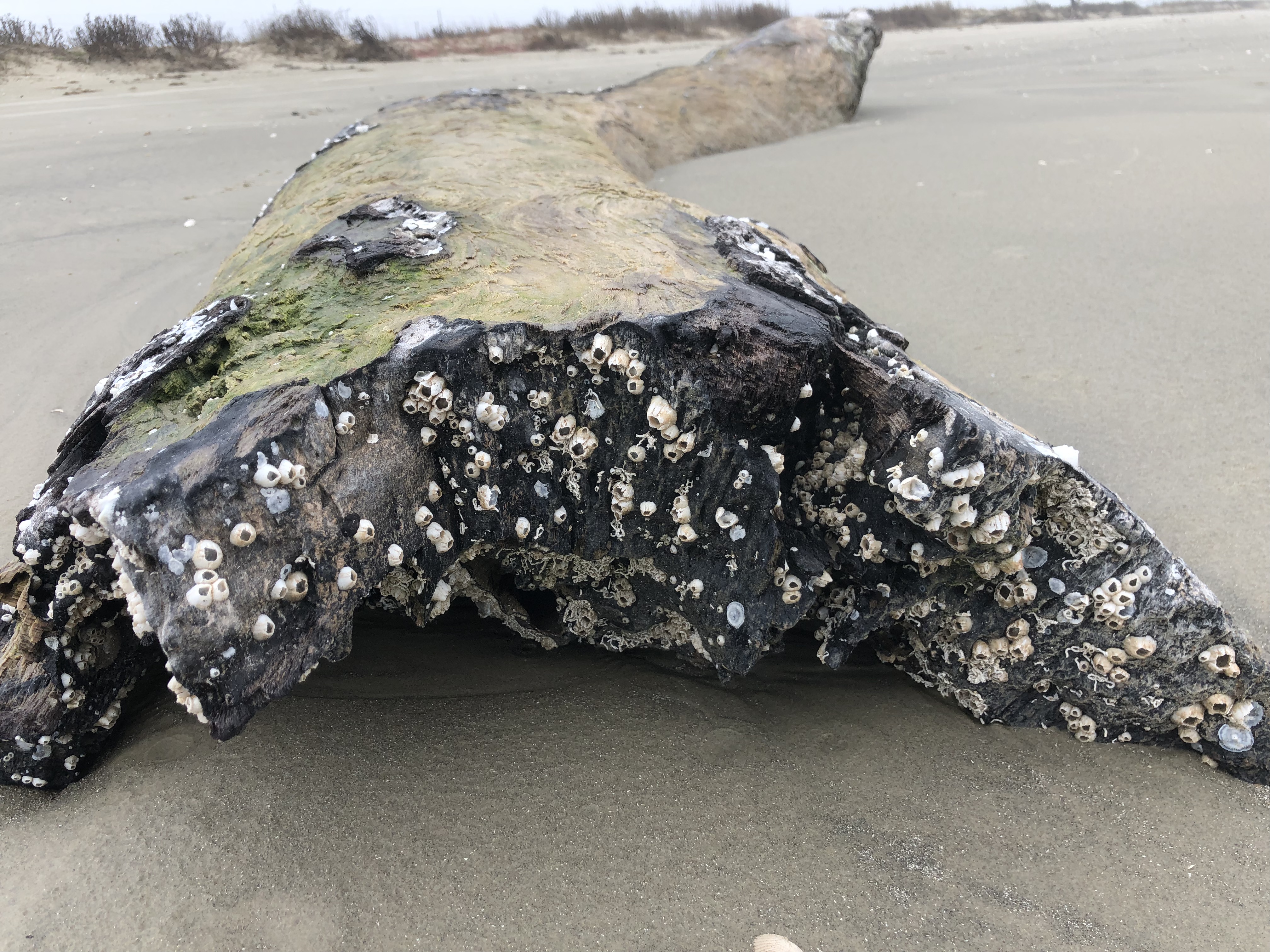
One particular piece of wood that had been in the water enough for barnacles to grow on it really seemed beautiful. Such a mix of land and sea.
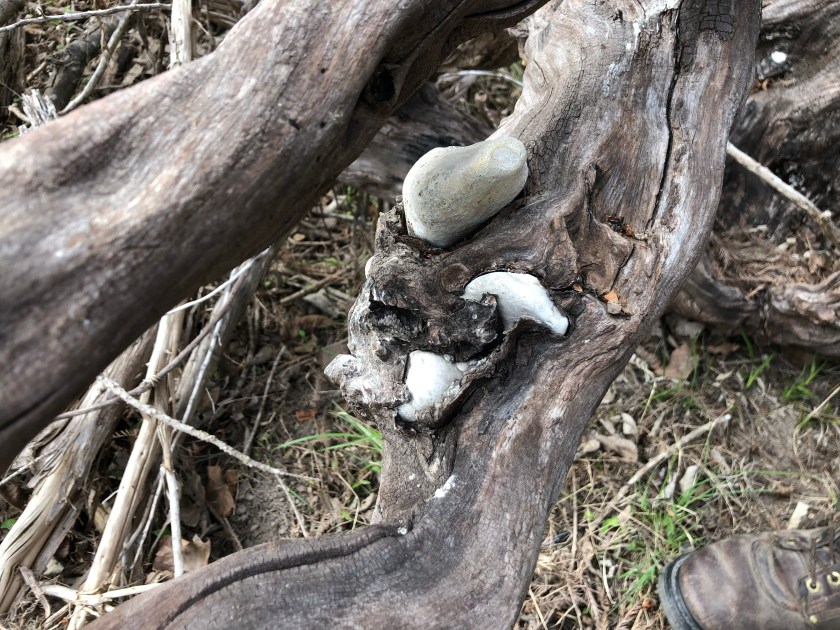
What’s your guess as to what this is?
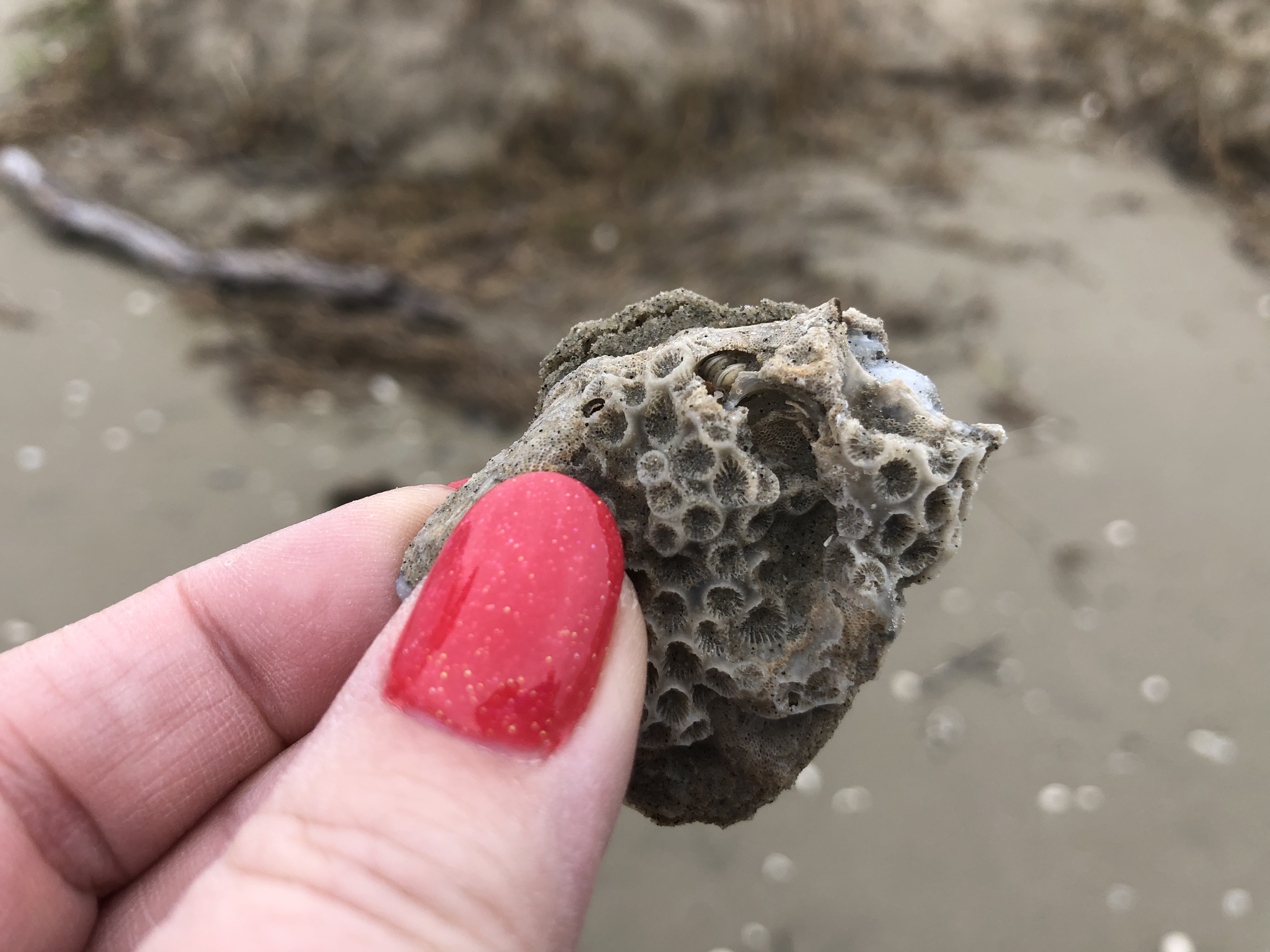
We also found another rock or piece of tree or coral. It was hard to say. But there were some cool worm tubes on it, too.
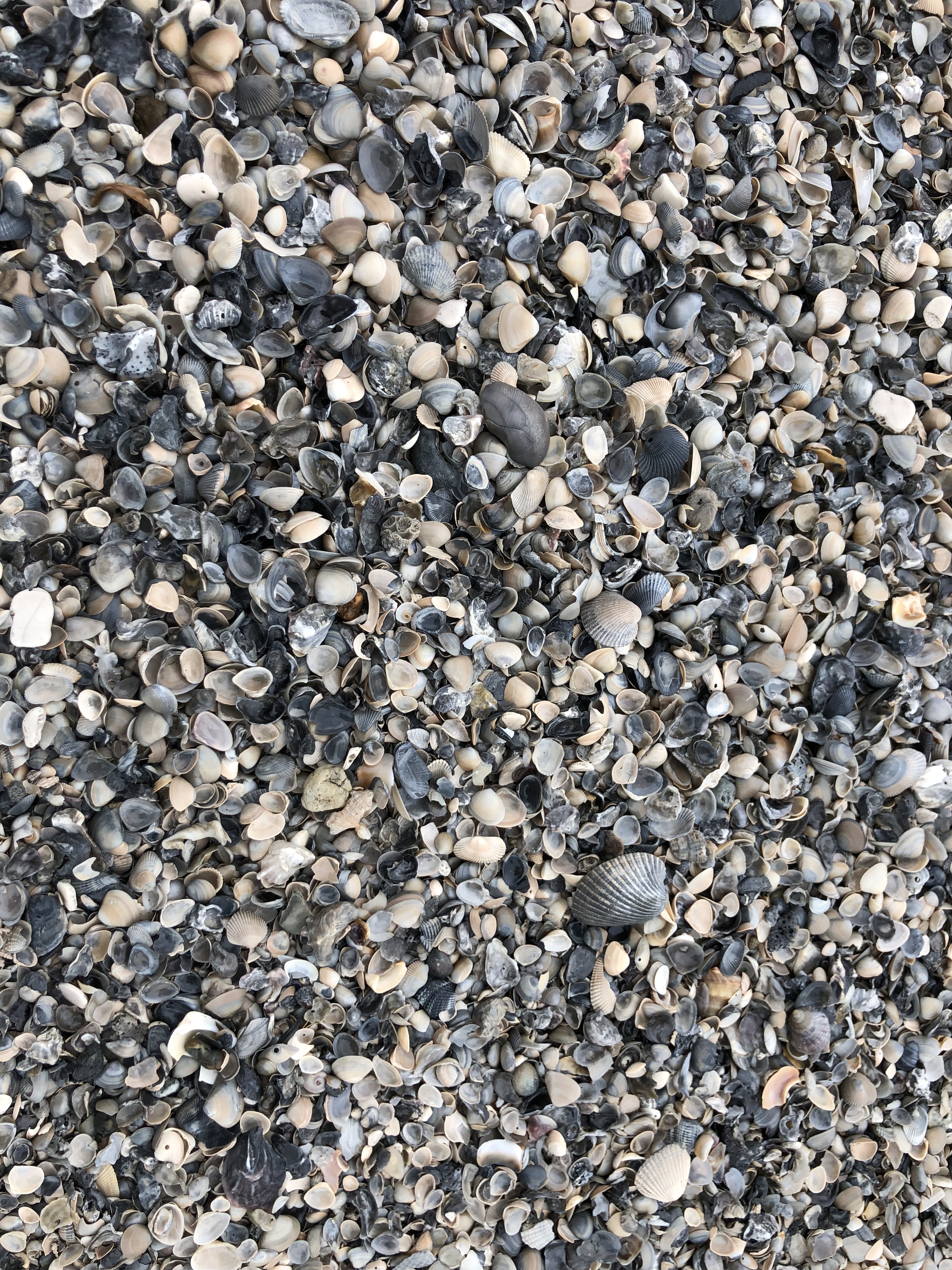
Little shells in a heap.
Of course there were shells, mostly broken up, but in many shapes and colors. Where they washed up in piles I kept thinking they’d make a great computer monitor background.
Coral, and my Valentine nails, which are red, pink, coral, or watermelon.
I did find a small piece of coral, too. I have to say these and the oysters in the bay kept distracting me from my bird and plant recording duties, but that’s okay. I had time to enjoy all the gifts the ocean and wetlands gave me.
Wow, yesterday was just one amazing discovery after another around the ranch! The wind finally died down, which made it much easier to be outside, so I engaged in a lot of running around with dogs and exploring things, once the cattle moved off and the cattle torture ended.
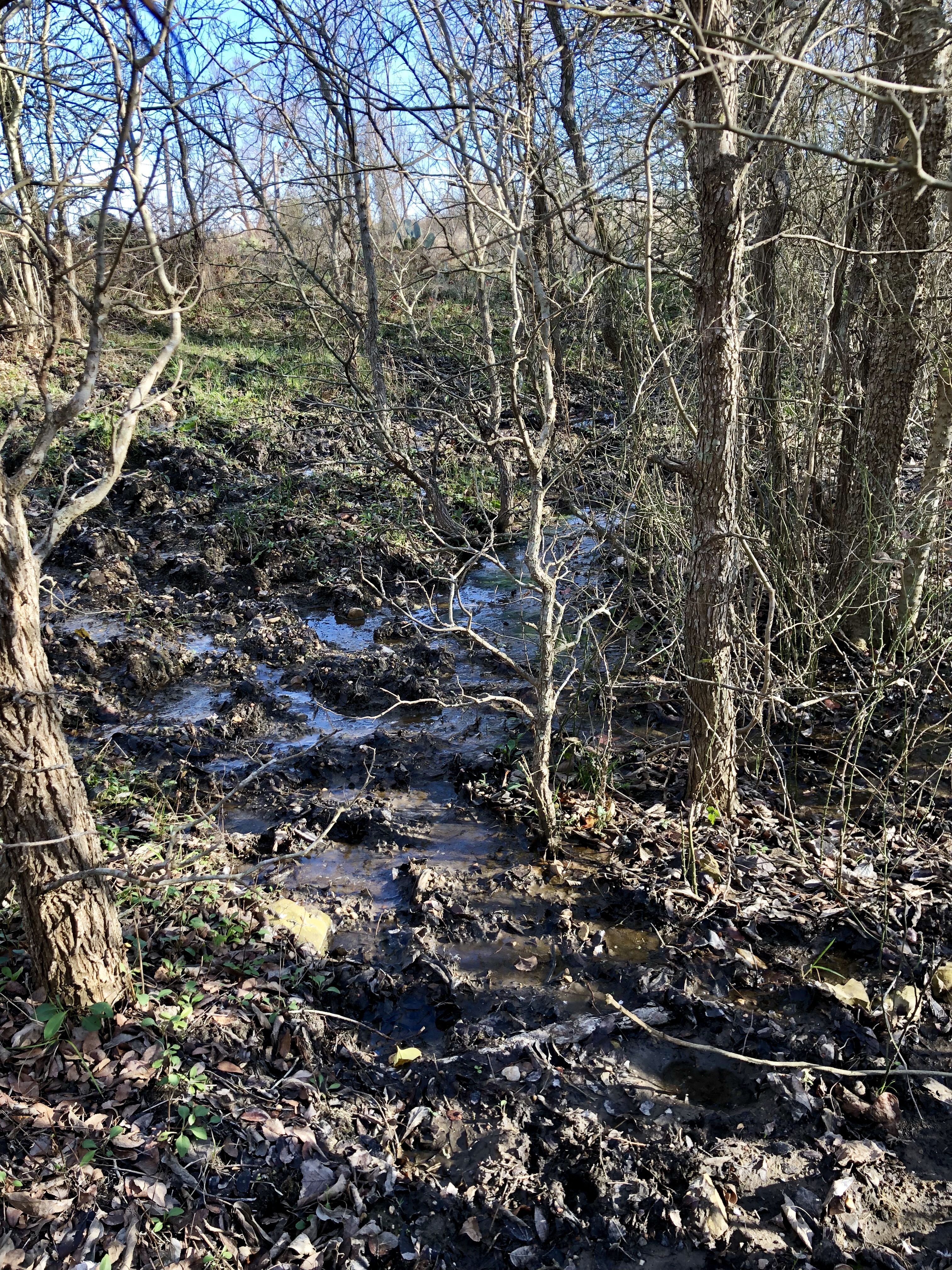
This is the “springy” area of the woods. It’s on a slope, and the water drains down to the Hermits Stream.
Our neighbor Mike came over earlier than usual in the afternoon, so that we could go check out a few things in the woods. Of course, the dogs went, too, which gave them more opportunities to irritate the cattle. Sigh. But the good news is that we found an old food storage container that had slipped out of Lee’s hands and disappeared into the woods during the summer, when you can’t see a thing in there.
There is a lot of moss, algae, and other moisture-loving foliage here. I wonder what the area would look like if cattle weren’t stomping all over it.
But, WAY more important was that I confirmed my suspicions that the last remnant of the big drought that was going on when we first came to this area is going away. It’s quite clear that our springs are back!
I’d been seeing a wet area from our side of the fence, but we wanted to see it up close. Sure enough, water is seeping out of the ground and heading toward the stream. I’d heard that there were springs in there before, but other than getting a little muddier than the rest of the area, it hadn’t showed any signs of flowing.
Carlton investigates the babbling brook. The tree bridge is getting less and less sturdy as time goes by.
We also noted that the little brook/stream that flows into Walker’s Creek is flowing pretty briskly. Two things could cause that. Either the pond is still getting water from runoff and flowing through the arroyo, OR the other spring is working. Mike and I confirmed that the culvert is barely dripping, so that brisk flow of water must mean that the big, deep spring is flowing on its own again. Hooray! There’s water under the ground again!
Heron or egret footprints in the mud.
Now that the flooding has died down, we can see lots of tracks in the mud that the flooding deposited. One thing is for sure, those herons are BIG birds.
And the chickens?
I am very happy to report that the longer days, increased food, and/or less owl stress have combined to ramp up egg production. We were afraid that the one who was still laying had been the last owl victim, but, hooray, we had three eggs today, and since two of them were white, there are at least two laying now! Of course, we are down to a dozen chickens, so we won’t have what we did before, but it’s an improvement.
THREE eggs! And the beautiful cutting board the neighbors gave us for Christmas.
And, by the way, Mandi is ordering some netting to help foil the predators.
And more mooning
A picture-perfect end to the day.
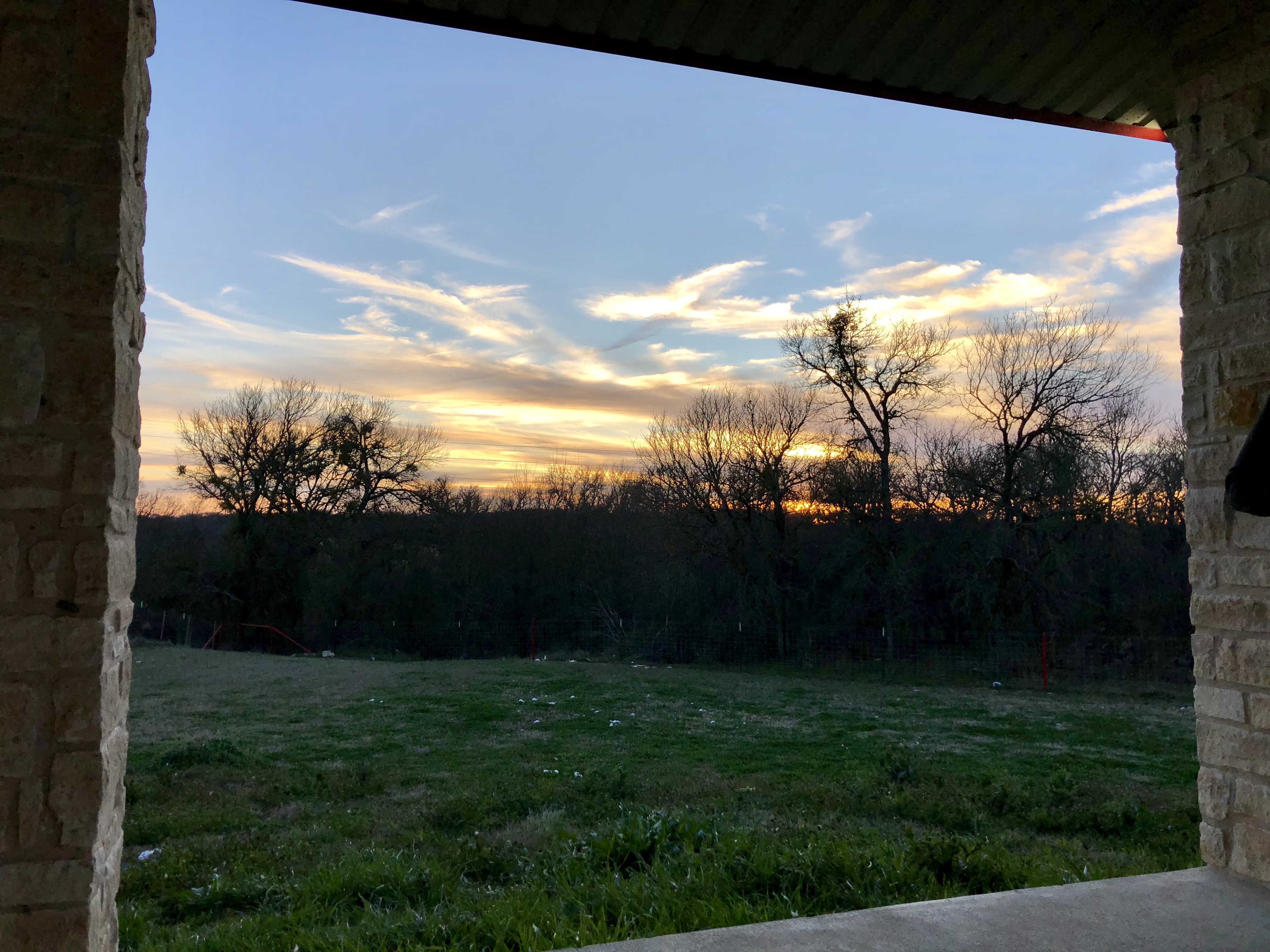
We got back home and sat on the porch (it was cool, but not too cold) to enjoy blackberry wine and yet another lovely sunset, which I managed to frame in the porch, like a painting on a wall.
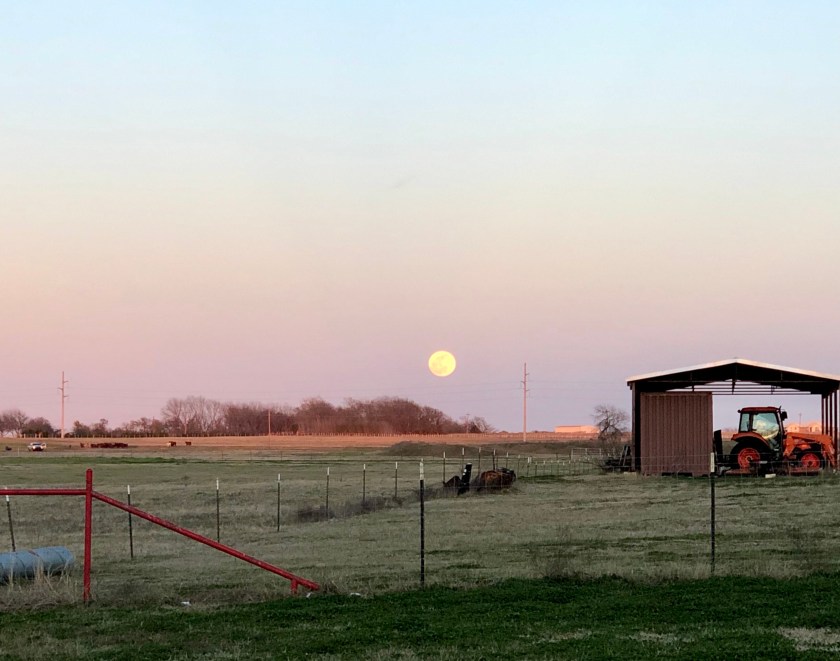
Here comes the moon!
Then we turned around to see the super moon rising in the east. Wow, that thing was big. My phone doesn’t do very good eclipse photos, but the red moon was very cool. I wish that happened more often. You know that sight must have been confusing to ancient people who didn’t know how the sun. moon, and earth coordiate!















 The Hermits' Rest