Do you know how to tell a frog from a toad? Here are some hints from around the Hermits’ Rest.
I bet some of you know this, but I got two good example specimens that will help the rest of you. Both are big ones, which makes it easy to see. But they ARE trying to fool us.
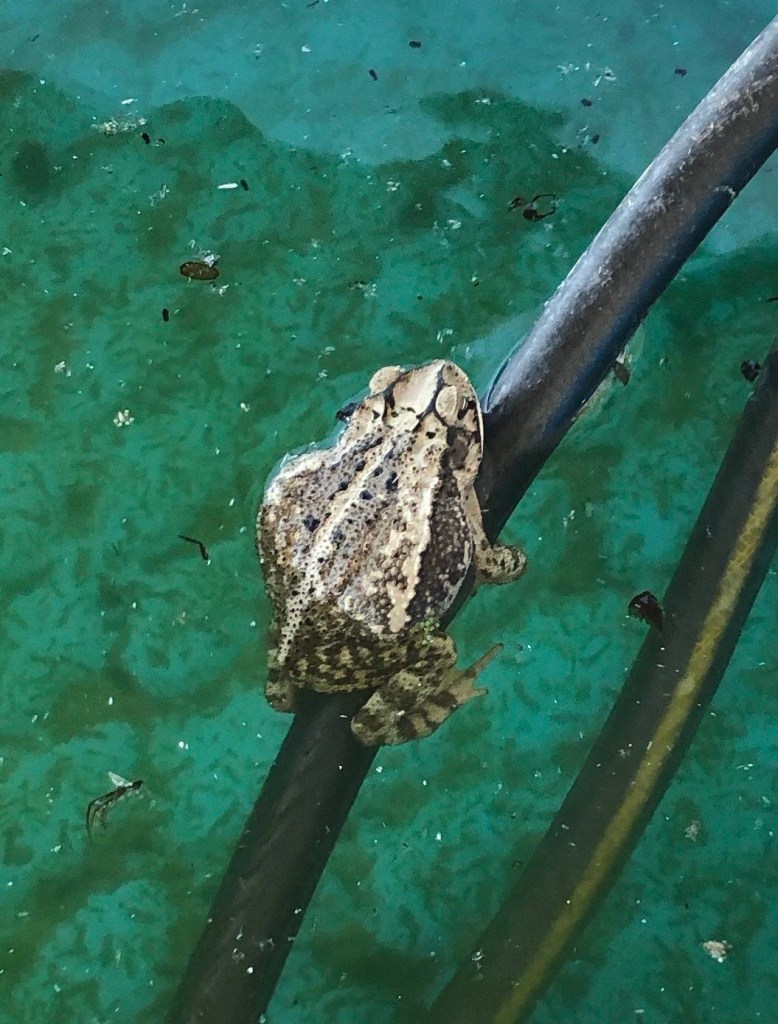
Gulf Coast toad
How did I know this was a toad, sitting in the dog pond? First, she has warts. Toads are bumpy. Most toads hang out on land, but this one is in water, but not swimming. That’s normal. She also has relatively short hind legs, for walking, not hopping.
Pond with exit ramp. Yes, we empty it weekly for mosquito prevention.
The toads like to hang out in the dog pond so much that Lee built them an exit ramp. He said he saw a smaller one in there, too, so maybe mating was planned (males are smaller).
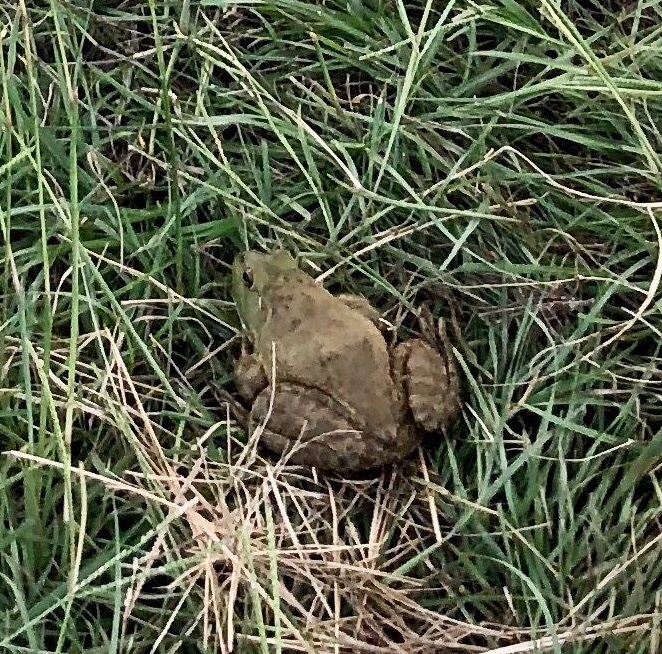
American bullfrog, in the chicken run.
This big fella we found when I moved the new chickens’ water dish. It’s as big as the toad, and too dark to be one of our green frogs. How did I know it was a frog, even though frogs are usually found in or near water and this one is on land?
Well, the skin is smooth (even in the blurry photo). And look at those legs! They are much longer than the toad’s! And it WAS right next to a water dish. I admit it is within a pretty short hopping distance of the pond behind our house, from which bullfrog croaks have been heard.
Our biggest green frog, ready to dive back in the pond. Finally an amphibious creature doing what it’s supposed to.
We are happy to have both the toad and the frogs around here. They eat bugs and all sorts of critters that need to have some population control!
By the way, a toad is a frog, but not all frogs are toads.
Today I have a hodgepodge of stuff to share, but first I want to talk about what’s lurking around the ranch these days. That would be things that bite, and things that jump. Yesterday, I went to sit down on one of the front-porch rocking chairs, when I saw something on the seat.
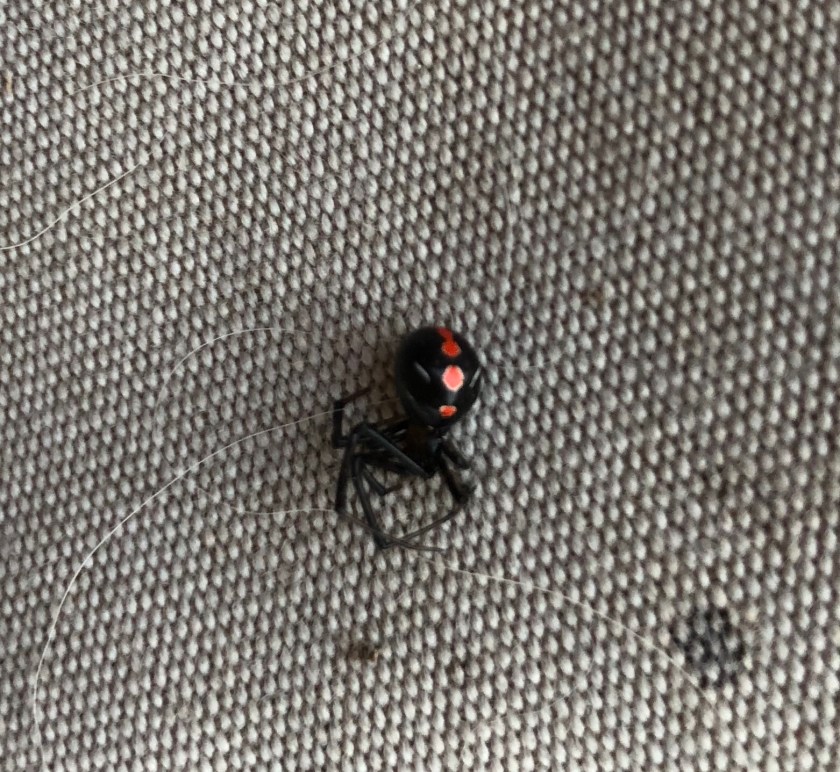
A member of the widow spider family.
I am very glad she was pre-dead, and that I saw her before I sat. Certainly it confirms my habit of checking for creatures before plopping down anywhere around the Hermits’ Rest! I’m not sure what kind of widow spider she was, but I don’t want any of them biting me. These are the main reason I continue to support having pest control come around the house.
The second reason is scorpions, which I haven’t seen any of, but Lee and Kathleen have killed a few. I love them out in the woods, but not in the house. And I love the spiders, but not ones that could really mess with my health.
I’ve apparently become allergic to mosquito bites, and they make huge welts, so I could do without those right now, too. And biting flies! Argh. There are black flies around here, and horse flies (thankfully not around ME), and deer flies. Whatever. One of them bit me on my FACE this morning. That could have to do with how much poop we have at the ranch
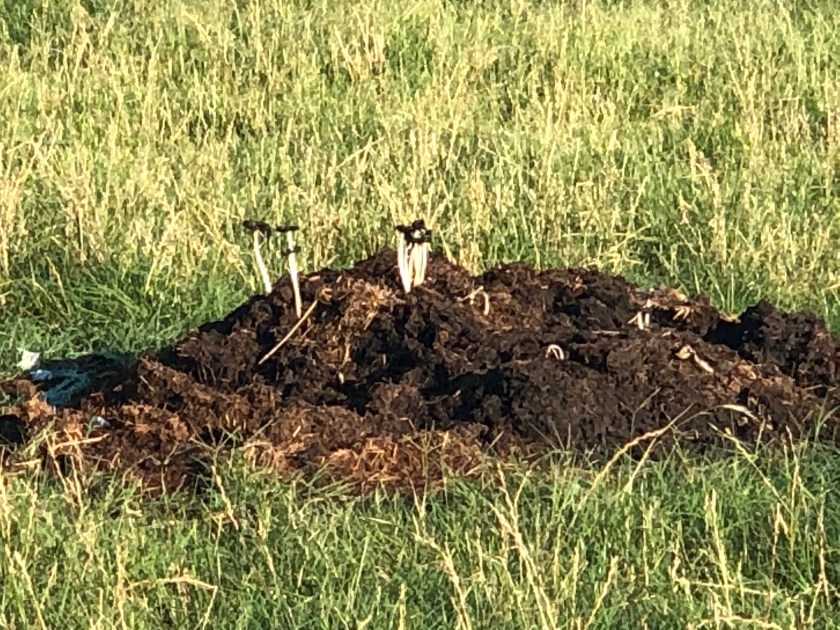
Cool poop mushrooms
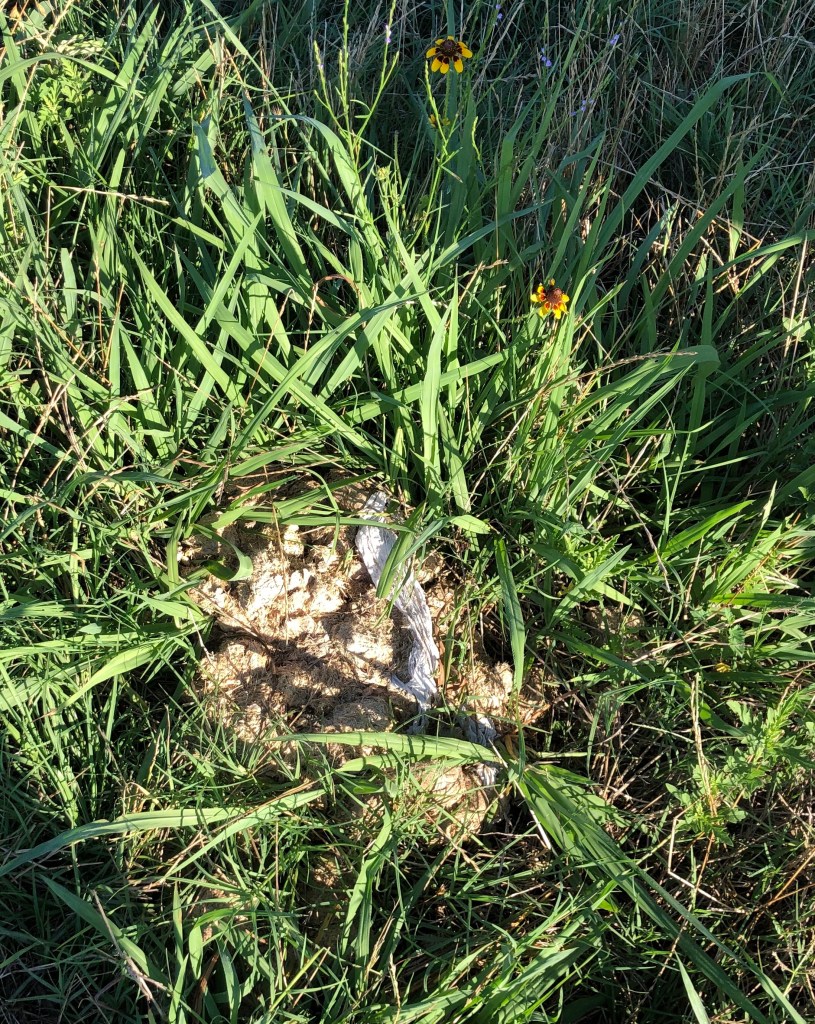
Horse poop with plastic in it. GRRRRRR.
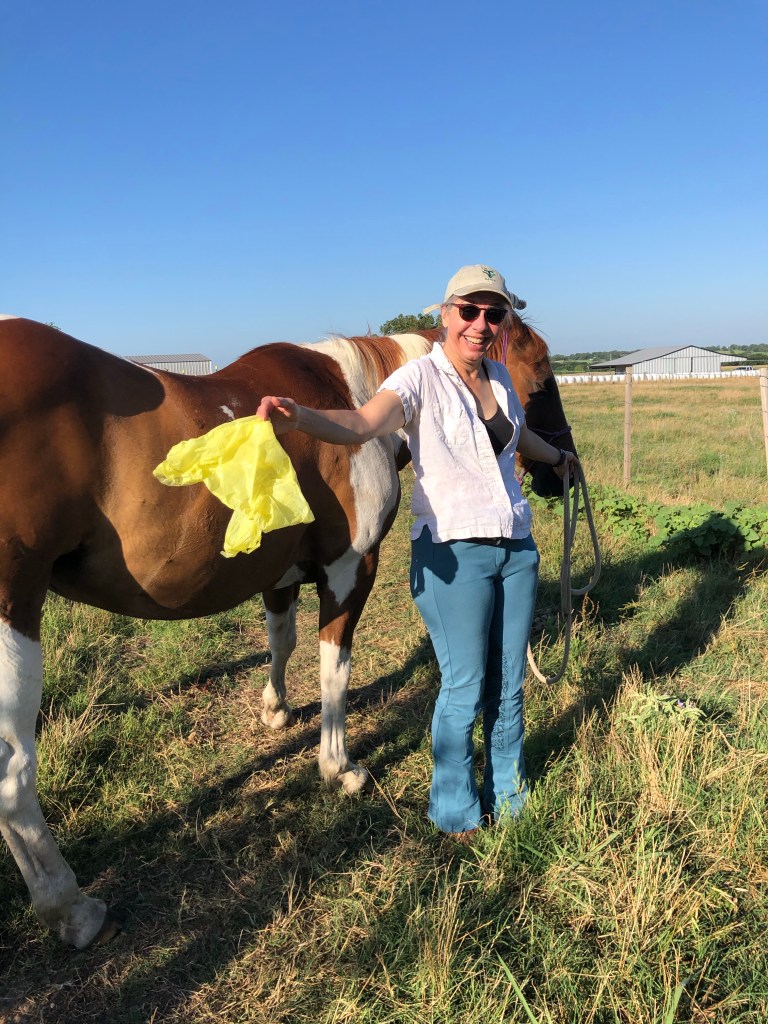
Sara disposing of a bag, so a horse or donkey won’t poop it later.
Poop, and things that show up in it.
Nonetheless, I am heartily enjoying discussing different kinds of flies and grasshoppers and stuff with Eric in our Master Naturalist class. He not only has good eye for finding them, but he has a good camera, and the patience to work hard to identify them.
Eric wrote me an email today about the coolest thing he saw (a “mystical experience,” in his words), which was he was trying to photograph a large grasshopper:
It jumped off the path into the high grass and when it landed it appeared to turn into at least a dozen tiny projectiles which flew off in all directions like a firework. A closer look uncovered a great concentration of grasshopper nymphs in the area.
Eric N., email 6/6/2020
Of course, he didn’t get a picture, but WOW, what an image!
My grasshopper experience this morning was also something you couldn’t photograph. I was walking back from horse riding (it went well), noticing that it’s definitely grasshopper season. Then I noticed the sound. As I walked, I was disturbing dozens and dozens of them (small ones, since they aren’t adult yet), and my walk seemed to have a rhythm section accompanying it. Tap, tap, tap, tap, tap-tap-tap.
I k now a lot of people don’t like grasshoppers (like my sister), and I admit they are annoying in the summers when there are hundreds pelting me as I drive the utility vehicle. At least they don’t bite often or hard. But they are so varied and interesting. I have an AWFUL time photographing them, so I think I’m going to get a good butterfly net soon, so I can get some to hold still.
That’s blurry
That’s blurry
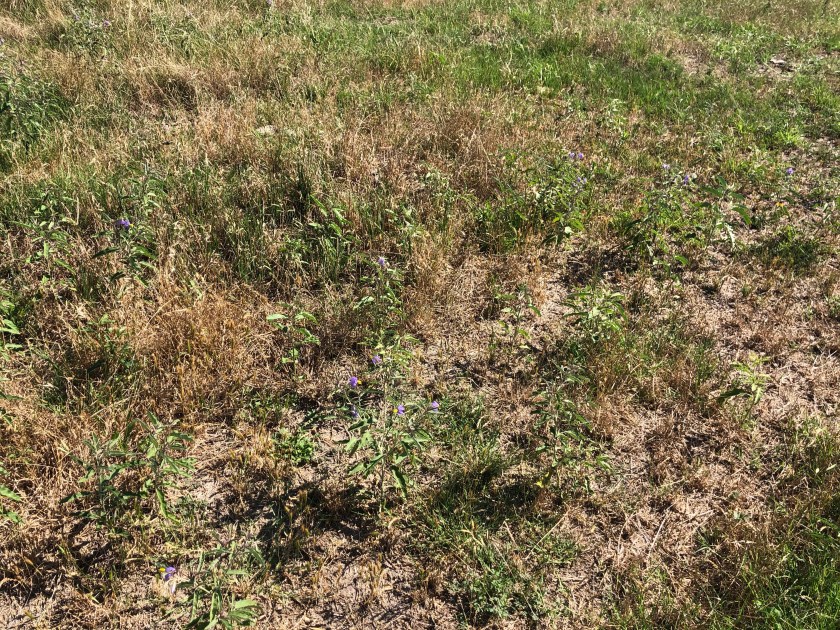
I can’t find anything in this picture.
What Doesn’t Bite?
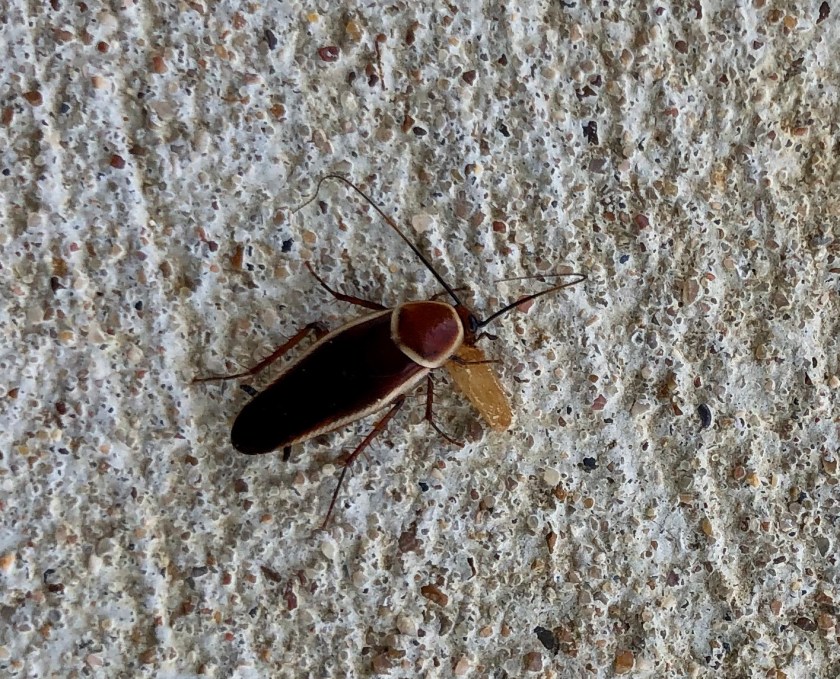
Roaches. Secretly, I have never been fond of roaches, due to childhood trauma, but I am doing better since I started doing iNaturalist. I recently even found one I thought was interesting to look at. It also lived outdoors, where it should.
Fairly attractive pale-bordered field cockroach
And non-venomous snakes don’t bite humans, often anyway. So, I was sad to see this one in the road this morning. Rat snakes are my buddies as long as they aren’t eating my hens’ eggs.
Poor snakey got hit by a car.
Okay, time to go see what’s outside that will hurt in some other way…
Last week I had a lot of Master Naturalist fun participating in the Texas Invasive Species BioBlitz 2020 that got set up by Texas Nature Trackers. You may remember I talked about it a bit last week. The idea was to see how many observations you could get from a list of invasive species found throughout the state. I knew I had easy access to a few, so I figured I’d try.
Here’s the main page for the event.
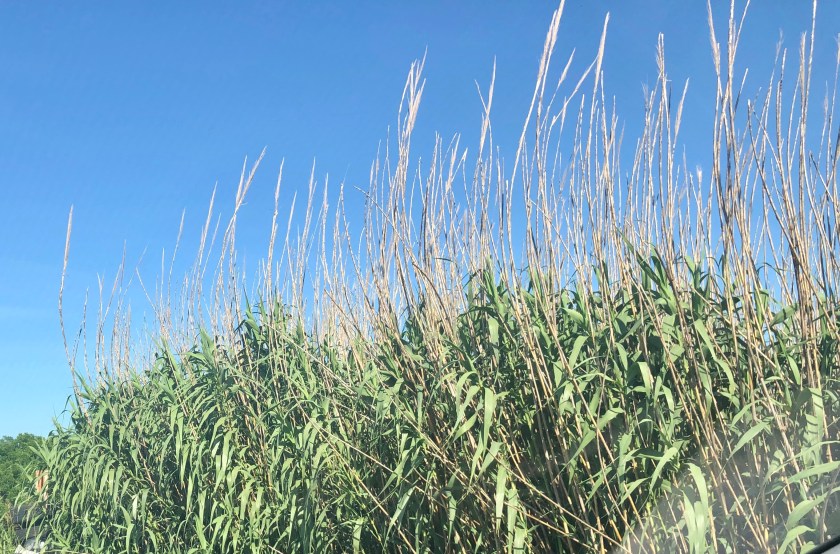
I got a good number of invasives pretty quickly, since I knew right where there was some Arundo donax (river cane), Johnson grass, and a lot of nandina on my own properties. I must have spent 3 hours the first weekend looking for invasives (and observing lots of other things, too).
Arundo donax
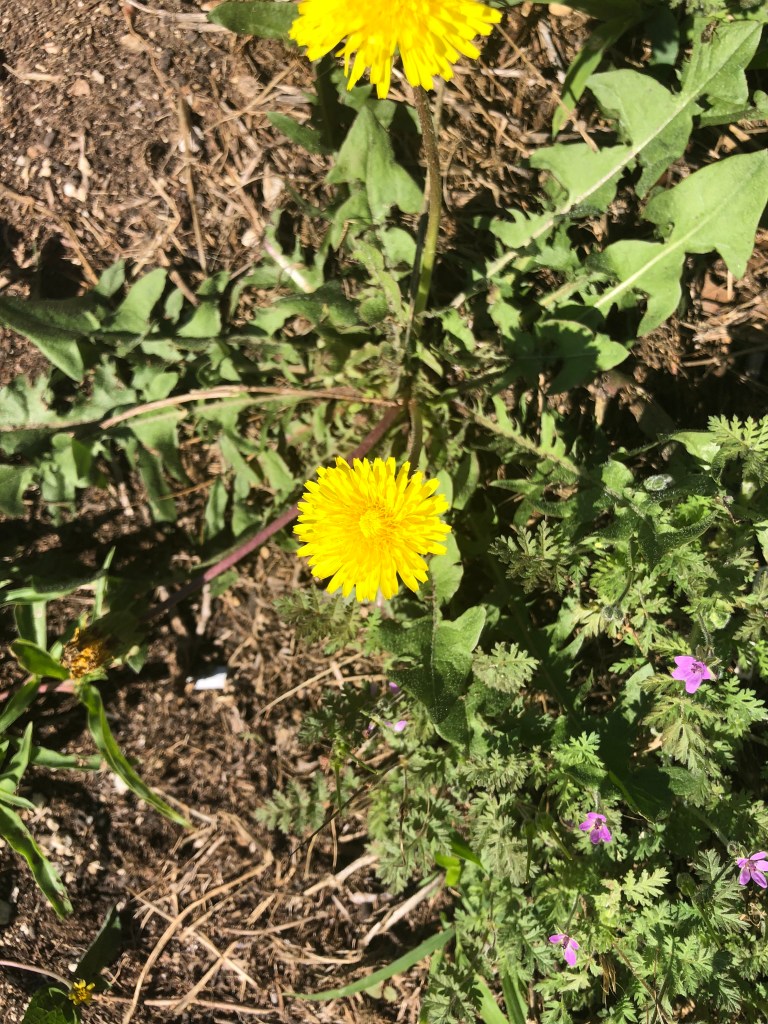
Common dandelion
Common lantana
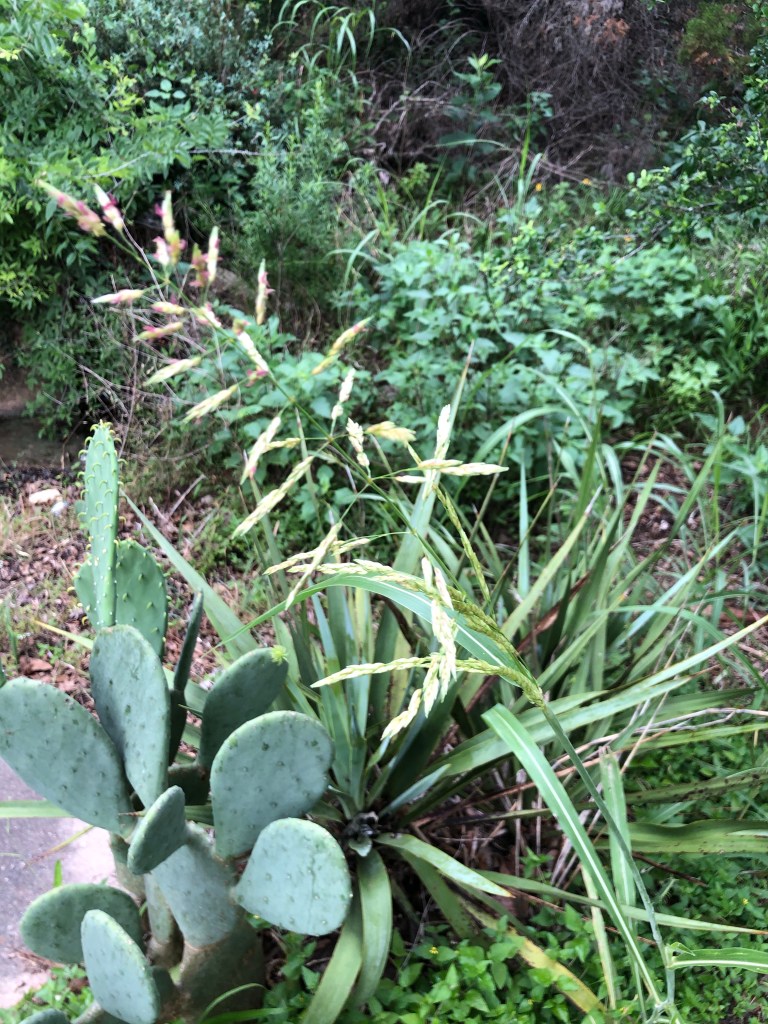
Johnson grass (with prickly pear)
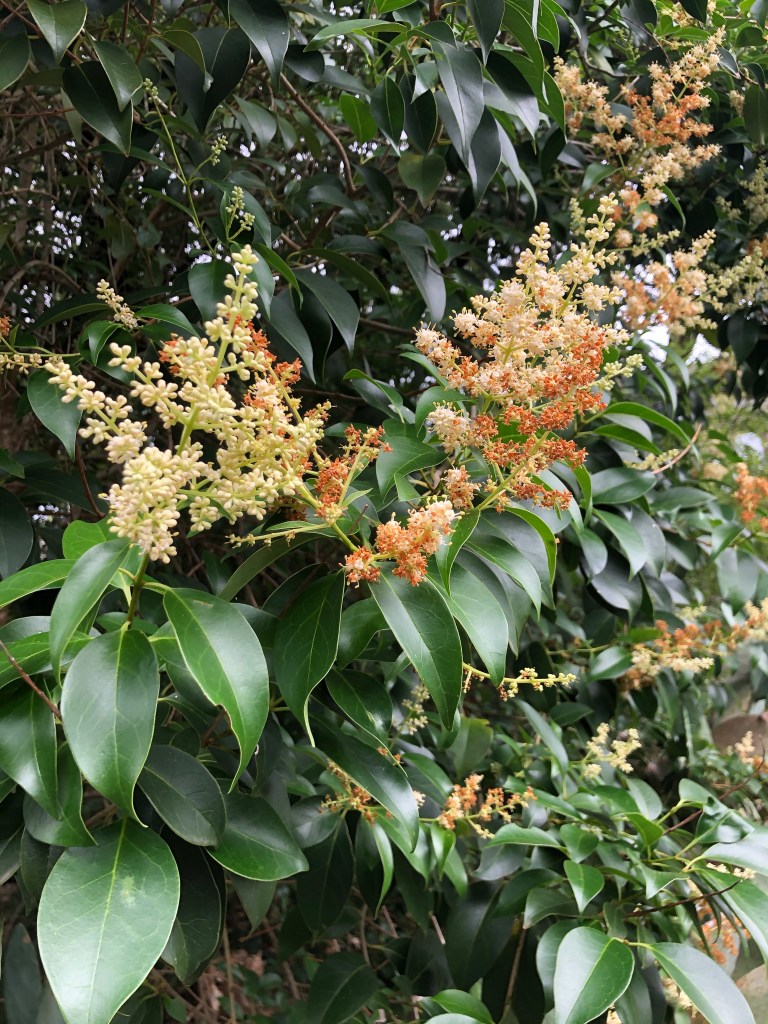
Glossy privet
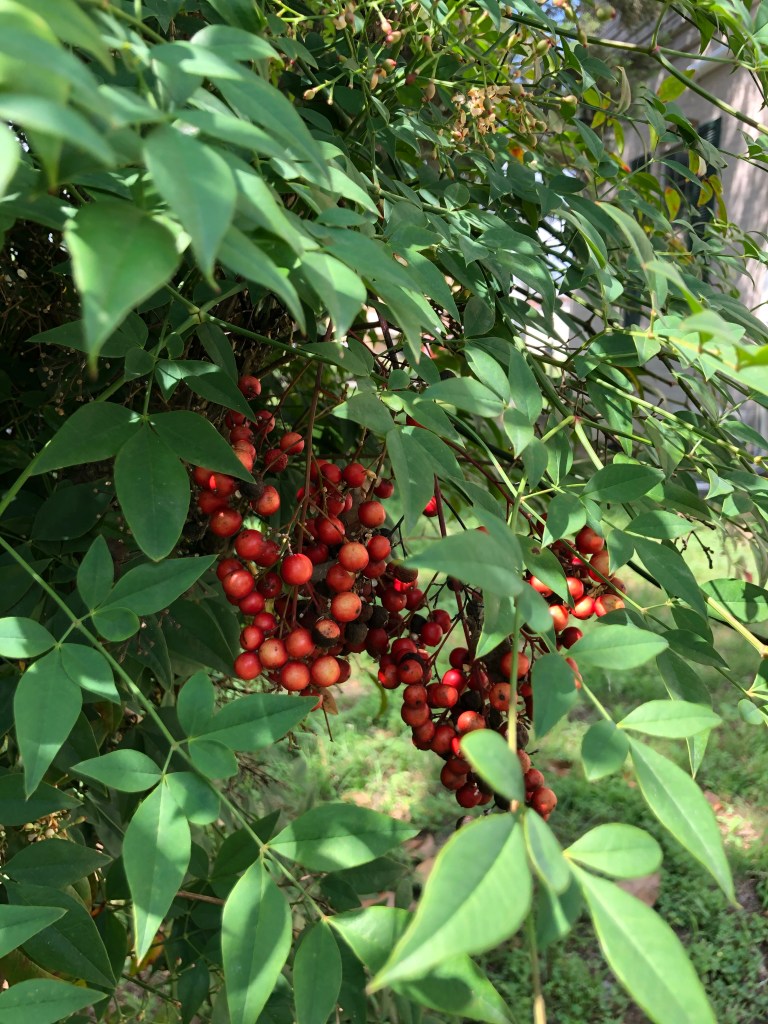
Nandina (heavenly bamboo)
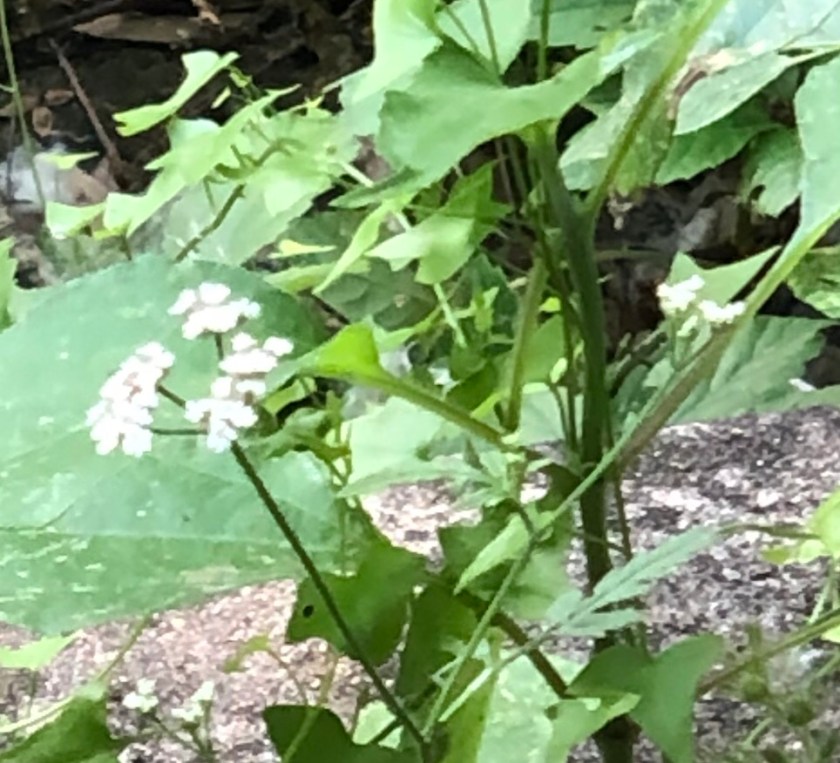
Bad photo of common hedge parsley
By the time I went to Austin on Tuesday, I was doing okay on the leaderboard. Just a few walks around the neighborhood of Bobcat Run produced more “goodies” like Japanese honeysuckle and privets.
My final list of plants.
By the time the week was over, I was proud to be in the top twenty of number of species observed, and doing okay with number of observations as well.
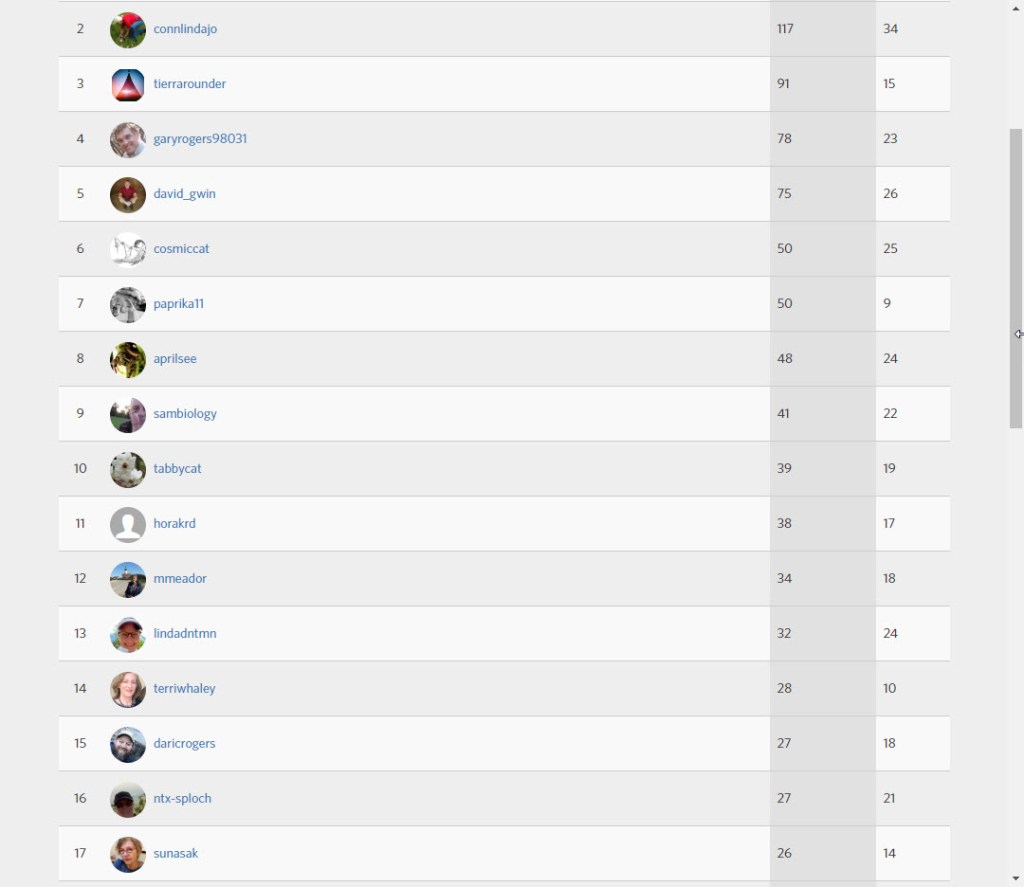
Here I am, number 17, and Linda Jo number 2 (I couldn’t fit number 1 on the screen, darn it.)
Of course, my fellow Chapter member Linda Jo Conn was in second place in number of observations and first place for species. Some other guy had way more observations, because he had multiple photos of some of the species. I did a few, like things I saw both in Austin and Cameron, or ones in distinct locations. However, I could have ROCKED the numbers by just walking across the lawn and taking pictures of Bermuda grass (I would NOT do such a thing, of course).
Regrets
Darn the luck! The day after the bioblitz was over, I drove down a street I don’t usually go by, and there were a whole bunch of mimosa trees taunting me with their fluffy pinkness. Argh!
Beautiful invasive mimosa tree, just one block off of where I usually drive every day.
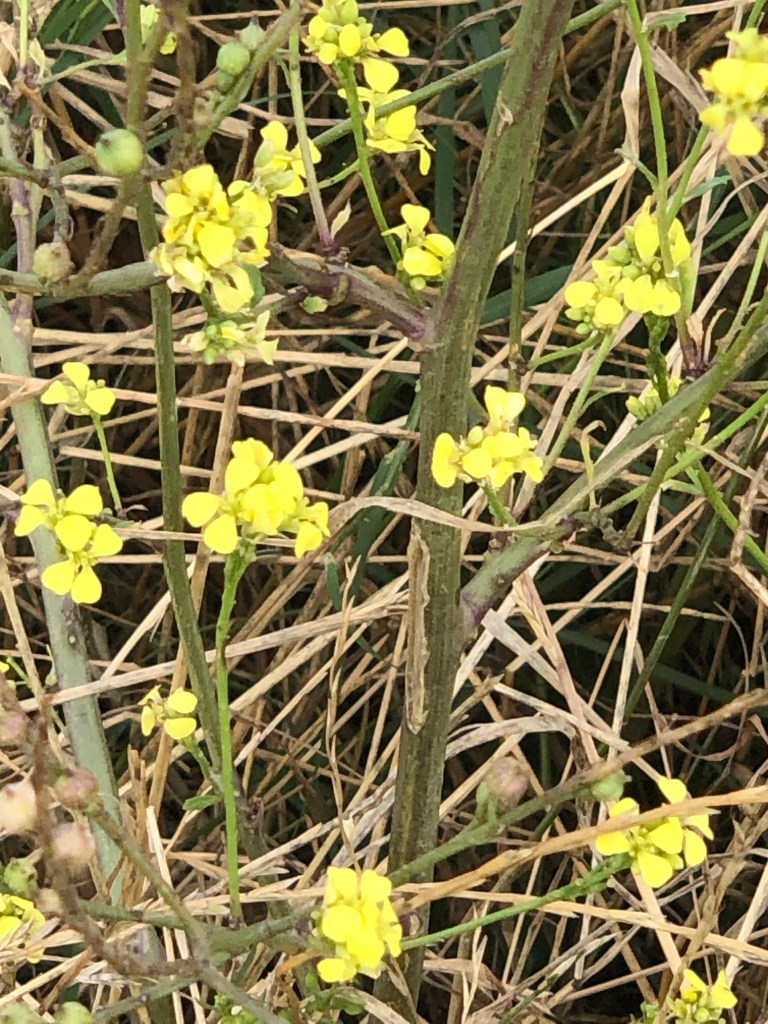
Then, yesterday I walked to the horse barn (I’d been driving our utility vehicle because I have a sore tendon), and right on the side of the driveway was a cheerful annual bastard cabbage/ wild mustard plant. I’d been looking and looking for one, because I knew they were there! So, that’s two more I could have found if I’d been a bit more diligent.
What Did I Learn?
I think the project did what it was intended to do: it got me much more aware of invasive species wherever I saw them, and because I kept talking about it to friends and family, I raised awareness as well. That’s exactly the kind of thing I want to be doing as a Master Naturalist.
Oh, and also, I had fun. What have been your fun projects while we’ve been not gathering in large groups and such?
Yep, it’s one of those nature posts. I don’t have anything to rant about today. It’s probably because my day started out so nicely, having coffee with Lee on the back porch (usually I rush off to the office, but I had a sinus issue). Looking out at the lawn, Lee remarked that he was glad his brother hadn’t mowed yesterday.
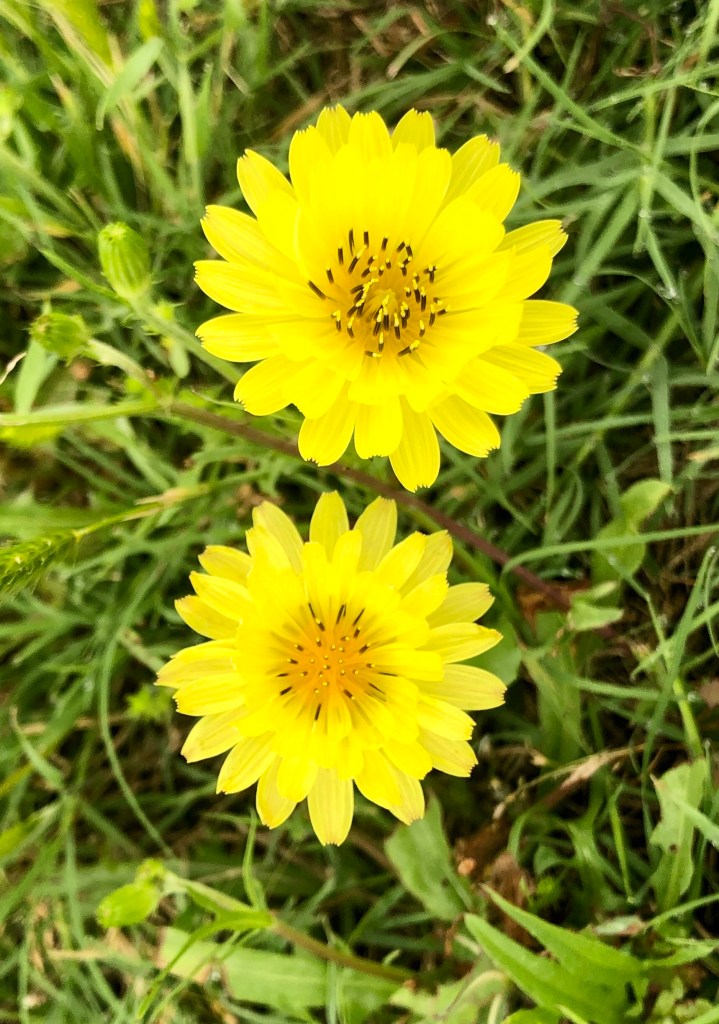
The humble wildflower makes the lawn glow.
There were hundreds of dandelions in the field, with their little faces all turned toward the morning sun, or where it would be if it were less cloudy. More rain is coming. Remember, most of the flowers in our field are actually “false dandelion” (Pyrrhopappus pauciflorus) and not the common dandelion (Taraxacum officinale).
False dandelion
Common dandelion, so yummy to chickens
The chickens love both varieties, actually. The highlight of every evening for me is feeding the hens dandelion greens from my hands.
Yellow always pops on a gray day.
While I was out there checking out flowers, I saw this really great spiderweb. If you look closely, you’ll see how big it actually is, but I was drawn to the center, where it looks like weaving. I think I know where the term “orb weaver” comes from now. Too bad the spider is in back, so I can’t identify her. You can tell she is the size of the “woven” area, though.
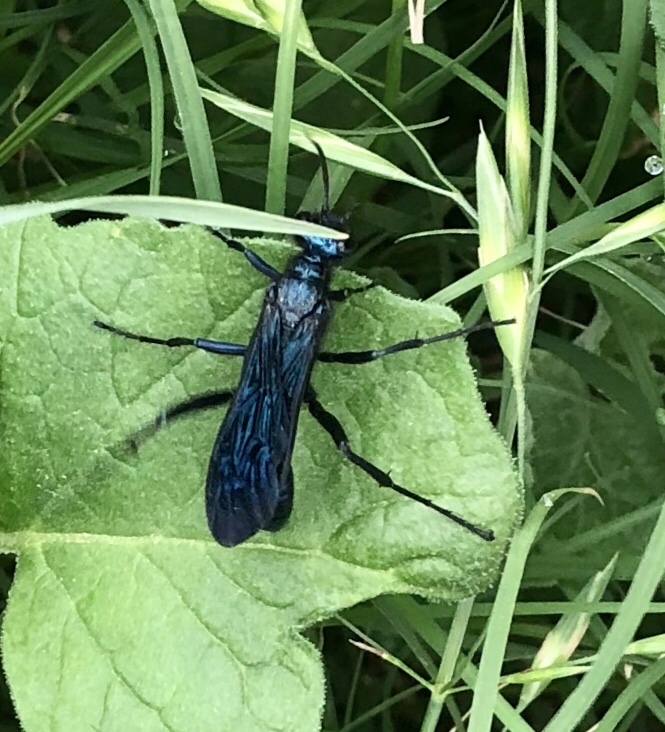
We have lots and lots of wasps this time of year. Mostly they just fly a few inches above the grass looking for something to eat, or posing as bird food, depending on your point of view. These blue mud daubers sure are beautiful, though.
And just to clarify: No “murder hornets” live in Texas, so it’s okay to get this close.
A Very Humble Fly
I’ll leave you with what I saw when I came downstairs for lunch. This is one big fly. It’s not as big as a horsefly, but it’s big. Eric in our Master Naturalist class says it’s an Archytas. iNaturalist agreed. I just think it looks really, really, prickly and like it would bite. One thing I dislike is fly bites. Shudder.
It’s sitting on a mop. Look at its cool bronze eyes and greenish body. With bristles. Lots of bristles.
Well, I got curious, so I looked up more information on the Archytas flies. It turns out their larvae are parasites, and they often grow in moths, beetles, and bugs that harm crops. So, they are often used as natural pesticides! How about that? I loved this quote by the person who wrote the article I read:
This tachinid fly is one of my favorites. It’s a huge, hairy fly with a blue metallic abdomen. I frequently encounter it nectaring on flowers and mucking about amongst the vegetation, never on offal or other nasty things like many of the more disgusting fly varieties. I would not allow just any fly to walk my skin with impunity; Archytas is just, well, special. (My affection is probably misplaced, and this bugger is just as filthy and revolting as all the others, but what can I say? One has to find something pleasant to think about.)
This scientist really loves their flies! By the way, the flies are named for “Archytas of Tarentum (c. 428-350 B.C.) – Greek statesman, military commander, leading Pythagorean mathematician and philosopher; often called the father of mathematical mechanics.” He also invented the screw and the pulley. There’s a crater on the Moon named after him, as well. Again, huh.
I think I found my favorite fly. Humble, yet lovable. And oddly beautiful.
That Chris, he needs a break from constant caulking, which is the never-ending phase of the Pope renovation he’s on now. Every bit of trim needs some caulk. Ugh. I’m sure glad he does takes some breaks, because that means we get birdhouses!
The bird house will get a perch and a lovely fake bird. I ordered a bunch of potential residents to try out.
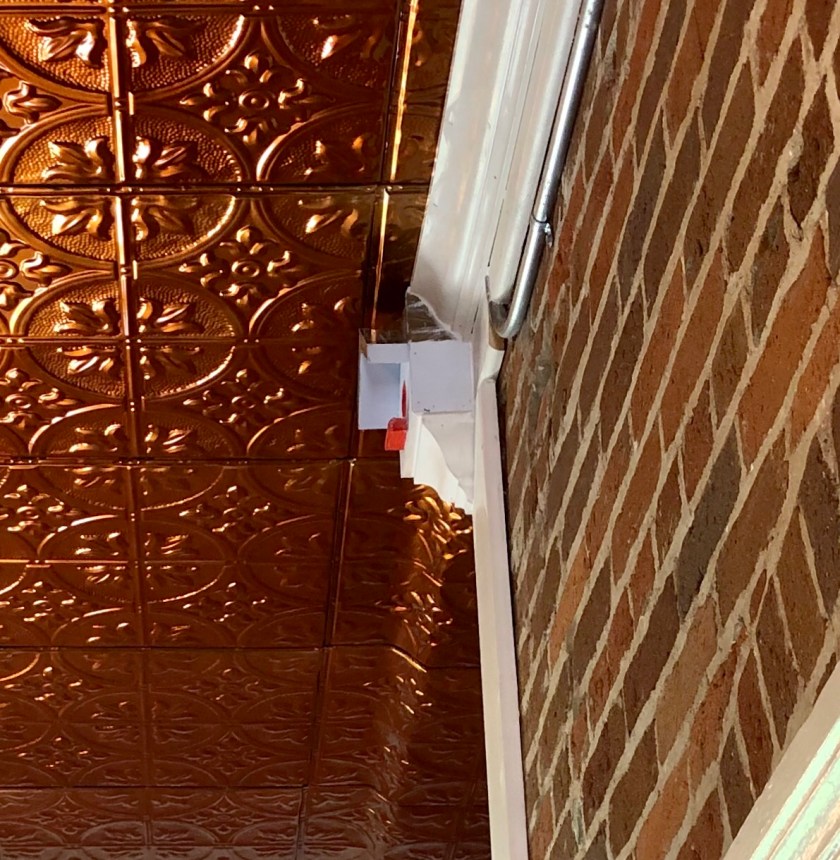
Today’s house is at an extremely awkward corner where I guess we could have put some kind of decorative finial or something. But a birdhouse is way more fun and adds quite a bit of whimsy to the project. Chris knows I like birds and Kathleen likes that kind of thing, so we are not complaining a bit.
Classy molding
Basking in that shiny ceiling
I like how today’s house has molding on the bottom, to make it look like it just grew there. Hmm, where will the next house be? (I know, but I’m not telling). I got a vision of little kids visiting and being sent off to find all the birdhouses in the building. That would be fun.
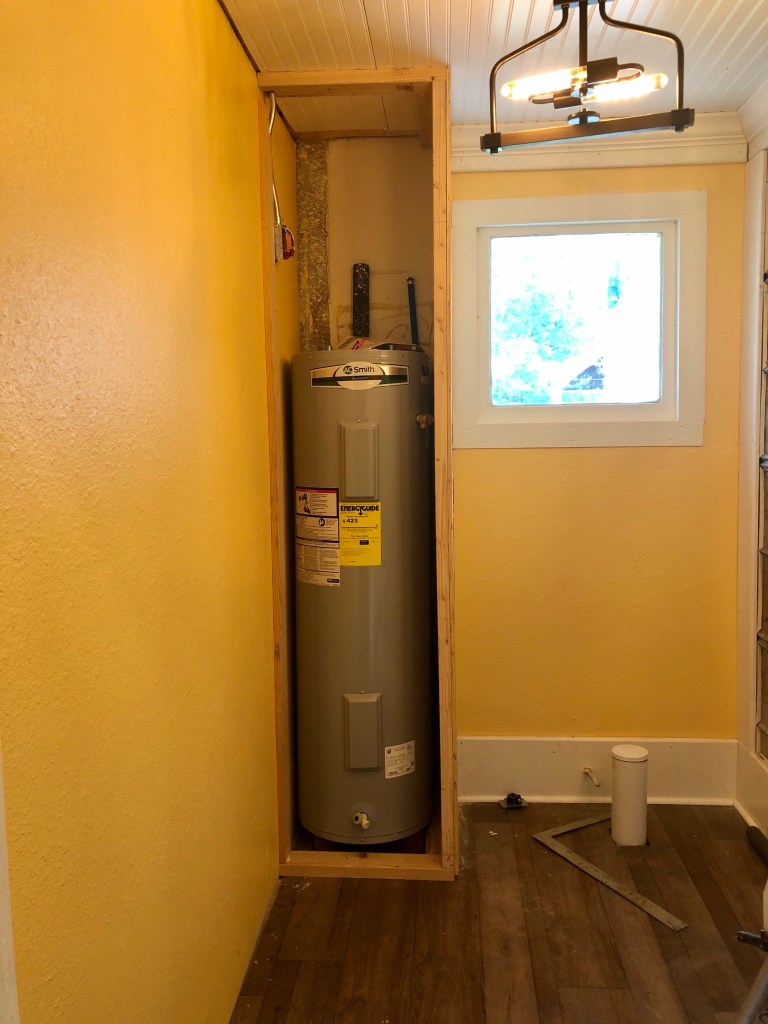
Another project has gotten started, too. The water heater is getting its cabinet in the main bathroom. It’s going to fit quite nicely in the corner, and there will be some storage added, which will be good in a downstairs with no, zero, zilch closets.
Closing in on the water heater
Wait, was there a water heater here?
I believe the plan is that the compartment can be easily unscrewed for access, since it won’t happen too often once it’s hooked up. Ooh, what an exciting day that will be for all of us who wash dishes at Hearts Homes and Hands!
Breaking with Butterflies
I needed a break after finishing yet another slog of a project, so I walked around the block by the Hermit Haus. I turned by the Baptist Church, because I was wondering if the fancy New Gold hybrid lantana that’s planted all around its borders attract as much wildlife as the native ones in my tiny garden.
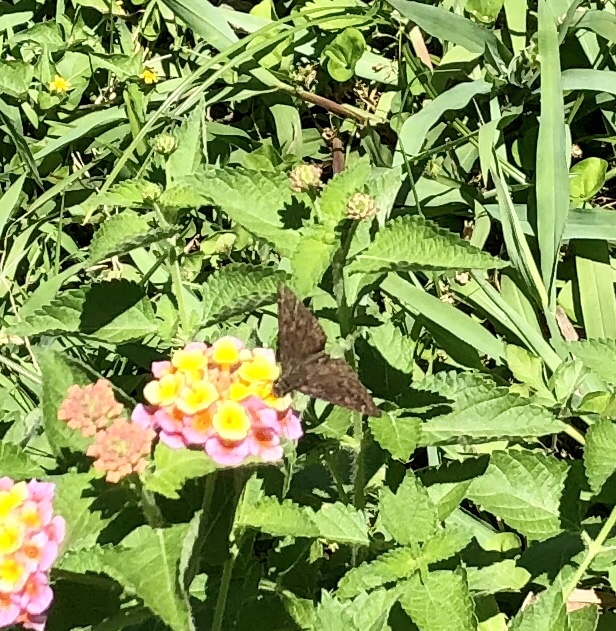
The answer was a resounding yes. There were skipper butterflies skipping all over the plants, as well as quite a few duskywings. I saw another variegated frittilary, but didn’t get its picture.
Duskywing
Skipper
Big wasp enjoying a lantana flower
I also saw a very large wasp, which reminded me of an even bigger one, the cicada killer (they are so cool, but I haven’t seen any this year). This one appeared to be a Guinea paper wasp, judging from its stripe pattern and large antennae. But, I could be wrong and it could be a regular ole yellowjacket, which we have plenty of around here. I’ll find out on iNaturalist, I’m hoping.
It really does me a lot of good to take little walks and outdoor breaks, which are just fine to do in an uncrowded place like here. Since we are getting more and more coronavirus cases here, I’m not going anywhere crowded right now!
It’s been so much fun checking out what’s growing in my tiny garden outside my office. Every day, there’s a little bit more to see in and around it. This little space supports so much life!
This morning, I found the Inca doves poking around in the area where there’s dirt. I wondered where they were living, and then they were kind enough to show me! They have a nest right above our carport light! I love these birds, because they are calm, busy, and beautiful when they fly. The underside of their wings is a russet red, which makes them easy to identify, and looks beautiful.
Hello from the Casa de Inca
I looked a little closer before I went into the office, and saw even more life, on a tiny scale. I saw something yellow on the milkweed plant and was all excited that it might be monarch eggs or something, but when I got closer, the yellow dots moved. They are very bright aphids with little black legs. Turns out they are oleander aphids, which are also, conveniently enough, known as milkweed aphids. Well, the plants are supporting their tiny life, so I let them keep sucking away.
MMMMMilkweed! (I don’t know what the black aphids are)
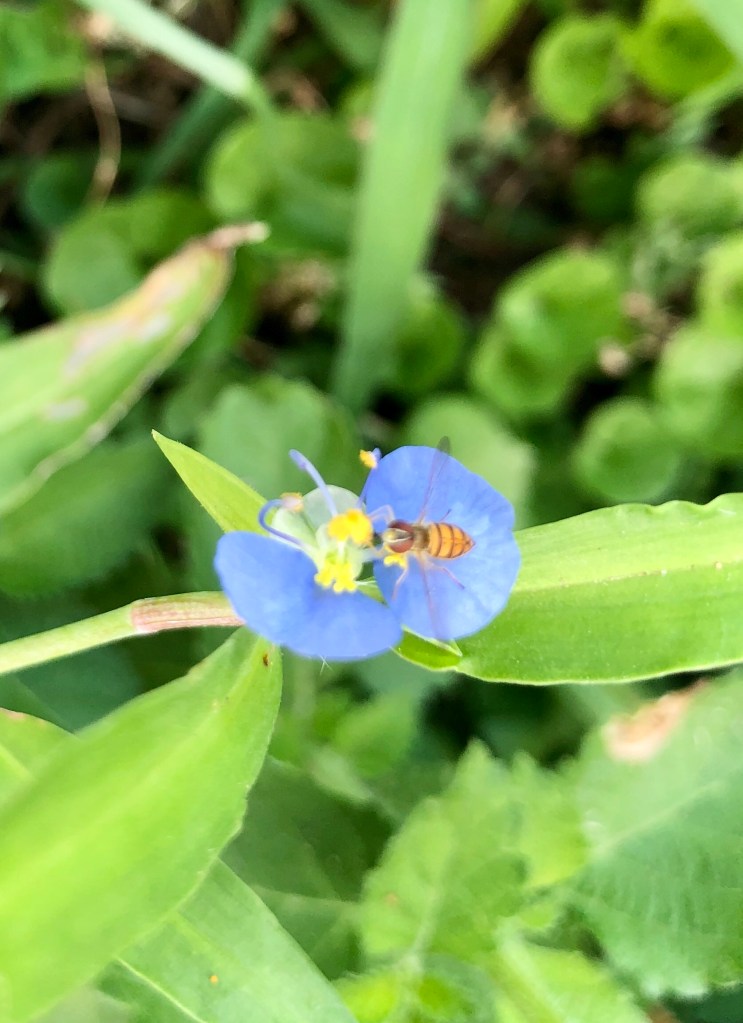
Over to the left, something moved on a common lantana flower (which Linda Jo, my iNaturalist identifier, called “not one of the good ones”). There was a tiny, tiny fly. It has stripes that make it look like a bee or wasp, but it’s one of the little flies that lives on nectar from flowers, a calligrapher fly. I guess it does look like it has writing on it!
I can’t write calligraphy, but I am pretty.
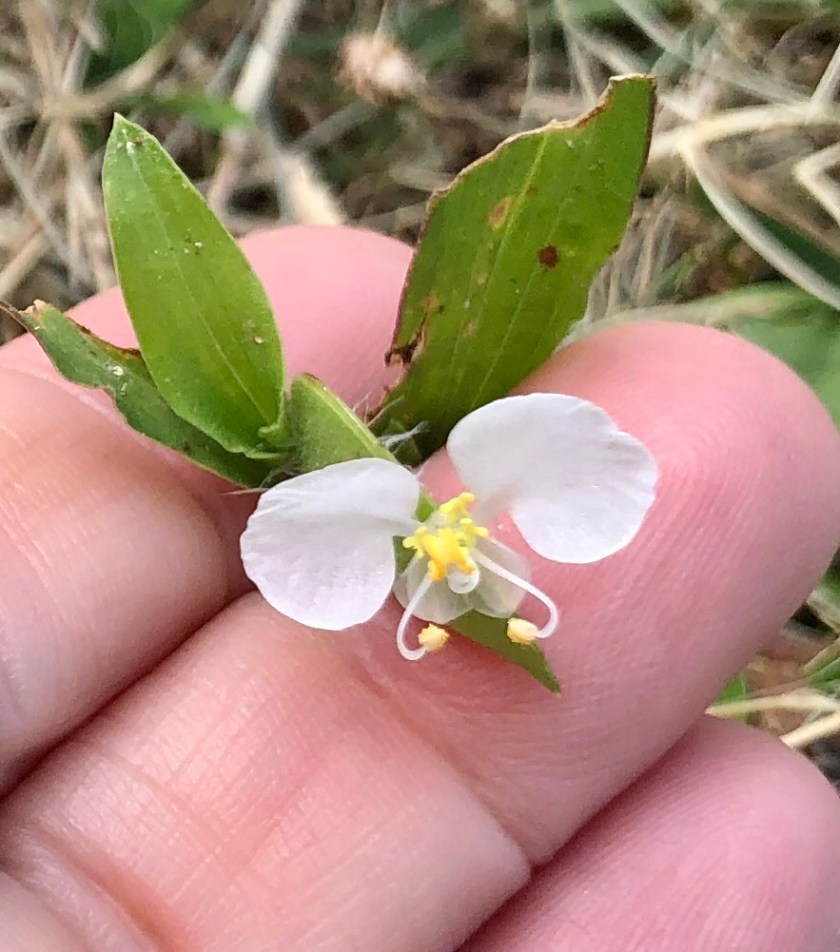
And finally, when I stood up, I saw one little dayflower that did not look like all its beautiful blue friends. It’s a white sport! I love it when I find the oddballs of nature smiling up at me.
I’m a standout
What a great way to start one’s day, just noticing the bounty of life around me. This really is a little garden that could…be full of life!
What about me? I’m living in the little garden, too!
One More
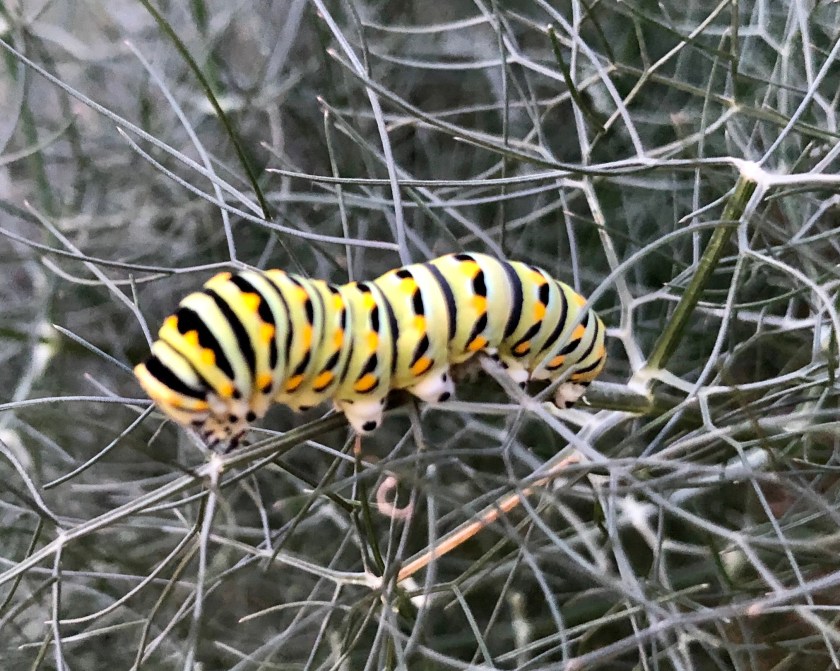
I have to share, because it’s so pretty, this black swallowtail caterpillar on my bronze fennel plant at the ranch (one of two herbs that didn’t die in my planter). I’m so happy to support future beautiful butterflies!
I’m pretty even before metamorphosis! And this fennel is delish!
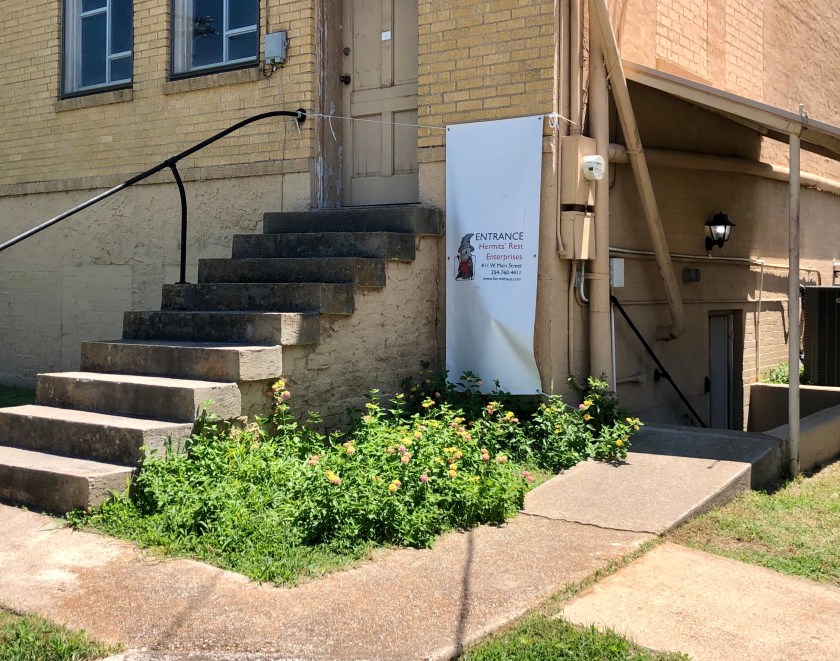
Now for some cheerful nature fun. I’ve mentioned that I spent a lot of time weeding the space right next to the back entrance to the Hermit Haus building, with the goal of making it a wildflower garden.
My little wildflower garden
I’m really happy with how it’s turned out now that the plants I want have a chance to shine and the ones I don’t want are mostly gone. The happy little lantana plants are growing bigger by the day and blooming away. All we had to do is stop mowing!
Maybe they’re a weed, and maybe they’re poisonous, but they are pretty.
The day flowers are also blooming, um, daily. But the best thing is that this tiny corner of land supports so much life.
This is a duskywing moth. You can see some straggler daisies in the back, and the grass-like leaves are the dayflowers.
Every day I see butterflies and moths stopping by, and there’s a family of spotted whiptail lizards that lives in the hole next to the garden.
This is the biggest of the whiptail lizards. Note that the lizard is shedding its skin.
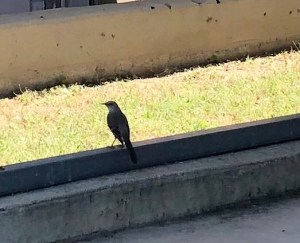
Mockingbird on the lookout
I see mockingbirds every day, probably looking for the many insects that fly and crawl around, and there are also house finches and and the Inca doves.
I’m going to find another couple of native perennials to put in, and maybe one of the fancy verbenas as a contrast. The success of the little Hermit Haus garden makes me smile every day. And I’m really happy, not faking it.
Today I went somewhere! I saw people! I did a good deed. And I stayed safe, especially considering the true dearth of infected people in this county.
Last week, a woman contacted me about a lot of things that one of the founders of our Master Naturalist chapter had been storing when she died. This woman, KB, as I’ll call her, was one of those people who are the backbone of an organization.
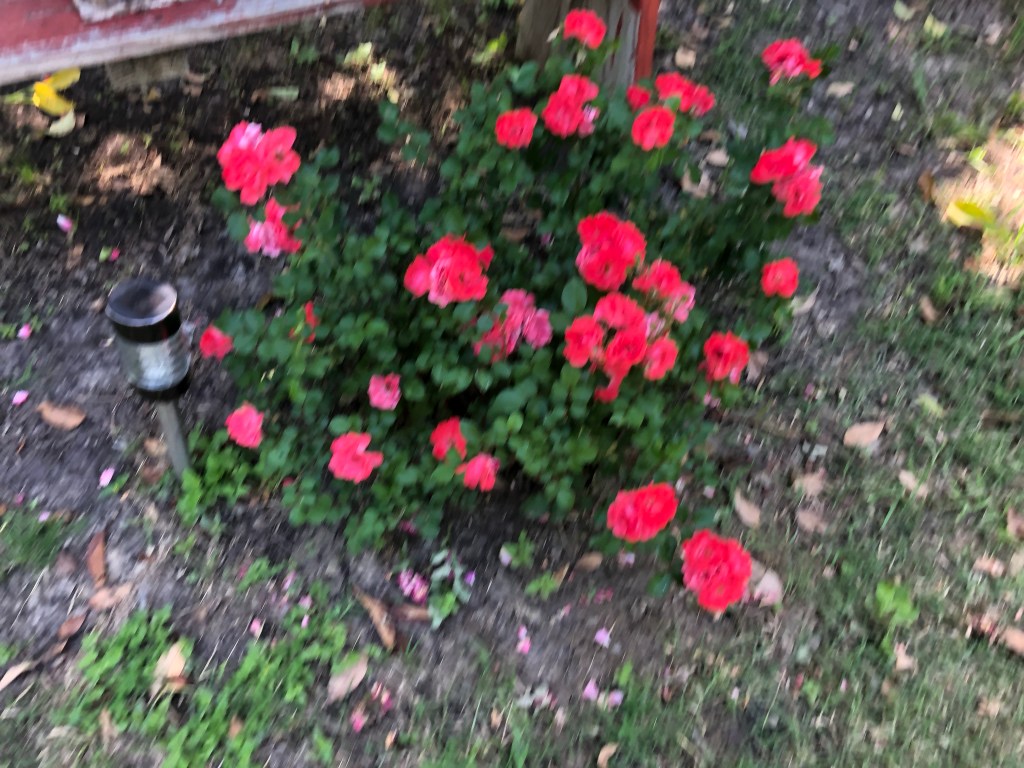
These folks have beautiful roses.
KB kept all the materials at her house, planned numerous events, workshops, and activities for the group, and apparently was a ton of fun, to top it all off. She was a prolific writer and note-taker, plus took lots of pictures. She had an entire room full of materials. After she passed away, the chapter wasn’t able to get the majority of her things, and I heard many expressions of regret.
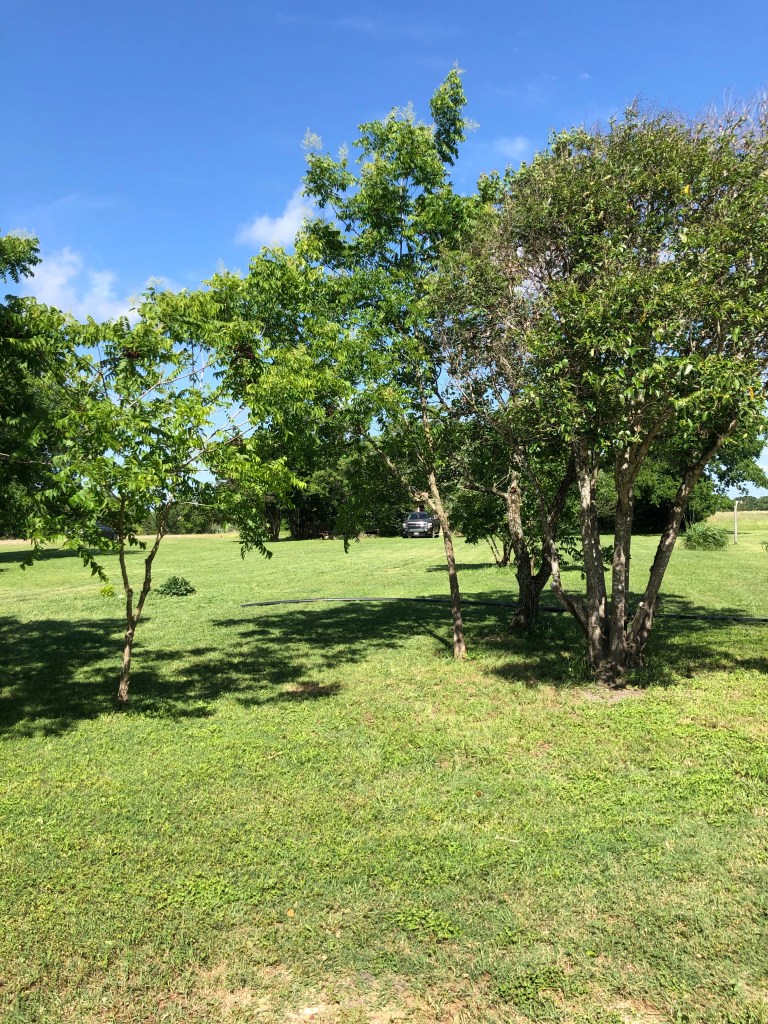
Native trees.
Obviously, we were all excited when the woman who’s with KB’s husband gave us some of her old shirts. Then she wanted to let us look through more stuff that they’d made easier to go through. I didn’t feel qualified to do this, since I showed up in the sad, post-KB year.
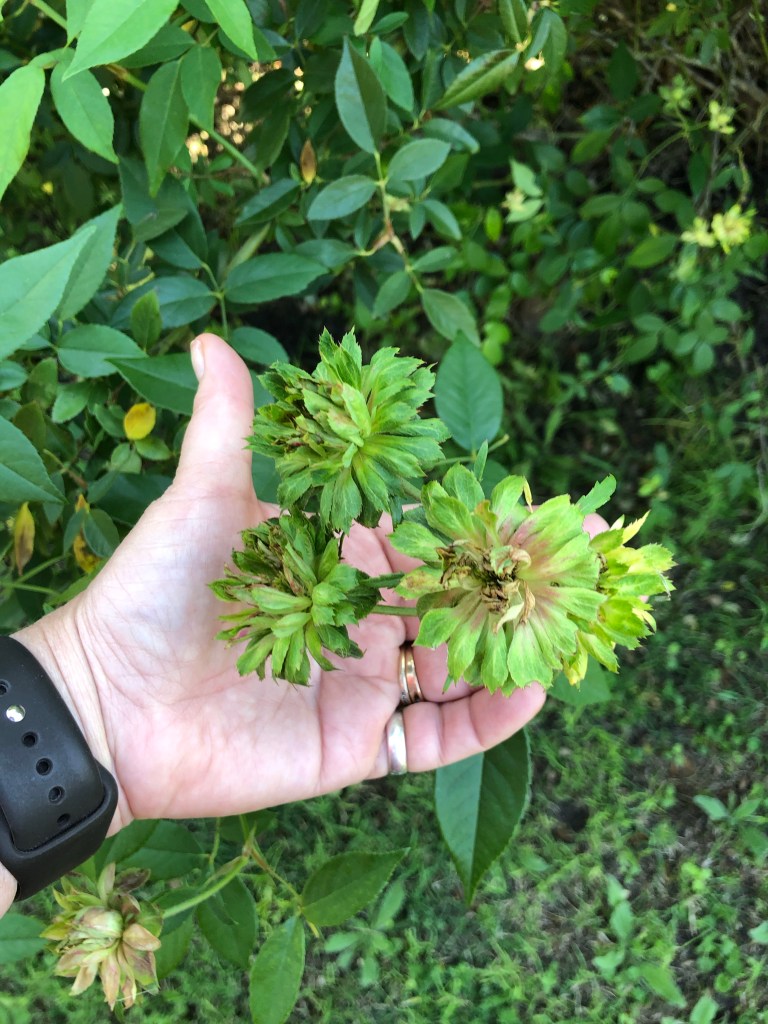
They called this green roses.
I gave her a couple of names, and she got in touch with Phyllis, our previous chapter president. Our board agreed we should go over, and I offered to go along, since there was supposedly lots of stuff.
Catalpa blossoms
Neither Phyllis nor I had gone anywhere other than to get food since March, so we both really enjoyed the drive over to the property. It was full of native trees and plants, and Phyllis said she was glad they’d mowed. It may have been too natural for most people during KB’s time.
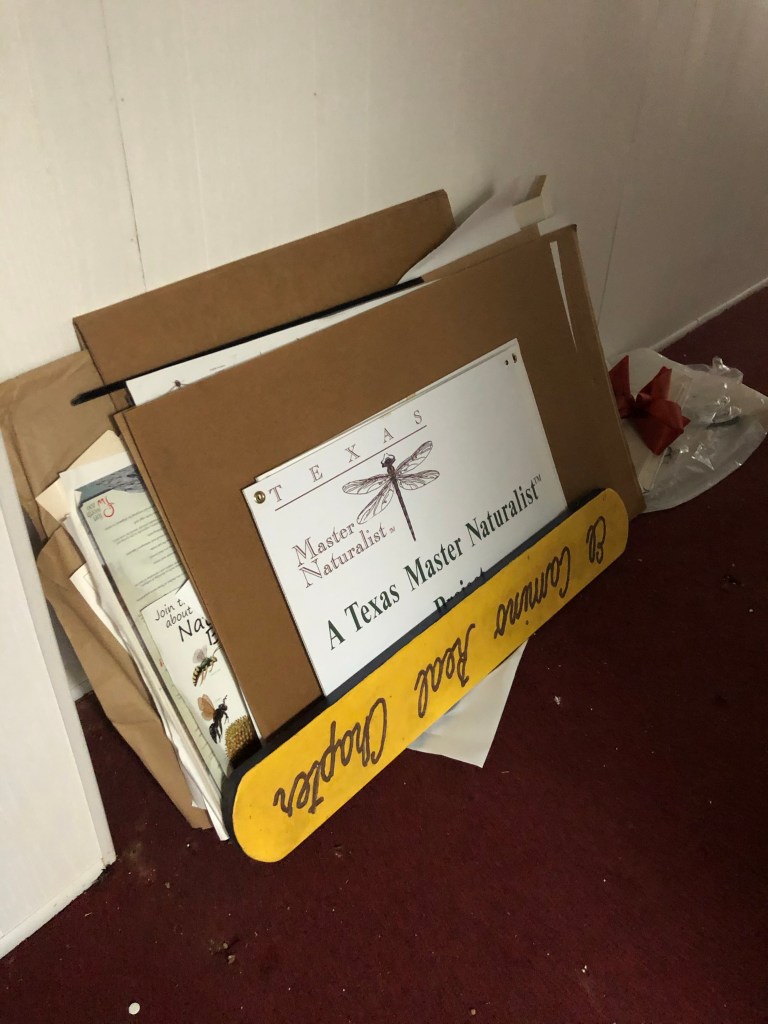
Posters, signs, etc.
I know it was hard on Phyllis to go through all the many notebooks, notes, and other materials. I found the easy things like posters and signs, and was thrilled that the legendary mussel collection was intact. We did keep some collections and drawings to show our newer members. They were meticulous and awesome. This woman was a true citizen scientist.
Flower/plant presses
It turned out that KB’s former husband and his current partner were very gracious hosts, so we got to tour their gardens and workshops. I was in awe. Nothing was fancy, but it was so interesting! Both of them are really creative. I even loved the chicken coop.
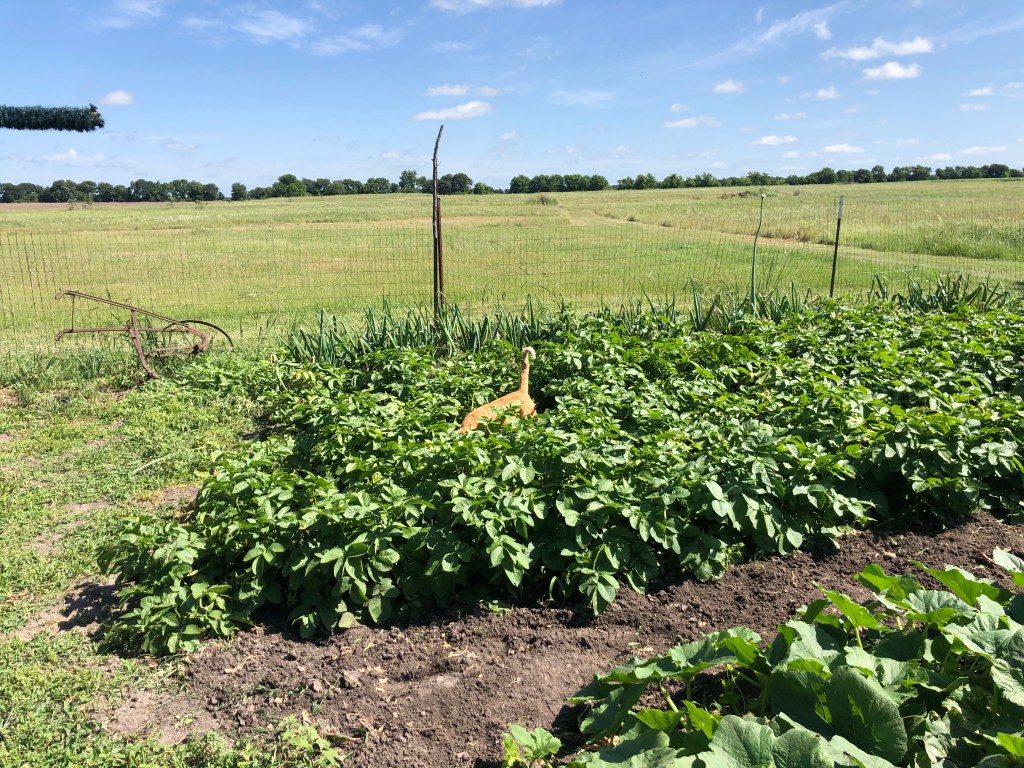
Squash, potatoes and onions.
Then we toured the house, made much less fun by wearing masks. You know, you read about “farmhouse chic” a lot. Well, this is an actual chic farmhouse. Everywhere I turned there was an idea I wanted to try. Each room was more charming than the previous one. It was a comfortable home just full of old things being used as they always had, along with creatively repurposed stuff.
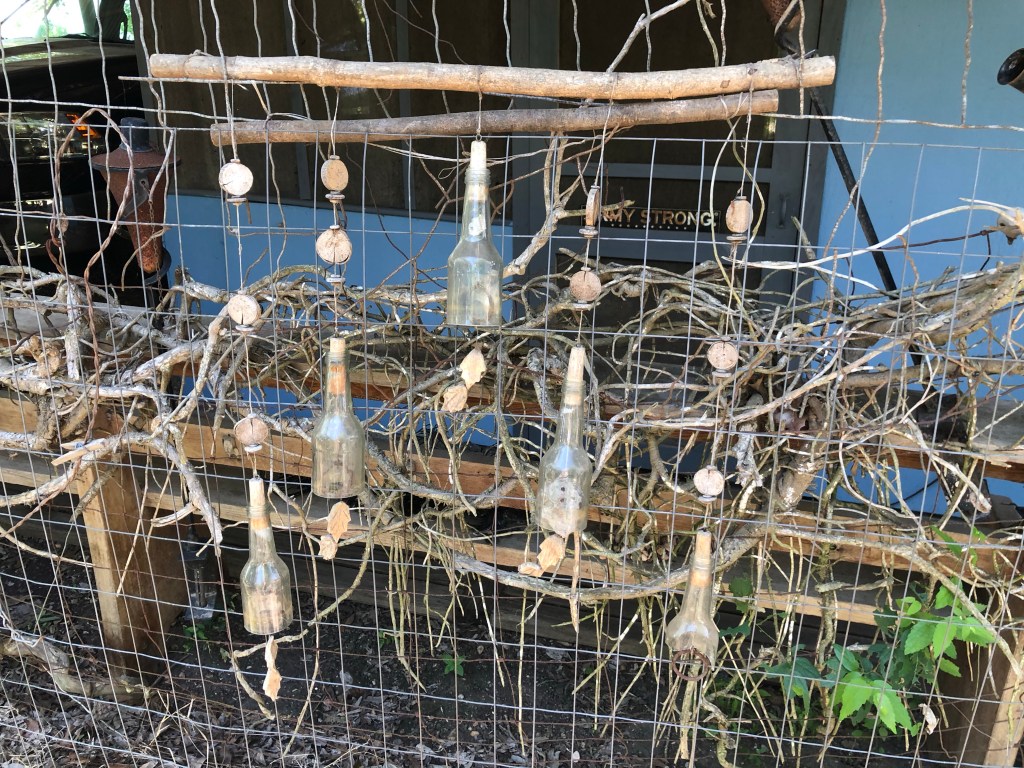
This is cool. I want one.
That was fun. I really enjoyed meeting new people and chatting. I probably won’t do it again for a while, but that was nice.
This is made from the light part of an old fan.
What stuff have you been doing that’s more fun than it should be? Have you taken a drive?
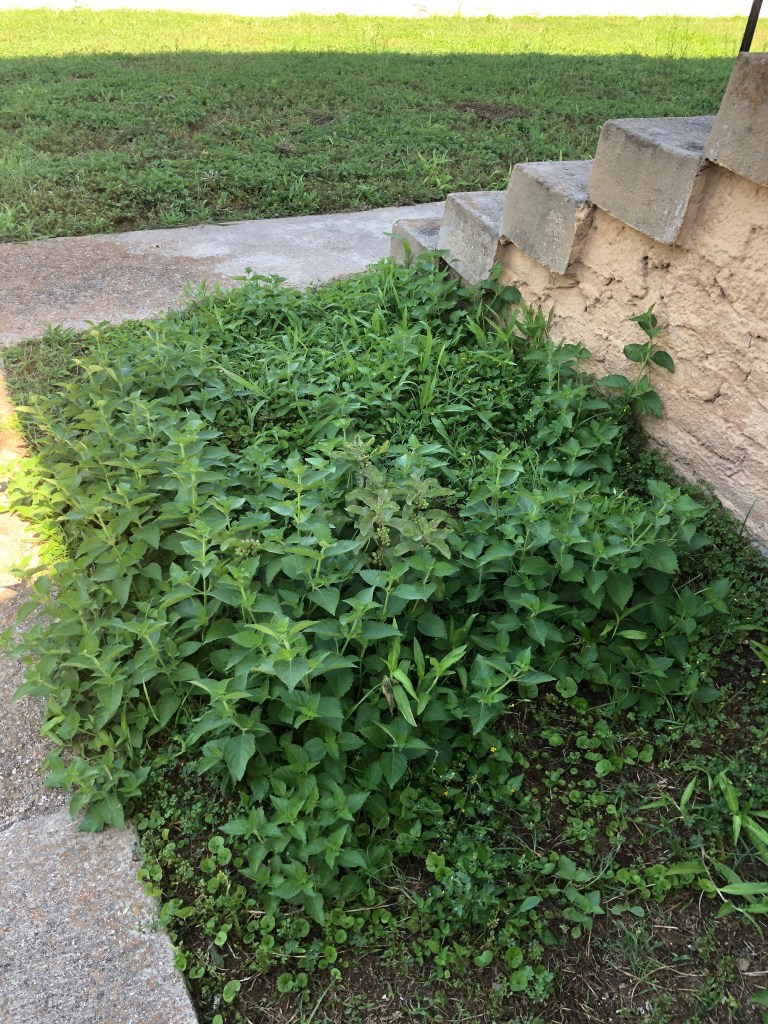
The need to focus on things that aren’t related to pandemics and other stress-causing circumstances has continued to this morning, so I took a break and checked out what’s going on around the Hermit Haus offices. My main focus was my “wildflower garden,” but I branched out. That got me lots more entries in iNaturalist, too!
The “wildflower garden” next to the stairs. It is about to get pretty.
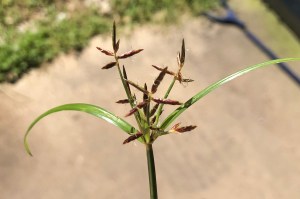
The seeds are shiny in the sun.
I have to say that I find it fascinating how varied the plants are in what looks from a distance like a lawn. Actually, there’s very little turfgrass, just a few sprigs of our nemesis the coastal Bermuda. The one other grass is what they call nutgrass around here, but is actually purple nutsedge, a nonnative plant that sure likes to grow here. I have pulled up many, many sprouts of it in the “wildflower garden,” and there are still more. However, I think the seed heads are quite beautiful.
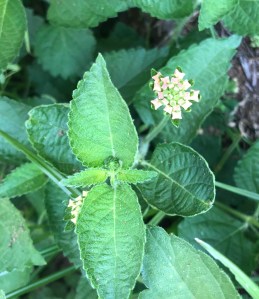
The lantana bud is pretty in its own right. Nutsedge is coming up behind it.
The area I am using as a showcase for the “weeds” that grow up around our building has lots and lots of lantana in it. I noticed those trying to bloom last year before the weedeater got them, so I decided to ask that this one area be left alone. The lantana are now getting nice and big, and are just about ready to start their late spring blooming festival.
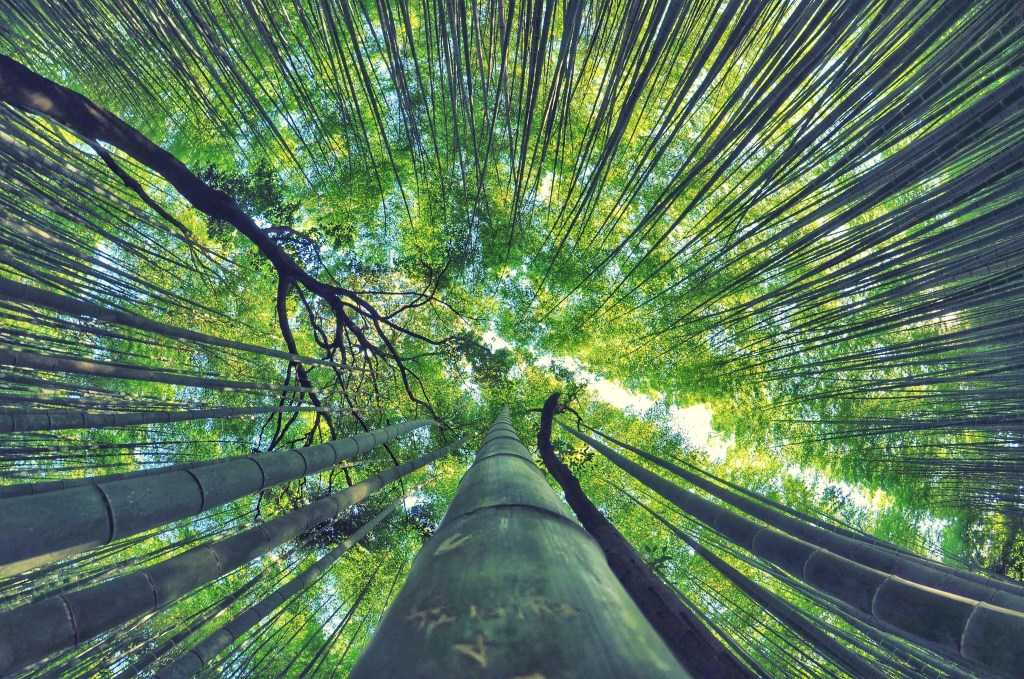
As a certified Master Naturalist, I am obliged to acknowledge that today’s the 50th anniversary of Earth Day. As a human being, I relish the opportunity to dwell on my concerns about the planet we all share and to remind myself to keep doing the things I do to help our green and blue mother stay a welcoming home for us all.
Thanks, Earth, for bringing us sights like this. Photo by @simogarb via Twenty20.
It’s hard to think about the Big Picture when so much little stuff is on our minds. But, it can do us a lot of good, too. We get presents from the Earth every day. Surely we can give back some, too!
This is little quaking grass. It’s seed-heads look like rattlesnake tails, or tiny Christmas trees to me. Behind it is our doggy swimming hole, which is FULL of tadpoles right now. Thanks, Earth!
What Can You Do?
Sure, we’re all avoiding big gatherings, so our Master Naturalist chapter isn’t doing an event like we usually do (actually, we’d canceled anyway). But the internet is just full of ideas. Here are some things I’ve read as well as my own suggestions:
Read a book! Head on over to my Book Reports Page and find one of the many nature books I’ve recommended over the past two years, or go ahead and get Nature’s Best Hope. We all need that inspiration sometimes, and reading takes our minds off “stuff.”
Go outside! Take a walk with your eyes, your ears, and your mind open to what the Earth has to share with you. Do you hear birds, squirrels, dogs, or coyotes? Do you see butterflies and moths? Are there plants growing in all sorts of places you don’t normally see? Make a list; you might be surprised at what the Earth has for you, no matter where you are.
Share with others. Remind people you know that it’s Earth Day and that they can do something to help. Use Facebook, Twitter, Snapchat, email, your Zoom meetings…whatever! Word of mouth is always the best way to encourage new learning.
Start a new tradition. My friend Donna just told me that she has planted a tree every single Earth Day for the past 50 years. Hers is already in the ground. You can start your own Earth Day practice now!
Recycle something. Even better, re-use something you already have. I’ve made chicken feed scoops from plastic containers that have lasted months and months. I’m saving wine bottles and corks for projects (can’t wait for all my shiny bottle trees to start sprouting!). Let us know what YOU do!
Venus’ looking glass was my gift from the Earth yesterday.
I hope that’s given you some ways to celebrate Earth Day from the comfort of your property. The Earth is our home, and it never hearts to tidy her up, make her beautiful, and keep her safe.

























 The Hermits' Rest