Book Report: Oh, William!

Rating: 5 out of 5.

Another Elizabeth Strout book is now under my belt. I started it a while ago, then a few other things pushed their way into the queue. I was also savoring it. I do love to read the words of the fictional Lucy Barton, and that’s what all of Oh, William! is.

I love the white tulips on the cover (which are a part of the book)

Elizabeth Strout could make Lucy Barton walk across the room to go to the toilet and I’d find it poetic and striking. That’s just how Lucy’s thought processes come across to me. Even though Lucy doesn’t stray from her theme that you can really never know what’s going on in anyone else’s mind, it’s great to see her come to that conclusion over and over again, especially when it comes to her first husband, William.

Lucy has always felt like an outsider from the rest of the world, thanks to have been brought up in an isolated setting with no media or other outside influences besides school. William was, in her view, a safe haven. The plot, such as it is, revolves around Lucy slowly realizing he actually never was that.

The contrast between William and Lucy’s second husband, David, could not be stronger. David was warm, loving, and comfortable, while William was one big, scary (but fascinating) mystery to Lucy. I had so smile as I realized that Lucy just could never shake William out of her system.

William had a glamorous mother who it turned out, was not from glamorous roots at all…much like Lucy. The other subplot had to do with this woman, Catherine, who abandoned her first child…much like Lucy felt she had abandoned her daughters (but really hadn’t).

Enough about the plot. You read these books more for the way the plot presents itself and the language Strout uses to express the ideas in Lucy’s head. It’s just so, so wonderful.

Now. After I finished the book, I began wondering why I feel a kinship with Lucy and how she relates to the men in her life. It then dawned on me. I’ve had my own William and David. I literally worshipped my high school boyfriend, but in the end I had to get away to be myself. And he was much like William. And his mother was exactly like Catherine (from poverty in Mississippi to a glamorous adulthood).

But it was how Lucy felt about men that struck me. She viewed love like I did much of my life, and I never realized anyone else was like that. I always thought I was very odd. But, certain circumstances where love is sort of withheld from you can lead you to not trust yourself to really love people, so you sabotage relationships. Huh. I’ve done that. Repeatedly.

Stopped now.

Gosh, I’m glad Lucy is seeing things clearly, now that she’s my age. I hope I am, too. And if this review doesn’t make sense, well, it’s because I don’t make sense, either. Do any of us? I’ll ask Lucy in the next book.

Book Report: Atlas of the Heart

Rating: 2 out of 5.

Here’s the review of Atlas of the Heart: Mapping Meaningful Connection and the Language of Human Experience, by Brené Brown (2021) that I promised recently. I think I am growing tired of self-help books or something, because this one didn’t impress me as much as some others I’ve read.

Pretty cover.

There were good parts to this book, which consists mostly of a discussion of a wide range of human emotions, which it turns out there is no agreed-upon number of nor many firm definitions. I enjoyed learning the difference between envy and jealousy, as well as pride versus hubris. Pride can be good. Hubris is not a good thing to have. You think you’re great, people think you’re awful, but you don’t care. Sound familiar?

I was disappointed that some of the emotions didn’t get much discussion. I would have liked more information on many of the complex ones. It felt like Brown just stopped at random points, inconclusively.

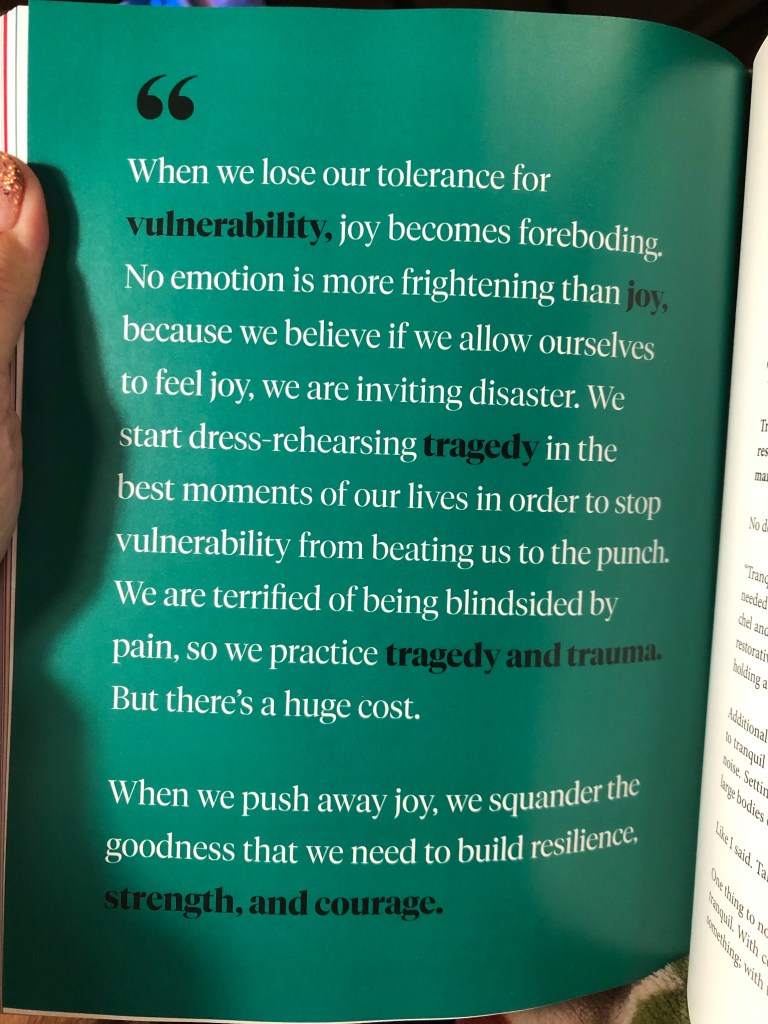
I liked this one. P. 244.

Anyway, the last part of the book is about a new grounded theory of meaningful connection. I’m all for meaningful connection. Combined with her concept of “near enemies,” Brown defines how to develop grounded confidence, the courage to walk alongside others, and practice story stewardship. The last is interesting to me, as it has to do with listening, believing and acknowledging, without giving advice, taking over people’s stories, or putting others down.

I think this is useful, but not as earth-shattering as it has been made out to be. A lot is common sense. Oh well, it’s helpful information, but it came across like a PowerPoint presentation not a full-fledged explanation. I’m being nit-picky.

And I’ll be eternally grateful for the concept of foreboding joy.

And one more thing. A whole lot of the book is quotes from her earlier books. It seemed a bit like padding. But hey, it’s on really nice paper and has lots of colors. I like colors.

Book Report: The Lincoln Highway (or a Fine Way to Spend a Couple of Days Off)

Rating: 5 out of 5.

It’s been a while since I did a book report, but no, it’s not because it took me that long to read The Lincoln Highway, by Amor Towles (2021). I spent the last number of weeks knitting and reading magazines (and I admit, not reading very much of Oh, William, by Elizabeth Stroud, to savor it). This big, fat book of 500+ pages took me only three days to read, because once I started, I kept saying, “One more chapter…” many chapters in a row. Yeah, it was a good book.

Maybe there will be a volume 2 and they will finish going down the highway.

Once again, I am grateful to the Bobcat Book Club for deciding on a book that I’d never have chosen for myself based on its description. But y’all, if you want to take some time away from your troubles and go on a Heroic adventure about Heroic adventures, here’s a book for you! I can easily see this book becoming part of undergraduate humanities classes where you assign The Odyssey and every other epic journey…then conclude with this book and tell the kids to go write their term paper on the themes therein.

I give Amor Towles a lot of credit for building out the many heroes, both tragic and triumphant, who flow through the book, weaving and interweaving their stories and adventures into a big ole bundle of enchantment. You just can’t wait to find out who does what next or to fall deeply into the backstory that makes you think you’re suddenly in The Canterbury Tales. Geez, this book really IS like a long demo of all the forms of storytelling in Western Civilization, all presented in modern language. I’m glad Towles didn’t try to shorten the book by skimping on any of the stories. Stories are important, all of them, and that’s what he tried to convey in this book!

This is one of those kinds of books where you find yourself growing so fond of the characters that you don’t want it to end. They are all so multi-faceted, and of course, each hero has his or her own fatal flaw. You can draw a lot of lessons from them, too, like how people who are labeled “criminals” may well not be and people who label themselves as “good guys” may not be. A little bit of humanity makes a story a lot of fun and will get you through any overly contrived coincidences and improbably good timing.

I invite you to sit down and get to know Emmet, Billy, Duchess, Woolly, Sally, Sarah, Ulysses, Pastor John, the nuns, and of course, “Dennis,” the only completely unlikeable character in the whole book, who is never without his quotation marks. Adventure awaits!


(And hey, thanks to all of you who were so fascinated by photos of an old cabin that I had my biggest day of blog stats ever yesterday. I do know book reviews are not the big hit generators.)

Book Report: A Year in Provence

Rating: 3 out of 5.

This is certainly not the kind of book I usually read, but it’s what the Bobcat neighborhood book club chose, and I want to stay in the book club, so I read it. As many of you who read this book years ago already know, A Year in Provence, by Peter Mayle, came out in 1989 originally. The copy I have contains an update from ten years later.

Much wine and pastis are consumed in this book. And why is that doomed fox smoking?

This would not be a beloved best-selling novel if it didn’t have its charms, and Mayle most assuredly can paint a picture of a culture in just a few words and a few bucolic tales of the neighbors and neighborhoods. I think any Francophile would just love the little vignettes and word portraits of the people in a remote area of Provence and how their activities and non-activities change from season to season.

There’s the problem. I’m not, alas, a Francophile, even though I once married one and have beloved friends who adore France. Too many years of watching French cinema could be a cause. Or it could be the particular set of grumpy, chain-smoking French people with strong superiority complexes I’ve known. (Before you rebuke me, I realize there are plenty of people in this continent who could be characterized similarly.

I didn’t find the way the contractors working on the house just disappeared for months with no warning nor any explanation (this may be because our pool workers have done the same). I didn’t find the smelly, mean-spirited neighbor, who Mayle seemed totally enchanted with, at all fascinating. He reminded me of half of Milam County, Texas.

And I know he was a sweet old man with much going for him, but Mayle came off to me as someone with more money than he knew what to do with, and no ability to make his own decisions. He just went along with everyone else and their ideas and timetables. Oops, I hope I didn’t just describe myself. I may have described how I must come across sometimes (I assure you; I do NOT have more money than I know what to do with–each horse and swimming pool expenditure comes with sacrificing something else and with the sad bonus of annoying my dear spouse).

This book review is not about me, it’s about Provence, an area of France where it gets quite hot and is often very windy…much like Milam County. Maybe I found too much of my own life in this book to find it a real getaway.

Oui, c’est un gros trombone – I did not know paperclip was “trombone” in French.

And also, I’m a linguist and all that, but I didn’t know what a lot of the words in the story meant. I’m not ignorant in French, but I wish more context from which to figure out the meanings of some of the liberally sprinkled French words and phrases had been included. Some of us studied Spanish, you know.

Still, anyone will enjoy some of the little bits you learn about Provence, the stories of grapes and mushrooms, and learning about how hunters of over thirty years ago a lot like the ones are today (they need their modern conveniences!). At least there is a lot less trash on the side of the road after hunting is over in Texas. You can enjoy a few days with this book and not get upset, angry, or bored, so it’s worth a shot.

Monsieur Renard is not happy about what is happening to the fox on the book cover.

My favorite part of reading A Year in Provence, though, was that I got to use my new bookmark that I got in Breck. It’s a cool fox, or dare I say, renard, on it. Its little face looks très amusant” peeking out from the top of a book. I can’t wait to use it again.

Book Report: Anything Is Possible

Rating: 4 out of 5.

Here’s one more Elizabeth Strout book. This is not exactly a sequel, but it builds upon the events and actors in My Name Is Lucy Barton. Anything Is Possible impressed me, because it has the same people in it, but is a completely different type of book than the book about Lucy. Here, you hear about all the folks she encountered in her book and insisted she didn’t know anything about or understand.

And it quickly becomes clear that Lucy was right. Each of the people you learned a few facts about from Lucy or her mother before has a complex and interesting story to tell, with their own deep regrets, shame, and accomplishments. I was surprised over and over at how the people I encountered in the first book changed as they aged and had experiences.

There’s a theme of people surviving the loss of their mothers, many by having their mother just up and leave, others by having them pass away young. That made me empathize a lot, since I always felt like my mother was never really all there the whole time I knew her, even though I loved her an all her flaws. The same seemed to be true of almost everyone in Anything Is Possible, too. It warmed my heart to see estranged siblings realize their love for each other and estranged children realizing they love their parents (even the ones who were unacceptably eccentric, bordering on abusive). That gives me hope for my own situations, and that’s a thing that makes me really careful.

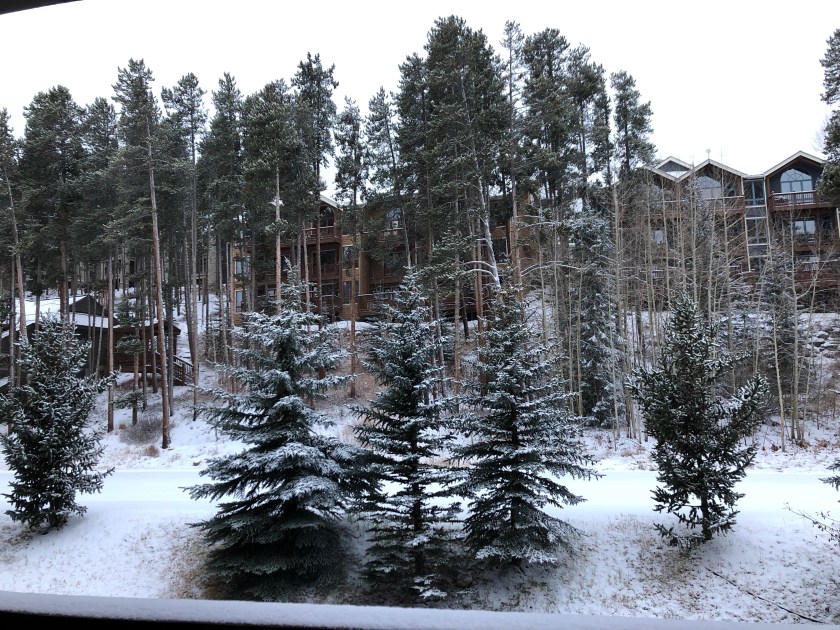
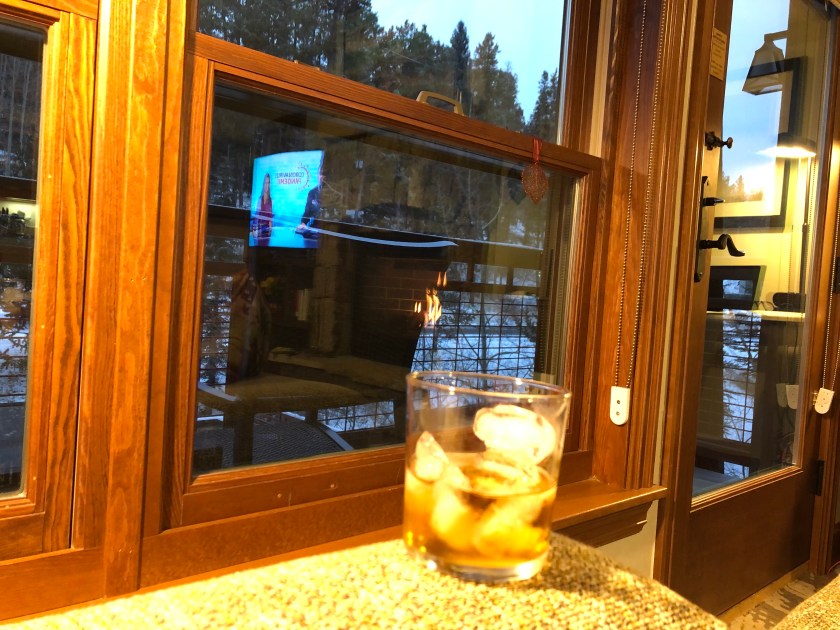
My view while reading.

Strout is right, anything IS possible. You also can’t predict what’s going to happen with people. Even the most broken of us can rise above early experiences, but it’s not guaranteed, either. Strout did a masterful job of showing us that “stuff happens” to everyone, but we will all learn, grow, and remain able to love.

Anything is possible. I am happy, content with my life situation, and no longer dwelling on my own shame, doubt, or eccentricities.

I hope you get a chance to read both of these books, and read them in close succession. You’ll experience complex emotions, but in the end, you’ll be realistically optimistic about humans and their resiliency.

Book Report: My Name is Lucy Barton

Rating: 3.5 out of 5.

I’ve been knitting a lot in my spare time, but I need a break sometimes. Good thing I brought a bunch of books with me to Colorado. At least three of them are books by Elizabeth Strout, who wrote the Olive Kitteridge books I enjoyed so much. The first one I read is My Name is Lucy Barton (2016), which is apparently going to become a major Broadway play.

my  name is lucy barton cover

The book looks much more substantial than it actually is. That’s because it starts out with eight pages of praise for the book and ends with a book club guide and an excerpt from another book. Why did they need to pad it out so much? And my suspicion is immediately aroused when they spend so much paper on telling you how great the book is, rather than letting you figure that out for yourself by actually reading the darned thing. And check out the cover, which tells you how much the NY Times, the Boston Globe, and the Pulitzer Prize committee love the book and the author.

Now, I did enjoy this book very much. The writing is as spare and open as the other books I’ve ready by Strout. And the story, which revolves around a writer reminiscing about a long visit from her estranged mother, while she was hospitalized with mysterious complications from surgery. You get hints of an abusive past and damaged family members, but a lot is left to your imagination, because as Lucy points out she really can’t know what anyone else thinks, felt, or experienced. I loved that part.

And I really like some of the other themes that Strout repeats throughout the book. One is that people really seem driven to find ways to make themselves feel superior to others, even those at the bottom of the social hierarchy (which is where Lucy comes from – an entire family who lived in an unheated garage for many years). Lucy spelled it out this way:

I have said it before: It interests me how we find ways to feel superior to another person, another group of people. It happens everywhere, and all the time. Whatever we call it, I think it’s the lowest part of who we are, this need to put someone else down.

page 95

If you know me at all, you know that this is one of my big areas of concern, too. I like the way she talks about it at an interpersonal level rather than a cultural level. Lucy appears to remember every single person who ever looked at her as an equal or treated her kindly, having experienced so little of it as a child.

The other theme that gets repeated often (and by the way, Lucy is very explicit in her repetition, as in the above quote, where she reminds us that she’s repeating herself) is our inability to know what other people are thinking or feeling. Heck, she often points out that she is not sure what she remembers or what happened. This is so true, and if we are honest with ourselves, we will take this lesson to heart. I mean, I have had conversations with people from my past where our memories don’t even sound like memories of the same events, they come out so different. Lucy knows that, explicitly.

And because Lucy doesn’t really know what’s going on with other people, her readers don’t get a lot of information about any of the other characters in the book, like her mother, husband at the time she was hospitalized, neighbors, and siblings. You just find out how they affected Lucy. That’s an interesting perspective to me, and I liked it more than I thought I would.

Strout does an excellent job of showing how Lucy Barton is like a stranger in the society she lives in, often just with subtle word choices. And Luvy often shares that she has huge popular culture gaps, due to never experiencing things like television shows, movies, and the world outside her Illinois farm community (which she also portrays well – those cornfields and views resonated with my time in east-central Illinois).

But, sometimes I get to wondering how Lucy did all the things she did with such limited life experiences. Of course, she was smart, read a lot, and, as her truly weird mother would say, she just went and did things. She knew she had to get out of her abusive home environment, and she did. But how did she deal with college roommates, traveling, and things like that? How did she go from not understanding shopping to spending so much time in Bloomingdales? How did she manage to raise her daughters?

A final thought I wanted to share is that I admired how Lucy owned being “ruthless” as a friend of hers termed it. Sometimes she had to do things, even if she knew it would hurt others. I see that in myself a lot, especially when it comes to people in my family. Lucy knew that having to leave her husband was right for her, but perhaps not right for her daughters. This paragraph hit very close to home for me, and I see both my child self and my own children here:

Do I understand that hurt my children feel? I think I do, though they might claim otherwise. But I think I know so well the pain we children clutch to our chests, how it lasts our whole lifetime, with longing so hard you can’t even weep. We hold it tight, we do, with each seizure of the beating heart: This is mine, this is mine, this is mine.

p. 190

I had to suspend my logical mind’s questioning during My Name is Lucy Barton, but that was okay. And if you think of the book as more of a Zen Koan or a spiritual guidebook than a novel, you will come away with a lot of insight to think about later.

Book Report: The Heartbeat of Trees

Rating: 4 out of 5.

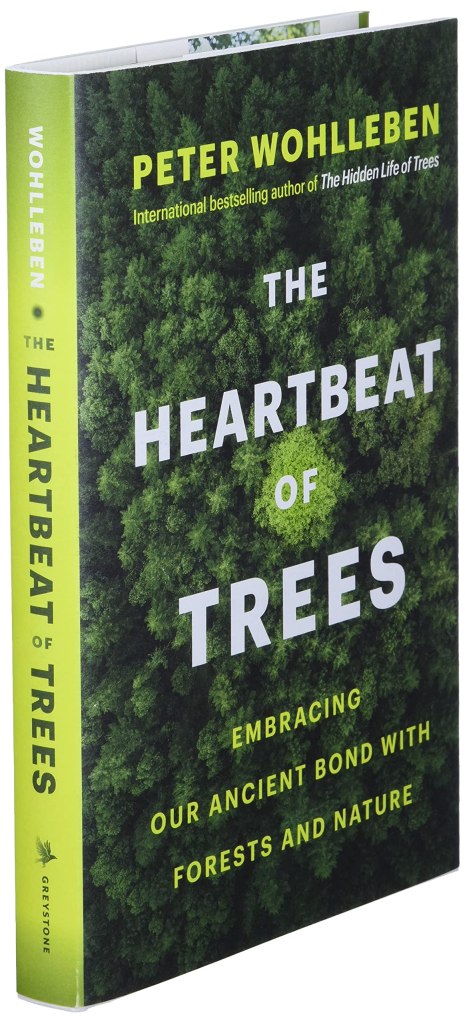
Yes, indeed, I read another tree book. In fact, I read another tree book by one of my favorite tree-hugging authors, Germany’s Peter Wohlleben. This one, The Heartbeat of Trees: Embracing Our Ancient Bond with Forests and Nature (2021), is the English translation of his latest book from 2019. It’s theme is that we are not so removed from trees (and the rest of life on earth) as we make ourselves out to be, and that it behooves us to listen to them and care for them as part of our family of living, thinking beings.

The book has some really comforting sections, along with simple and fun ways to remind ourselves of our connections to nature and the forest. I think that’s the part I enjoyed the best. There are reminders to breathe, listen, and observe when amongst our tree friends, not just plow through our hikes like we have to meet some goal of efficiency. Plus, Wohlleben shares scientific evidence of how being out in nature contributes to both the health and wellbeing of humans. Don’t you forget that!

A lot of the book made me incredibly sad, however. Alas, there are no, make that zero, examples of untouched old-growth forests in Europe. Humans have messed with that land so much that even the very old forests that do exist were originated by humans planting them in the past few hundred years.

Worse, foresters aren’t necessarily out there protecting the trees and looking out for their best interests, in Europe or in the Americas. No, they are “managing” forests for productivity. I think I read enough passages on cutting down ancient trees, clear-cutting entire forests, and strip mining to last me for a long time.

Now, Wohlleben is no fool, and he points out that we need trees to be harvested (you know, so his books can get printed, and such). He’s not unrealistic; he just thinks it would be worth it to come up with some management techniques that are more respectful of trees, kinder to the environment, and supportive of all the life that surrounds forests. Just because something’s small and insignificant to us (like a mold, an insect, or a fungus) doesn’t mean it has no role in the balance of life. You probably know that, of course. I’m just saying it, because I’m all filled with righteous indignation.

We aren’t all lucky enough to have our own woods (and I certainly don’t have any old-growth forests at the Hermits’ Rest, either, just some old trees in pastures, where they can’t reproduce because of mowing), so the ones that are out there to be shared with our fellow humans and others are treasures. This book tells us about how some people are working to make things better, and that’s hopeful. The fact that governments and industries are not convinced that using up every resource we have isn’t a good idea is NOT hopeful, though.

You’ll learn a lot of you read The Heartbeat of Trees, and my hope is that it gets you to pay attention to your surroundings, wherever you are, and to do whatever you can to help the earth maintain a healthy balance for all of its inhabitants. You will also have a more global viewpoint, since he focuses on Europe as well as North America.

Book Report: Fuzz

Rating: 4.5 out of 5.

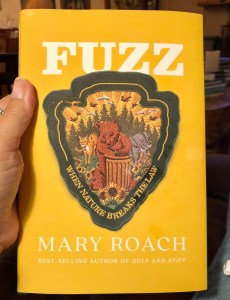
After the last book I read, I needed something a little more light-hearted to entertain me. I’d been hearing good things about Fuzz: When Nature Breaks the Law, by Mary Roach, so I chose it from the “Books to Read” stack in my office. At least I knew I’d enjoy holding it, because the fake merit badge on the book jacket is embossed and feels cool.

I do love the book jacket.

Mary Roach is a very popular science writer, because she’s known for her humor, but this was my first book of hers to read. She just oozes folksy humor, puns, and silly digressions, and I think they could actually be irritating for some readers. I had set out to read something amusing, so I got what I asked for.

In addition to entertaining us, though, Roach educates us. I think I originally thought Fuzz would be a series of cute stories about naughty bears and coyotes, but it instead provides fascinating information about how animals and people can have deleterious effects on each other.

I learned about bears and why the eat the trash in some resort areas but not others (people follow the garbage can rules in one place better), how people cause many of the animal pest problems (boy, we made a lot of mistakes in the 1800s by bringing European animals into places like Australia and New Zealand), and how hard it is to get deer to not run into the road and just stare at oncoming cars. There really are a lot of ways humans and animals can run into conflict.

Sometimes Roach makes me laugh, just by revealing how little background knowledge she has in some areas that I seem to have picked up by living here at the Hermits’ Rest. She mentions more than once how she’s baffled that someone can be both an animal lover and a hunter, for example. We learn all about that in Master Naturalist classes.

It’s sort of like a high school band mom decides to write a science book, and is happy to share her naivete with her readers. It’s pretty charming, though you know she can’t be as naïve as she sounds, because she managed to arrange to travel all over the world and meet with specialists of all sorts in order to ask them her sort of silly questions. At least she had to be a master of logistics!

After reading this book and laughing, groaning, or grimacing at the jokes, you’ll end up knowing a lot more about the complex interrelationships between humans and all kinds of animals. I know Mary Roach hopes you’ll agree to live with a little irritation (yeah, even grackles and squirrels have their roles to play in the ecosystem) so that we can all enjoy the only world we’ve been given to live in. I’m up for it!

Book Report: Coffeeland

Rating: 3 out of 5.

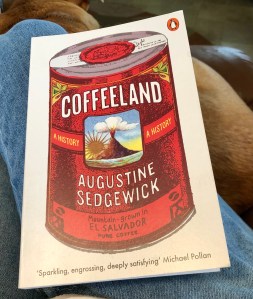
I managed to get through this very dense book by taking breaks for light-hearted magazine reading every couple of days. Coffeeland: One Man’s Dark Empire and the Making of Our Favorite Drug, by Augustine Sedgewick (1920-21). It’s the second of the books I decided to read after they were referred to in This Is Your Mind on Plants. I’m not saying it wasn’t a good book, because it was, but there were so many details that sometimes I got a bit snoozy while reading it.

The book is not a history of coffee, but rather is a history of how the cultivation of coffee shaped the country of El Salvador, as engineered by one coffee planter and his descendants, starting in the late 1800s. James Hill came over from England at a time of much change, and he instigated just that when he emigrated to El Salvador. His descendants, now fully embedded in the upper classes of the country, continue to work toward change.

There’s a LOT more to this book than just a history of one coffee planter and his plantations. There are long digressions on the history of growing coffee, processing coffee, and marketing it. I had no idea how much it had changed, and what other changes to society went along with it (coffee breaks and supermarkets, to name a few).

You also learn a lot about the history of Central America from a much more neutral point of view than you’d get in a US history book. By the time you’ve read about the conditions the Hill family’s worker-people (as he called them) lived and worked in, you can easily see the appeal of Communism when it showed up. And Sedgewick does a great job of laying out the perspectives of the plantation owners, the government (such as it was), and the indigenous people who worked the land.

I guess what I learned the most about, and what was hardest on me to follow, was all sorts of scientific theories of humans and work. You learn how calories originally were measured, how the idea that in order to eat you need to work came about (that’s right, it was not always a given), and how people like James Hill motivated workers by giving them food, but not too much food, so they’d have to keep coming back to earn more food.

There was also a very interesting history of economics, what it originally was and what it came out to be. Yeah, there’s a lot of educational material crammed into 350 pages of Coffeeland. I’m not sure if this was stuff I was dying to learn about or what I had hoped the book would be about, but I think I’m probably a better and more thoughtful world citizen after learning all these things.

A final thing I enjoyed about Coffeeland is that it was told from the perspective of another part of the world, not the US. I enjoyed learning what the priorities were and are in El Salvador, the modern history of that country, and most of all, how events around the world (the Great Depression, World Wars, etc.) affect our commodities and societal norms.

While not everyone who reads this blog will be the right audience for the book, fans of history, science, philosophy and how they all interact, will enjoy it a lot and come out much wiser.

Book Report: Olive Again

Rating: 5 out of 5.

I didn’t think I’d love the writing in a book as much as I loved Olive Kitteridge, but here I am, prepared to gush over Olive Again, by Elizabeth Strout, the woman of the bestest words ever. I keep reading paragraphs over and over, just marveling at how Strout manages to capture the inner lives of her characters so succinctly, yet evocatively. As I read her work, I am constantly seeing vivid scenes and smelling all the smells of Maine, yet she doesn’t write long, descriptive paragraphs full of endless adjectives and adverbs. Nope. She uses just enough words to do the job. That’s a writer, all right.

As always, Olive appears in each chapter, though she is often not the protagonist, and most chapters aren’t from her point of view. You get to meet many new people, as well as some of the folks from the previous book, and see how small things affect their lives so profoundly.

You learn that people really, really, don’t understand what’s going on in other people’s lives, and especially in their minds. I really needed some of this knowledge this week, as I come to grips with the fact that there are people I have known all my life who live in an entirely different reality from mine, and for whom the facts as I see them just aren’t relevant to them. It’s the same in Crosby, Maine.

Thanks to Strout, I learned many new definitions of love, too, and how it fits into people’s lives and fills the gaps in their loneliness. The point in both the Olive books seems to be that bad things happening isn’t the worst part of people’s lives, it’s a lack of connection to others. I think she’s absolutely right about that. Here’s what the character Bobby says in the “Exiles” chapter:

And it came to him then that it should never be taken lightly, the essential loneliness of people, that the choices they made to keep themselves from that gaping darkness were choices that required respect.

p. 195

If I were writing an actual book report, I’d cite Bobby’s musing as Strout’s “thesis statement.” That’s the essence of both the Olive books.

And what fills my heart with comfort is that each individual you glimpse in this book finds their own reason to keep going and to figure out their path in life. I’m going to borrow the reason that Suzanne states in the chapter called “Helped.”

I think our job – maybe even our duty – is…to bear the burden of the mystery with as much grace as we can.

p. 116

This type of spirituality permeates Strout’s writings. She sees the divine in Nature and never lets the reader forget it for one second. I’ll see her sparkling waters and intensely yellow autumn leaves often in my own mind.

This was the book I needed to be reading right now, today. I hope you pick it up and it speaks to you, wherever you are on your life’s path.