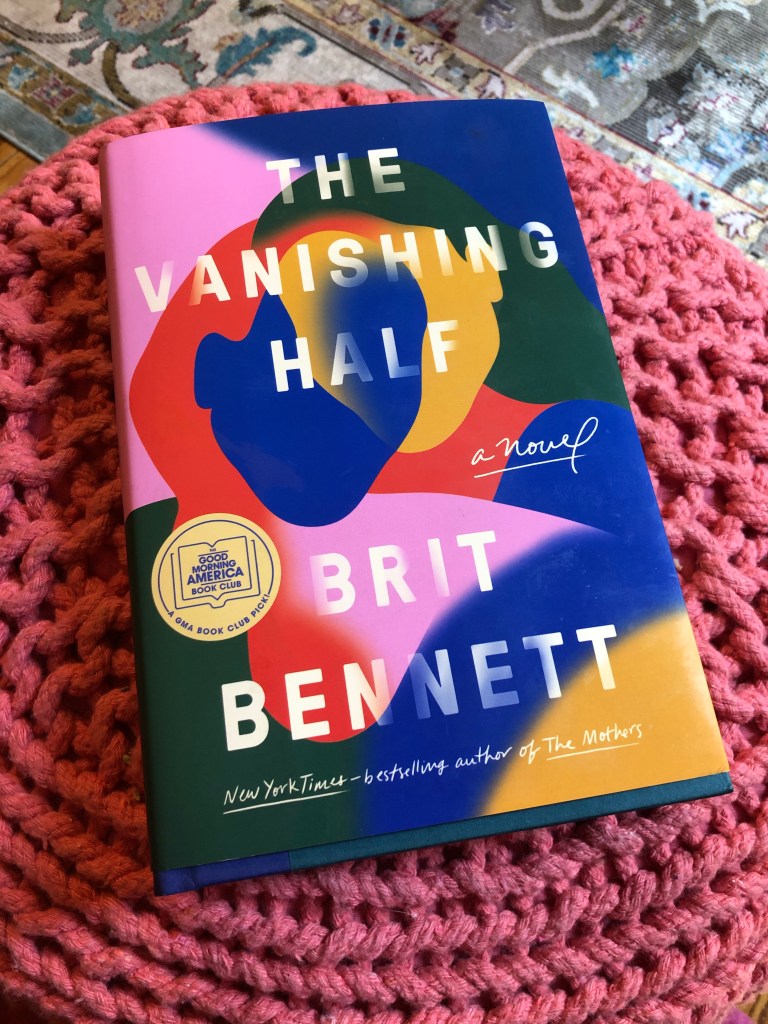
Been wondering where those book reports went? I had to take some time off while reading The Vanishing Half, by Brit Bennet, because at some point, my dislike of almost every character in the book made me not look forward to picking it up again. I was also disappointed that I’d scheduled a trip to Austin just to attend book club there, and they moved it to next week, when I have to stay in Cameron to attend all-day meetings that would drive Anita nuts.
I didn’t figure out that the cover art was anything more than blocks of color until five minutes before I started writing. I’m not sure if that’s good or bad.
In the end, I came to appreciate how everyone in the book constantly lied to themselves and each other, because it became clear that the theme to the Bennet’s story was that we are both tied to the labels we are assigned at birth, but we are also free to move away from them, when we are seeking our true selves. More on that in a bit.
The Vanishing Half was chosen by the book club members, and I wasn’t there for the discussion, so I knew nothing about it until I opened it up. I was hoping for something less intense than How to Be an Antiracist. Imagine my surprise when I found out the symbolism-laden Louisiana “town” the book centers around is populated exclusively by light-skinned Black people. It was a chance to explore race in a fictional context. Serendipity!
This skin color thing was a source of great pride in the community, which consisted of people with freckles, red hair, hazel eyes, and other combinations of superficial markings of White people. But, the surrounding area deemed them Black, and they worked at jobs that Black people in the South used to be stuck with. They were proud of being culturally Black, but also looked down at darker-skinned people. As you can imagine, that can complicate things.
Eventually, the very light twins who are the pivotal characters end up exploiting all the possibilities you can imagine for people like themselves. One stays home, and one vanishes. They each have daughters, one very light, one very dark. The daughters meet, and all sorts of racial stereotypes get twisted, turned, and explored.
Every single character you run across is very human, capable of truth, lies, devotion, desertion, prejudice, and acceptance (which explains why, at some point, I really didn’t like some of them). The only character I didn’t feel like I got to know well was the husband of one of the twins, but maybe it’s good that the stereotypical White business dude is the one who’s not worth fleshing out. At least it’s a nice change.
I liked how the daughter of the twin who lives an entirely new life after disappearing becomes an actor, herself, and feels most comfortable when playing a role. It’s all acting, for them. They fluidly go from identity to identity.
And I liked how Jude,the daughter of the twin who stays and plays the role tradition assigned her, knows who she is and what she wants to do, despite hardship and prejudice. She never doubts herself, just her confusing family. She never doubts the love of her life, Reese, sticking with him as he transitions his external appearance to match who he is inside.
I hope the world comes to accept everyone like the characters in The Vanishing Half. Be who you want to be. Love who you want to love. Cherish your roots, however tangled they may be.
Have you ever read a book and wanted to start over immediately after finishing it? Have you ever wanted to make everyone you care about read a book? Have you ever wanted to give a book a big hug and thank it? I have. And this is the book: How to Be an Antiracist, by Ibram X. Kendi (2019). I am so grateful that I saw an interview with Kendi by Stephen Colbert that convinced me to stop procrastinating and get this book!
My beloved copy of this book!
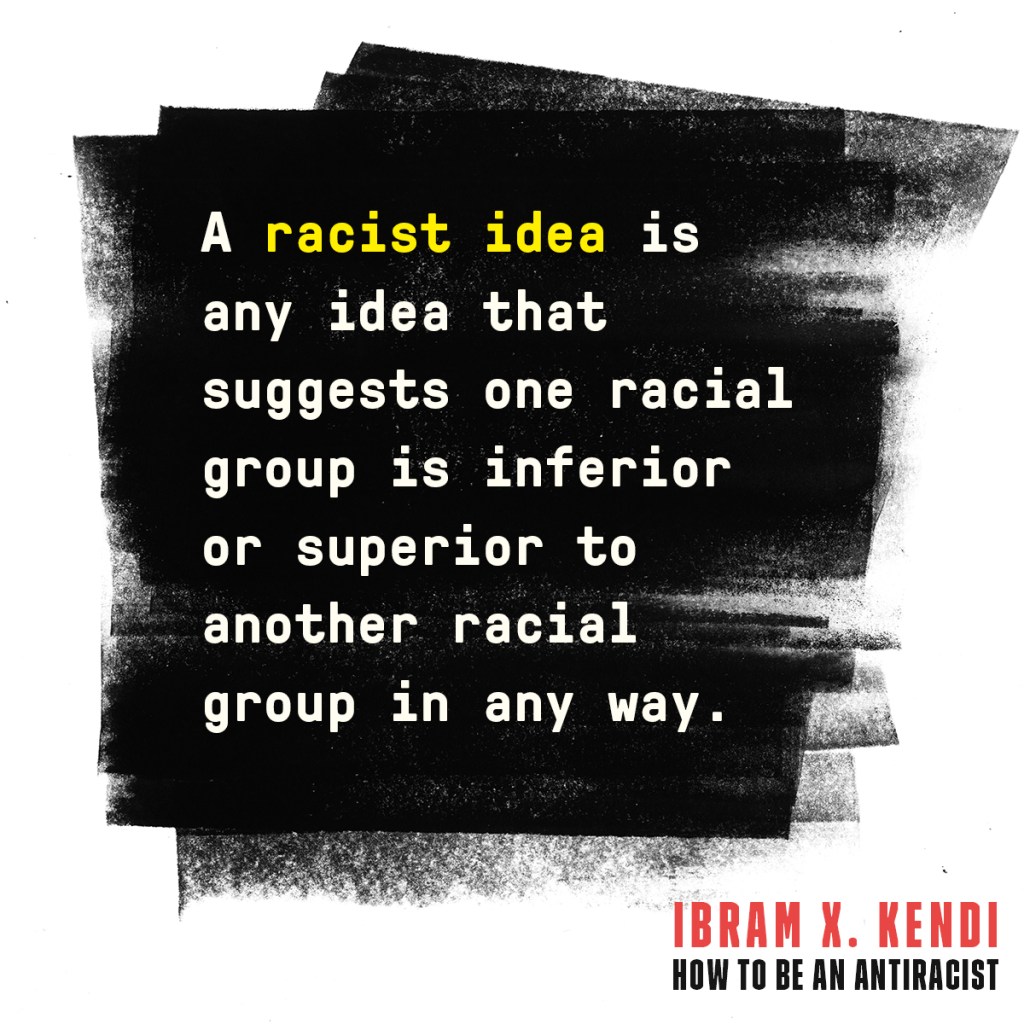
You see, a lot of books, films, journal articles, etc., on racism have annoyed me, but I never could quite put my finger on why. Thus, I was reluctant to read this book, even with all the great reviews and recommendations from people I respect. But, ha! Now I know why I was so annoyed! My internal definition of racism, though not very well thought out and rather ineffable, was more like Kendi’s definition. And I didn’t have his term for antiracism in my vocabulary, but the ideas were back there, churning away, making me feel like I was missing something.
I was glad the publisher shared these images.
I was missing the ideas in this book. As I read through each chapter, I learned more and more about how the times I lived in shaped my views, and WHY some of the things I kept hearing bothered me (things like Black people can’t be racist). Now it’s clear that anyone can express racist ideas or do racist things. People aren’t racist, ideas are. And people who have done racist things in the past can do antiracist things, even before they know what those are in Kendi’s definition.
My favorite assertion he makes, though, is that we all will have both racist and antiracist thoughts. We can’t help it, living in this society. Kendi brings this home with a vengeance as he talks about his own journey and attitudes toward race in the US. Some of the most powerful parts of the book are where he breaks down his own mistakes and shows that he learned from them and moved forward with new knowledge. We ALL can do that.
Kendi thanks his editor for his help with the way the book is organized. I thank Chris Jackson, too. The structure of the book is complex, as it interweaves stories of Kendi’s life with research and analysis. Here’s how Kendi put it:
“This book was quite difficult to wrap my head around and write–the chronological personal narrative interspersed with a series of connected chapter themes that build on each other like a stepladder to antiracism.”
How to Be an Antiracist, p. 239
This writer and technical editor was very impressed with every bit of the structure of the book, and how well the content flows. Dang. Life goals.
But, if the book was written like a textbook, I’d still have lapped it up like someone thirsty for a concoction they didn’t know existed. I just kept repeating, “yes, yes,” to myself with every page. I saw my own mistakes, I saw where my instincts were good but my actions weren’t, I saw areas for growth, and I saw things I could be proud of in my past.
Like Kendi, I got most of my ideas about racism and antiracism in graduate school, where I was surrounded by a mini United Nations of people from all over the world (I studied linguistics at the University of Illinois, which had a large program and did a lot of research on languages from Africa and India). When you work closely with people from different cultures, religions, and backgrounds, you quickly learn that there are people you like and people you don’t like in every group, but MOST IMPORTANT you end up losing the idea that YOUR culture is better than anyone else’s. I got an early start on realizing that no culture is without flaws and sad histories, but that no culture is without beauty, joy, and precious traits that should be treasured.
However, Kendi put these ideas into words way better than I ever could, so I’m grateful to him for giving me words and concepts to express my beliefs and goals.
I’m putting this book right next to The Color Purple and Where the Crawdads Sing among my favorites, ever.
Stuff I Learned
I want you to read this book. Still, I want to share a couple of the things I learned, having read way too much history from the perspective of the dominant culture, and being totally unaware of a few important ideas (to me, at least).
Race as a concept didn’t exist until 400 years ago! How did I now know THAT? It was invented to support the slave trade from Africa to Europe and later the US. Before that, people identified themselves by their cultural groups (tribes, kingdoms, etc.) not skin color.
The combinations of racist ideas with sexist, homophobic, and other ways of dividing people can lead to an entire system of X is “better” than Y (meaning they have more opportunities for education, jobs, and safe places to live).
All that stuff we tried to do in the 70s and 80s, with integrating schools by busing Black kids for hours to give them “equal” education was misguided. What we really need is for everyone to have the same opportunities right where they live. Black neighborhoods, Hispanic neighborhoods, Asian neighborhoods, and others are no better or worse than each other. Given equal access to power and influence, we could all thrive equally.
And this: racism is not about ignorance and hatred; it’s about power and influence. Power is what needs to be equally distributed among all of us. And that, my friends, is why I identify so strongly with social democrats, as does Kendi. If we all share, we can all thrive. And we can still have free markets and all that, just without one group having all the power.
See the quotes in the images for other gleanings.
I wax political. And I note, as Kendi does, that getting to the place in our society that I outline here (from him, sorta), is not likely. He likens racism to a Stage 4 cancer in our society. It’s one that is growing and growing. But some of those cancers can be eradicated by hard work and a multi-factored approach (chemo, radiation, diet, attitude). Maybe racism can be eliminated if we work from an antiracist perspective to deal with the actual causes of the problem, rather than applying bandages.
A Summary
Since summarizing books is not my best skill, I wanted to share this nice summary from the publisher. I hope it will encourage you to take a chance on being made uncomfortable sometimes, but go ahead and read How to Be an Antiracist so you can help build a just and equitable world where we can respect each other as we are.
Antiracism is a transformative concept that reorients and reenergizes the conversation about racism—and, even more fundamentally, points us toward liberating new ways of thinking about ourselves and each other. At its core, racism is a powerful system that creates false hierarchies of human value; its warped logic extends beyond race, from the way we regard people of different ethnicities or skin colors to the way we treat people of different sexes, gender identities, and body types. Racism intersects with class and culture and geography and even changes the way we see and value ourselves. In How to Be an Antiracist, Kendi takes readers through a widening circle of antiracist ideas—from the most basic concepts to visionary possibilities—that will help readers see all forms of racism clearly, understand their poisonous consequences, and work to oppose them in our systems and in ourselves.
In any case, things I was reading today about other people’s biases gave me pause to think about my own. As hard as I’ve worked to overcome different kinds of prejudice, some seem almost hard wired. I have no scientific basis to go on, but my gut feeling is that these are the ones I learned when I was very young, before my ability to make judgments like that on my own kicked in.
Yep, I’m a white person. I was raised in a Southern US white culture. Some of the prejudices of that group rub off. I’ve spent many years dwelling on this, and it doesn’t make me happy. I know that having slave ancestors as well as slave owning ancestors is something to think about. I know I have biases in other areas that skew my opinions. I know I can’t fix past things. But I know I can work hard to treat people fairly today.
Where Prejudice Comes From (for me)
I sure know where a lot of my prejudices come from, and that’s my mom, whom I loved dearly, but I could tell from an early age had some extra doozies of flaws. One was her wide range of racial and ethnic stereotypes. She had a bad World War II experience (lost a fiance) and was pissed off at Japanese people and Germans (they spit when they talk) her whole life. She was also quite opposed to “white trash,” and kept telling us not to be like them. And she both loved black people personally and said awful things about them them as a group (probably from her own upbringing). All this stuff confused the heck out of me, and even though I was uncomfortable with the things she said and did, I know some of it sunk in.
Skin is just skin. Cultural differences are interesting, not scary. Yep. All images from here down from Twenty20.
Thanks to my upbringing, I was scared of black people and looked down from my barely middle-class perch at poor white people. I have a feeling many of my black and poor white future friends came about from me wanting to distance myself from my mom and not wanting to be like that. At least I stuck around to like my friends as people. But to this day, I get this tiny bit of negativity that my higher thought processes immediately slap down. Whew, no wonder racial stereotypes and prejudices are so hard to eradicate, when even someone who knows better and wants to judge people on who they are, not how they look, still deals with childhood crap.
I’m really having a harder than usual time listening to people lumping me in with some group of tantrum-prone babies because I have differing opinions from them. I’m not using my best words, either, which doesn’t help. I can work on me, though, after listening to my friends’ criticisms of me.
I am not Supergirl. I’m fallible human woman.
It is so hard to not stereotype groups of people when people say stuff like this to and about me:
Attack when the opinion differs. Humiliate when you don’t get your own way. Scream in people’s faces like a spoiled child when you can’t make someone succumb to your way of thinking. They are a bunch of spoiled brats who don’t know how to communicate, they never had to. They were led to believe no one loses, that someone calling you a name will destroy who you are instead of defending yourself, they were taught any college degree is worth an above average wage, even though it might have been in fashion, or liberal arts! We used to sit, have discussions, not arguments. We never disowned our friends and families because we disagreed with their policies. We never had to convince our friends, we only gave our viewpoints and that was ok. This new political party is a rude, childish, a true embarrassment to us all.
a guy on Facebook who I don’t know
Wow, I’d said that some people find it really important to own objects designed for killing, while other people want to have more peaceful, secure lives. I do realize that when people expect a certain type of words to come out of people they don’t like as a group, they will interpret the words in the worst way possible. And I am NOT at my word-smithing best today. I am sorry for that, honest!
Summary
Anyway, gun-loving friends, I do not think you all want to kill people. Pacifist friends, I am against killing people, so would use the shotgun I own only to scare away animals. That’s just me. You feel how you want to feel.
I really DO want to sit and have discussion. And folks, name-calling may well make you feel better, but I don’t like it. Why? Not because it hurts my feelings. No, because it stops any rational dialog in its tracks and just leads to escalating labeling and ranting, not listening. Or, as in my case, I just leave the “conversation” and concentrate on places where I actually can engage in dialogue and learn from others.
When you feel attacked, you defend, even if you don’t want to. So, this is my public apology to anyone I’ve been unfair to on social media. Now you know why I’be been trying to keep quiet. I will work on figuring out a way to share my thoughts without inadvertently making others feel attacked.
I admit that studying this got me more upset yesterday. And it’s made me vow to not be part of the problem.
My next post will be about tea, or ants, or something neutral. Please encourage me to keep growing and making myself less easily provoked.







 The Hermits' Rest