People who know me well may find it odd that I only just finished reading Braiding Sweetgrass, by Robin Wall Kimmerer (2015). After all, as I mentioned a couple of days ago, it’s a Suna kind of book.
Certainly, Kimmerer and I are kindred spirits, both of us seeing the natural world as a part of us, and humans as ones who should learn from nature. She has some real advantages over me in that she actually got to become a botanist and she was born into a Native American tradition. She gets to learn firsthand about things I can only read or hear stories about. I’m so glad she has shared her insights with other humans!
This is one of those books you read slowly, so you can let the ideas and images sink in and process the poetry, science, and memories within each chapter. The ideas of a giving society, generosity, and shared resources that she shares ease my worries and make it harder to believe that the Ayn Rand adherents of the world are going to prevail. There ARE ways to live that aren’t all me me me.
I’m very strongly drawn to the ideas of the various indigenous traditions Kimmerer shares, but I’m also very aware that they aren’t my traditions to assimilate and take over. She gently points out that she’s sharing examples, but it is up to people like me to make ourselves a part of the land we now steward, to make our own traditions, and to tell our own stories.
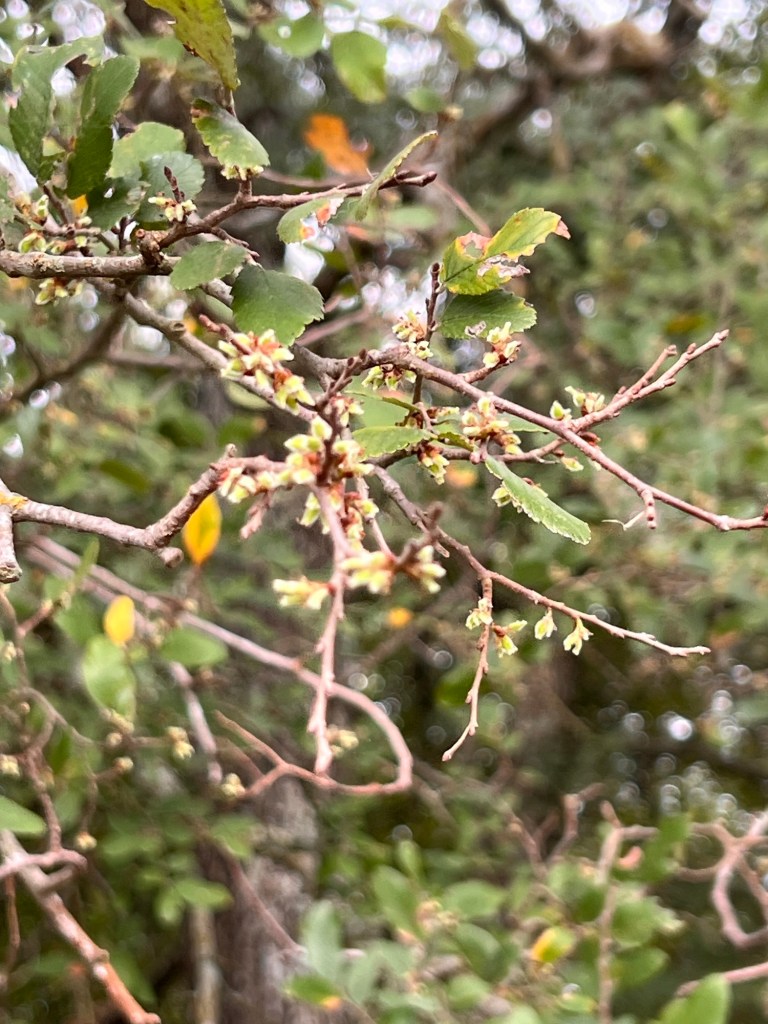
I noticed today that the Cedar Elms are putting out flower buds. Is this late? What is the tree telling me?It turns out they are late bloomers, but sometimes late summer rains can inspire a second bloom. I observed this before looking up the answer.
I’m up for this. I think people who feel attached to the life and land around them can show their gratitude to their adopted homes, enjoy the gifts they are given, and return the favors by caring for their neighbors.
Have you read this book? How has it affected you? I was already fairly entrenched in the mindset Braiding Sweetgrass promotes, but now I have more of a framework to go forward in. Your ideas are appreciated!
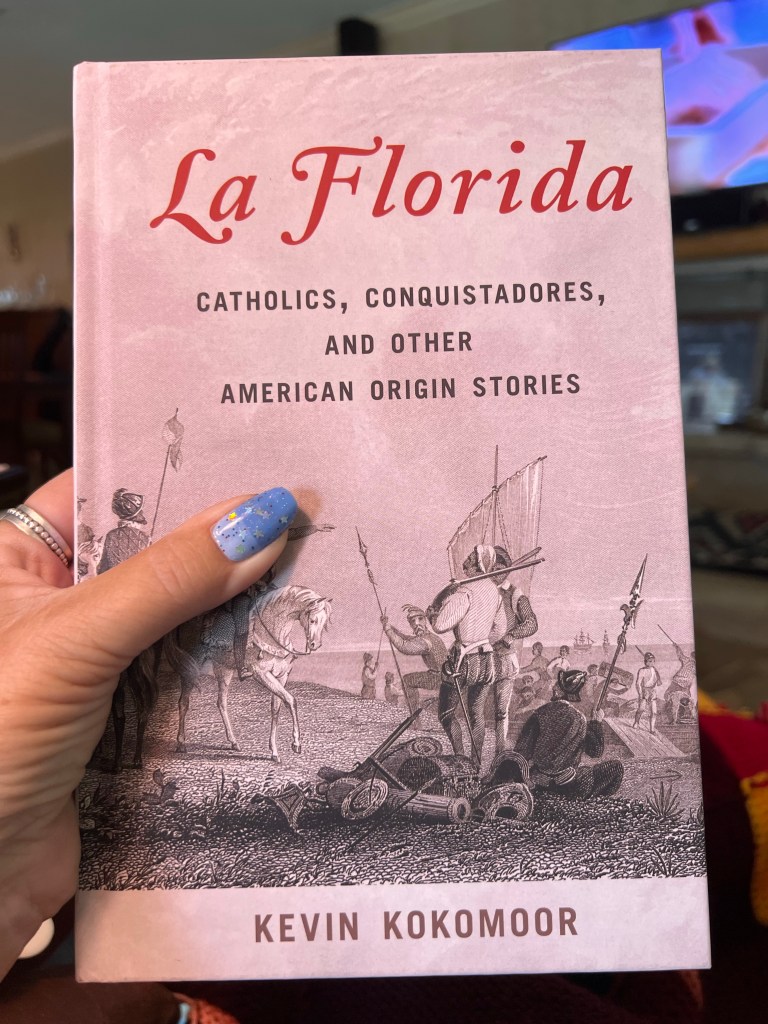
I actually read a book over my time in Myrtle Beach. Impressive! I have been so overwhelmed with magazines (which I read, not just look at pictures) that I haven’t been finishing books lately. The book I read was La Florida: Catholics, Conquistadores, and Other American Origin Stories, by Kevin Kokomoo (2023). It’s not actually published yet, so I was happy to get a copy from Kevin.
I blocked Hernando de Soto’s head. I’m not a fan.
Kevin teaches at Coastal Carolina University, where he focuses on the history of Florida and the rest of the southeast. We bonded last year when I found out he knew the story of when my mother’s family showed up in Florida and that we had lots of fun Florida stories from our youth. That Ocean Enclave place hires the most intelligent and interesting bartenders!
Since I had a lot of alone time while I was in Myrtle Beach, it was easy to get through La Florida, especially since I enjoyed its mix of academic rigor with humor and a bit of conjecture thrown in to bring the history of Spanish Florida (which was much bigger than the state) to life.
You must have a pretty strong stomach to get through the uncensored accounts of what the Spanish explorers did on behalf of their King and church. It’s incredibly violent, though it’s sorta fun to see how those “valiant” conquistadors ended up dying pretty miserably as they wandered cluelessly through the South. Florida was a lot harder to conquer than some other parts of the “New World” were.
Being mean to a French guy. Don’t worry, French guys were also religious fanatics.
It’s easy to reach the obvious conclusion that the more things change the more they stay the same after reading La Florida. Kevin’s chapter on the influence of the Catholic Church on the actions of the Spanish in Florida both horrified me and didn’t surprise me. In a nutshell, the violence against the early residents of Florida was justified because they didn’t accept the Church the moment they were presented with the opportunity to do so. How did they get this opportunity? Well, priests read them an announcement of the requirements for peace, which might have had a better chance of coming across if they hadn’t read the announcement in Latin. Once they determined native folks weren’t Catholic, then they were no longer people, and slaughter was just fine.
I pity the poor Mississippian culture. If all the slaughter wasn’t bad enough, of course the Spanish left lots of diseases to which they lacked immunity. Good times? Nope. (They disappeared, leaving holes for many other tribes to fill—the parts of the book on these groups, especially the Seminoles, filled in a lot of gaps in my knowledge.)
And it wasn’t just various native groups that were slaughtered because they weren’t Catholic, there were fellow Europeans who had the nerve to be Huguenots, who also were deemed to be not human, thus killable if they dared show up and try to bother poor old St. Augustine (what a non-success story that was, but at least it lasted). There were so many wars and invasions and burnings to the ground!
Slavery was another huge part of early Florida history, and I enjoyed learning about enterprising slaves who made big contributions to Florida history. I think slaves fared better because they figured out that getting married and doing other Catholic things got them slightly better treatment. Of course, it wasn’t all that great. No one seemed to have a lot of fun in La Florida. I guess maybe things got better after England took over and the rest of Mom’s family showed up.
In among the descriptions of plunderings, diseases, starvation, and slavery, there are interesting tidbits about how Florida got to be the way it is, such as how citrus fruits showed up, and the history of barbecue (spoiler alert: fish were the first meats to be cooked this way).
So, what are my opinions? I really enjoyed the book, other than coming to the depressing realization that the way people in the US are treating each other today by dehumanizing them isn’t much different from people’s beliefs 600 years ago. If you are from Florida or are a fan of American history, I’d highly recommend it, because it’s a point of view you don’t get in traditional Anglo-focused US history books.
Those Spanish dudes searching for gold and other riches (sigh, they “only” found tons of pearls) were the first people starting European settlements and their efforts deserve more focus. Thanks to Kevin Kokomoor for bringing this history to light!
Pin and paper acquired. My first educational certification in many years.
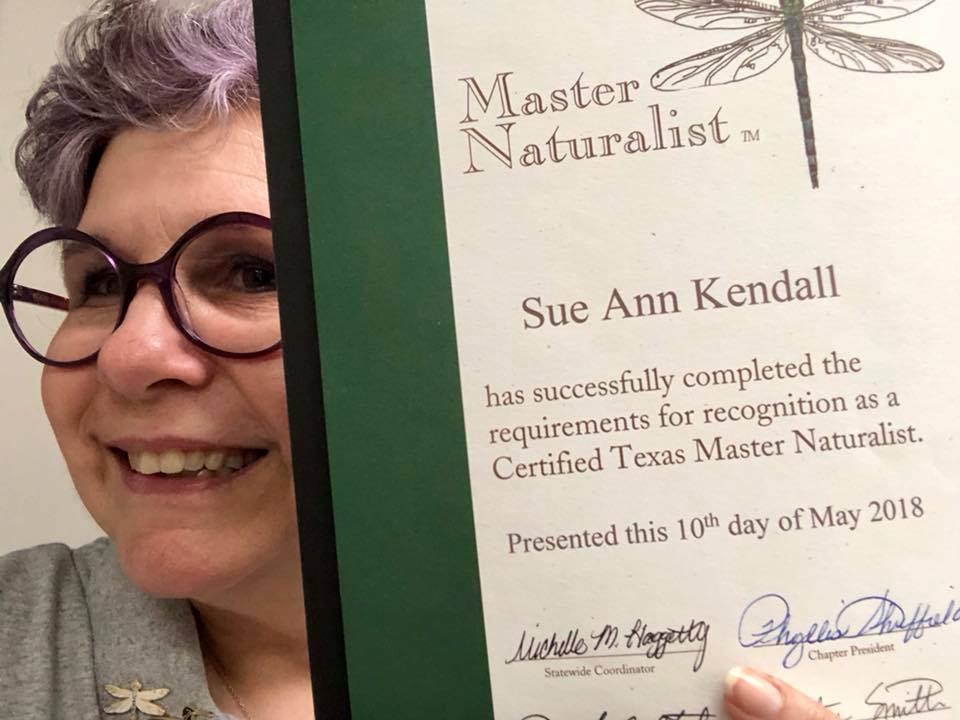
I am proud to say that last Thursday I got my dragonfly pin and my certificate to show I am a Certified Texas Master Naturalist. I can’t say it was hard work, because it was too much fun, but it did require an investment of time and effort! In addition to the weekly classes for three months, I also did 20+ additional hours of advanced training, and over 40 hours of volunteering.
We also got sweet hummingbird pins to thank us for participating in the Earth Day work. They do love their pins here. (They also love cooking; the potluck featured perhaps the most delicious cabbage dish EVER cooked; this bunch needs a cookbook.)
Here I am all happy as heck, with our chapter President and our membership chair.
I’m really glad I ran into Dorothy Meyer at an essential oil class and got to talking to her about the group! They sure are an interesting bunch, with so much to teach me. I just want to soak up all the local lore!
What Did the Native Americans Here Eat?
We also had a very interesting speaker, Prof. Alston Thoms, an anthropologist from Texas A&M. He is an expert on Native American history, and focused the talk for us on what people ate in past centuries in this area. It was lots of roots and berries, cooked in earth ovens (which he does yearly for his grad students). The most “duh” moment came when he asked what the most common food source would have been. It took a while to realize that of course, it was the white-tailed deer. It’s been in the area as long as humans have, and always on the list for what’s for dinner!
I could listen to this guy all day long. I wish he could come back and talk more about the Native Americans currently in Texas. I met some who live near Aquarena Springs a few years ago, and they were really knowledgeable about herbs and healing.





 The Hermits' Rest