Hooray! It’s actually REALLY raining today. This is what we need to refill the ponds and help all the plants over the winter. That said, I don’t look forward to going out in it!
Someday we will pave that giant puddle.
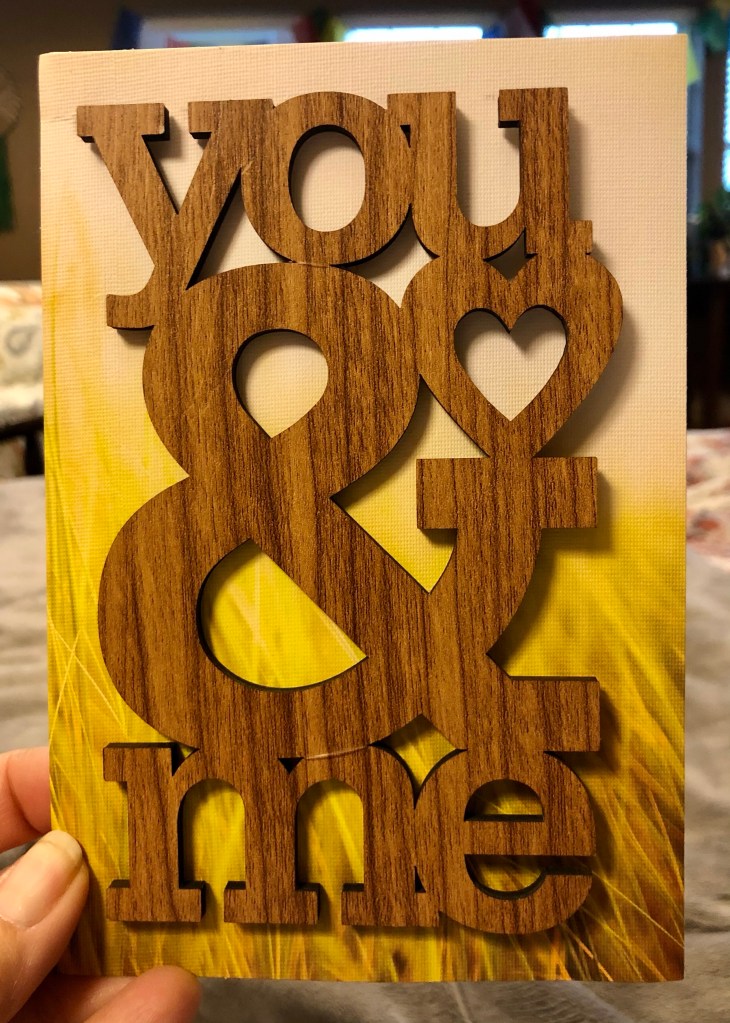
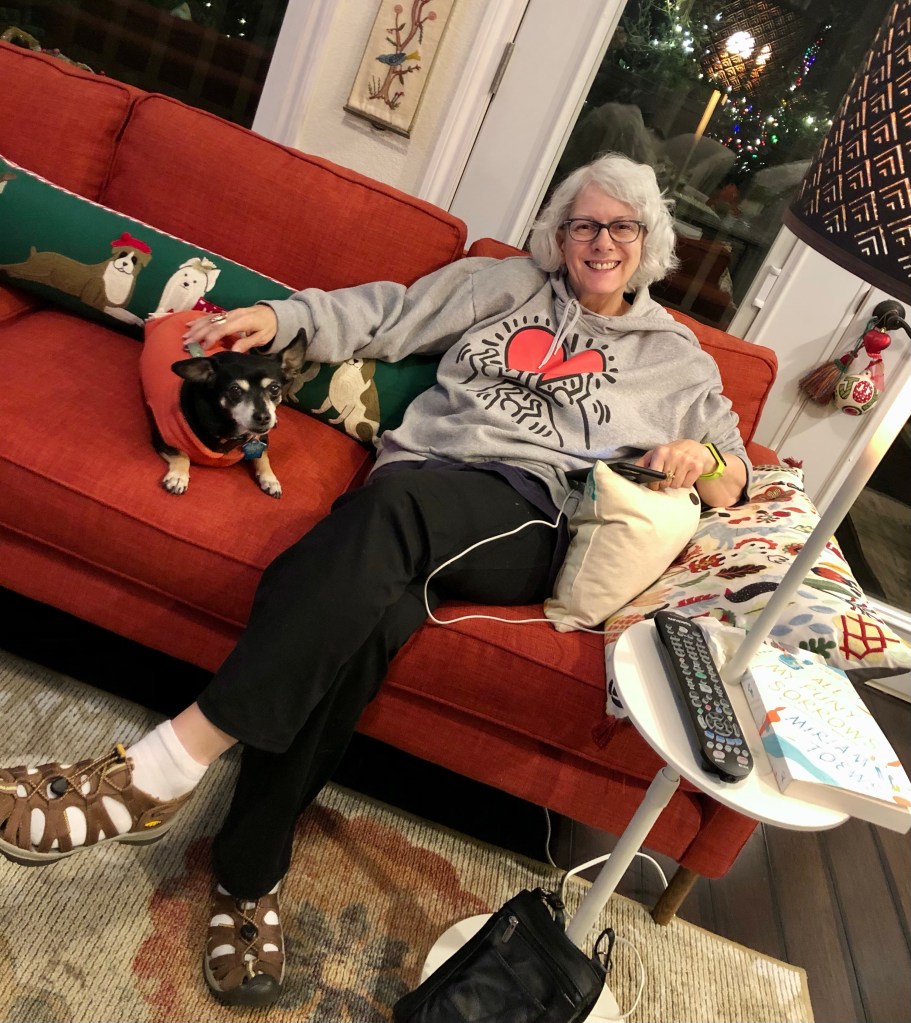
Meanwhile, I’ve enjoyed a morning with Lee. I even gave him his anniversary card (note that the anniversary was November 29). I’d left it in Austin. But, there’s rarely a bad time to remind your partner in life that you love them!
Lee wants to keep the wooden part. Good card.
It’s nice to spend a morning enjoy your loved ones. Harvey’s giant belly has been rubbed a lot! Carlton is under the bed, because it thundered.
I’m watching it rain.
I’m especially grateful to be home and warm, since the rest of the household had to go out and do some hard work. I love their dedication. The personal assistance service is not an easy thing to run!
A Question
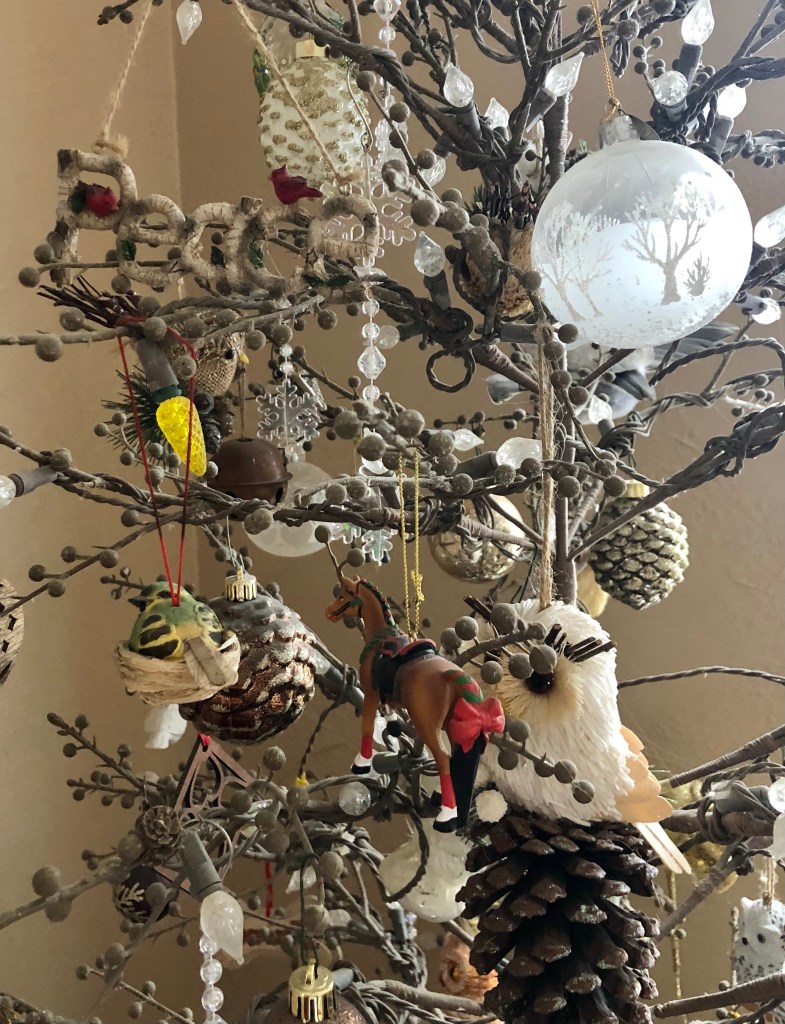
I was thinking about how much I love our former Christmas tree that’s now a tribute to nature, peace, and our pets. The poor thing no longer lights and has gotten droopy. I think I need to find another tree with mostly bare limbs to put my ornaments on.
It used to be really gorgeous, if non-traditional.
If any of you see a tree that’s at least 6 feet tall and mostly bare (on sale!) that I could order, send me a link in the comments or on other social media! I’m on a quest!
Howdy! Today my Cameron office is happy, because I finally got my window and desk glass. The glass for the desk came out perfect. I can’t wait to put my stuff on it.
A desk is born!
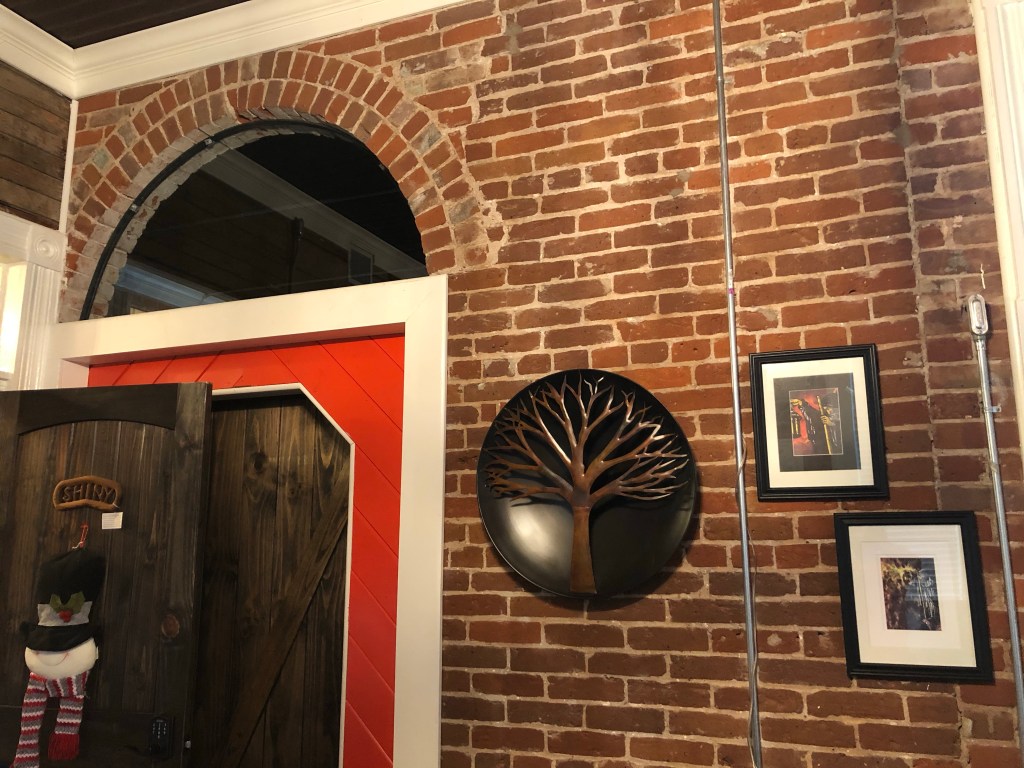
The glass guys also got the beautiful half round window up between Lee’s and Kathleen’s offices. That should help with sound and cold air transfer.
The glass is so clear you can’t see it. Also, Lee put up art on his walls. It’s looking great.
The challenge was the glass for the window in my office that looks into the hallway. At first they brought one that didn’t fit. Then they went back to Taylor (which is a good distance away) to get another one. They brought back a second door top instead.
So, they went back one more time and finally brought the right size. They’d just finished when I arrived at 4. It looks really good. Ahh.
Glass!
I look forward to less noise, protection from germs, and a warmer office. I also have two sets of shelves, since the glass people accidentally made two sets. They seem a bit confused. We will get those set up tomorrow.
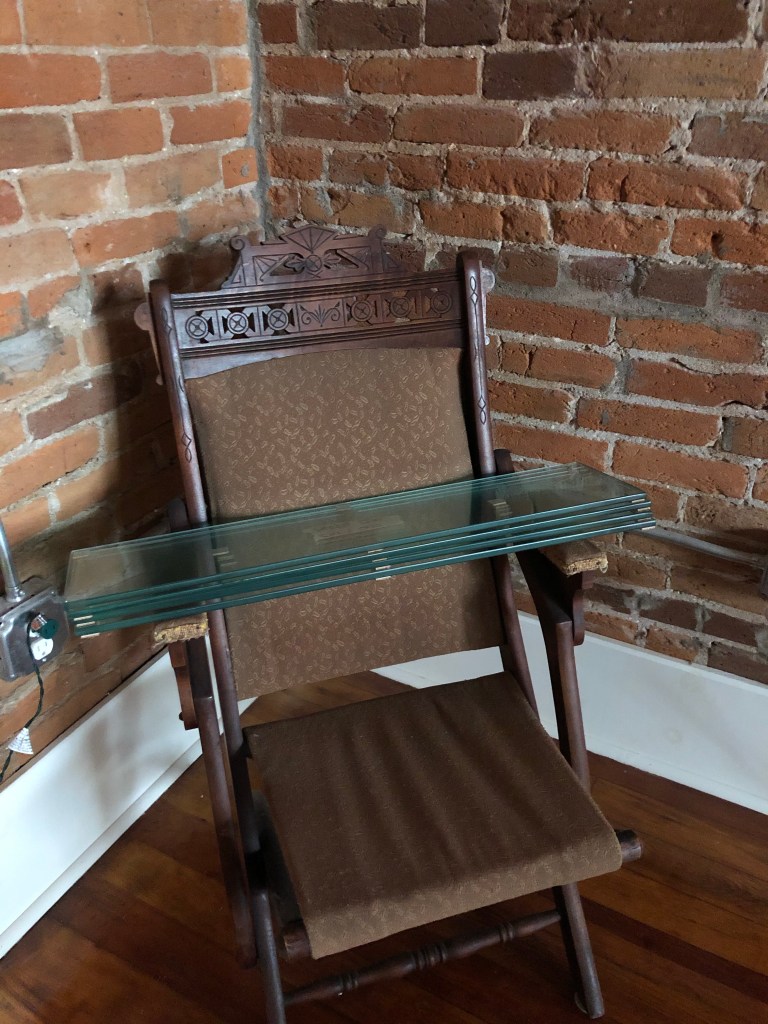
The cool old chair is holding the shelves safely.
I’m looking forward to furniture and glass rearranging tomorrow!
The glass looks great held in by quarter round trim.
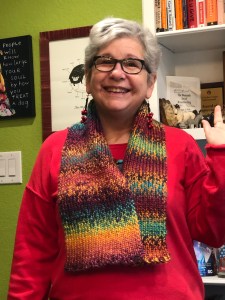
Last night I finished the scarf I was making for Kathleen out of some yarn I’d never have bought, mainly because I don’t shop at Hobby Lobby (Yarn Bee Wildstreak Brights). It really makes up into a nice fabric, though, and is very soft. Plus, it makes a great jelly roll.
It was really fun to just sit around knitting and purling as I watched television this week, not having to think about much other than how easy it is to stick your needle in the middle of the loosely twisted roving-like yarn.
It’s pretty cheerful
It’s short, but wrapping it right would protect one’s delicate neck wrinkles.
If it were for me, I’d have made it longer, but Kathleen said she likes shorter scarves. Since it’s 100% acrylic, it will be very warm. I think it’s perfect for wearing under a jacket to protect your neck, without adding a lot of bulk under the jacket. So, it will do its job.
Now that I am making things again, I’m just going to be a bit more careful than I was in the past about making things for people who don’t realize how much time and effort (and expense) can go into hand-made items. My photos of past projects are reminders of what hard work I did, only to find the item wadded up on the floor, never worn or used. But, that’s a problem of the recipients, not me. I did take some things back when a former young housemate abandoned all her stuff. So there.
This photo just made me laugh. My feelings about ungrateful recipients.
My recommendation is that, if you knit, crochet, weave, or whatever, you do it because you enjoy the process, the feel of the yarn, the developing fabric, and the colors, not to please other people. That leads to craft happiness.
I’m ready to start the next project, which should go quickly, because it’s made from bulky yarn (also inexpensive stuff from a big box store). I do look forward to using more of my yarn from local yarn shops and indie dyers. They need our support, so much, especially right now!
Here are the rest of my pictures of the project, for your snoozing pleasure.
Jelly roll!
This gives an idea of how long it is
Another Project
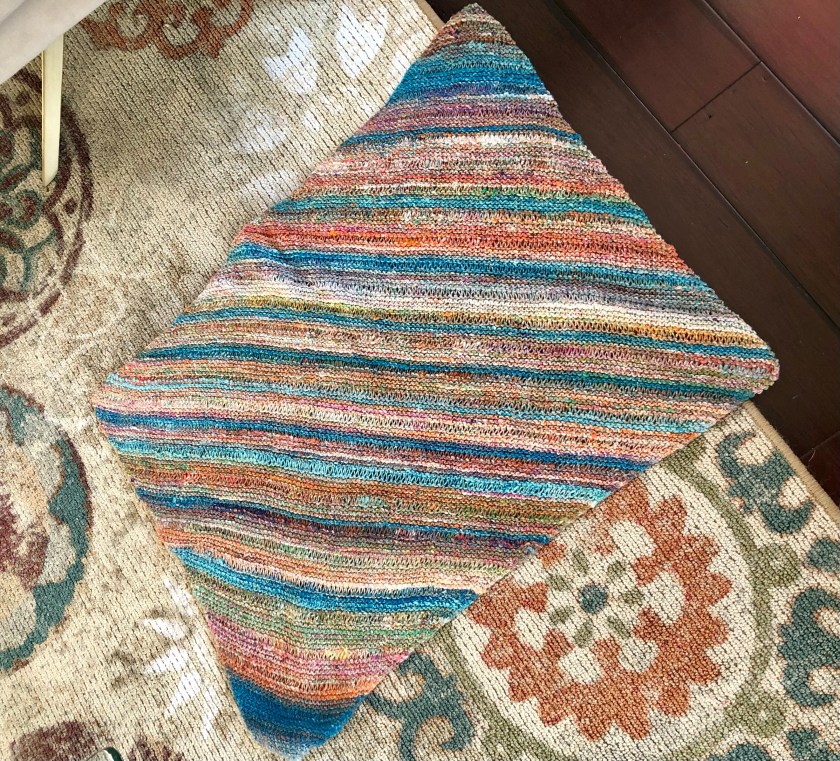
I did want to share a little project I realized has been sitting around the house, just doing its job. I’m not sure what it was originally was intended to be, perhaps a wrap. It’s made with a nice Noro yarn in a pattern of knitting a certain number of rows then doing a row where you wrap each stitch 3 times.
Another simple but pretty pattern.
And I knit it corner to corner, with strategic increases and decreases to make a rectangle. I guess I got tired and stopped when it looked like this.
A striped item
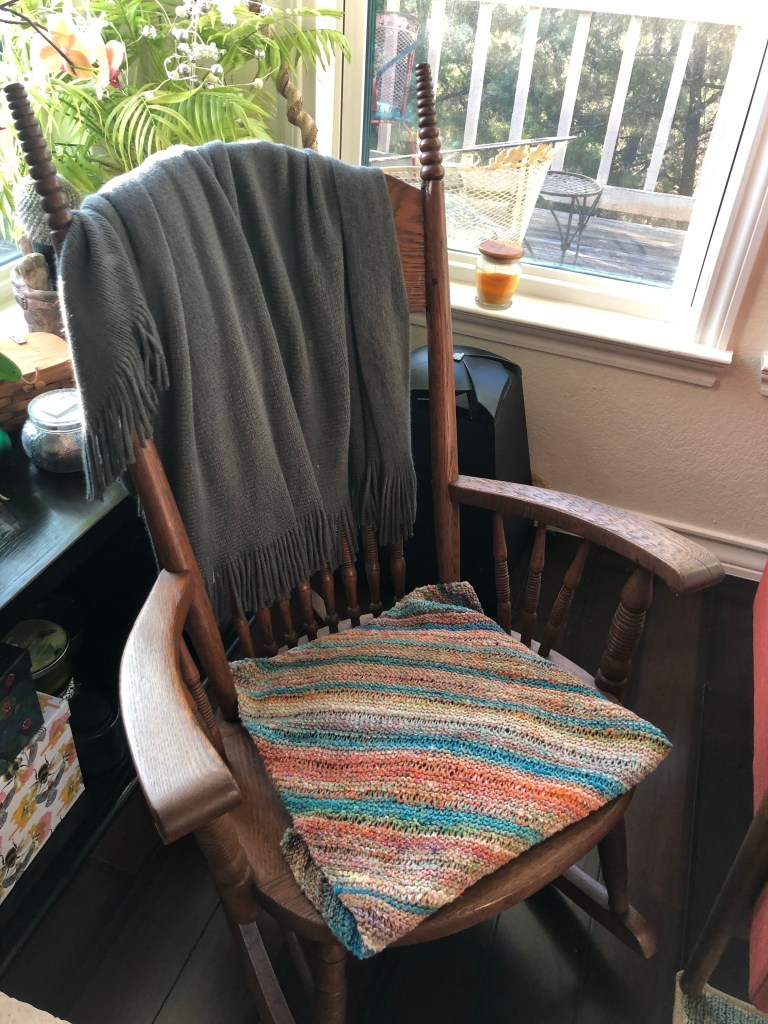
It apparently occurred to me that it matched our colors in the Austin house, so it is now serving as a cushion cover for my antique rocking chair (it needs a new seat cover; my dad covered it in the 80s).
I had it on there more attractively before I took the pictures.
This just goes to show you that simple projects can be beautiful and serve well. I’m glad I’ve learned to stop trying to make more and more complicated things and to just enjoy beautiful yarns and textures. That lets me take advantage of the calming properties of my chosen hobby.
I’m always interested in what hobbies you’re using to help you pass the time, create gifts for your family, or take your mind off world events. Share away!
Allow me to return to the original purpose of this blog, which was to document my nature observations and Master Naturalist activities. I want to share that I finally solved our Bobcat Lair fruit mystery.
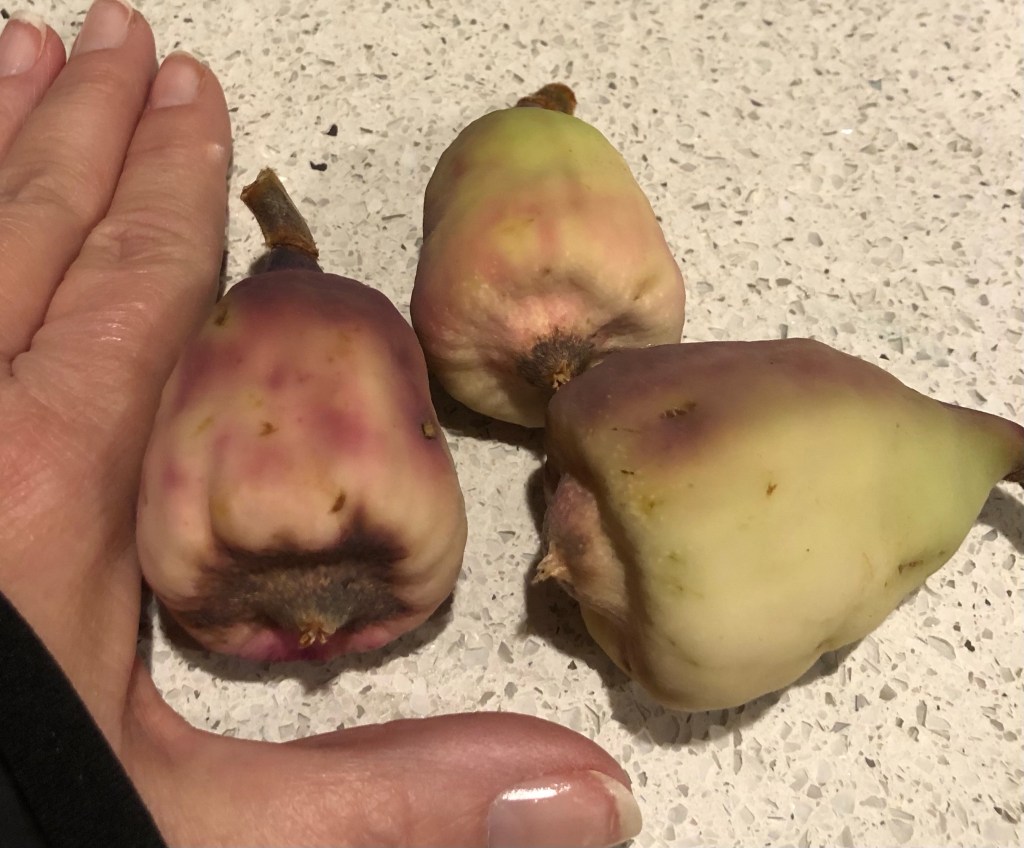
For a few weeks we’ve been seeing these weird fruits in the road and in the grass near our house. Anita and the neighbors had been baffled. A plant identification mystery!
What the heck?
Finally, last week, Anita and neighbor Angela determined that they were coming from across the street from us, where new owners had recently trimmed back some overgrown shrubbery. That’s been letting more fruit be seen. And it appeared to be coming from…a cedar (Ashe juniper) tree?
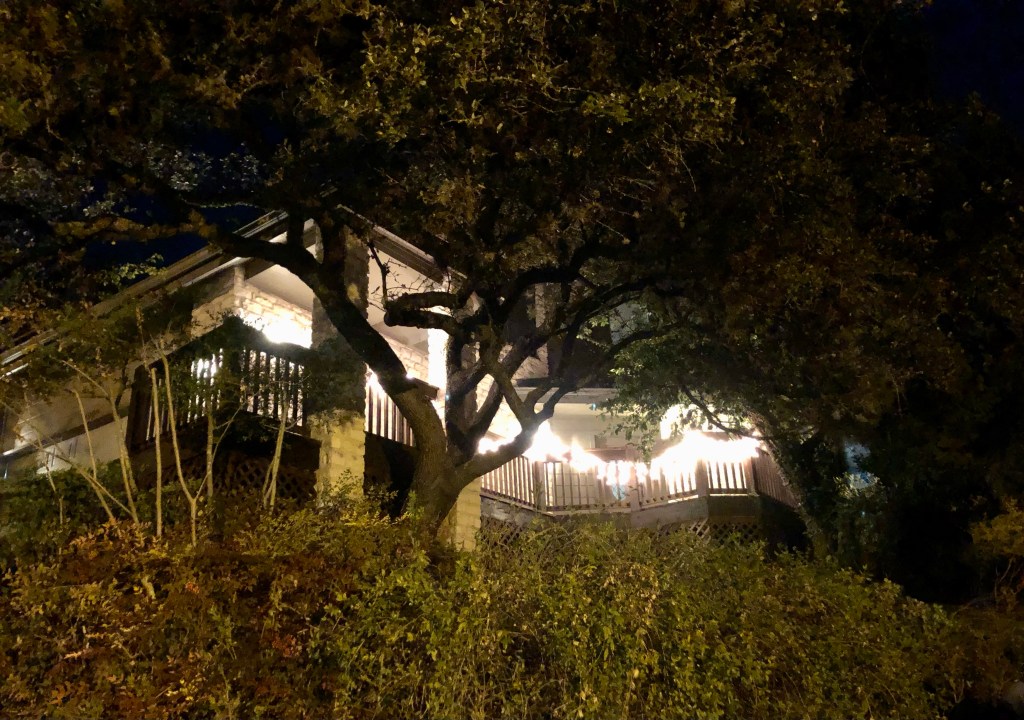
Tree is just to the right of the lights. We had never seen the porch lights on or Christmas lights here before recently.
Looking harder, at the tree we realized there was something non-juniper-esque in there, which we never could see before. Well, we couldn’t see the house, either.
There it is!
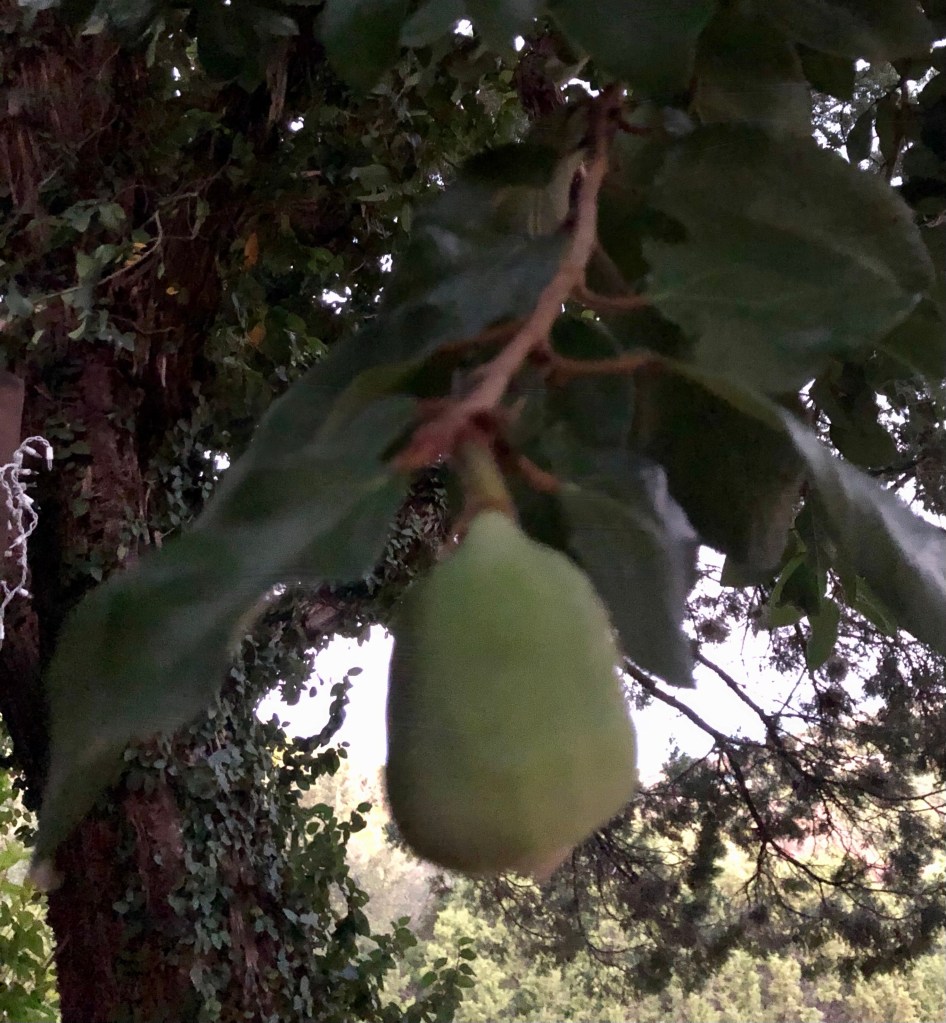
I took a photo of the fruit, which resembled a fig or a banana or a cashew to us. It was identified on iNaturalist as a snail. Nope. I posted to our chapter Facebook group and a couple people said a fig. But it didn’t feel like a fig.
The picture that looks a lot like a snail.
So, today I took more photos, including the leaves, by crawling in the neighbor yard. Hmm. That tree could be a big vine.
I also got more fruit and cut one open. Hey, there were lots and lots of tiny seeds in there! Like a fig. Okay, so I have fig and vine.
The inside. Spongy pulp and teeny seeds.
I uploaded all my photos, and finally found a match. And it’s both a fig and a vine.
It doesn’t always have small leaves.
This seems to be a weird plant. It often has tiny leaves, but also parts with large leaves. I think the one across the street has both. (Look at what’s growing on the tree trunk above.) And those weird pulpy fruit! They are not like figs you eat. And they are in the mulberry family?
I looked into it more. Mulberries are a big family. So is ficus. Breadfruit is also one. Here’s more from Wikipedia (donate to them) about our new figgy friend:
But what the heck is a liana? I have a friend named Liana…what is she named for? It’s a woody, bridgy viney thing.
Do any of you know more about these plants? Interesting, huh?
This morning, I started the day out doing a presentation highlighting the work our Agile team has done in the past two weeks (the usual presenter is already off for the holidays, so I was the stand-in. I had on professional-looking clothing and got to enjoy looking at my little holiday decorations in what passes for my cubicle. Most important, I could see in my Zoom window this little sign I recently bought.
Peace, a thing I knitted, and petrified rock from the ranch.
It’s one lesson I’ve been taking to heart this year. Peace doesn’t show up, you make it happen, and it starts inside. As I was feeling peaceful and proud, I did a good job presenting all our stuff in exactly the time allowed. I may know what I’m doing!
The world may be a bit sideways right now, but we can always get some wisdom out of it, right?
There was then a company-wide meeting, at which some changes were announced that I suspected would happen, but still made me sad and added another layer to this change-ridden period we’re living through. But, our CEO told a great story at the beginning of the meeting.
He talked about listening to a golf podcast (how CEO-like) that said the word of the day was “rejoice.” Minutes later, on his commute to the practically empty office, a car cut him off (join the club!). He had to laugh when he saw the car’s bumper sticker, which read “Rejoice.” It would probably help to pay attention to your driving while you’re rejoicing, I think.
As the rest of the company wove the idea of rejoicing through their presentations, I was rejoicing over the amazing work my team had done so quickly, as well as the work our Diversity and Inclusion initiative members have done. I’m so happy to be a part of the new LGBTQ+ group and to help out with learning and development at the company. It’s amazing what people who really care about things can do, and that’s worth some rejoicing!
My work plant is not dead, and just seeing it and the little wren brings me joy.
As a company, we have found things to be happy and proud about, even during the hardest times of many of our lives. As a person, I am aware that I’ve been doing the same thing all year, in this blog, as I talk to people, and as I go about my life. There is much to rejoice about, even though some of us have to look pretty deep to find it.
No need to buy more inexpensive yarn, I can also rejoice in my immense stash, just waiting to be something someone wants! Photo from @AZ.BLT via Twenty20
And if there’s nothing going well, make something you can be proud of. That’s what we are doing at work, and I’m taking that lesson into the rest of my life. I’ve even started putting projects into my Ravelry page again (it had been sadly neglected since 2018), rejoicing in my newly simplified knitting adventures. Not only am I bringing peace to myself, I’m bringing joy. Or else. Join me!
Lately I’ve been enjoying photos of some friends who are my age. For example, Kathy, who I know from high school, has been sharing a sweater she knitted every day this month, and it’s been so fun to see what she’s made, and I’ve envied that she lives in Colorado now and actually gets to wear them.
Also, though, I’ve been enjoying how she looks in each photo. She just glows with happiness, her eyes shine, and her smile is bright. So what if she just had another birthday? This is my idea of beauty, because her beauty as a human being shines through.
Yes, she made that herself. Check out mountainpurl on Ravelry for more!
In my family, we sometimes talk about how the pandemic hasn’t been kind to our figures or that all the stress is showing in how we look and feel. I know I sometimes look in a mirror and wonder who the heck that is looking back.
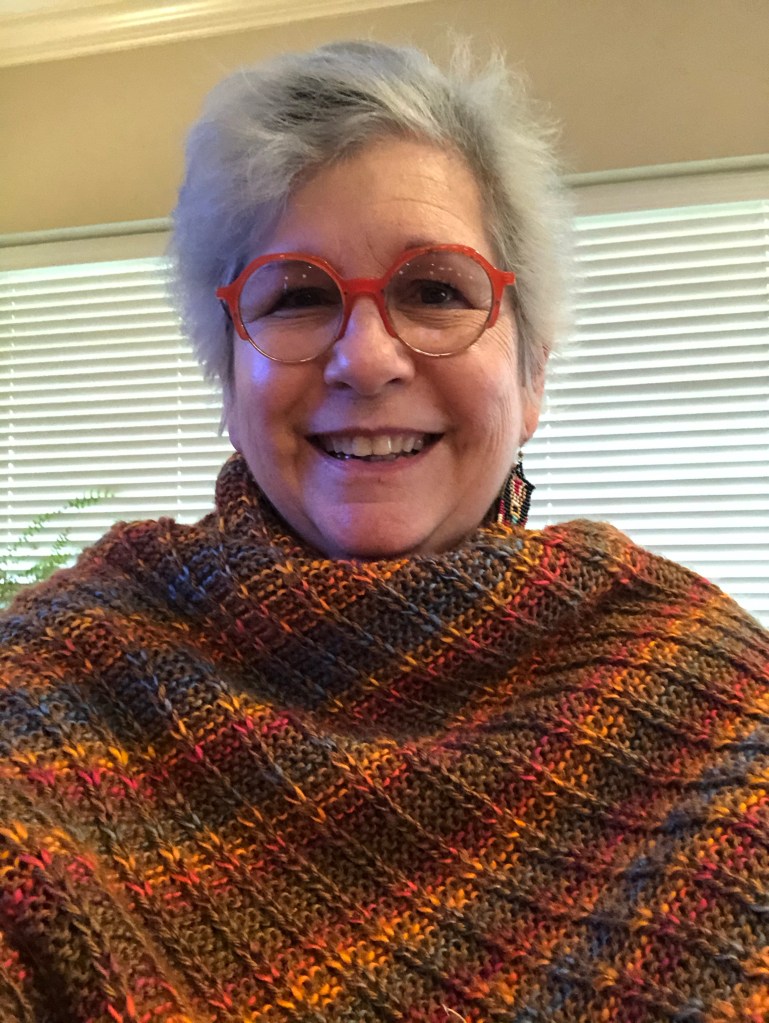
Unretouched photo of me, today, with hair no longer blue.
It’s really tempting to focus on the obvious signs that I’m not a kid anymore. Those lip wrinkles make me look like a long-time smoker (I never smoked!), the jowls make me wonder if I’ll look like Droopy Dog eventually (my great aunt did). And the neck. Eww. That’s enough, though I could go on.
Other parts of me are fascinating, too. I have interesting new moles and marks (yes I get them looked at), my stomach is at its poochiest (and it’s pooched since birth), and while my breasts finally got larger than an A cup, they have been defeated by gravity.
So What?
Yeah! I’m mentioning all this stuff, because when I looked in the mirror this morning, I saw this new me and I was fine with her. I don’t exactly recognize her sometimes, but I like her. When she’s happy, she really looks pleased. When she’s down (or thinking, in a Zoom meeting), she looks like my dad or my brother, so at least I’m still a member of my family.
This is nowhere near as awful as I look in some meetings. But, it’s me.
And I feel so free to dress and act however is comfortable to me. That was a long time coming. I used to try to dress to portray membership in my group (hippies, corporate employees, cowboys). Now it’s more like, what looks fun today?
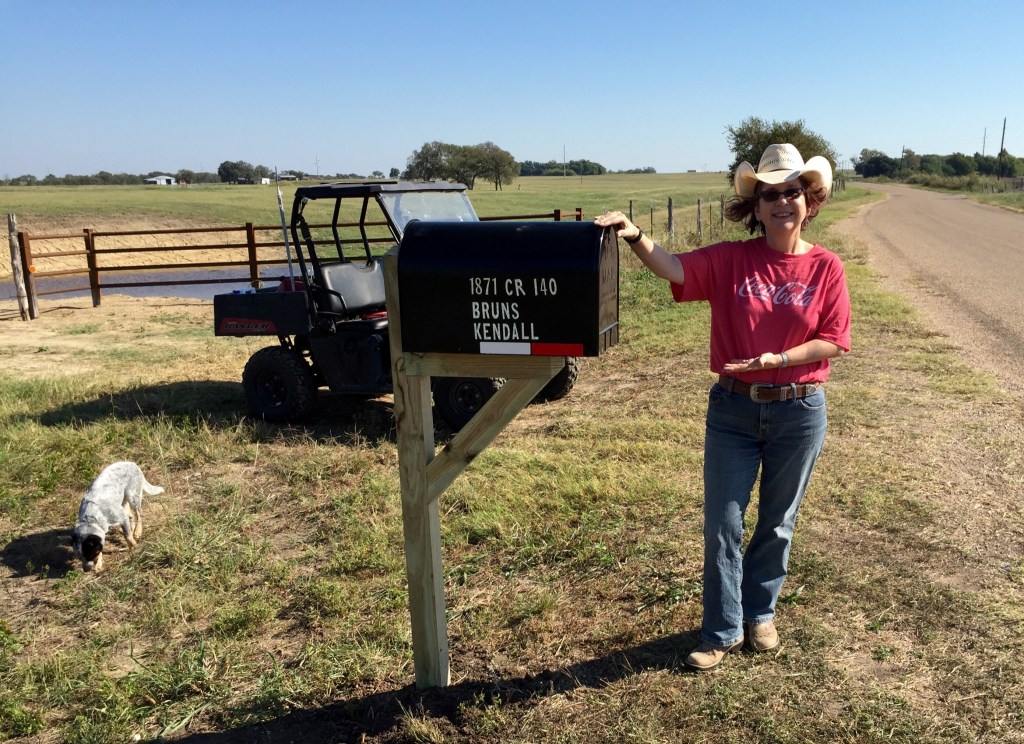
Cowgirl time (2014).
I wish I could find the article I recently read about people who identify as women and their relationship with makeup. It talked about the conflict between so many young women claiming makeup gives them freedom with the thoughts of many of us older feminists who feel that requiring makeup of women, but not men, is another sexist vestige.
I think back to what I’ve spent on makeup, hair stuff, nail stuff, etc., and know I have gotten some company executives richer. It’s a conflict for me, for sure. I don’t think I NEED makeup, nail polish, or blue hair to be attractive. I don’t NEED overly coordinated clothing, either. I could wear jeans and a t-shirt every day the rest of my life and be fine. But, dressing up is fun. I guess it’s a part of my cultural identity as a Western woman that I can’t get rid of completely.
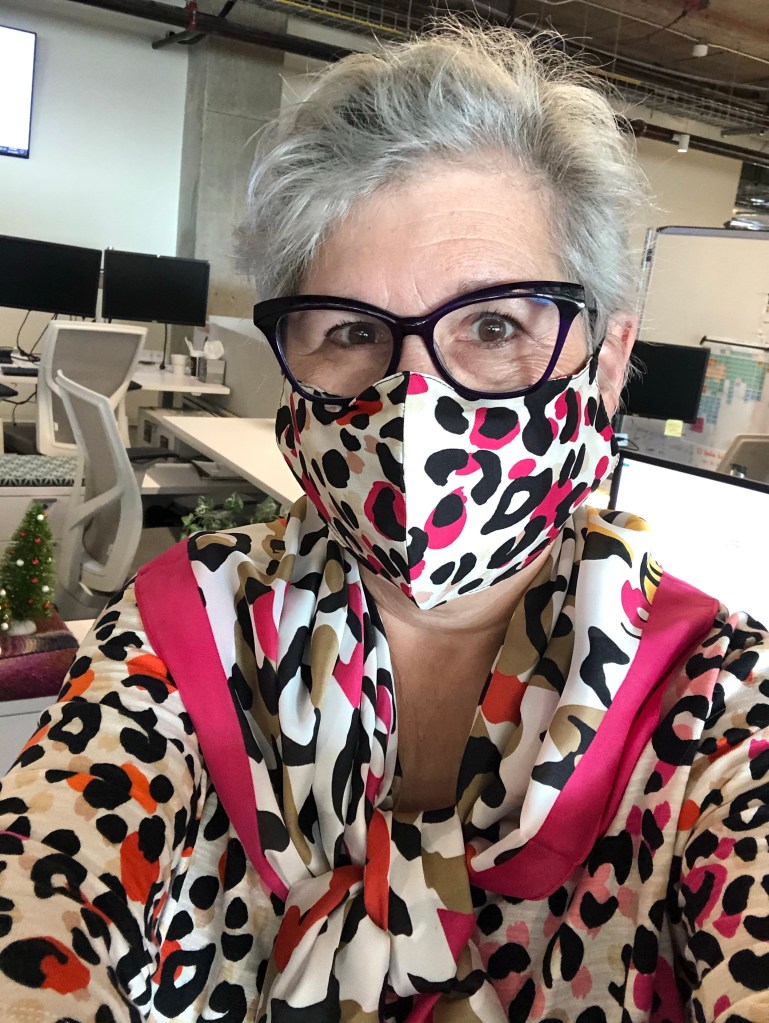
That’s right. The outfit even has a coordinating mask.
At least I acknowledge it! And that’s the thing. I want to encourage all my friends to love who they are at the age they are and feel pretty, all over. We’re here, we’re alive, and we’re creative. Let’s not hide who we are, but shine like Kathy in all her sweaters! It’s all GREAT.
Came close to being not alive or close, today. I had an excellent drive to Austin and enjoyed getting lots of work done. Then, Anita and I decided to go to Costco for her staples (especially toilet paper!), because it’s practically empty at 4 pm on a Tuesday.
Anita, Not Injured
I asked Anita to drive. I’d driven on wet roads and was tired. That was an excellent idea.
We were driving down scenic Far West Blvd., at normal speed, because the school zone was over. As we went through the intersection with Chimney Corners, where our eye doctor is, there was suddenly a black Suburban accelerating towards us, attempting to turn left into the space Anita’s Mazda was occupying.
You can see the driver had sped off, but got caught at the light.
There were other cars all around. I guess the dude was trying to thread a small gap and didn’t see us. Anita slammed on the brakes and veered left to avoid the giant vehicle.
Somehow, she managed to end up still on the road, without hitting the curb or any utility poles. And the vehicle behind us managed to not hit us from behind. Wow. Such skill.
Grr. I can’t read the license plate.
The asshole just sped off, leaving a bunch of stunned other drivers. As we carefully made our way to the stoplight, the guy who had been behind us checked in us, asking if we were okay. Physically, yes! He had a matching Dallas Cowboys hat and mask, which cheered me up a bit.
Yet another Blogmas miracle, I guess.
I’m glad there was hardly anyone in the store and that we got a lot of toilet paper and paper towels. We came home and aren’t going anywhere else.
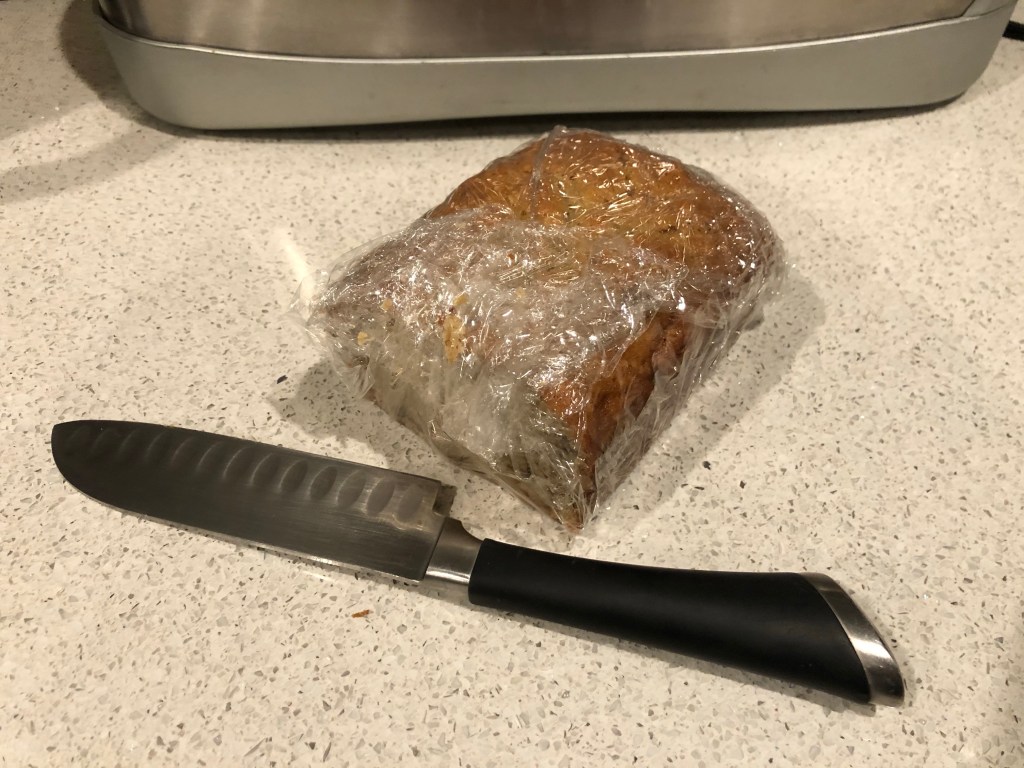
Partially eaten bread. Very fresh.
We got delicious banana nut bread from Ruth next door, too. I’m so grateful for friends and good drivers.
Rain may not be an exciting topic to many of you, but to ranchers in Texas, it’s pretty fascinating. The area where the Hermits’ Rest Ranch is located is midway between the very damp eastern part of Texas and the very dry western part. That means we get a medium amount of rain, averaging about 35 inches per year (according to Lee and my friend Lynn).
The street is wet.
This year, we just hit the average amount, thanks to some rain finally falling this week. It hadn’t rained significantly in a few months, so we are officially back in a drought. All the rain was really early in the year last year.
Damp squirrel
I know I’m in Texas when people run into my office, breathlessly informing me it’s raining! And then I have to go out and look outside, to verify (I also go in the little bathroom, where I can hear rain on the roof). Sort of sad what passes for excitement around here.
Listen to the rain. And see how sad the Pope house neighborhood looks.
Though it only rained a half inch over the previous couple of days, it was steady, slow rain, for the most part. That means it soaked in. When it rains hard, it all flows down to the arroyo, off to the stream, into the creek, and ends up in the Little River. That doesn’t help us much.
So, if you see me doing a rain dance, don’t be shocked. Rain is joy around here!
A few days ago, my blogger friend V wrote up her opinions of multi-level marketing companies (MLMs). I thought she made some great points, and her viewpoint helped me solidify my own thinking about these businesses. I also read the many comments on her post (how do you get people to comment? I have no clue!) and learned a lot from them.
These are “the” pyramids, and have nothing to do with any marketing scheme other than their shape. Photo by @HazemElEtre via Twenty20.
Definitions
First, since I posted something about this on Facebook recently, I know some of you want to know what an MLM is.
My Facebook post, which is still getting comments after two weeks.
MLM companies sell their products or services through person-to-person sales. That means you’re selling directly to other people, maybe from your home, a customer’s home, or online.
If you join an MLM program, the company may refer to you as an independent “distributor,” “participant,” or “contractor.” Most MLMs say you can make money two ways:
by selling the MLM’s products yourself to “retail” customers who are not involved in the MLM, and
by recruiting new distributors and earning commissions based on what they buy and their sales to retail customers.
Your recruits, the people they recruit, and so on, become your sales network, or “downline.” If the MLM is not a pyramid scheme, it will pay you based on your sales to retail customers, without having to recruit new distributors.
A pyramid scheme is an illegal and really bad version of an MLM.
Examples
You have heard of many MLMs, though you may not know it, since most people who participate call them small businesses. They started out a LONG time ago, too. I remember our 1960s “Avon Lady” very well (she gave me tiny lipsticks, which made me feel grown up). And my grandmother had a friend who pushed Amway detergent at her.
MLM examples you may know of include: Amway, Avon, Color Street, doTerra,* LuLaRoe, Mary Kay, Nu Skin, Onehope Wine, Pampered Chef, PartyLite, Perfectly Posh, Rodan + Fields, Scentsy, Tastefully Simple, Thirty-One, and Young Living. Who hasn’t bought some of these products? And many of them are pretty good quality, fun, and only a bit over-priced.
A product sold through an MLM (one I have never bought from). Photo by @jeswfromtexas via Twenty20.
My History with MLMs
I cannot come across Holier Than Thou and say that I’ve never been involved in MLMs because I have so many ethics and know how much money they take away from friends, etc. I’ve bought a LOT. I also can’t say I don’t know people who have made a reasonable supplemental income off them, because I DO.
To be honest, I always felt good about helping friends out with making a little extra money on good quality items that I can actually use. I even had a few “parties” back in the good old days. We used to have a blast with PartyLite, quickly getting past ordering some candles and into chatting, eating, and drinking. When my friend Gina was doing Tastefully Simple, too, there was a lot of fun to be had.
I just LOVE these products, though. Sniff.
The online events they have now aren’t as much fun for me, but I appreciate how much work people go to so that their events are engaging and fun for people who like guessing games and the community-building questions.
Most of the people I know who’ve done MLMs have been sincere people who needed to make some money from home. The sales pitches from consultants who recruit new ones are also very good. It’s easy to see how the prospect of recruiting someone else and making money from that would be enticing, especially if you have few other options. Building up a “team” is the “multi-level” part and what makes me uncomfortable.
Random sampling of MLM lotions I happen to have within arms’ reach.
That’s where I always drew the line. I don’t care HOW much I liked something, I was NOT going to sell it to others or recruit friends. I didn’t mind spending my own money on something “frivolous,” but didn’t like trying to get my friends to spend their money. I can’t tell you how many times I’ve been begged to sell products I like and use myself.
*One Time I Did Join Something
Confession time. I like essential oils. The chemistry is really interesting to me. I like diffusing them, smelling them, and in some cases, ingesting them (I am also familiar with caveats about them, so no need for lectures). When I started buying lots of them from my friend Sara, who also really likes them, she said I really needed to become a consultant, or whatever they call them, so I can get the products at the lower cost. As I tend to go through them pretty fast, that made sense.
I’ve got hundreds of these kinds of things. Oops.
I’ve been a doTerra consultant for at least 4 years now. I have sold two items at retail. I have recruited no one. I get stuff for me, my family, and my friends. And, I guess I will have to stop soon, for reasons I’ll eventually get to, as I ramble along.
I Gotta Live My Principles
Back to the beginning, reading what V was saying about her friends going into deep debt, and knowing the debt some of my own friends have gotten into, it became clear that when I was “helping” friends by buying things, I really wasn’t helping, just encouraging them to get deeper into the MLM world, getting them more and more pushy, insistent about you buying their wares, and becoming “assholes,” as V put it. I’d say acting like assholes, since these are people I like.
The online MLM pressure is really getting out of hand, and I don’t think it’s healthy at this point, if it ever was. These are NOT small businesses, they are people making money for other people, up and up a pyramid. I can’t do it anymore, so I will have to go cold turkey on some things I really like (I don’t know if I can give up my R+F skin care stuff though; it really works).
So, friends, if you really start up a new business, I’ll buy something. And if you are one of my few friends who does really well with MLM, I salute you. I just know how hard it is when you are stuck with hundreds or thousands of dollars of inventory with no one to sell it to, because you’ve alienated everyone you know. I don’t want to encourage that to happen to more people I care about.
If you’re thinking about going into one of these things to pay for gifts, or whatever, remember what V says in her blog post:
If a business exists solely on social media, that is a red flag.
If a business relies on your initial investment to be a legitimate ‘boss’ that is a red flag.
If a business is teaching you how to get rich quick on social media, that is a red flag.
If a business relies on teaching someone how to teach someone how to teach someone, that’s a pyramid scheme.
Another happy story, for your Blogmas pleasure. I once knitted. A lot. Pretty much every day from high school to when I moved to the ranch, I knitted every day. It was a great way to keep my hands occupied. I taught knitting to anyone willing to learn, which felt great, because it’s like giving someone the gift of never having to be bored again. I had a knitting blog and wrote up some patterns. I enjoyed being part of the local, national, and international knitting community, where I made lifelong friends.
It’s a wrap.
I stopped knitting when it ceased to bring me joy. A few things happened that caused it, and I have written a good post on this before, so go over and read it and see more things I’ve worked on. I’ve been trying to get back into it, sporadically, but I think the start I got in Utah has worked.
It’s as tall as me, so it will stay around my shoulders. I could have made it longer, but I think it will do. This was the plan, anyway.
I seem to have my knitting muscles back in shape, so I can do it a long time with no pain, and I now WANT to knit again. Yesterday I finished the project I’d started the last week I was in Utah, which is a wrap/lap blanket in a simple slip-stitch pattern (instructions here). I love how it came out, and can’t wait to give it as a Christmas gift (I can post photos, because the recipient has already seen it).
It looks good from the front and the back. It should get larger when blocked.
When I was done, I marched over to get the super-bulky yarn for the next gift project, only to find there was no needle to knit it with! We are sure we bought one when we got the yarn, but it’s gotten lost in all the travel and car changes the family has gone through.
Kathleen went into her room one last time to see if the big ole needles were hiding in there, but nope. She did come out with some yarn she’d bought earlier, which she couldn’t remember her plans for. “Make me something,” she said. So I am making a rib-stitch scarf. I like them because they look the same on each side (K1 P1 ribbing, cast on 45 stitches). That will keep me going until I can get to Austin and find one of my numerous size 9 or 10 needles.
I do like the effect this yarn makes.
Little-known fact: I am a very relaxed knitter (other than on that runner I recently made), and always need to size my knitting needles down to sizes to get the right gauge. Luckily, gauge is not vital on scarves, wraps, and throws.
Good News
This weekend, I discovered something really good, knitting-wise! The dogs are settled down enough that I can knit with them around! I have both Carlton and Penney trained to stay down by my feet, so I can knit with my project in my lap. I just have to keep an eye on Alfred’s giant paws. Harvey doesn’t jump up on me except to greet me in the mornings and evenings, so he’s good. I’ll have to work on Vlassic if I’m ever able to take him with me to Austin again!
Good Penney.
So, as long as I make simple things that can easily be interrupted, I am back to my favorite pastime. I won’t be making lace shawls, mosaic patterns, or complex fair isle, but I’m okay with that. I no longer feel compelled to show my mastery of the craft; I just want to relax and enjoy it. And I’m even using inexpensive non-natural fiber yarn (still like expensive and natural better; I haven’t changed that much, but at least moths won’t eat acrylic!)