Since it’s rained like crazy and the rivers are still rising, I thought it would be a good time to check out our pond, the arroyo, and the riparian areas at the front of our property.
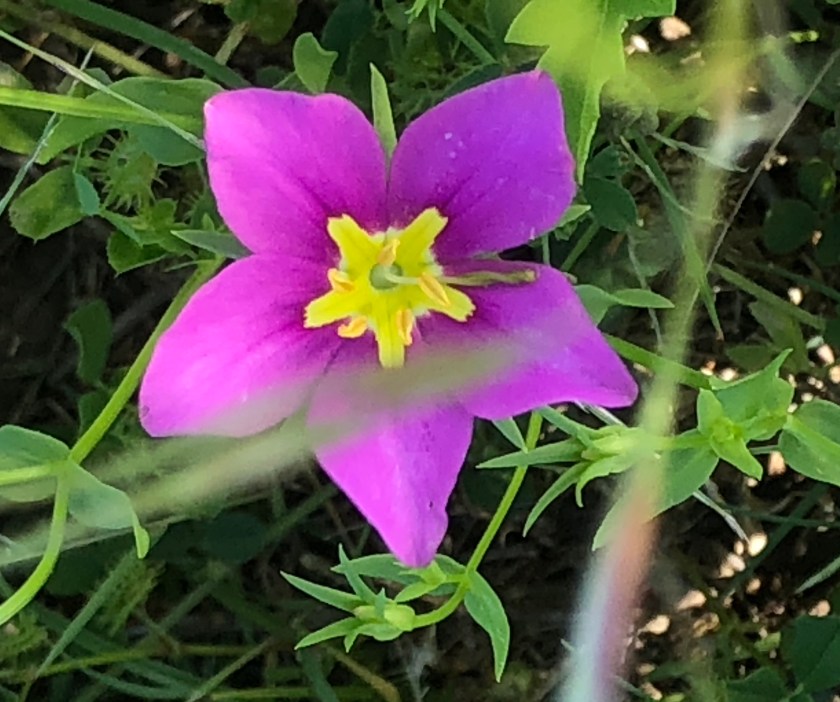
A meadow pink for my newfound love of the color.
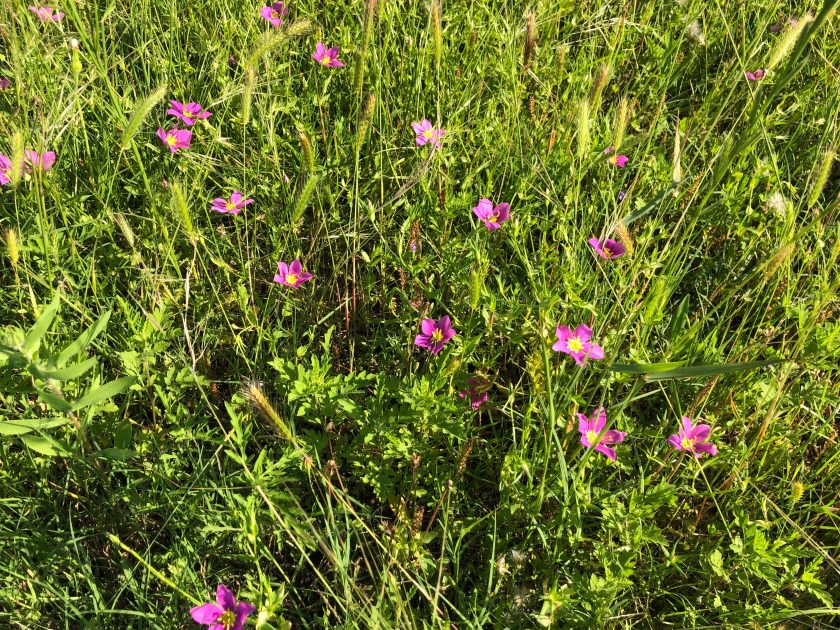
Also, since it’s time for the second wave of wildflowers, I’d check them out, too. I’m always happy when these pink beauties are shining forth, so that was a good start!
I’m so glad they didn’t get all of these in the hay!
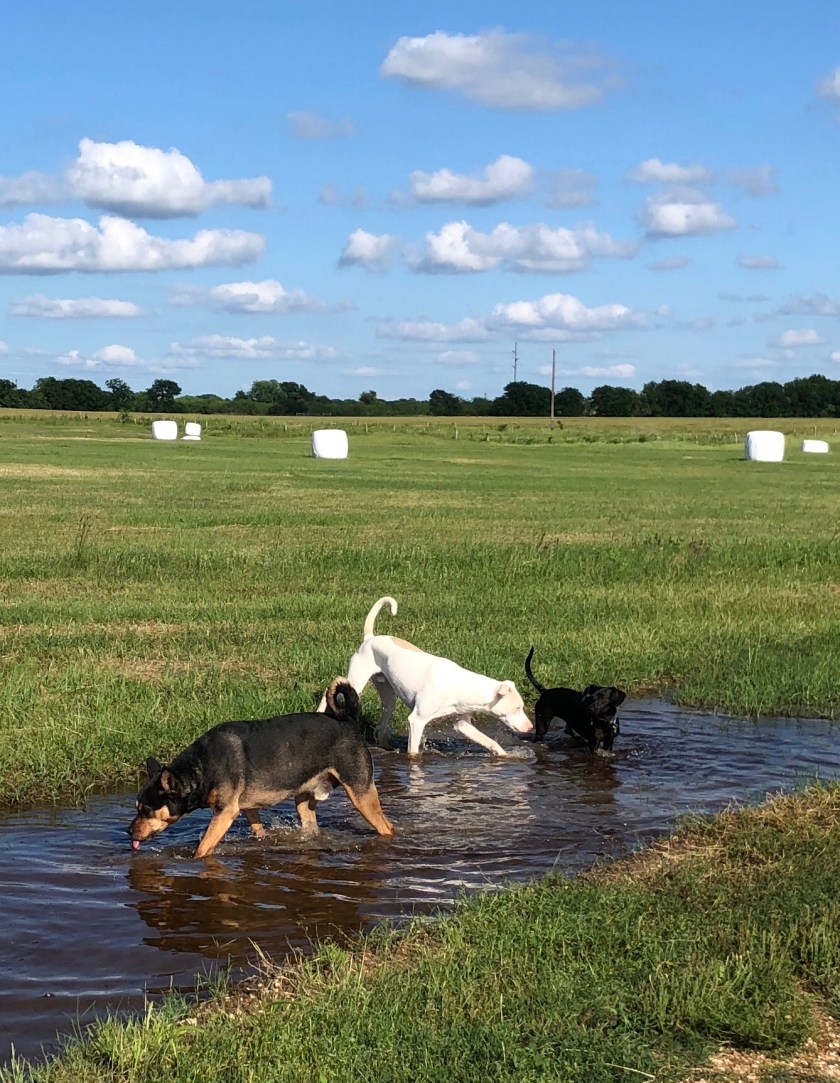
The dogs came along and enjoyed their own “pond” made by Lee’s unfinished drainage area.
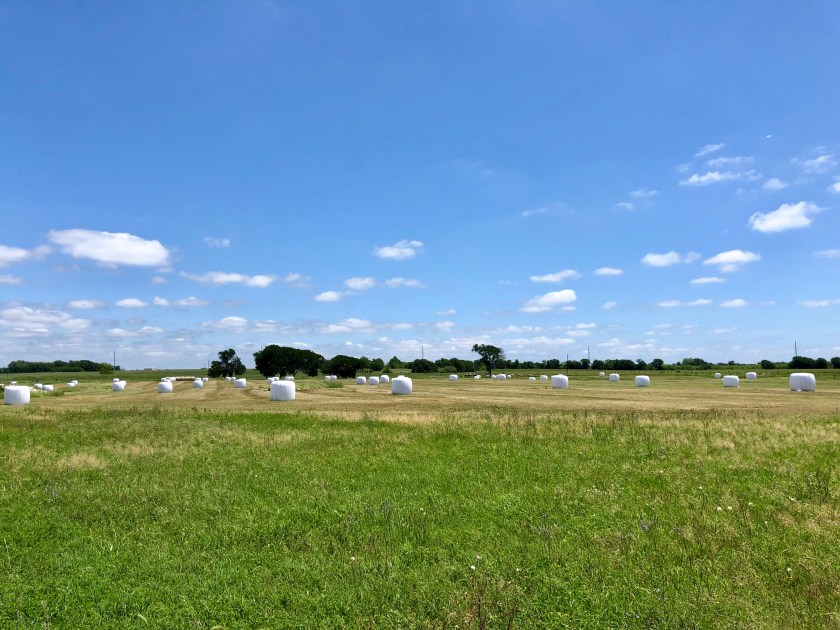
It’s the time of year when the lush grass of spring becomes the forage of autumn. Just yesterday we were riding the horses through the tall grass, up past Fiona’s belly. Today it looks like this:
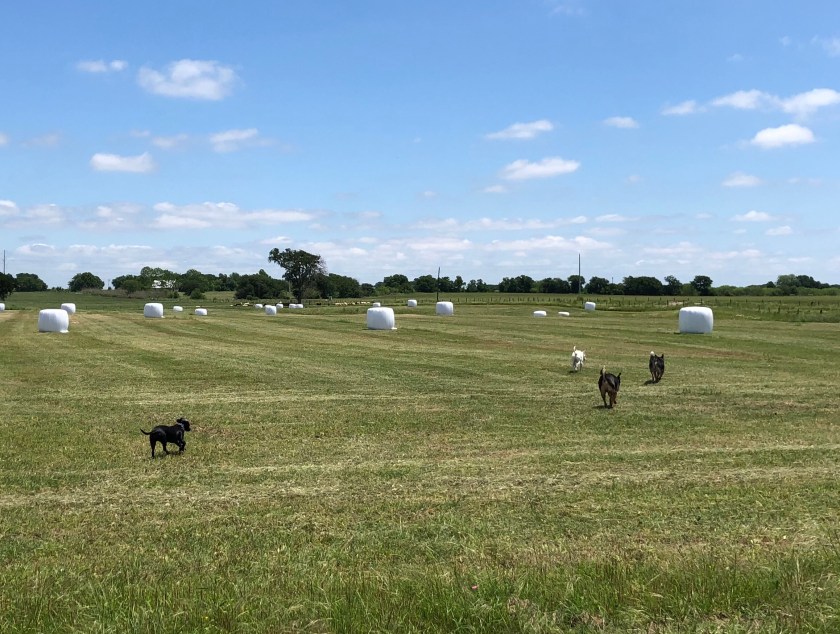
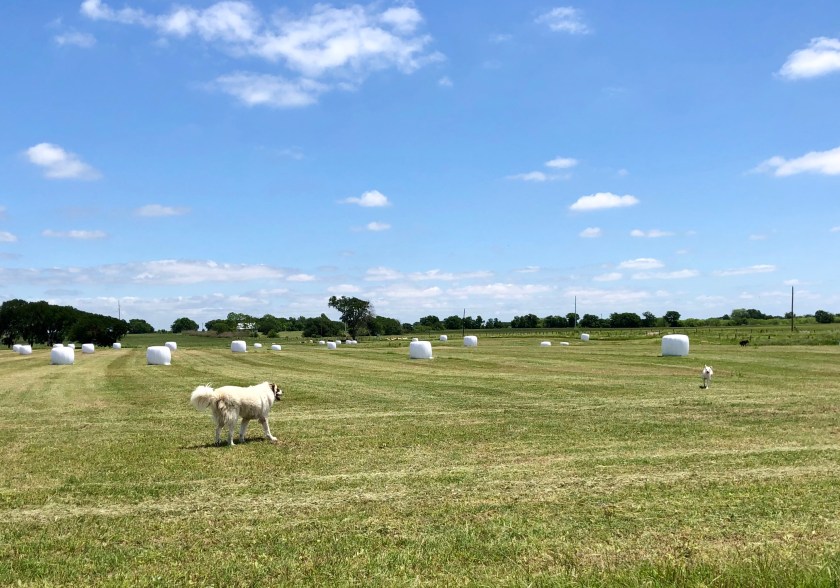
I like how the silage bales look like mirrors of the clouds.
While my friends and I were out frolicking in Temple and eating great food (Megg’s), the Vrazels had baled a lot of silage. Silage is hay that ferments a bit. Cattle love it.
Blooming Temple Festival. Pretty tame, but pleasant.
They did our whole meadow, which delighted the dogs. They can run without having to bound like deer, which they cannot do amid all those wildflowers in front of the house.
Whee! We can run free! Four out of five dogs prefer short grass.
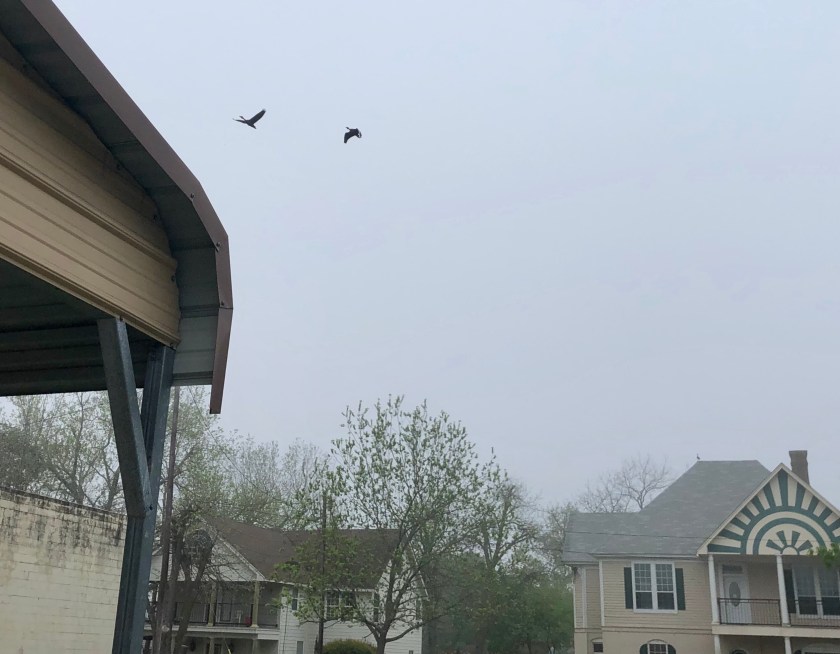
The other residents who love baling season are the raptors. When I was driving back from horse riding, the air and ground were both full of hawks. I counted eight red-tails as well as the harrier. I saw a hawk leap in the air and land on a creature. Boom.
Hawk, as seen from my car.
I hope there weren’t too many nests of the local sparrows destroyed. I remember finding one last year, but haven’t seen any today. I also worry about turtles. Spice nearly stepped on one yesterday!
I guess that’s how it goes here in ranching land. Life and death.
I must say that the baling machine is cool. It picks up a round hay bale, then spins it round and round as it wraps it in plastic. And that’s a life and death thing, too.
Make that five out of five dogs! Hi Alfred.
Where does that plastic end up? Lots of it’s in landfills. Even organic farms use the stuff. I just hope the advantages of silage over hay are worth the cost.
But wait, nowadays hay tends to be baled in netting, not with wire. That’s a mess, too. I’ll have to look into this more.
Fair warning: the reason I wrote nothing in any of my blogs yesterday is that even when I was resting I was doing stuff! Since I’m not at the computer yet, I’ll just summarize and write more later.
Vehicles
Friday was spent driving all over the county with Lee and Mandi looking for a good used car for her, and seeing if we could find a replacement for our huge diesel truck that we could actually use around Cameron.
I actually liked this white, because we could put a sign on it. A nice used vehicle.
We found that I like a Chevy Traverse and Lee likes Suburbans, which are still too giant for me. Unfortunately Lee couldn’t get the trade-in he wanted on the truck, so we walked away. But al least I realized that a smaller SUV was okay for me and at least some Chevy vehicles aren’t plasticky.
The drive was worth it, though, because the countryside on the back road to Rockdale was gorgeous.
As I was leaving to go to my Cameron office this morning, I heard a strange bird call. It didn’t sound like anything I’d ever heard, so I looked up to see what new bird was on the property. All I could see was a crow.
And that crow was acting mighty strange. It was making this weird noise, that was not the usual “caw” at all, and flying round and round the large black willow tree in our arroyo. I noticed another crow, doing the same thing.
I don’t see anything a crow would want here.
So, I drove down the driveway to the gate. While I waited for the gate to open, I realized there were THREE rather upset crows, and they were circling because a red-tailed hawk was sitting on a branch of the tree, all huddled down. She was huddled down, because the crows were dive-bombing her over and over.
Of course, just as I got my camera out, she had enough of the torture and flew off. I inspected the tree as I drove off, and for the life of me I didn’t see any reason why the crows would have been so pissed off at the hawk. I know what a crow’s nest looks like, and there was not one on top of that tree (poor choice for a nest, the way willow branches fall off so easily). Maybe there was some other bird nest up there that the crows wanted to steal eggs from? I’ll look more closely when I get home.
I don’t cry much anymore. I used to cry multiple times a day, but I hadn’t in months, until yesterday. I thought the chickens were acting a bit off, and when I walked into the coop, I saw why.
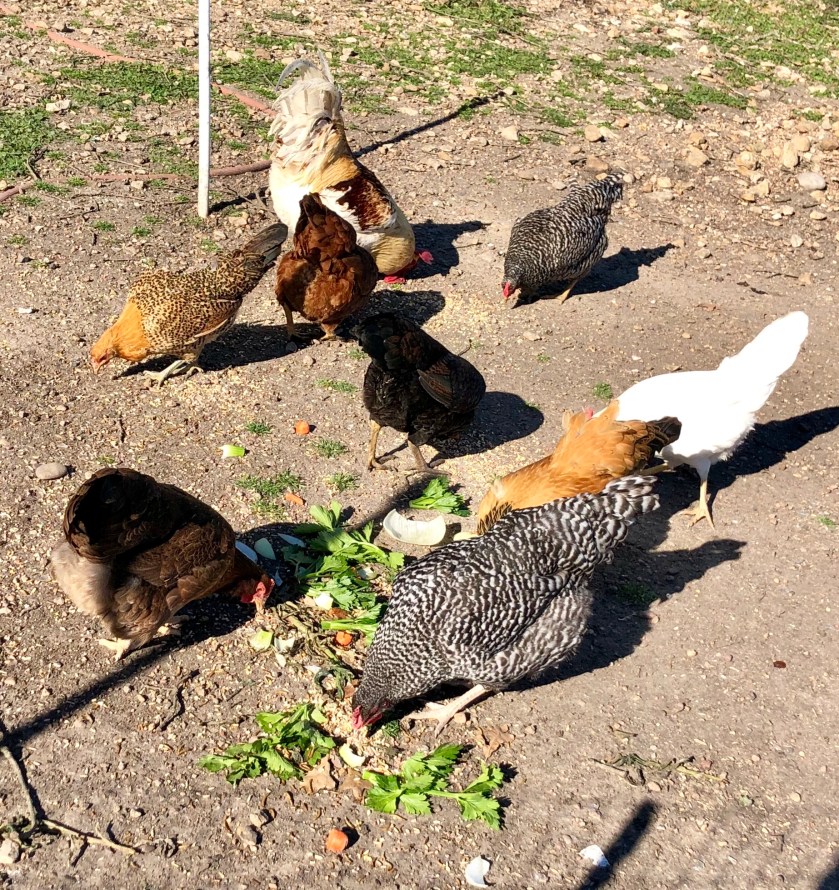
Of these chickens, we lost two this weekend.
There lay one of the older black hens, with our dear rooster, Buckbeak, lying at her side. I screamed, “Nooo!” as if that would fix things. It never does.
A couple of weeks ago, Buckbeak inspected Tyler’s new garden. He was a red sex-linked rooster (they have different color chicks depending on sex).
I was pretty stoic when all the other roosters and so many hens were attacked and killed over the winter. This one was different, since I Buckbeak was one of the oldest chickens in the flock, and I had known him since right after he hatched, around three years ago. He outlived all the other roosters, and was always there, protecting his “ladies.” Or trying to make more chickens with them. Ahem.
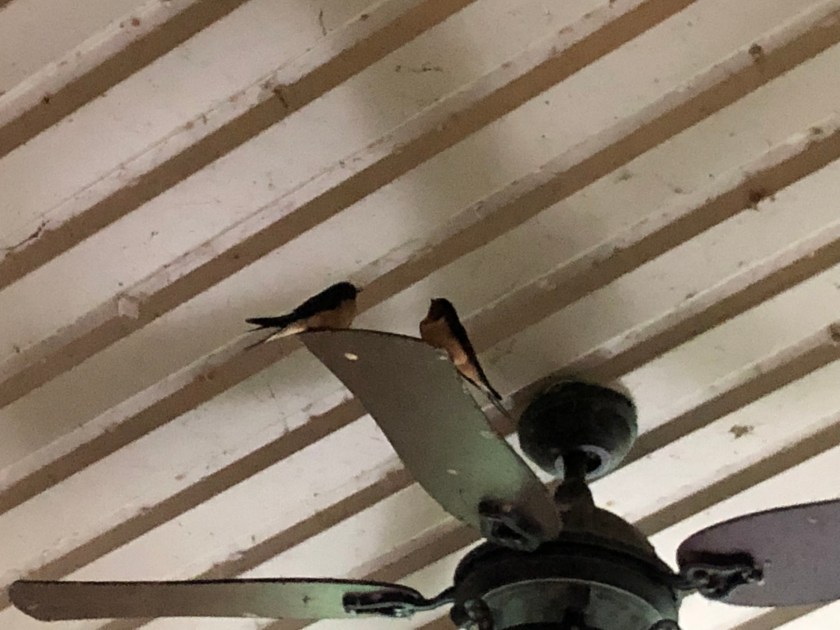
Once the weather settled down a bit yesterday, the local insect-eating birds had a feast (including my chickens). There were a couple of phoebes sitting on our fence wires and zipping down to pluck tasty morsels, but the most excited birds had to be our barn swallows, who view our home as a very nice barn to live on.
When will that human LEAVE?
We discovered a new nest right above the door the dogs use to go in and out. They are a poly family, I guess, with an extra member to help feed the little ones once they hatch. Here are two of them looking displeased at me while the third one was in the nest thinking about pooping on me, no doubt. Because they are so close to the dog door, their chattering and chirping is very easy to hear in the family room. Luckily we like our noisy neighbors.
Getting back to Austin
This morning I drove back to Austin later than usual, so I’d be sure to be able to see any flooded spots along the road. I saw a lot of places that obviously were road closure spots over the weekend, judging by the debris patterns.
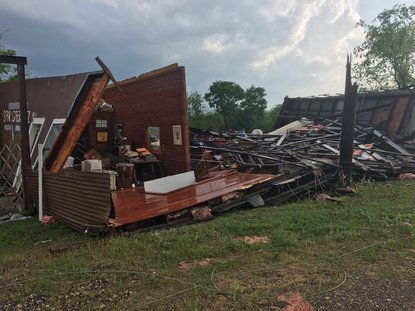
Just to the left is the main road, with soda machines. Apparently a church got all messed up, too.
The saddest thing, though, was driving by the old building in San Gabriel that held the hamlet’s only “business,” two soda machines. It was surrounded by red tape declaring it a danger. The darned tornadoes got it. Here’s an article.
Today is another day
Happily, today turned out to be beautiful. Anita and I enjoyed looking at some of the native plants and insects we pass by on our walks. Two were right outside our house, next to a steep rocky slope.
Cedar sage outside the Bobcat Lair (our Austin house)
No matter how hard the landscapers try, they can’t get rid of all the beautiful plants that were here before the development was here. Case in point is the cedar sage you see here. It’s native habitat is cedar brakes on caliche, where the ashe junipers are located. They like the rocky hillsides. Yep, these beautiful flowers cover the rocks our house sits on, right under the native trees that got to stay when the neighborhood was built (now they qualify as “heritage” cedars, so allergic people can’t cut them down).
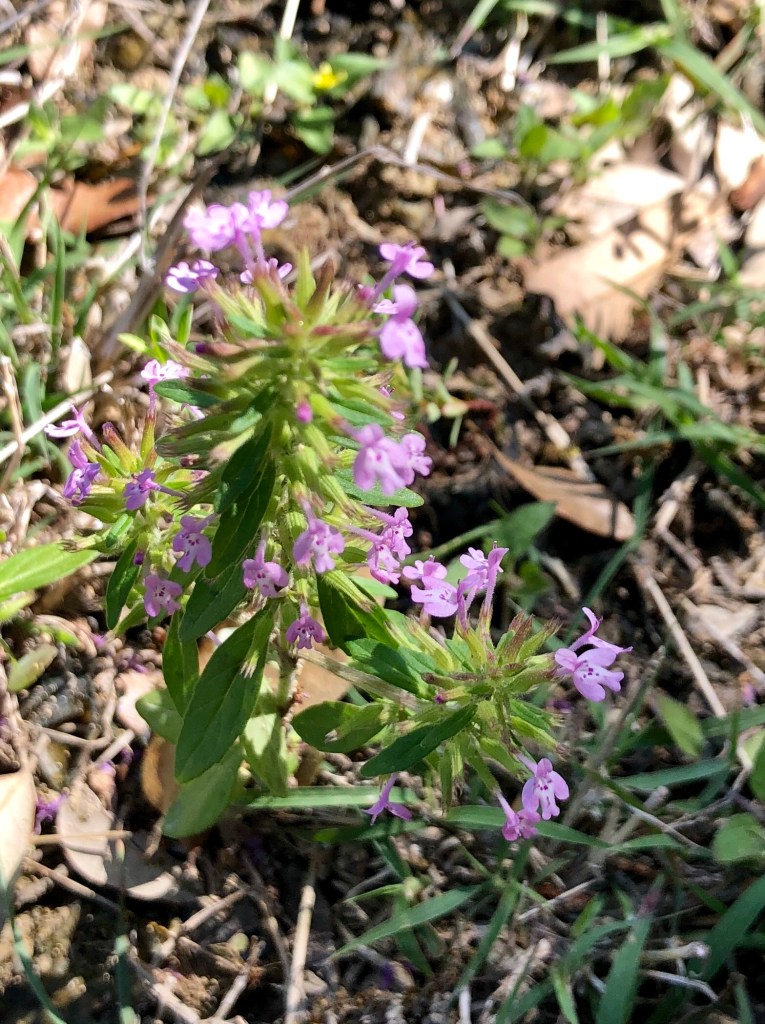
Slender false pennyroyal
Nearby were these lovely little plants with tiny pink blossoms. There are many tiny plants with pink blossoms this time of year, but these looked different from all the others I’ve been finding. Sure enough, they are slender hedeoma (Hedeoma acinoides). There is not much about them in iNaturalist, but a quick check of their habitat shows it’s mainly the middle of Texas. It’s a local! Further checks found that their common name is slender false pennyroyal. I learned something new!
At the mailbox, my housemate, Anita, started jumping around, and I saw that there was a large winged insect flying and landing, which caused that reaction. I got everything nice and calm so I could photograph it.
Extreme crane fly closeup.
It appears to be a crane fly, but I’m not sure which one it is. It could be Tipula tricolor or Tipula furca, juding by the wings. I assume someone on iNaturalist will set me straight. I thought it was nice of the crane fly to hold still so I could get such a good picture!
Spring is the time when things get moving around. We’ve had mouse visitors at the ranch house, but the dogs took care of that.
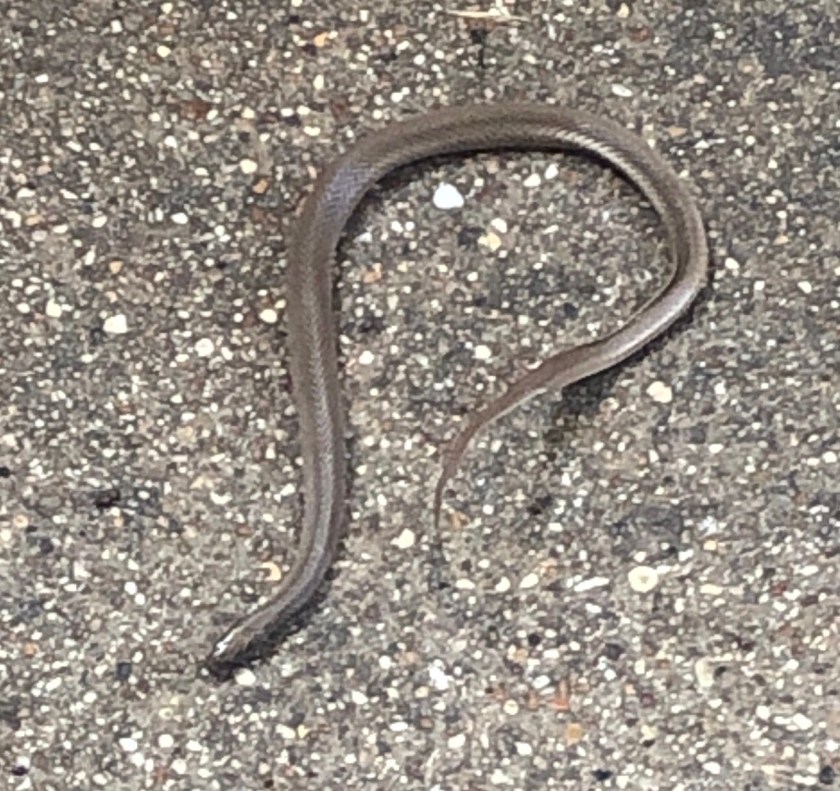
This li’l guy is a rough earthsnake.
The Hermit Haus office also got a visitor yesterday. Our neice, Kathleen, was there working when, to her surprise a little wriggly fellow crossed the floor. Luckily she’s a farm gal (she lives on our farm in Yorktown where Lee’s dad used to live).
Onviously it was a small snake. Those are small holes.
According to her, it took a while, but she got the little fellow to exit the building, and he or she quickly beat a retreat down the drain outside the door. We’ve been checking for our neighbor since then, but there have been no further signs.
And those ducks
I continue to get a lot of joy from the whistling ducks. This morning, three of them were sitting on top of our house across the street. It just seems weird to see ducks up high like that.
Three ducks on a roof.
Of course, I scared them off before I could get a closer picture. But they made that hilarious whistlig duck noise, so it’s okay!
You disturbed us!
Weather?
Hope your Friday is or was a good one. At least it’s no longer cold here. Monday started off in the 30s, and on Thursday it was well over 90! Texas weather is something else!
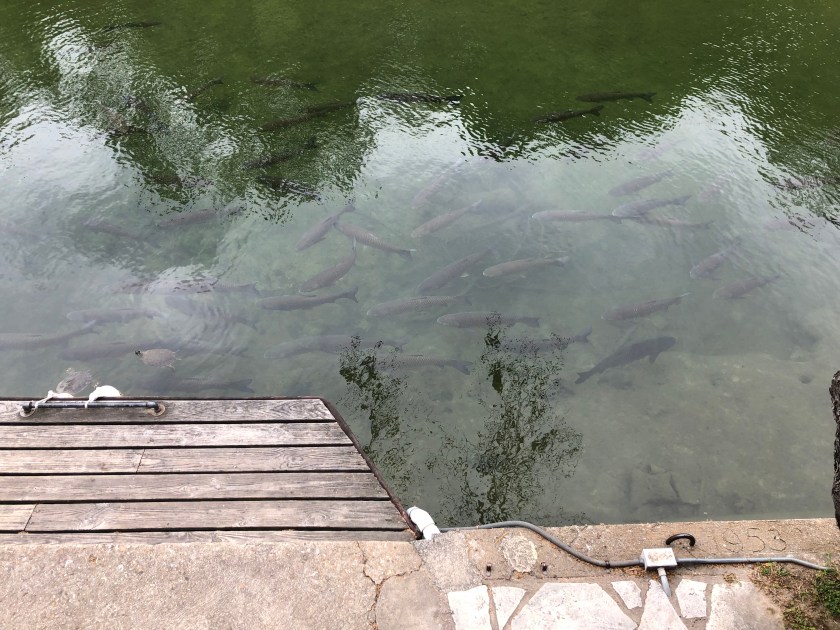
Our Austin house is minutes away from Bull Creek District Park and Greenbelt, a popular recreation destination and one of Austin’s most charming assets. It’s sad that Anita and I haven’t made our way over there after living in the Bobcat Lair for over a year. Today I was working from home and needed a break, so we grabbed my son and his partner, had some delicious barbecue at the County Line. There we enjoyed all the turtles and the massive carp hanging around wanting to be fed.
Check out those BIG fish.
Then headed over to check out the greenbelt. This was sort of a reconnaissance visit, since we knew we would not have time to go on a long walk or explore much, but we had plenty of fun.
I skillfully hid a car and a trash can to get this view looking toward the road.
There are beautiful oaks here that you know were here all along, not planted by someone.
Ah, peace and quiet in Austin.
What a joy it was to explore the quiet creek and riparian area in peace and quiet. This place can be quite busy, but we shared it only with a mother and her two sons, who reminded me of myself twenty-something years ago. The littlest one was buck naked and running around with a stick, poking it into chunks of algae and laughing in the way only a little kid with all the time in the world, cold water, and a stick can laugh.
I did so much over the weekend that I never got time to sit down, much less write about what I was doing!
Just for the beauty. Not a native tree!
A lot of my stuff was work-related, so I wrote about that over on the other blog. Much paint selecting, light fixture choosing, office rearranging and such. I’m actually quite surprised at how little my arms hurt after wrangling giant tables.
Fuzzy willow blossoms and a bit of the bluebonnet I was sniffing. They smell great.
Luckily, there was also some time to check out what’s blooming and flying overhead. I think the black willow flowers are really pretty, like fuzzy caterpillars.
Flying ducks
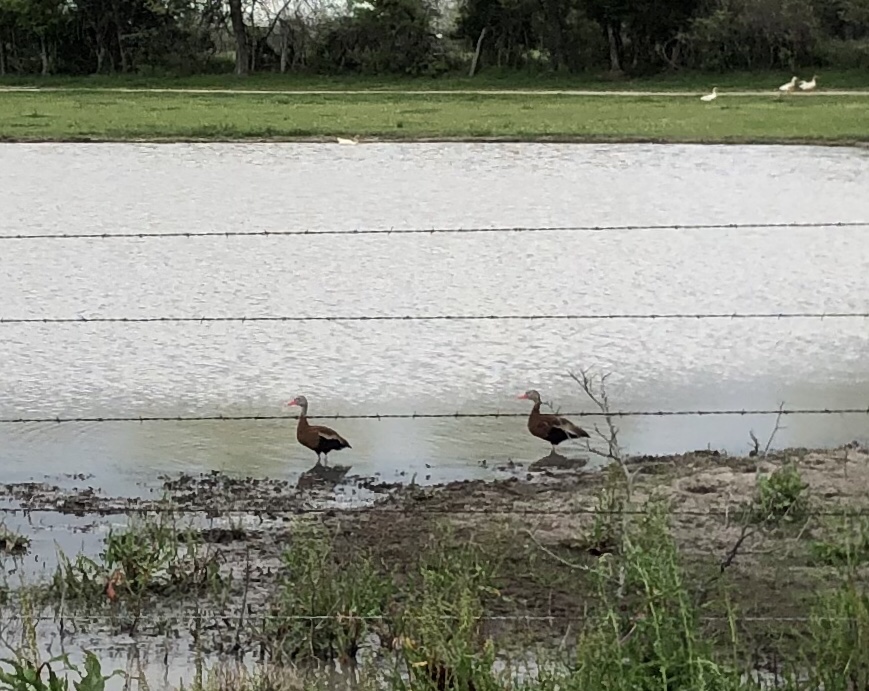
And all over town, as I was driving between projects, I enjoyed hearing the gurgling sounds of the black-bellied whistling ducks as they flew over.
I’ll try to get a closer photo.
I was not at all upset to need to take our helper, Kim, home, because I knew I’d get closer looks at the ducks. They really have day-glo beaks and feet! I love their visits, especially when I can spot them in trees.
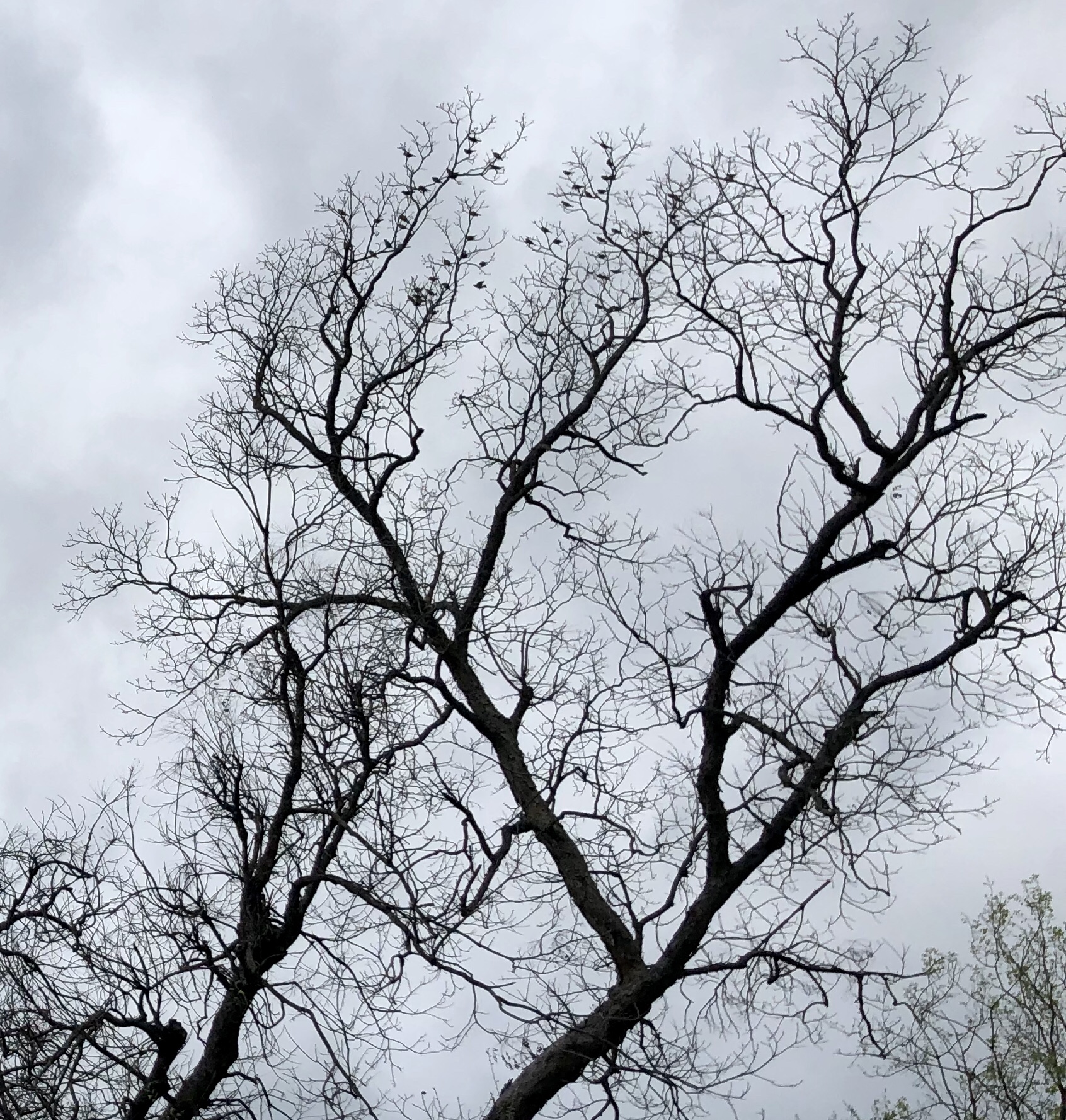
Cedar waxwings backlit.
The cedar waxwings are still around, too, and their little chirps often surrounded me. Kim had to be very patient when I took a bunch of pictures. I had to!
And I’m friendly, too.
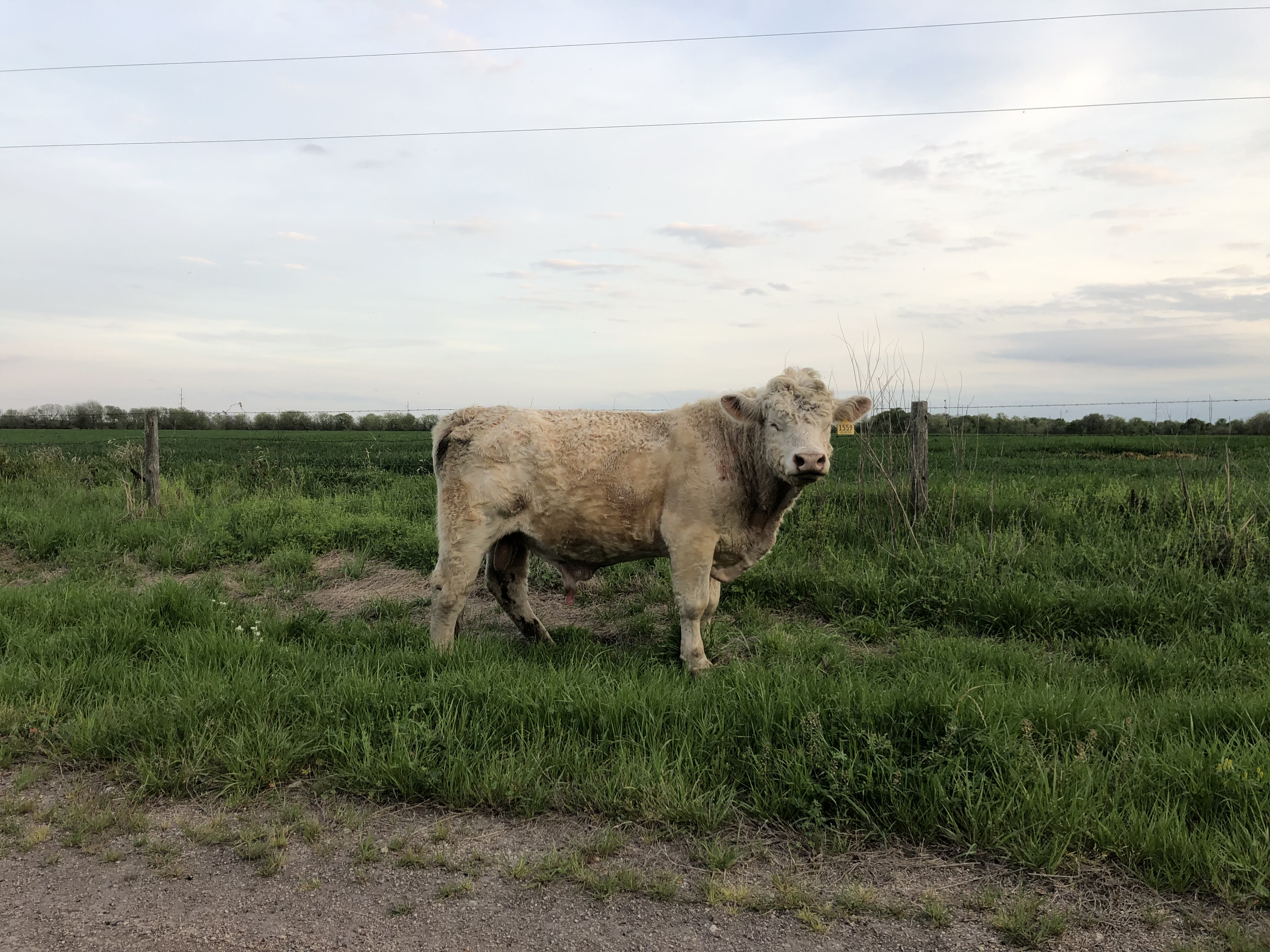
Saturday night we spent a bit of time with this fellow. He’d spent two weeks in the rye field across the road. He finally figured out there is a big gap in the fencing and took a stroll. After much discussion it was determined he didn’t belong to any neighbors and got taken to a sale barn where they’ll try to find his owner. You’d think someone would miss a Charolais bull this handsome.
See my sweaty back? I’m so tired.
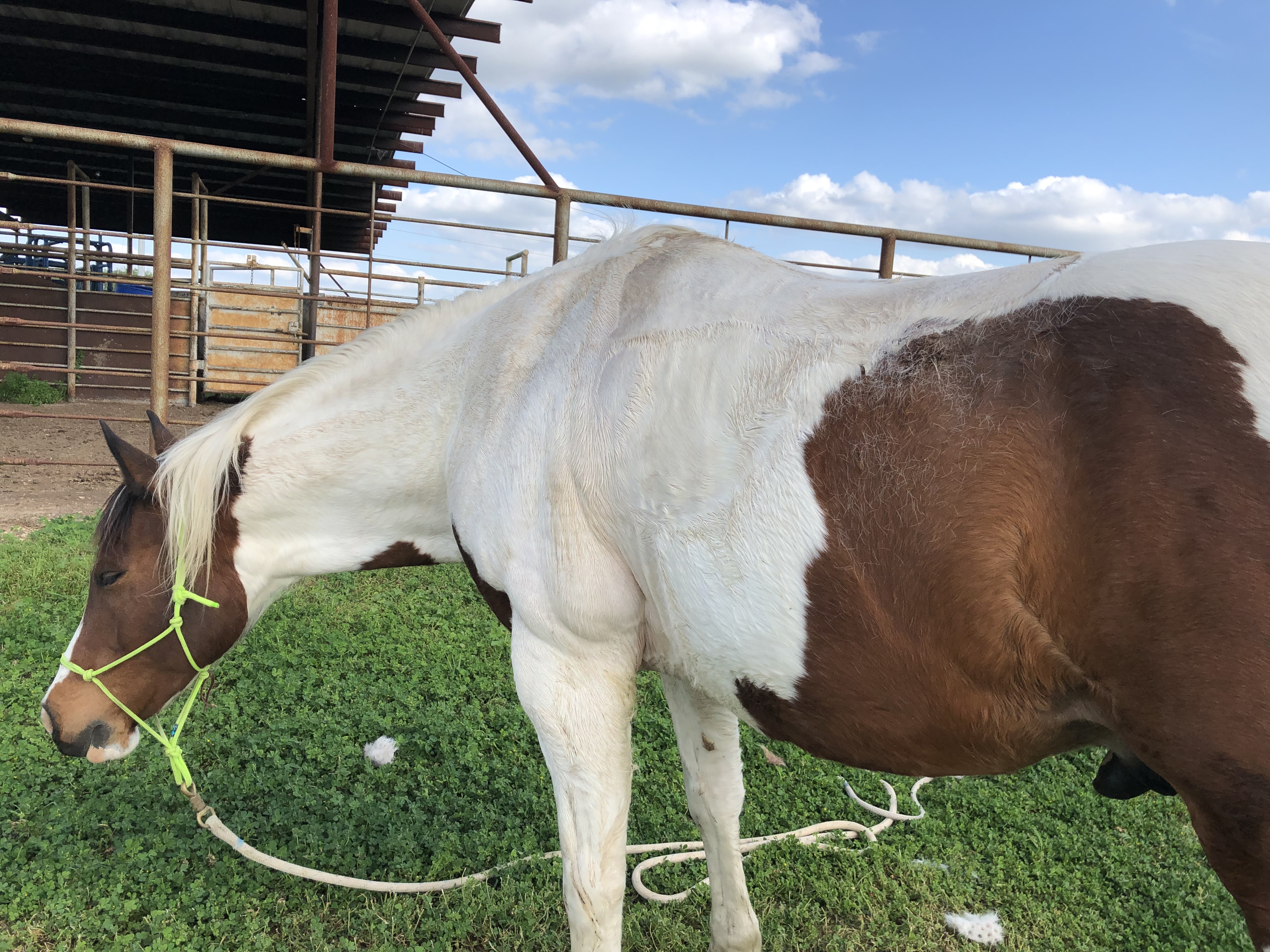
My final weekend fun was getting the poor horses all sweaty. We went all over the ranch and did brave things. Fiona kept dawdling, so Sara and Spice kept herding her. Once we just waited in the cool shade of a wooded area. When Fiona finally made it, we looked down to see the grass higher than her belly. She looked like she was a toy in an Easter basket. Wish I’d had my phone!
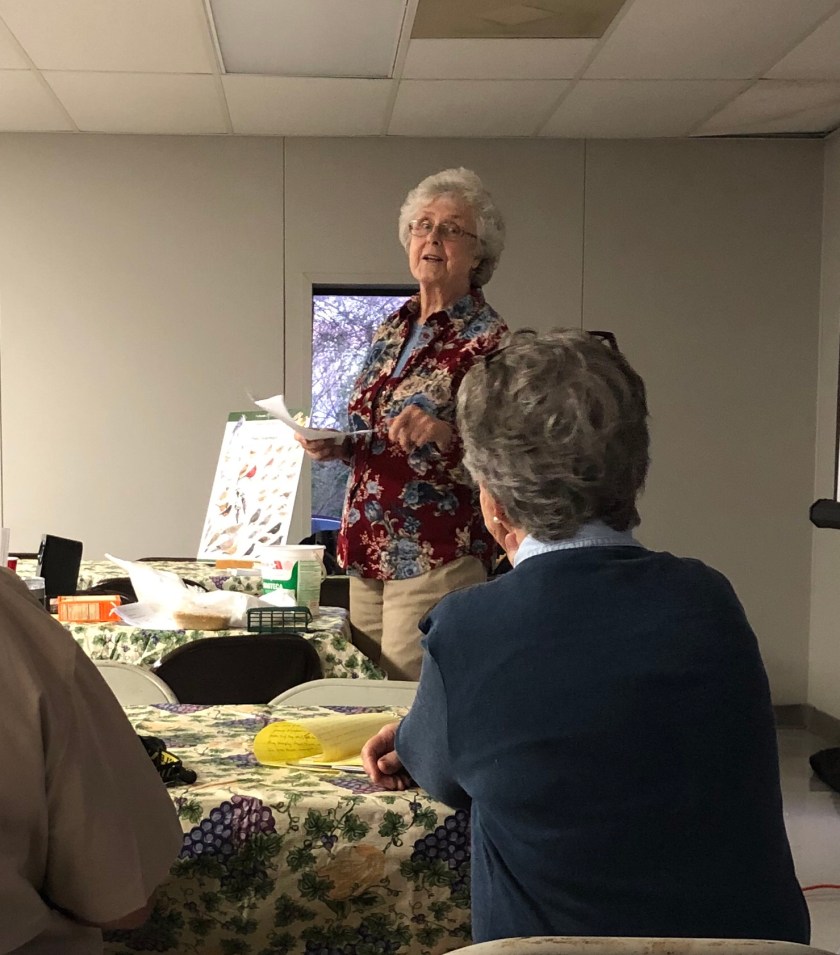
Last night I went to the El Camino Real Master Naturalist meeting, as I do most every month. I wrote up a post for their blog with lots of details about what I learned, so here I want to share my deep enjoyment from listening to women who are passionate about birds and birding as they share their passions with others.
Three women from our group spoke about how they engage in bird watching, each with a different perspective and knowledge base. I sat there like a little kid, all enthralled at the details they shared. It was thought-provoking to look at how each of them engaged in their hobby. Here’s what I saw (just using first names here).
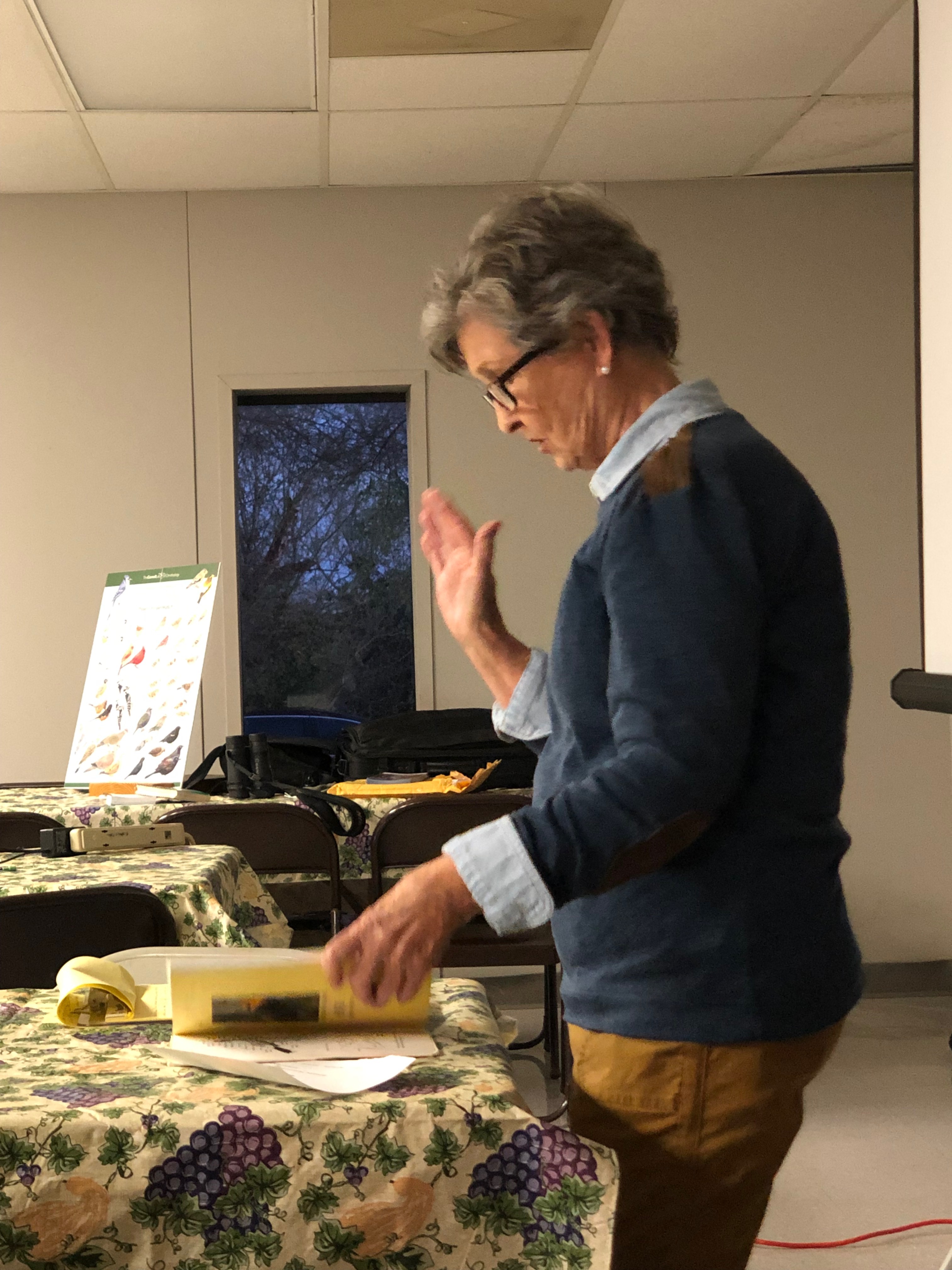
Ann tells us you really, really need a good bird book.
Ann has been birding for many years, and she does it for the same reasons I do: basically, she likes birds a lot. Her passion and enthusiasm for identifying new and unusual birds was very obvious, but she reminded me of my methods for birding. She said if she didn’t know what a bird was from quickly observing it, she’d often just move onto the next, in contrast to her birding friend who just HAD to identify every single bird she saw, in a scientific way. Of course, Ann knows pretty much all the birds you can see around here; she just doesn’t stress over what she doesn’t know.
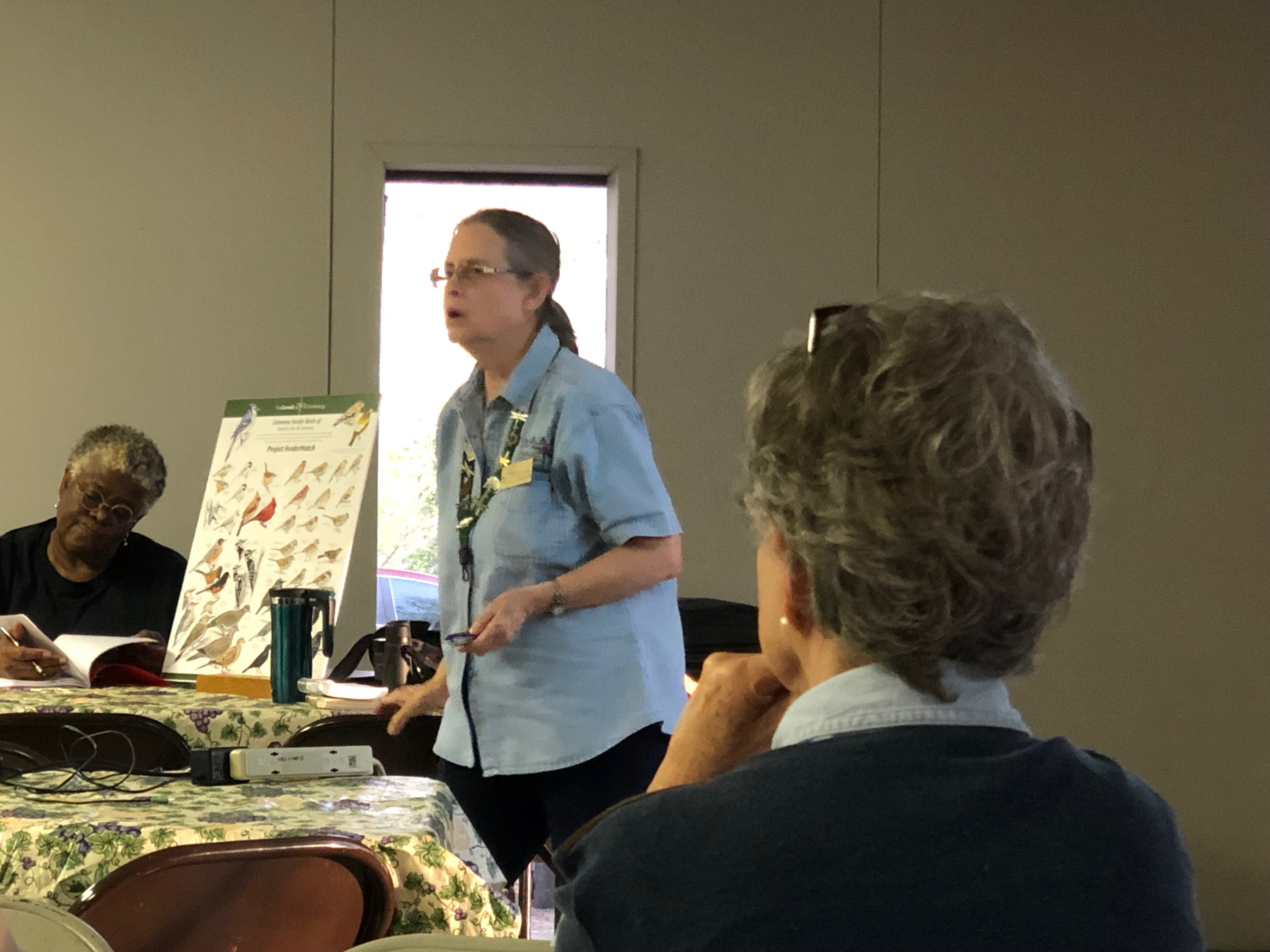
Joyce shares the various ways we can upload our observations to help researchers.
Joyce also loves birds, and watches them in a very accurate and detailed way. She keeps good records of her feeder, counting them carefully, and only identifying the ones that come into her feeder watch zone. There is a great deal of discipline to her approach to observing birds, which goes along with her amazing attention to detail in other parts of her life. We need birders like Joyce, too, to provide accurate data for researchers. (Of course, she’s also having fun.)
Here, Ann is listening to Cindy tell us her suet recipe. Some samples are on the table.
Then, there’s Cindy, whose approach to birding is to figure out how she can practically help the most birds. She shared with us her recipe for making lots and lots of suet for little money, so that the woodpeckers and other birds that like to feed on trees and eat more than just seed can be satisfied. She’s not there just to watch or count or record she’s there to help the birds thrive.
(All the women also carefully feed and water their birds; I was just contrasting their main styles.)
Another birder style was described by Ann, who talked about a very intense young man who asked to come to her house, because he was on a mission to get three more birds on his Milam County list of 100, and she had some of them in her yard. As soon as he saw one, he went on to look for the next. No lollygagging, watching behavior, or anything. And he didn’t stick around to chat; nope, he had to go to Bell County to work on his count there. These are the kind of birders people often gently poke fun at, but hey, they aren’t hurting anyone, are they?
Bonus sinset from the meeting yesterday.
Like any other hobby, there are many ways to enjoy birding (don’t get me started on process versus product knitters). Do you like to watch birds? Do you feel like you need to know what they are? Do you just enjoy their antics? Do you use them to tell what season it is? Share!
Now, that is a yellow flower!
By the way, I was almost late to the meeting, because I had to take this photo of beautiful evening primroses along County Road 140 across from the cemetery.













 The Hermits' Rest