Book Report: Eve

Rating: 5 out of 5.

Hey, look, I finished a book that I like enough to write about! I’d would wager (if I did that kind of thing) that any like-minded friend of mine would love Eve: How the Female Body Drove 200 Million Years of Human Evolution, by Cat Bohannon, as much as I did. It has footnotes and endnotes, too, which hints at some thorough documentation, yet there’s lots of humor scattered throughout, so it’s not boring one bit.
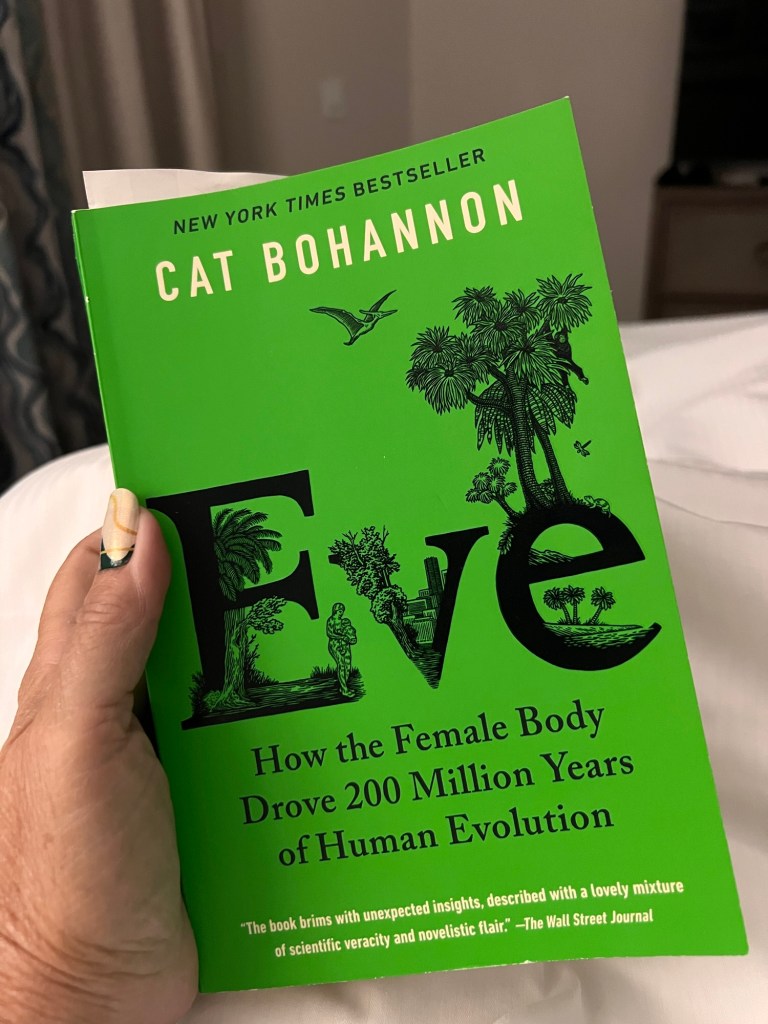
I got it at the airport on the way to Hilton Head. Those nails are so two weeks ago!

Bohannon tells the story of “Eves,” who are archetypal women of the past whose developmental firsts made big impacts on the evolution of humans. All my La Leche League friends will love the chapter on breastfeeding, though perhaps some more intense fans of this method of feeding might find flaws. I didn’t, and I even learned a little.

fingernails
Newest nails. Call me the Eve of Girly Gender Neutral Confusion.

You learn a lot about the history of hominids, as well as how mammals developed, told charmingly through example animals. You get all wrapped up in their little lives as you see how traits we still have made a difference millions of years ago. The book is a lot of fun.
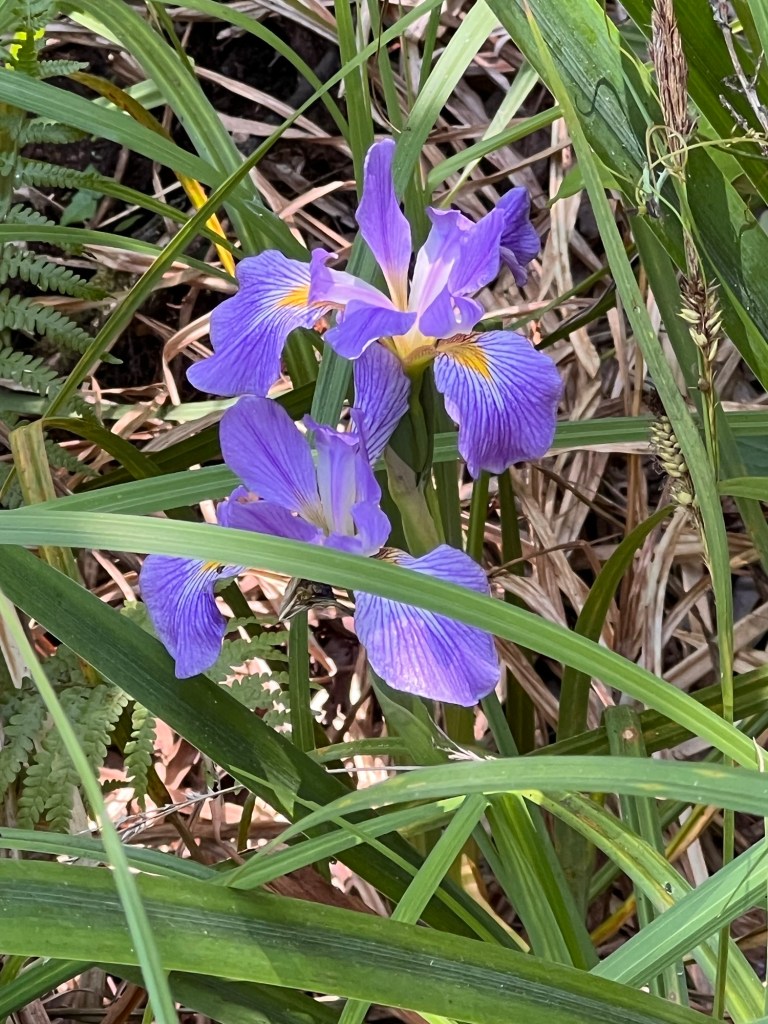
As are these blue flag irises. I’ll now stop with random photos.

I also have to hand it to Bohannan for being “woke” in the best possible sense. That woman doesn’t put down anyone, even inadvertently, and she navigates our world of gender dysphoria and sexual choices like the consummate professional she is. I was duly impressed, and if I were trans or XXY or whatever, I’d feel like I’d been talked about respectfully. But she doesn’t make things awkward–if she chooses a typical example, she always acknowledges possible exceptions. I hope her terminology holds up now that there’s a (scary as heck to someone who fought for women’s rights) sudden devolutionary trend in women’s rights and roles in the US.

My only criticism, if you can call it that, is that Bohannon doesn’t talk about the effects of hormone replacement therapy in post-menopausal women. I’d be interested to know if the current trend of using bioidentical hormones has a positive or negative affect on women’s health and longevity. Maybe that will be in her next book.

This is a hefty tome, for certain, but remember at least a third of it is end notes, bibliography, and index. You’ll wish it kept going.

Book Report: Tell Me Everything

I’ve been meaning to write about the latest Elizabeth Strout novel, and since I was wrong about going camping this afternoon, I suddenly have time. I guess I should have asked someone if we were leaving the day we originally planned. That’s what you get for making assumptions. I make an a** out of me. And, sigh, we have to leave a day early because I have jury duty Monday, I’m a bit pouty. I really want to go camping. We haven’t been in so long.

Must deal with these results of the investigation into why the bedroom slide won’t move. It needs professional help.

However, I did read this book, so let’s talk about Tell Me Anything (2024). As soon as I realized there was a new book in this series (I’ve reviewed them all on this blog, so you can search for Strout and find them), I ordered it. I was very interested to find out what was going on with the characters in Crosby, Maine, since the pandemic, so I dove right in. I was happy to see that this installment concentrated on good old Lucy Barton and her friend Bob Burgess, as they cope with a local murder.

As with most of Strout’s books, the plot is secondary for me. I just enjoy how she tells stories. Her style is so spare, and her use of repetition and the narrator jumping in with bits of information, just enough information. And as always, you get insights into how people think, act, and work from points of view you’d never considered before. I just love the pithy parts.

An imaginary Maine coastline.

I underlined and marked many passages that I can no longer see, but my favorite one was this part of a conversation about the meaning of one of the stories two characters shared with each other:

That was about the same thing that every story Lucy and I have shared is about. People suffer. They live, they have hope, they even have love, and they still suffer. Everyone does. Those who think they have not suffered are lying to themselves.” p. 315.

Actual small town in Maine. Photo by Leah Newhouse on Pexels.com

The people in the book are also fun for me. They are all so fully formed, with wonderful features and fatal flaws. They are real in the best way. I love how married couples are treated here. They have days where their spouses get on their nerves, then days where they don’t know what they’d do without them. And there are divorced people who don’t hate each other, but are glad to no longer be married. It’s refreshing to be able to feel empathetic with human beings who can be inconsistent, think judgmental things about others, but still be doing their best. I feel less alone.

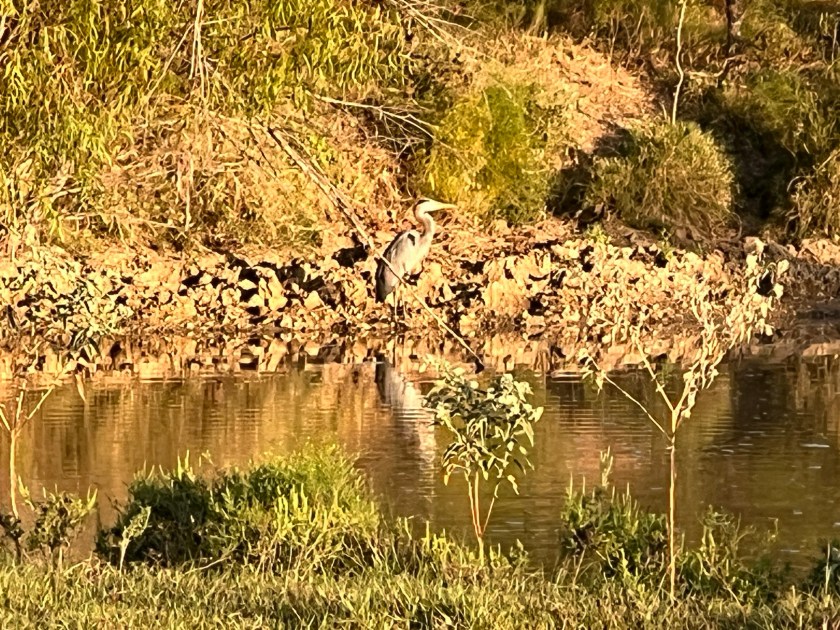
There’s always time for reflection, like the heron is doing. These books inspire you to reflect on universal truths and intimate insights.

One more thing is that I was glad to see that Strout introduced a few new characters, since the “old” ones are mostly getting old. Olive Kitteridge is now 93! I can’t wait to see how she weaves them into the continuing saga as she follows them on through the scary 2020s.

Book Report: In the Shadow of Liberty

Rating: 4 out of 5.

My friend Phyllis loaned me this book after a conversation we had about how history’s narrative differs depending on who’s version is being told. In the Shadow of Liberty, by Kenneth C. Davis (2016), is one of many books that have come out in the past few years that provide perspectives on events in North America from people who aren’t white, male, Christian, or wealthy. As one of those non-priviledged people, I appreciate these insights! (Of course I have plenty of priviledge, just not as much as I would have were I male or a declared Christian).

The book is not about me, though, it’s about people who were witnesses to a lot of the early history of the USA, though they were only 3/4 of a person legally and also enslaved to a wealthy landowner who happened to also be a President of the USA. Because of their proximity to people who wrote a lot and got written about a lot, they managed to get at least glimpses into their lives recorded for people in the future to learn from. As Davis points out there were thousands of people who toiled in the fields anonymously who never got to share their side of life in the 1700s-1800s.

Davis makes it clear that the history of slavery and slave-ownership isn’t as black and white as we make it out to be. Slave owners were known to change their minds over time or treated some enslaved people way differently than others. Some were cruel and some were more humane (a relative term, of course. I found it interesting to see how each group viewed the other and how differently their lives played out.

I’m not going to detail each chapter of the book, which has lots of interesting photographs, timelines, and illustrations to help us understand the times when the protagonists lived. What I do want to point out is how well Davis conveys the whole context of the Presidents and their families, as well as the families of enslaved people around them. It becomes very clear, for example, that George Washington both admired and trusted Bille Lee, who accompanied him on most of his battles and campaigns, yet he always referred to him as “his mulatto man, Billy.” I guess that’s just how people talked back then, but it made me sad.

You’ll find lots of information you may not have heard about before when you read this book, which isn’t very long and is more of a popular book than a scholarly investigation. Some of the people focused on are now pretty famous, but some have faded into the shadows (of liberty).

Reading this book now in 2024 will remind you of how important it is to not backslide on the freedoms we have fought long and hard for in the US. There are still people who would be happy to go back to a time where people could own each other (and it still occurs in the shadows, just a little differently). We all deserve to live our lives safely, with our families, and with meaningful paid work. No “but not these people…” should be allowed.

Book Report: The Promise of Unbroken Straw

Rating: 5 out of 5.

I started to read The Promise of Unbroken Straw, by Ken Steele (2024) because I know the author and want to support people who are brave enough to publish their writing. I finished reading it because I was fascinated by the people and the setting of the book. Most important, Steele is a very good writer and I didn’t get annoyed by any amateur errors like you sometimes see in books you read to be nice to your friends.

Ken and his wife, Cathy, who I met in an online email group decades ago.

I’m here to tell you that if you are a fan of historical fiction, you’ll enjoy this book very much and become totally immersed in the setting, which is Oklahoma during World War II (and some of today as well). You’ll become fond of many of the folks you’ll encounter, as well, and dislike the villains just as much. There’s a lot of angst, sadness, failure, and trouble to be found, but of course some ultimate redemption.

The book

I loved the way Steele portrayed his protagonist, Paul, as a somewhat clueless young teen who really didn’t understand a lot of what was going on around him, but kept trying his best, anyway. You can take a good lesson away from Paul, which is that sometimes what you think is happening and how you perceive events in your life may not be exactly what you think. At least Paul eventually figures that out.

The book resonated with me, because part of the drama revolves around oil being discovered on one’s property and trying to figure out what to do about it. That all played out down with my family here in Texas not so long ago, too, and the feelings are all-t00 familiar. I had a lot of empathy for Paul’s father and grandfather as they tried to do what is right but were tempted by visions of dollar bills dancing in front of their faces.

Ken took this photo of me being colder than I’d ever been in my life.

I’d recommend this book even if Ken weren’t the greatest host in Colorado, but I’m thrilled to be able to encourage all of you to check it out.