That’s the question I asked myself this weekend. So I wandered around with my head down to see what’s there.
I
Speedwell is so tiny, but it lights up the ground as it opens by midday.
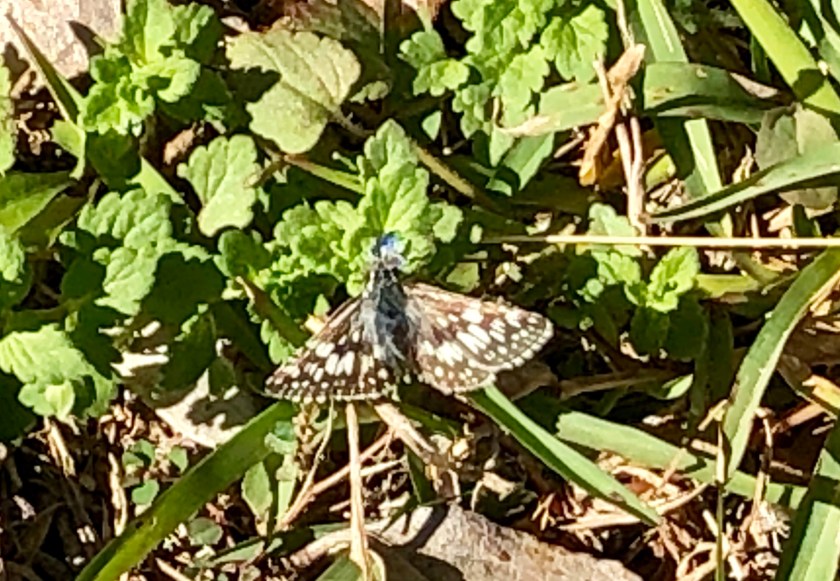
was surprised to find the lawn (sorta) around our old church property blooming away. Granted, they were tiny wood sorrel, blue speedwell, and pink storks-bill flowers, but they were enough to keep at least four kinds of small butterflies happy.
These are prettier in person. Their bodies look blue.
I saw lots and lots of these lovely tropical checkered skippers, plus elusive little sulphurs and a hairstreak. And my friends the fiery skippers still are hanging around. Not bad for December.
The fiery skipper loves the wood sorrel.
Looking Up
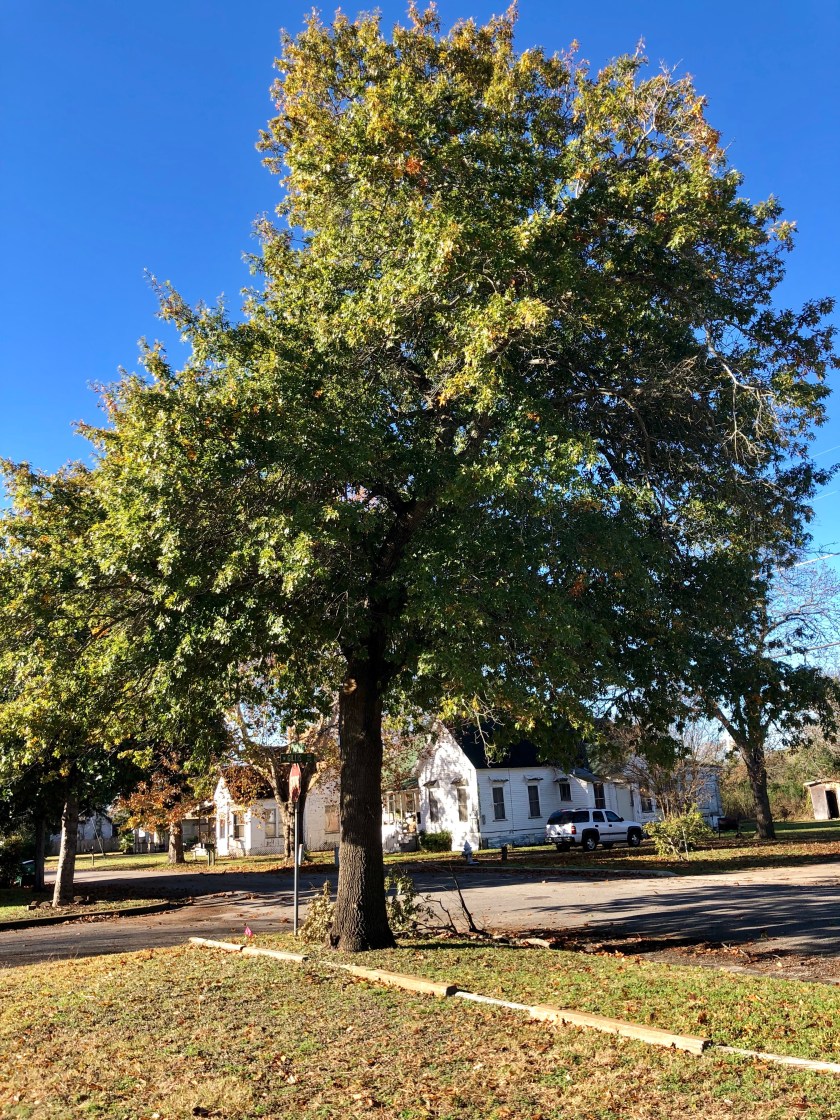
When I looked up, I noticed the big oak tree (the only tree on the property) seemed to be shaking, even though there was no breeze. Then I heard a whole lot of chattering.
The tree is holding up well, even though it lost some limbs in recent storms.
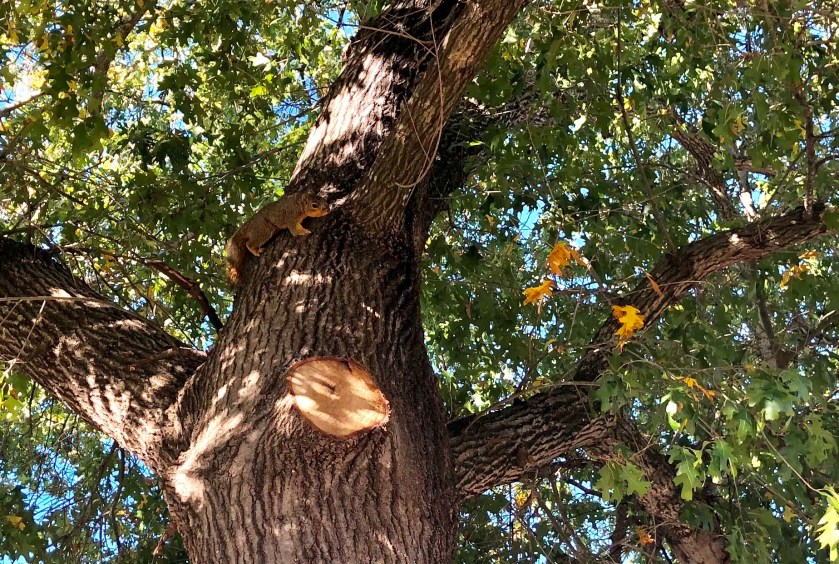
The tree was filled with fat, happy squirrels. They ran up and down, jumped over branches, and tussled.
I’m a happy rodent.
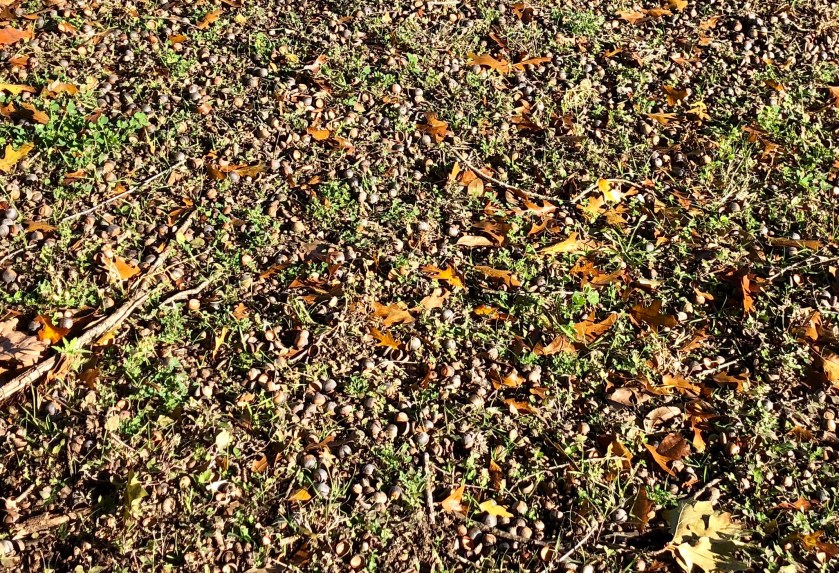
Why were they so happy? Well, it’s autumn, and this tree alone has provided enough acorns for an entire city of squirrels. Why go elsewhere?
The ground is solid acorn. Busy tree.
I wish you the bounty and happiness these little guys have found. I also hope you are finding the life and beauty wherever you are. It’s there!
I interrupt my sharing from the conference I attended to share what a lovely afternoon my spouse, dogs and I had at the Hermits’ Rest yesterday.
This is the back of a red admiral butterfly. I just love how this photo came out.
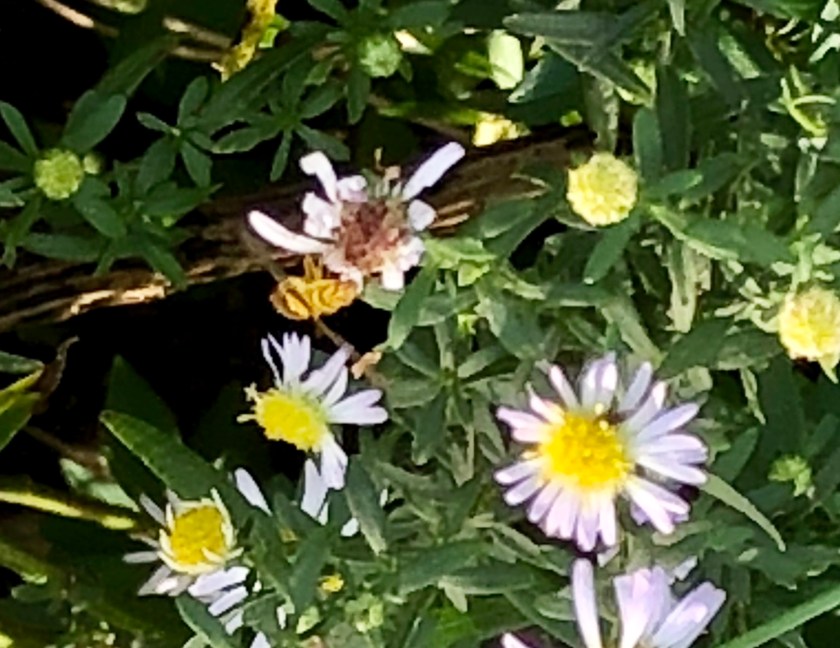
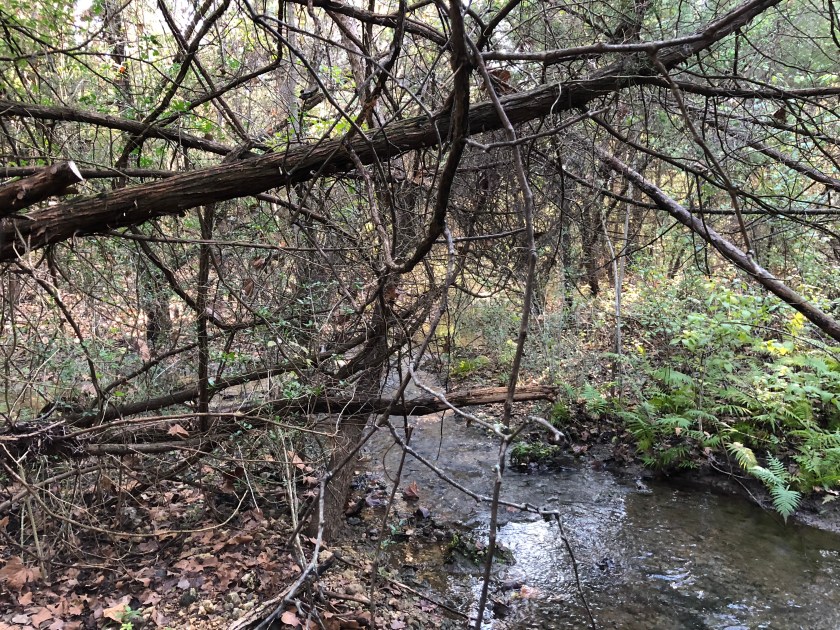
I came home from work, and just felt like taking a long walk. I gathered a few dogs and started my usual route around the property. As I went down toward where the arroyo stream meets the woods, something smelled wonderful. I realized it was a large bed of fall asters. The little valley had trapped the aroma.
Asters and small bees.
The aroma had attracted more than just me, too. The flowers were literally abuzz and aflutter with bees of all sizes and at least six types of butterflies. I was really happy to see Lee come down to see me, so he could enjoy the sights, smells, and sounds with me.
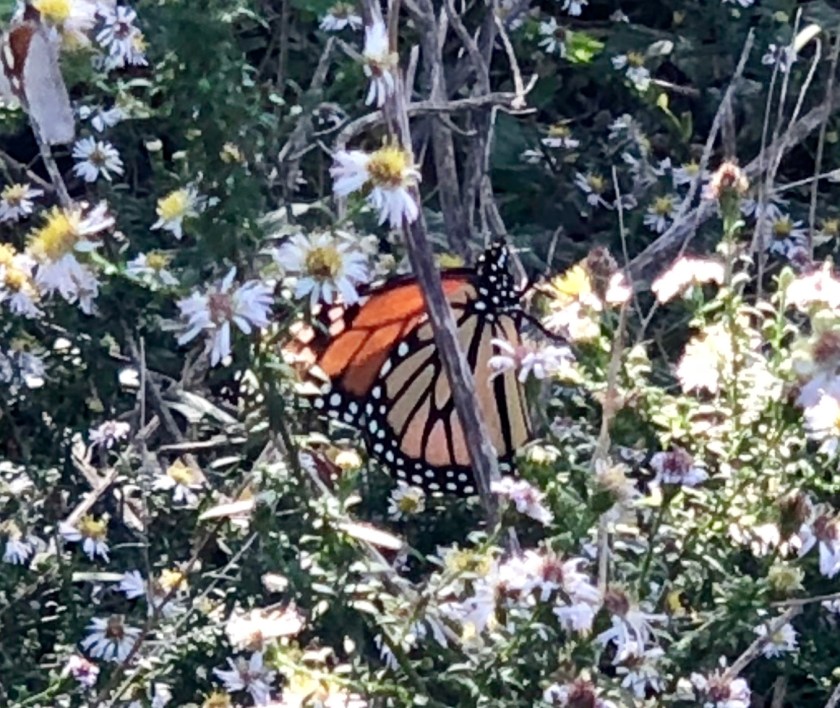
The monarch was in flower heaven.
I really didn’t take all that many photos, because we were just observing. Still, I have to share that we got at least one migrating monarch in the bunch! There were also Gulf fritilaries, a red admiral, fiery skippers (lots), and some painted ladies.
This lush, moist, fern-covered scene is typical in the preserve.
My next Master Naturalist conference field trip was to see the part of the Balcones Canyonland Preserve that abuts Concordia University, in the beautiful western hills of Austin. This area is full of endangered and rare plants and animals, including the beloved golden-cheeked warbler (who is not here right now). In addition, this series of preserved areas is interesting because it’s administered by multiple agencies, which is unusual. It’s also very big, as you can see from this interesting map.
So, an intrepid group of naturalists took a van over to the beautiful Concordia University campus (it’s beautiful, because they made a ton of money when they sold their very valuable but confining old location and bought this large property with plenty of room to grow).
This is Jared. He learned about nature from his grandfather, who shared his Cameron property with him.
We were met by the people in charge of the piece of the preserve that we were going to tour, and some really nice student workers who all really seem to love this property and know a lot about it. One student even had roots in good old Cameron, Texas (shout out to the Davenport family). I really enjoyed talking to the young people about their observations of the area. If they keep it up, they will sure have a fun life ahead of them.
We returned to the ranch over the weekend, with zero seconds of downtime, but we jumped right into the swing of things and enjoyed visitors, both human and otherwise.
Flying Friends
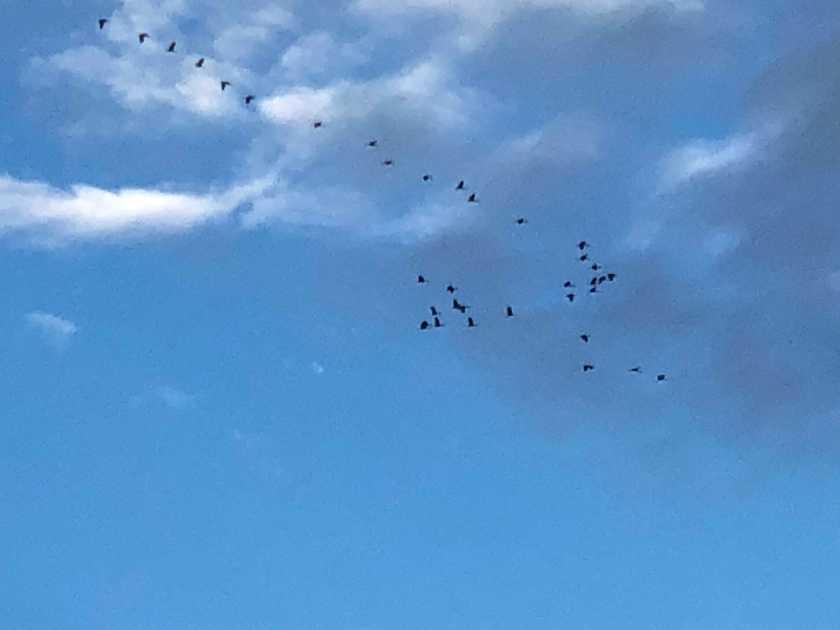
The most glorious visitors were just passing through. Many flocks of sandhill cranes flew over. We also saw a few snow geese. I just love the sounds of the cranes!
One of my favorite neighbors.
While I was taking crane pictures, two blue herons squawked, so I got nice close photos of them. Of course, they are blurry iPhone pictures, but some day I’ll get a new battery and learn to use the good camera again!
There have also been a lot of visiting starlings, which we don’t usually have. One thing I’ve noticed about them is that they make lots and lots of noise when they are all lined up on the electric wires, but when they take off as a flock to rearrange themselves, they are totally silent. It’s really eerie when you are standing around in the field listening, and suddenly all you hear are the coyotes.
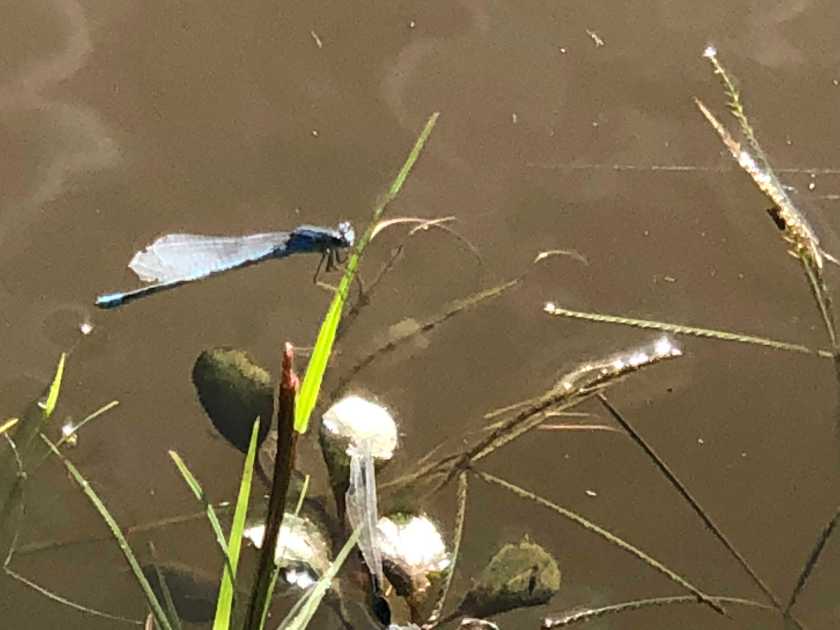
These are so delicate.
Most of the dragonflies are gone, but we did see a lovely bluet by the small meadow pond. These sure are pretty. They curve their bodies where you see the stripes.
Why won’t the turtle play with me? (You can sort of see it in the grass.)
More “Friends”
Because it’s rained so much (have I mentioned that? Lots of flooding while we were gone), animals seem to be wandering around. Yesterday, Carlton the dog found an extra large pond turtle in the middle of the pasture. He was most dismayed that it would not come out and play, so he stood there for 15 minutes and barked at it, poking it with his nose a lot. Treats had to be used to save that poor turtle from the torture.
This dirty part of the porch is where we harmless snakes like to hang out. I want to date this electric cord.
And later yesterday, I once again spotted a large snake on the front porch, in the icky dirty part, of course. I was pretty convinced it was a water mocassin, but the folks at iNaturalist talked me down, and asssured me it was a water snake trying to look like a poisonous one. I am pretty sure this is the same snake I’ve seen over by the pond. It hisses. We kept the dogs away, and it slowly meandered off.
Our house guest was not thrilled that we didn’t kill it. I repeated a number of times, “I don’t kill snakes.” I do understand many people aren’t good with them. My dad sure wasn’t! He’d kill them 3 or 4 times!
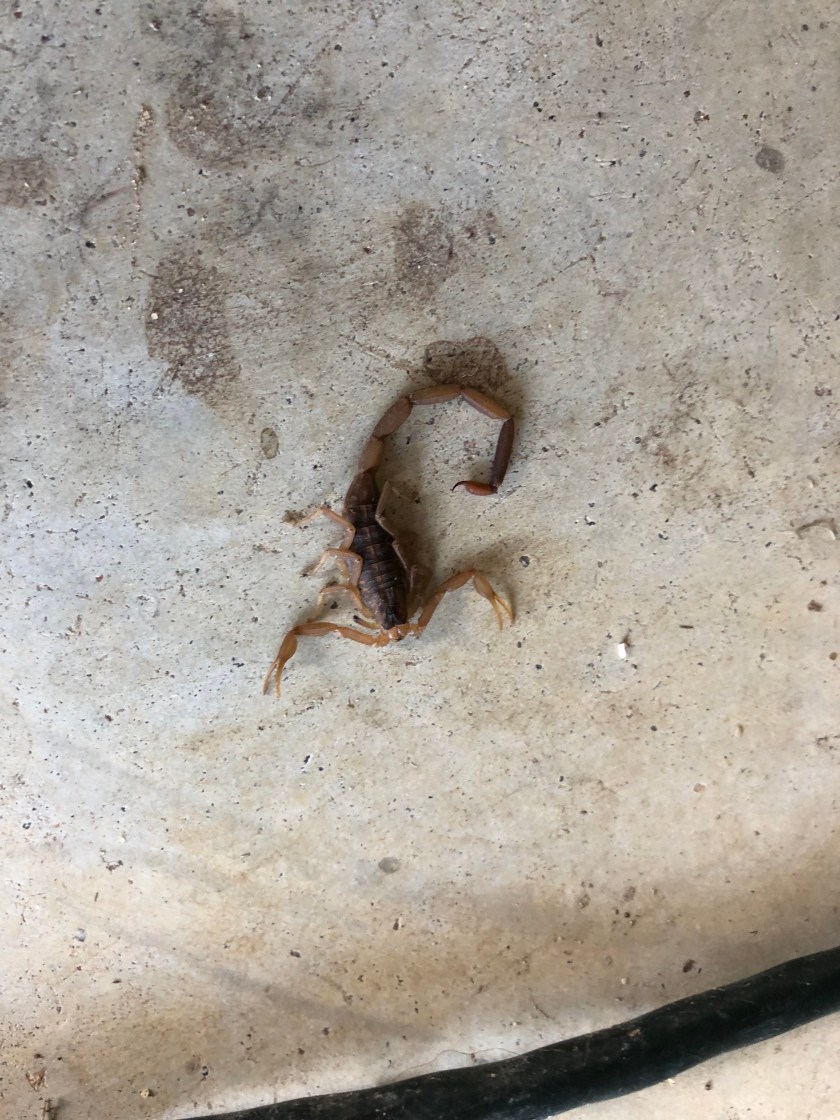
It’s a scorpion, all right. Small.
In the early evening, we found our first scorpion at the ranch. It was pre-dead, so we didn’t have to do anything to it. We used to see lots more in our house in the karst area of Williamson County
Not Friends at All
We apparently have a visitor over to the chicken coop who is not our friend. It has killed at least 4 of the chickens (at least two roosters, who were probably trying to defend the flock). It gets them IN the chicken coop. Yet another reason for them not to lay eggs in there!
The Neighbor is sure it’s an owl. I think it might be a bobcat, since both hunt at night. A cat could get in there easily from the tree, then scale the fence to get out.
Leave us ALONE! We just want to eat grass. And escape from these non-sheepproof fences.
Something also went after the four new sheep the Neighbor brought in, and one of them lost a LOT of wool and some flesh, but seems OK. We are hoping the culprit is not the cabin occupant’s dog, who went after the sheep when he first saw them, so they don’t want to leave the pen to eat in the pasture.
Nice of all these creatures to wait until I got home to show up, isn’t it?
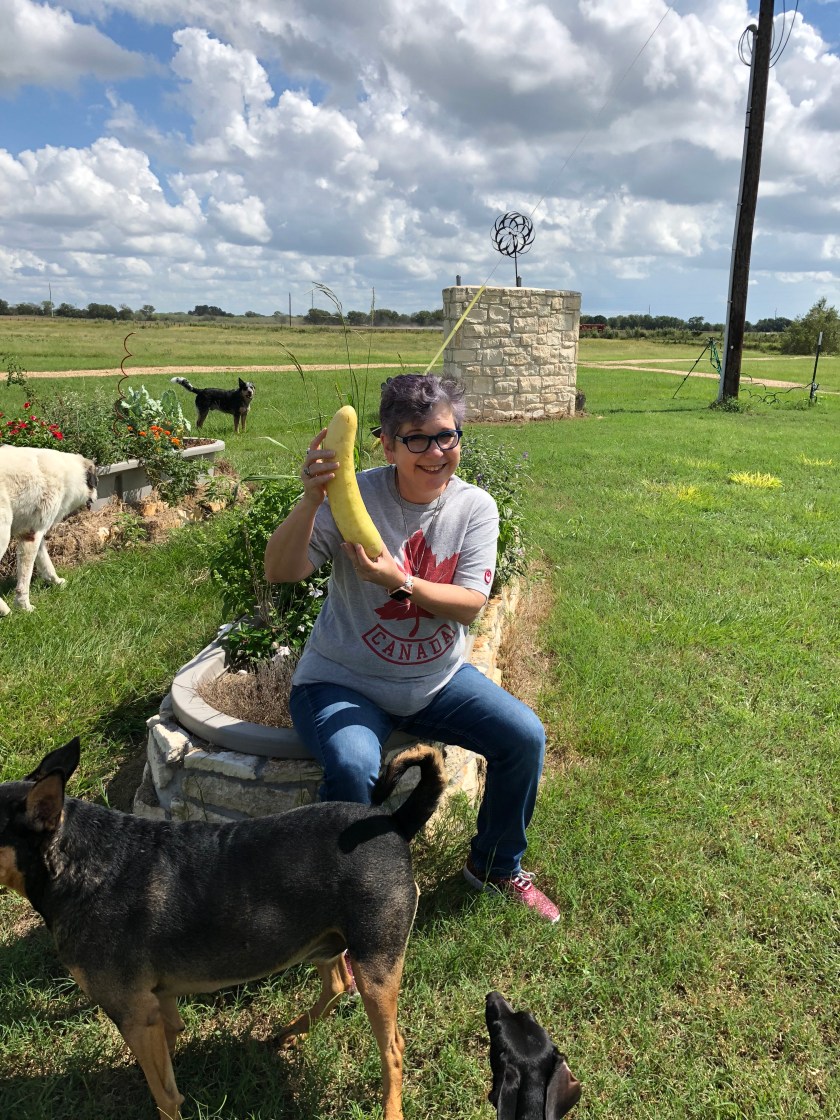
The dogs are very impressed with the size of this yello cucumber. It’s um, mature.
It’s a nice October weekend, and I’ve been taking advantage of it by really enjoying the Hermits’ Rest. We’ve had a couple of neat discoveries today.
The first came when my friend Mandi and I were checking the bed with the okra, basil, and peppers in it. Out of habit, I looked in to see if there was any action on the cucumber vine that had really not done a dang thing all season, other than grow and make pretty flowers.
Whoa. What did I see, but a HUGE and very overripe cucumber, just sitting there taunting me. You’d think I’d have spotted that one long ago. It appears that the plant decided it was more of a pumpkin, and put all its energy into this one immense cuke. You’ll be grateful to know I’ve spared you the raunchy photos.
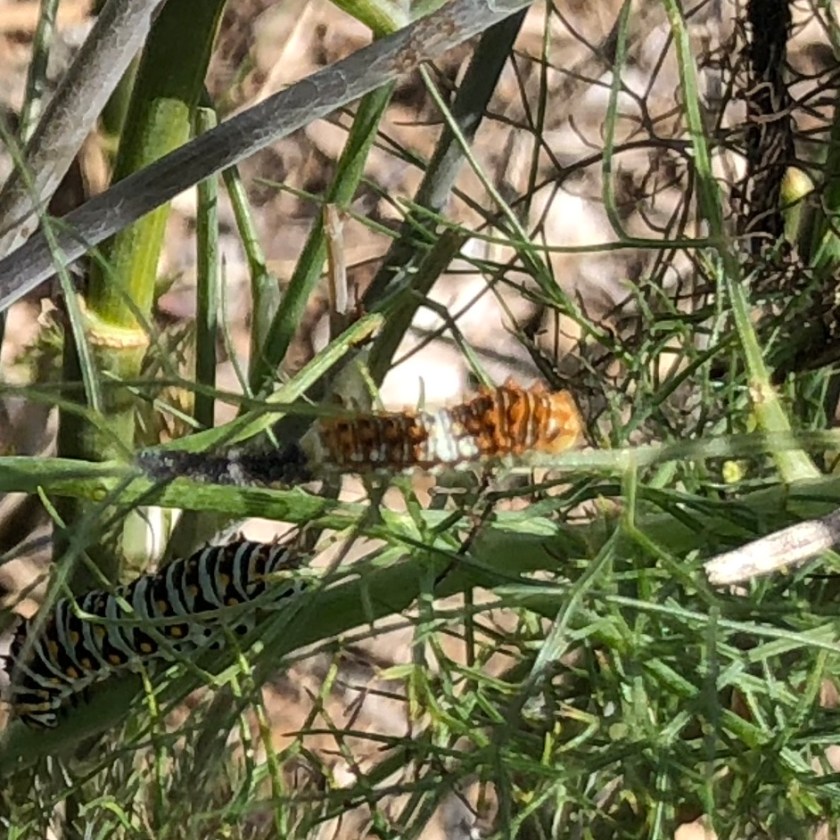
The hungry swallowtail caterpillar.
While laughing at the cucumber, I turned to look at the bronze fennel that is in its second year and going to seed. There I saw at least a dozen lovely caterpillars! They were munching away at an impressive rate.
I wonder what the little one is?
There were two types, and one was easy to identify as a black swallowtail, but the smaller ones I didn’t get. Someone has suggested that they are eastern black swallowtails, but I’m hoping someone can help me get a definitive ID. They are way smaller than the other ones.
Double rainbow, all the way! Mostly.
It was an extremely humid day, and there have been a few brief showers. We truly enjoyed the last one, which came from the shower that got me while feeding the chickens. It lasted at least an hour. You can’t complain when your surroundings are this beautiful.
PS: The chickens are finally making more eggs again. And Mandi and I found a dozen on the horses’ square bales. All were still good!
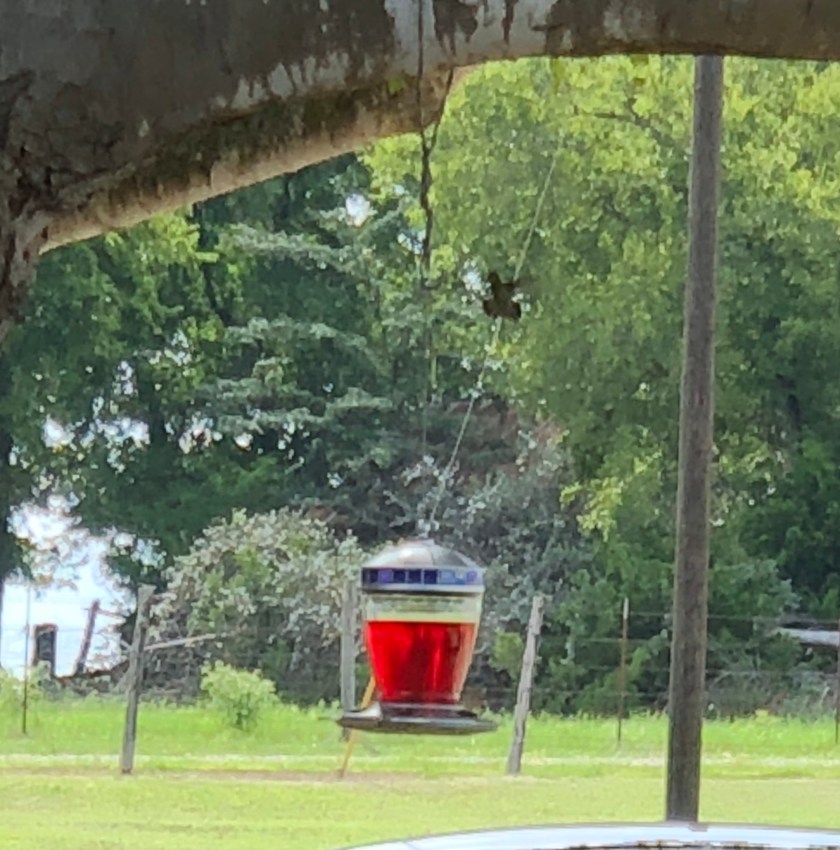
Over at the neighbor ranch, Wild Type, there’s been a battle going on for a few days, involving the black chinned hummingbird population and one persistent praying mantis.
Sara and Ralph noticed that hummingbirds were approaching the feeder but not feeding. They were displaying their tail feathers and darting around. That’s when the mantis became obvious. It had settled in around the feeder, apparently waiting to catch one of those hummingbirds.
As you can see from the photo, this is not the largest praying mantis. It may well be another Carolina Mantis, which is the kind I’ve seen in Austin, but I’m not really good at differentiating among mantids.
I know hummingbirds have been caught by praying mantises, though. I even checked on Snopes to be sure it is true! So, no wonder the hummingbirds are annoyed.
This blurry action shot shows the bird making itself look big to impress the mantis.
It’s fun to watch them, and I am hoping that Ralph has gotten some action shots with his good camera and tripod. I also hope no hummingbirds have actually been caught. What would the mantis do with such a big prey?
As an aside, I have seen more than one type of hummingbird at their feeder in recent weeks, since migration time has started. I’m sure I saw a ruby-throated one, and there was another I can’t identify. It’s a fun time of year.
(Also I am not participating in a debate over red vs. clear sugar water. I’ve solved it by not putting out feeders this year, since it’s a big commitment: my fellow Master Naturalist, Phyllis, has put out an astonishing amount of hummingbird food this summer!)
This friendly looking guy is the gazelle scarab beetle. They like to eat poop and attack tack rooms.
It seems like every year we get a different plague. This year’s infestation was quite a surprise. And how it managed to infest our tack room was quite ingenious.
You see, the room where we store all the equine food, saddles, and other equipment may not look great, but it is very well sealed, so that mice and other intruders can’t come in and eat our delicious beet pulp and expensive supplements. It’s also air conditioned, so that the leather tack doesn’t get all moldy and icky.
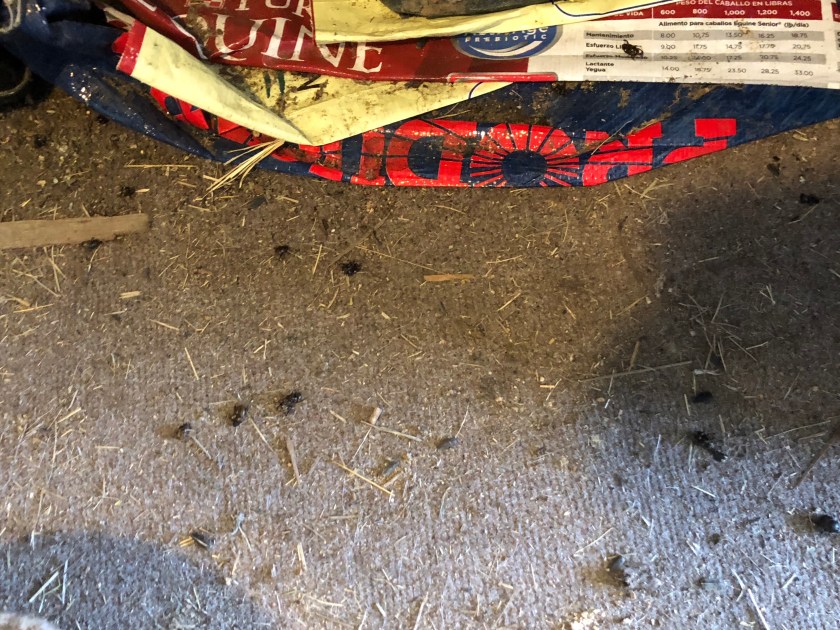
I recently dropped some black sunflower seeds, and from a distance, they do resemble dung beetles.
So, yes, we were surprised this weekend when what we originally thought were black sunflower seeds that we’d spilled were actually a LOT of dead bugs. I uploaded a photo to iNaturalist and got back a positive identification of gazelle scarabs (Digitonthophagus gazella), also known as brown dung beetles. Sara, my horse co-owner, was proud she knew it was dung beetles. Well, she was raised on a farm and has lived on a LOT of cattle ranches. She’s seen dung beetles.
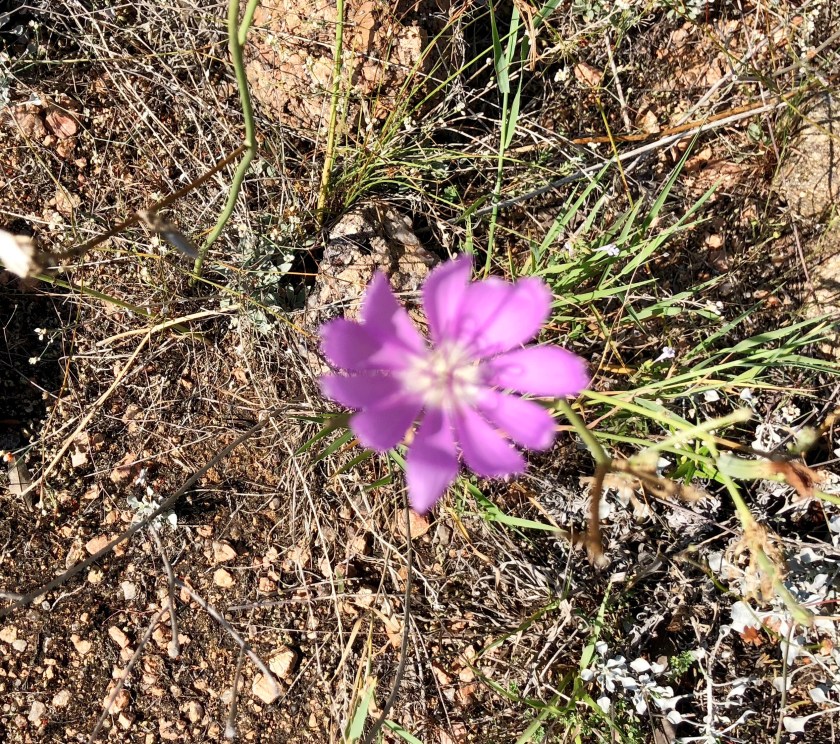
Summer color at Enchanted Rock. A tievine flower and some colorful lichen.
My housemate in Austin, Anita, and I are taking a quick mini-vacation to Fredericksburg, Texas. I haven’t taken her many places since she moved here, and I knew she’d love the Hill Country, even while we are enduring weeks and weeks of incredible heat.
Yesterday, we drove out to Enchanted Rock State Natural Area, a place you should also go, if you’re visiting the middle of Texas. It really is fascinating, especially in the spring or after a rain (due to flowers and little pools of water with tiny shrimp in them).
However, it’s very crowded in the spring and fall, so we discovered the great advantage of heading out early in the morning in midsummer is having the entire rim trail to ourselves (we saw one other hiker). We took Anita’s dog, so we didn’t try to climb the summit. Also, heat.
A Texas Skeleton Plant. That’s a new one for me! Big, pretty blossoms!
What I DID do, though, was put on my Master Naturalist hat (figuratively–I’d brought hiking boots, but forgot my hat), and see what kinds of plants, flowers, and other things I could spot. I’d never been to Enchanted Rock in the summer, so I did find some great surprises! And of course, I entered them all in my iNaturalist observations. Enjoy the photos, while I tell you about some of my favorite discoveries.
I’ve been reading a lot about these. I could make tea from them. I won’t, though.
You haven’t heard from me for a couple of reasons. One is that I’ve had so much fun stuff to do that it’s been hard finding time to write. I had lots of guests last weekend, and my company has been busy buying houses and commercial buildings. That’s all good.
The other is that it has been “one of those weeks” in which one weird thing after another keeps happening. I’ve been losing things, had a near-miss accident, have said some really odd and atypical things to others, and more.
The good news is that I’ve managed to get all my work done and am ready for a mini-vacation in Fredericksburg, so there should be some good nature stuff come out of that.
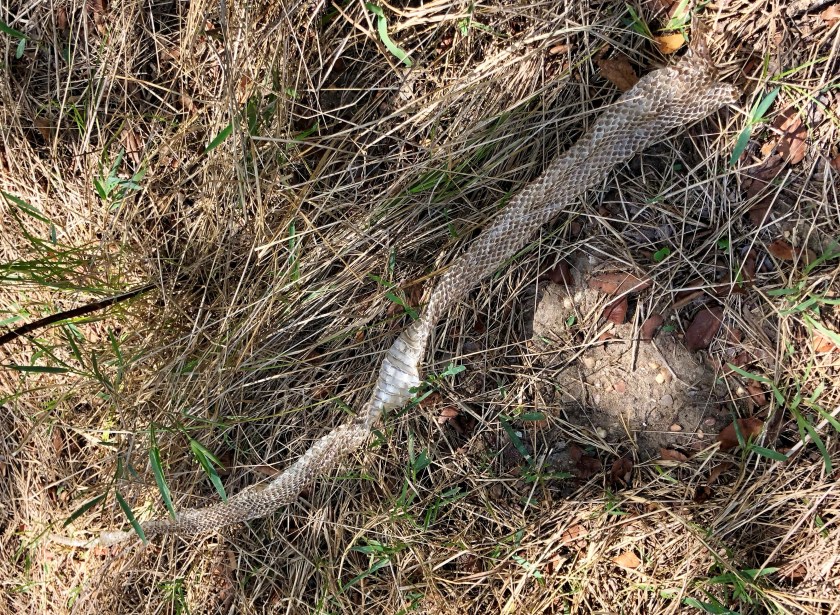
This is only a part of the big snakeskin we found. It was big in the middle, then got smaller. Interesting.
In the woods
Last weekend, Justin (nephew of the ranch neighbors) was here, and he and I had a great time tromping through our woods with the dogs (it was the first real tromp for the two newest ones). He is very much like me, in that he really notices things.
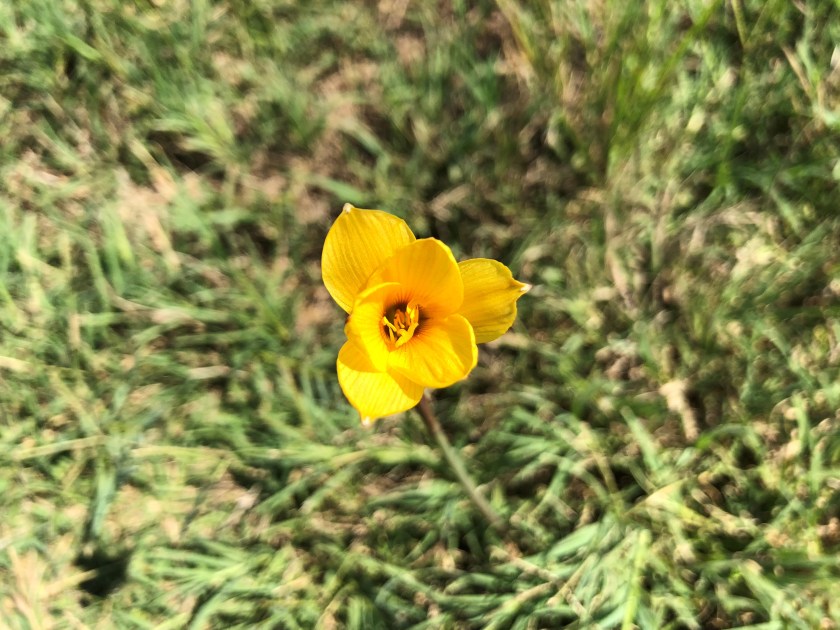
This is called a copper lily, but it’s in the rain lily family.
We had a big surprise rain event yesterday. No one was expecting it, but they were happy nonetheless. I hit some really hard rain in southern Milam County and was very glad for the rain mode in the car. There were waves on the road.
But the real topic today is rain lilies. Rain lilies (white ones) are a common plant around here. They pop up some time in summer, usually, in large masses after a good rain. I found it interesting that the Wildflower Center has two Latin names for rain lilies: Cooperia pedunculata and Zephyranthes drummondii. Apparently, the ones that bloom in the spring are different from the ones that bloom in the fall (no clue what the summer ones are). It has some cool alternate names, too: Hill Country rain lily, Prairie lily, Rain lily, and Flor de mayo.
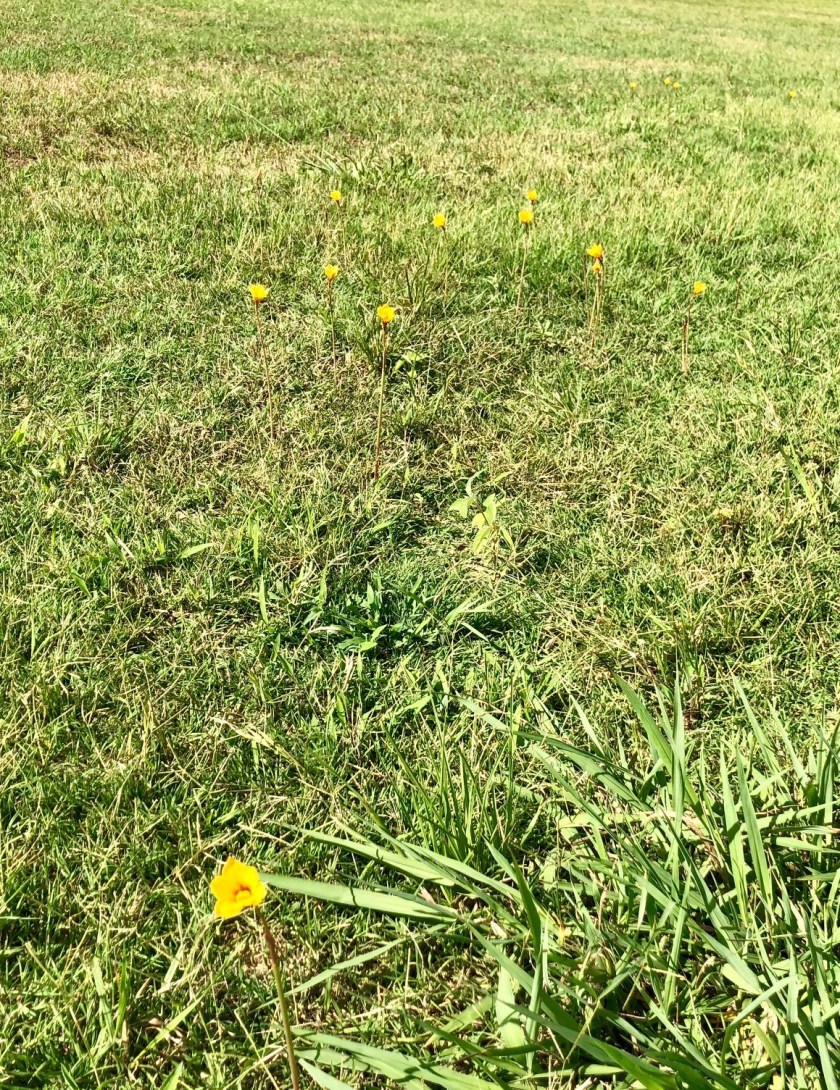
Here at the ranch, we have always had these really pretty yellow “rain lilies” that pop up around the same time as the white ones.
Here they are in a field.
When they came up this year, of course the first thing I did was look them up on iNaturalist, which is how I found out they were called copper lilies or Rio Grande copper lilies (Habranthus tubispathus). It says they are escaped ornamental plants from Central America that have naturalized. I can’t imagine anyone planted them in our pasture, but who knows? They definitely seem to appear most often in Texas.














 The Hermits' Rest