When I woke up this morning, my Facebook feed was full of beautiful pictures of the heavy snowfall in North Carolina last night.
Gina’s puppies didn’t even wait for daylight to check out all their snow. Photo credit: Gina Loffink
My friend Gina has two labradoodle puppies who experienced the joy of snow for the first time, and I just had to share her photo of their adventure.
Here it’s just wet and cold, but still beautiful. When I looked out the front window this morning, it looked like the ground was moving. My binoculars revealed there were dozens and dozens of Eastern Meadowlarks bobbing and hopping in the meadow.
If I go out and take pictures, they’ll fly away. So here’s a stock photo.
It’s great to see them in such large numbers, because they are one of the species in decline due to loss of habitat. I’m happy to say that our meadows full of native plants (and tasty bugs) are just what these guys want!
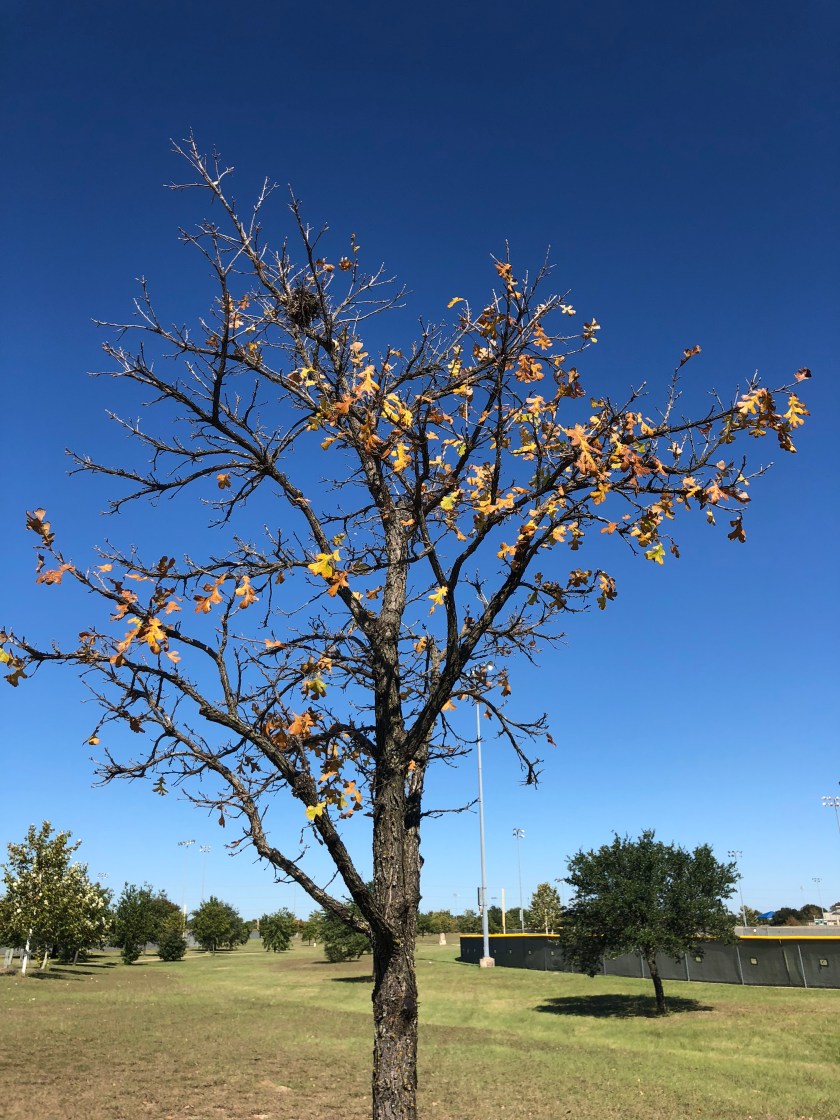
A loggerhead shrike nest in a bur oak tree in Old Settlers Park, near baseball fields.
My time with the Master Naturalists ended on a high note with a post-conference outing to Old Settlers Park in Round Rock. The idea was to observe how a declining species, the loggerhead shrike, has adapted to using the park as a habitat, and is thriving.
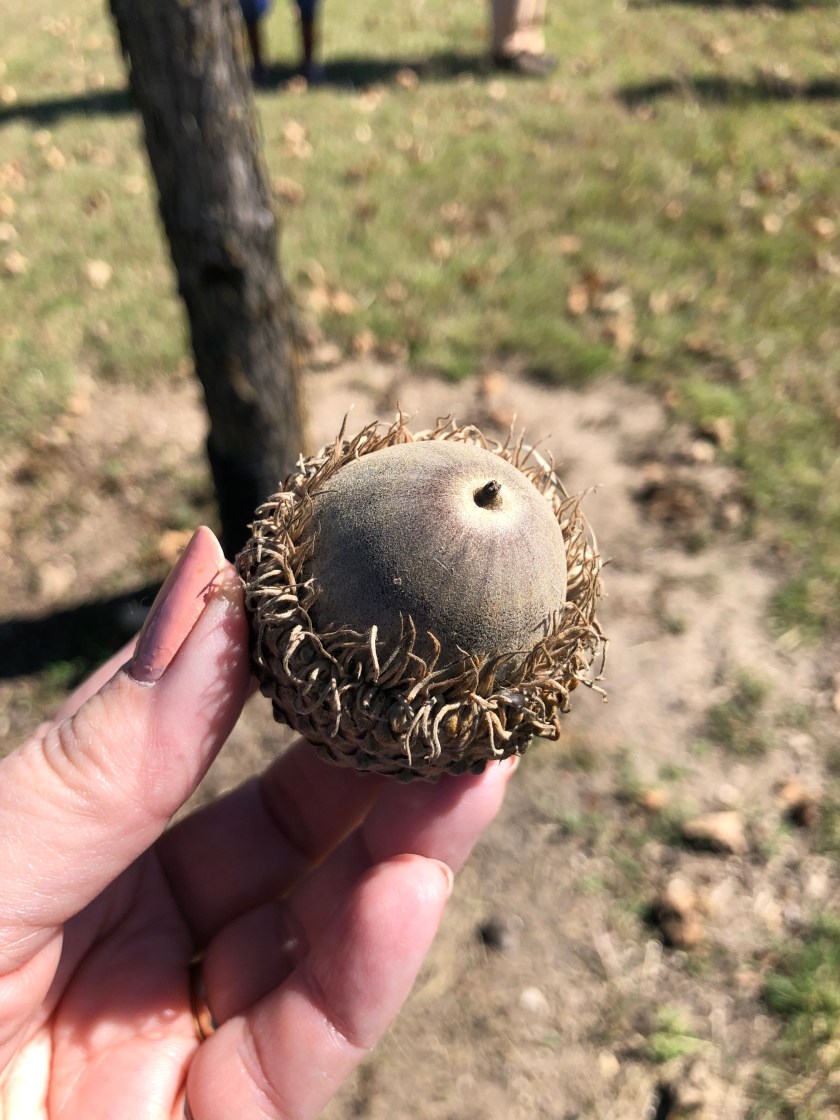
Bur oak acorn. Huge and tasty.
Before the outing, I’d attended a session led by Jim Giocomo on “The Geography of Grassland Birds: How International Bird Conservation Efforts are Linked.” He talked about how agencies and Master Naturalists can help provide these birds with more appropriate habitat, track their locations, etc.
Jim Giacomo (center) and some of the other experts he brought to our field trip in Round Rock.
In that talk, he mentioned his own work with the loggerhead shrikes (the only songbird that is a predator), which conveniently nest right near his house and showed us some great footage of baby shrikes. In one film, the parent birds keep trying to stuff a dragonfly in the mouths of the babies, but it keeps getting stuck. It was hilarious.
Tania’s Halloween costume was “nerdy birder.”
Jim’s luck in finding birds to observe over entire breeding seasons has given him lots of insights, so it was really fun to go with him and fellow biologist Tania Homayoun out in the field to see what he sees.
I interrupt my sharing from the conference I attended to share what a lovely afternoon my spouse, dogs and I had at the Hermits’ Rest yesterday.
This is the back of a red admiral butterfly. I just love how this photo came out.
I came home from work, and just felt like taking a long walk. I gathered a few dogs and started my usual route around the property. As I went down toward where the arroyo stream meets the woods, something smelled wonderful. I realized it was a large bed of fall asters. The little valley had trapped the aroma.
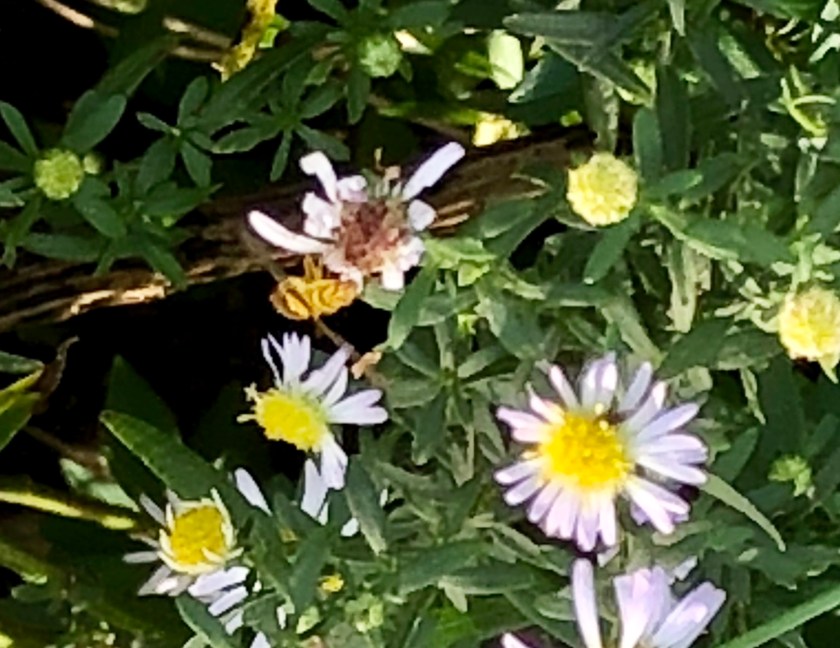
Asters and small bees.
The aroma had attracted more than just me, too. The flowers were literally abuzz and aflutter with bees of all sizes and at least six types of butterflies. I was really happy to see Lee come down to see me, so he could enjoy the sights, smells, and sounds with me.
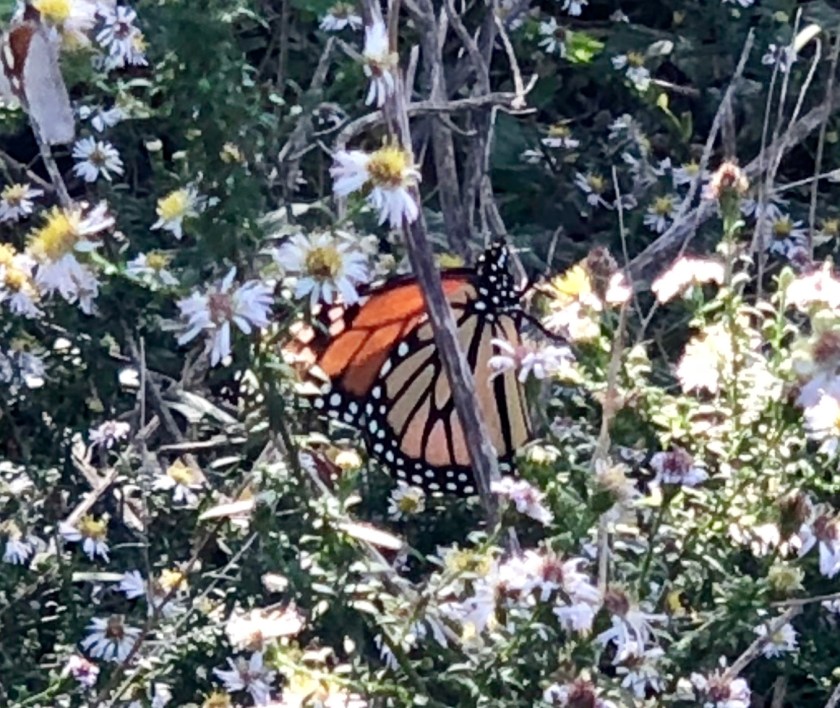
The monarch was in flower heaven.
I really didn’t take all that many photos, because we were just observing. Still, I have to share that we got at least one migrating monarch in the bunch! There were also Gulf fritilaries, a red admiral, fiery skippers (lots), and some painted ladies.
We returned to the ranch over the weekend, with zero seconds of downtime, but we jumped right into the swing of things and enjoyed visitors, both human and otherwise.
Flying Friends
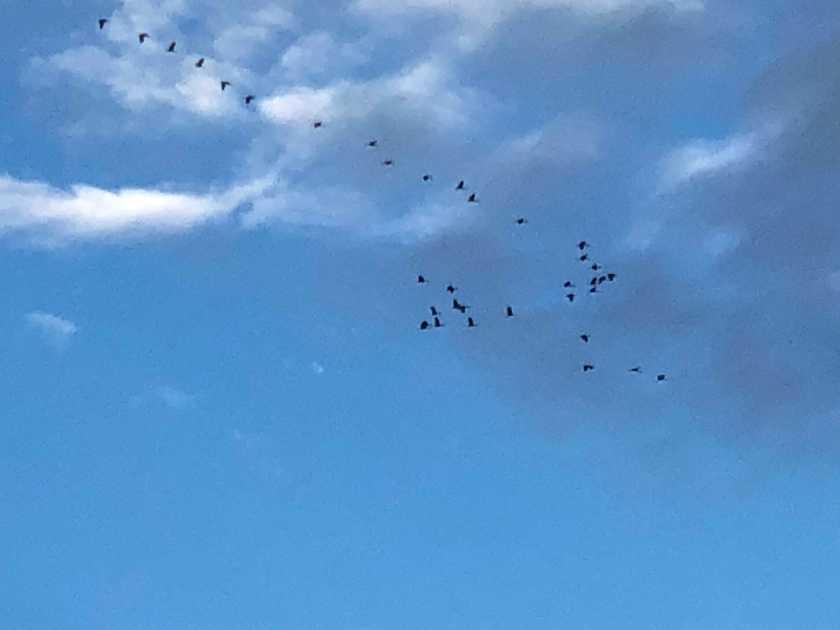
The most glorious visitors were just passing through. Many flocks of sandhill cranes flew over. We also saw a few snow geese. I just love the sounds of the cranes!
One of my favorite neighbors.
While I was taking crane pictures, two blue herons squawked, so I got nice close photos of them. Of course, they are blurry iPhone pictures, but some day I’ll get a new battery and learn to use the good camera again!
There have also been a lot of visiting starlings, which we don’t usually have. One thing I’ve noticed about them is that they make lots and lots of noise when they are all lined up on the electric wires, but when they take off as a flock to rearrange themselves, they are totally silent. It’s really eerie when you are standing around in the field listening, and suddenly all you hear are the coyotes.
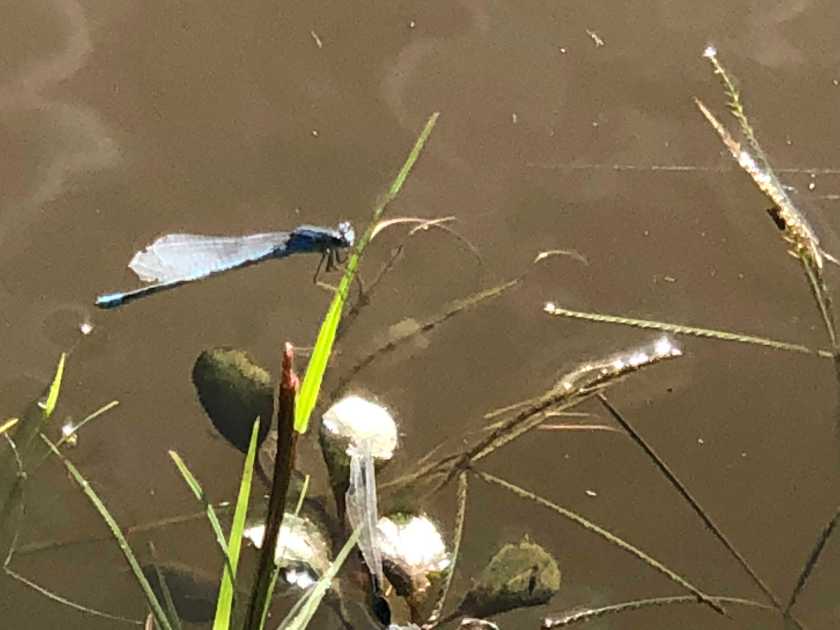
These are so delicate.
Most of the dragonflies are gone, but we did see a lovely bluet by the small meadow pond. These sure are pretty. They curve their bodies where you see the stripes.
Why won’t the turtle play with me? (You can sort of see it in the grass.)
More “Friends”
Because it’s rained so much (have I mentioned that? Lots of flooding while we were gone), animals seem to be wandering around. Yesterday, Carlton the dog found an extra large pond turtle in the middle of the pasture. He was most dismayed that it would not come out and play, so he stood there for 15 minutes and barked at it, poking it with his nose a lot. Treats had to be used to save that poor turtle from the torture.
This dirty part of the porch is where we harmless snakes like to hang out. I want to date this electric cord.
And later yesterday, I once again spotted a large snake on the front porch, in the icky dirty part, of course. I was pretty convinced it was a water mocassin, but the folks at iNaturalist talked me down, and asssured me it was a water snake trying to look like a poisonous one. I am pretty sure this is the same snake I’ve seen over by the pond. It hisses. We kept the dogs away, and it slowly meandered off.
Our house guest was not thrilled that we didn’t kill it. I repeated a number of times, “I don’t kill snakes.” I do understand many people aren’t good with them. My dad sure wasn’t! He’d kill them 3 or 4 times!
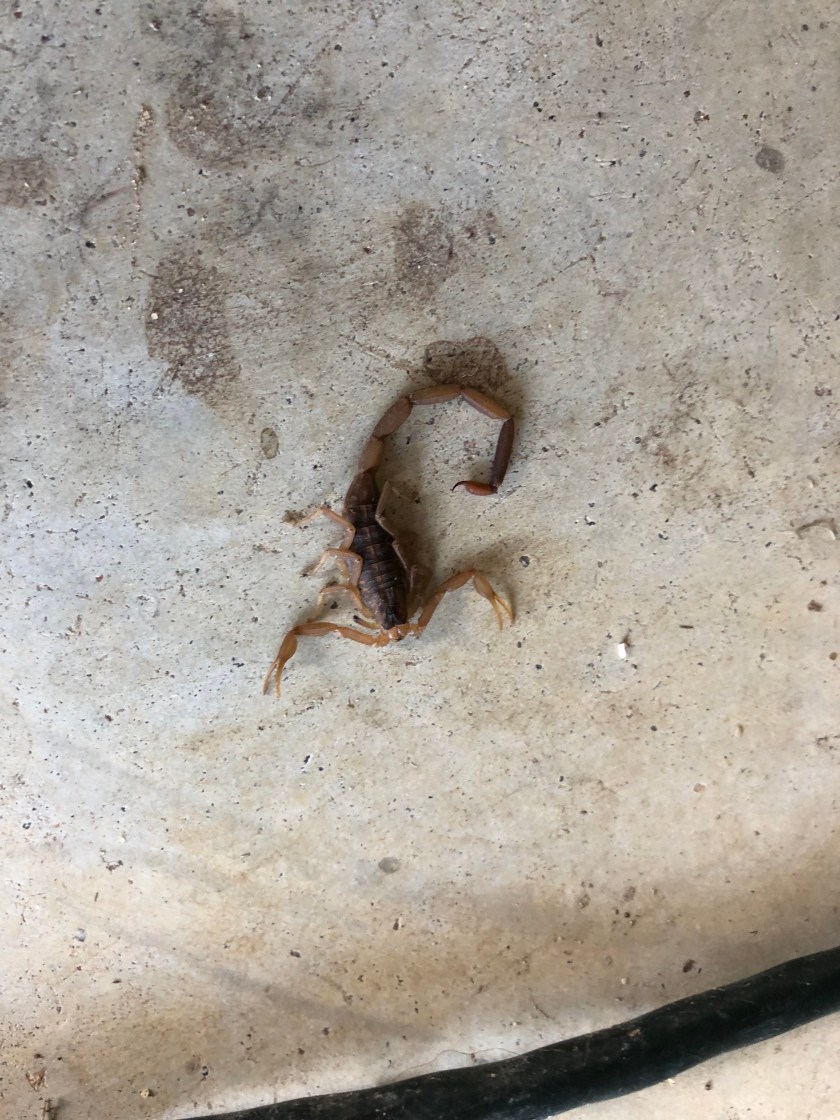
It’s a scorpion, all right. Small.
In the early evening, we found our first scorpion at the ranch. It was pre-dead, so we didn’t have to do anything to it. We used to see lots more in our house in the karst area of Williamson County
Not Friends at All
We apparently have a visitor over to the chicken coop who is not our friend. It has killed at least 4 of the chickens (at least two roosters, who were probably trying to defend the flock). It gets them IN the chicken coop. Yet another reason for them not to lay eggs in there!
The Neighbor is sure it’s an owl. I think it might be a bobcat, since both hunt at night. A cat could get in there easily from the tree, then scale the fence to get out.
Leave us ALONE! We just want to eat grass. And escape from these non-sheepproof fences.
Something also went after the four new sheep the Neighbor brought in, and one of them lost a LOT of wool and some flesh, but seems OK. We are hoping the culprit is not the cabin occupant’s dog, who went after the sheep when he first saw them, so they don’t want to leave the pen to eat in the pasture.
Nice of all these creatures to wait until I got home to show up, isn’t it?
Hilton Head Island is a beautiful place, and there are lots of regulations that keep it that way. They do their best to preserve vegetation, signs are kept small (making it hard to find restaurants until you pass them), and building colors are regulated. It’s all very soothing, but a lot of what you see is carefully manicured.
The light was beautiful, since we were there in the late afternoon.
That’s why, after a day of real estate stuff, it was wonderful to visit the Audubon Newhall Preserve, which is 50 acres that will never be developed. While the area looks “all natural,” there has been careful restoration and preservation of native plants, which has brought all sorts of wonderful birds and other wildlife.
The pond was filled with life.
The pond was made out of a natural depression that was made deeper, but there are also areas that show what the original island topography was like, with rolling terrain that allows plants that like it moist and sand-loving plants to live very near each other.
These asters were covered in a variety of butterflies, including these lovely long-tailed skippers.
I enjoyed seeing plants I was familiar with from my childhood in the Deep South, plus some new plants that are native to South Carolina. There were also lovely butterflies, and I’m thrilled I actually DID get a good enough photograph of the asters to identify the long-tailed skippers, which are everywhere right now.
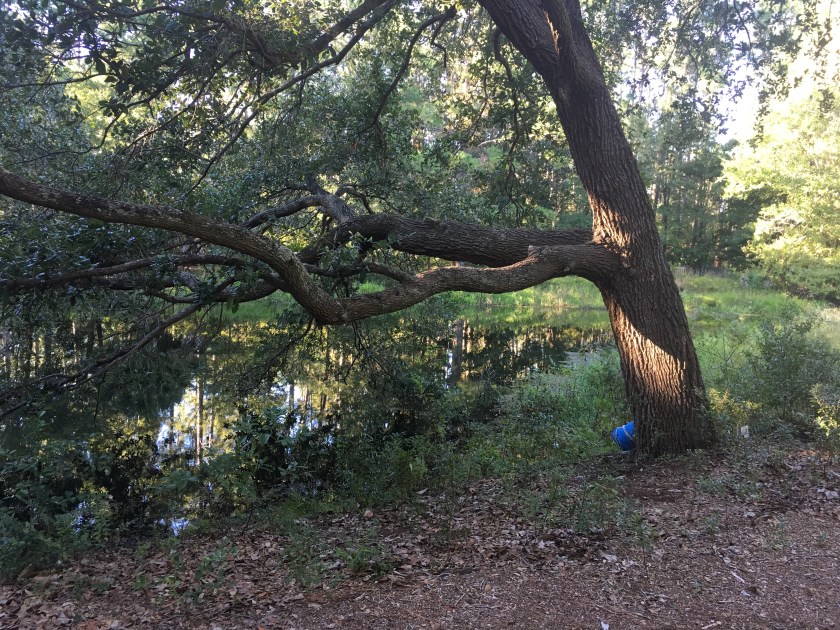
Beautiful tree, and someone’s sample bucket.
I saw a yellow-bellied sapsucker and a number of warblers, including one with black and white males and brown females. I think they were black-throated blue warblers. Plus there were crows, mockingbirds, Carolina wrens, and a nuthatch.
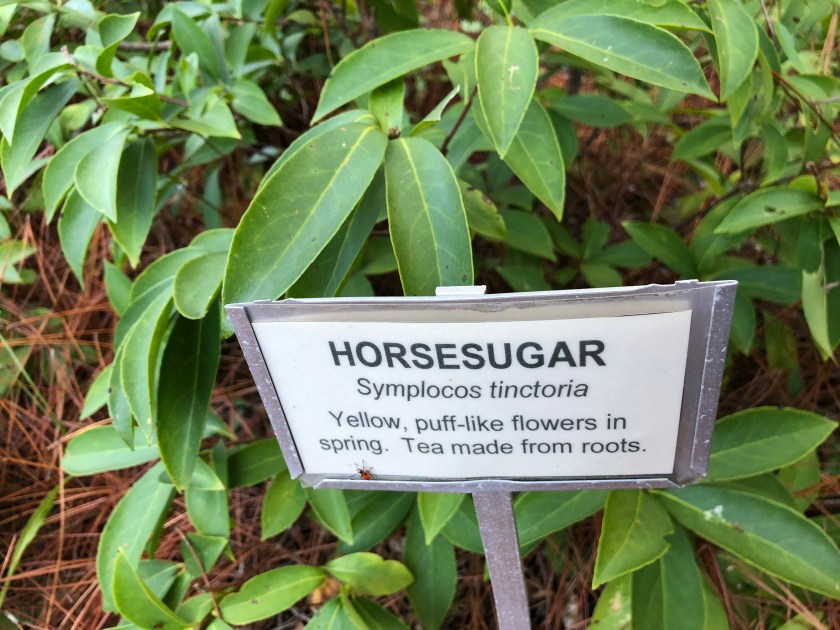
Here’s an example of one of the interesting signs around the preserve.
The people who maintain the area have been planting many new specimens, and they’ve also lovingly labeled many of the specimens with some details about them. That made it a lot of fun to learn as we wandered around.
I wish you winding paths, peace, quiet, and nature’s beauty.
I guess the best part of the place was that it was not over-developed or full of loud people. Mosquitoes were the only drawback!
Over at the neighbor ranch, Wild Type, there’s been a battle going on for a few days, involving the black chinned hummingbird population and one persistent praying mantis.
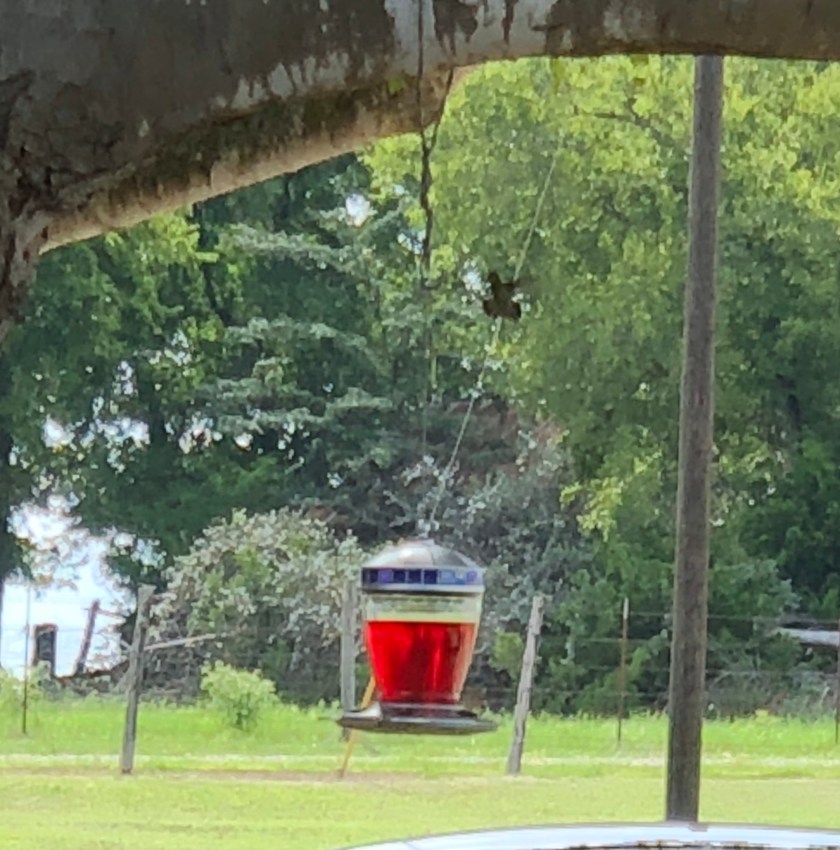
Sara and Ralph noticed that hummingbirds were approaching the feeder but not feeding. They were displaying their tail feathers and darting around. That’s when the mantis became obvious. It had settled in around the feeder, apparently waiting to catch one of those hummingbirds.
As you can see from the photo, this is not the largest praying mantis. It may well be another Carolina Mantis, which is the kind I’ve seen in Austin, but I’m not really good at differentiating among mantids.
I know hummingbirds have been caught by praying mantises, though. I even checked on Snopes to be sure it is true! So, no wonder the hummingbirds are annoyed.
This blurry action shot shows the bird making itself look big to impress the mantis.
It’s fun to watch them, and I am hoping that Ralph has gotten some action shots with his good camera and tripod. I also hope no hummingbirds have actually been caught. What would the mantis do with such a big prey?
As an aside, I have seen more than one type of hummingbird at their feeder in recent weeks, since migration time has started. I’m sure I saw a ruby-throated one, and there was another I can’t identify. It’s a fun time of year.
(Also I am not participating in a debate over red vs. clear sugar water. I’ve solved it by not putting out feeders this year, since it’s a big commitment: my fellow Master Naturalist, Phyllis, has put out an astonishing amount of hummingbird food this summer!)
Why, yes, I do have more to say about snakes. Thanks for all the great comments on the previous snake post! I guess all the dry weather had them all wandering around the ranch or something. (Aside: it has been raining this week, which we truly needed, but we could use more.)
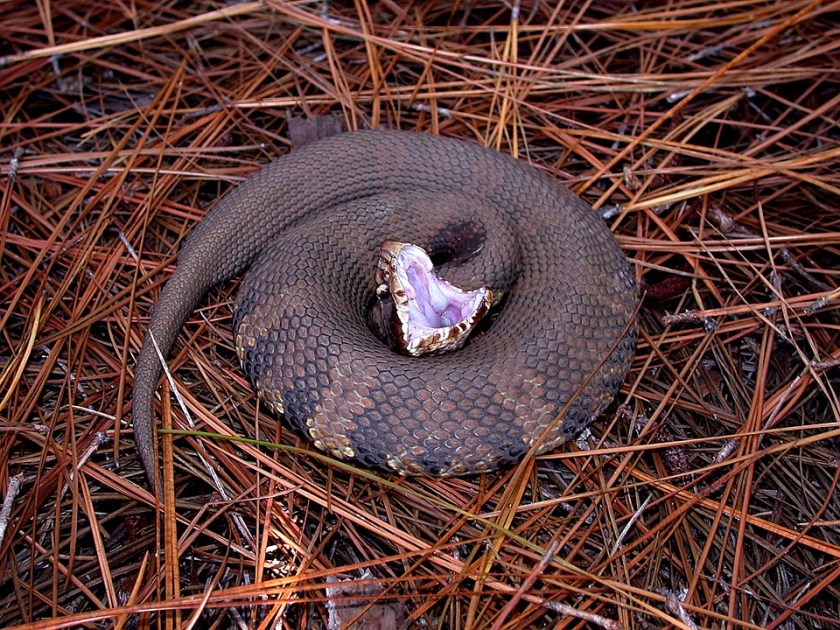
This public domain photo shows the cotton mouth and thick body of a water moccasin.
Another venomous encounter
Ralph at Wild Type Ranch reported a water moccasin (Agkistrodon piscivorous, also known as a cottonmouth) in his driveway last week. I’ve never seen one when it wasn’t swimming, so that was a big surprise to me. His dog tripped over it, so it wasn’t in attack mode. That’s good, because they are poisonous!
Another fact about these guys is that there is a non-poisonous water snake that just swims around, happily convincing people that it might just be a cottonmouth. That is usually what we see in our ponds. They get big, and are fun to watch while they undulate around looking for fish to eat (given the water moccasin’s Latin name, one can infer they mostly eat fish, too).
How do you tell them apart? Well, read this really good article, which I’ll summarize by saying that cottonmouths have a pit viper shaped blocky head, and thick bodies, while water snakes have thin bodies and a head that just flows into the body. Basically, leave them ALL alone. They’re really cool when viewed through binoculars.
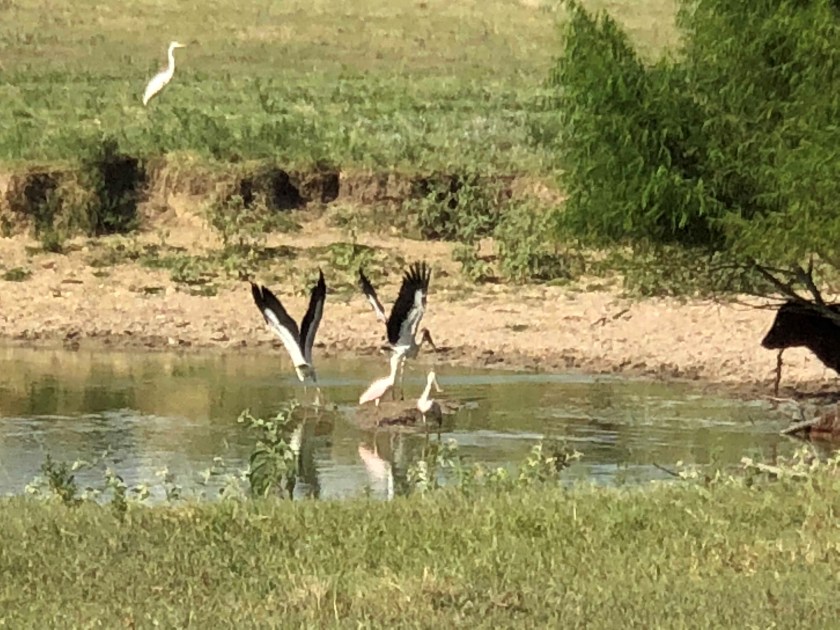
What we have here are three wood storks, two roseate spoonbills, and a great egret.
Well, it’s poor timing that I’m still limping around from my injured tendon and I have a long weekend! Being gimpy has not stopped me from making observations, and I had a DOOZY on Friday, and thanks to my neighbor, Ralph, had a good one yesterday, too.
I was looking out the window at the tank behind the house, like I always do, in case there’s a bird there. Yep. Lots of birds. I did a double take. That “egret” had a black head and black on its wings. Woo! The wood storks were here for their yearly visit!
I limped outside with the camera, hoping to get a close picture. I zoomed in, and got another surprise! Some of those “storks” were roseate spoonbills! Snap snap. I knew I’d have to snap fast, since the dogs had followed me out.
We’re out of here. Plus that cow is butting in on our territory.
Sure enough, the storks had enough of us interlopers and took off. That’s how I got this nice photo. I did get enough time to watch the storks going after fish like crazy. The water is so low that it’s got to be easy pickings for them.
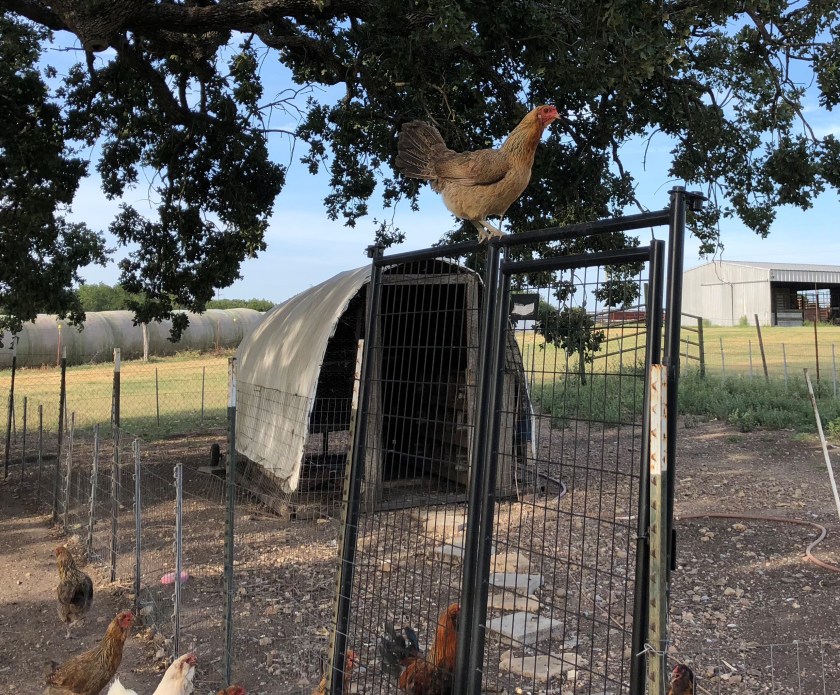
I’m the queen of the chickens, says this Ameraucana hen!
I’ve recently been put in charge of chicken feeding on the weekends, so I’m spending more time than I used to around our flock. They are a very happy bunch, and I got a request for more information on them, so I thought I’d share some of their antics and such.
History of the flock
When I first came to the ranch, our Wild Type neighbors had just a few chickens, who lived in an interesting coop made by Ralph the neighbor. The coop is next to the old cabin, so the residents of the cabin “get” to listen to chickens all day.
Later, the neighbors bought a dozen chicks and raised them. I can’t remember what breed they were, but I think they all produced brown eggs. But, disaster stuck. All the chickens but a couple disappeared one day! We still don’t know if it was some bad animal or bad people.
Front and center is Buckbeak, the senior rooster of the bunch.
After a while, we got a dozen Brown Sex Links from Ideal Poultry, which is actually a local Cameron, Texas business. These chickens have a weird name, but are pretty, lay brown eggs, and are friendly. The hens are dark red and the roostes are white, which you can see on Buckbeak, above. They also bought some black meat. Originally they had planned to share them with a friend, but we ended up with all of them. So, we had a lot of chickens.
It turned out that the “all female” chickens turned out to have a lot of roosters in them, so we kept all the hens. The black ones laid fine eggs, just not as strong as the red ones. All the future roosters other than Buckbeak became dinner. Our chicken keepers at the time, Cathy and Kayla, liked to name the chickens, so we inherited some names!
One of two angry birds that was encouraging this young hawk to go away (note its shadow on the building). Fuzzy iPhone picture!
A while back, I shared photos of a big hawk nest on the building next to my Austin work, and later I found another nest in a large oak tree in front of the building.
I thought you might like to see how those babies are doing. I guess at least one clutch of them hasn’t completely fledged yet, since I keep seeing small hawks flying around the building.
The resident birds are not happy, especially the mockingbirds, who, as we know, are busy raising their babes right now. There were actually two birds going after this poor youth.
I’ve seen at least two others flying around in the past week. I’m pretty sure these are the ones from the big tree, and the ones from the building have long since flown off to establish their own territories. (I do see birds by the nest still, but apparently they usually have just one clutch a year).
Nature sure helps when there’s chaos around you. I’m really glad to have birds and trees and random animals to enjoy wherever I am. We even have some wrens and tufted titmice coming to our bird bath at the Bobcat Lair house in Austin (I will try to get some photos). Remember, when times are tough, breathe, and notice what’s around you. It helps to see the big picture.
Tomorrow I’ll write about picking wild grapes. Adventures in foraging!















 The Hermits' Rest