
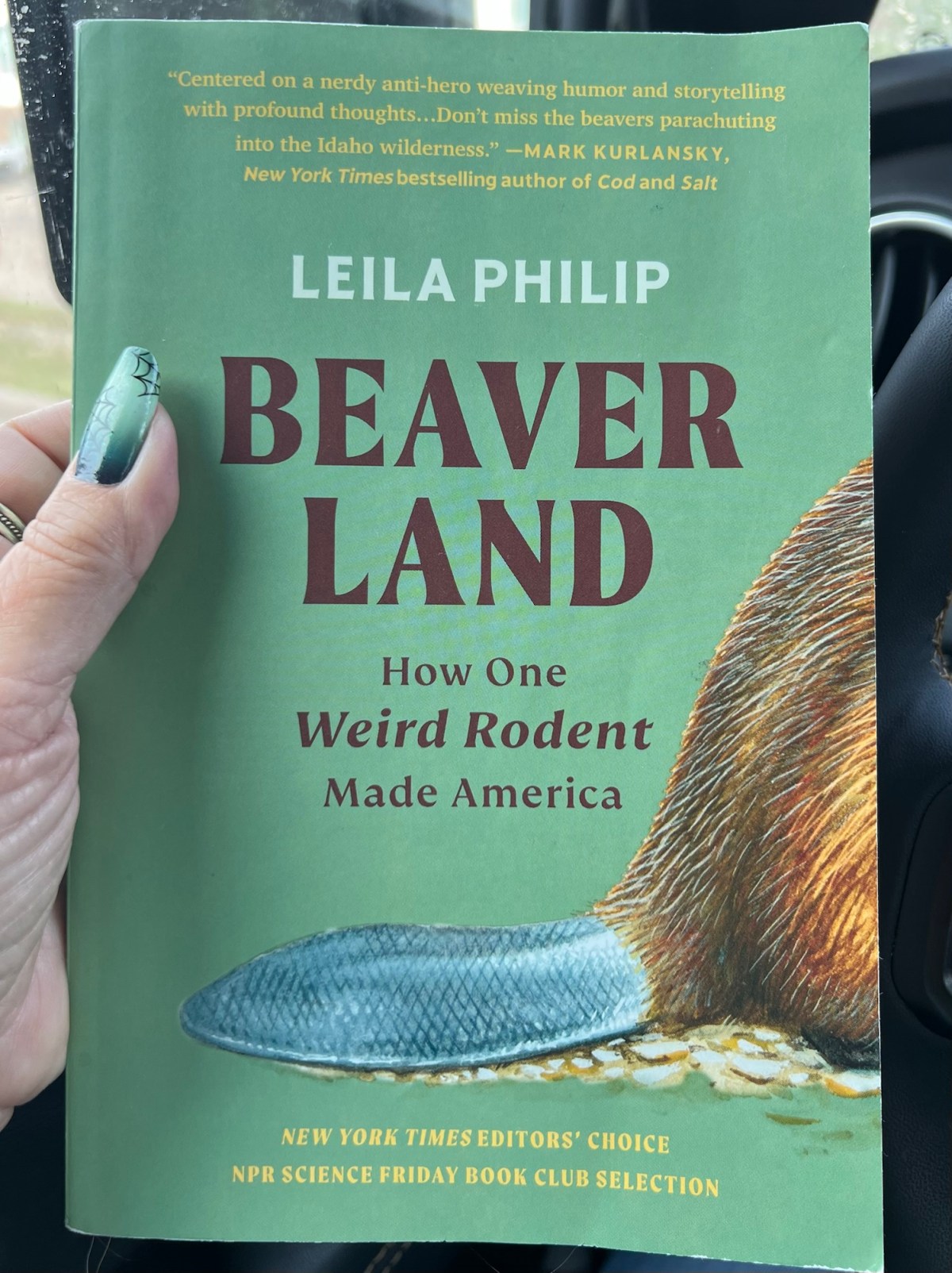
I recently finished this fascinating book about beavers, which opened my eyes to a lot of possibilities for healing the earth thanks to these helpful animals. Leila Philip is a New Englander who became interested in beavers when they were in the pond behind her house, so she spent a couple of years researching Beaverland: How one weird rodent made America (2022).

I like that Philip researched so many aspects of beavers’ presence in North America. The historical background was fascinating/horrifying. Fur trapping completely eliminated beavers in the eastern US and Canada but when reintroduced, numbers came back very quickly. That’s good.
Philip spent a long time learning about modern-day trappers and I commend her open-mindedness as she not only talked to trappers but went out with one as he checked his traps. This guy had incredible knowledge of the wildlife and terrain and a deep knowledge of beaver behavior and habits. I was fascinated, and came to accept that a reasonable amount of harvesting keeps numbers at a good level and provides hides that are used for hats, etc.
What boggled my mind, though, was finding out how beavers (and the prolonged lack of beavers) affect our waterways, water quality, and health of the surrounding countryside. Rivers didn’t look like they do now before trappers arrived. No straight lines and eroded banks. When there are beaver dams, water moves much more slowly toward the ocean and is cleaned of toxins. Oh there’s lots more, but I don’t want to rewrite the whole book!
Speaking of writing the book, my favorite part came at the end, where there’s a section called “The Story of the Book,” that provides context for her travels and research for the book. It’s just as interesting as the main book, and a lot more fun to read than typical endnotes, though it serves the same purpose.
My only quibbles with this wonderful book are that sometimes information is repeated almost verbatim, and Philip feels compelled to describe everyone she meets through a sort of annoying subjective lens. I’m not sure I need to know how messy someone’s hair is or the details of their clothing in every situation.
I’m in a grumpy mood, so take my criticism with a grain of salt or two. If you’re a naturalist or nature lover, you’ll treasure this book and the perspectives it provides.
 The Hermits' Rest