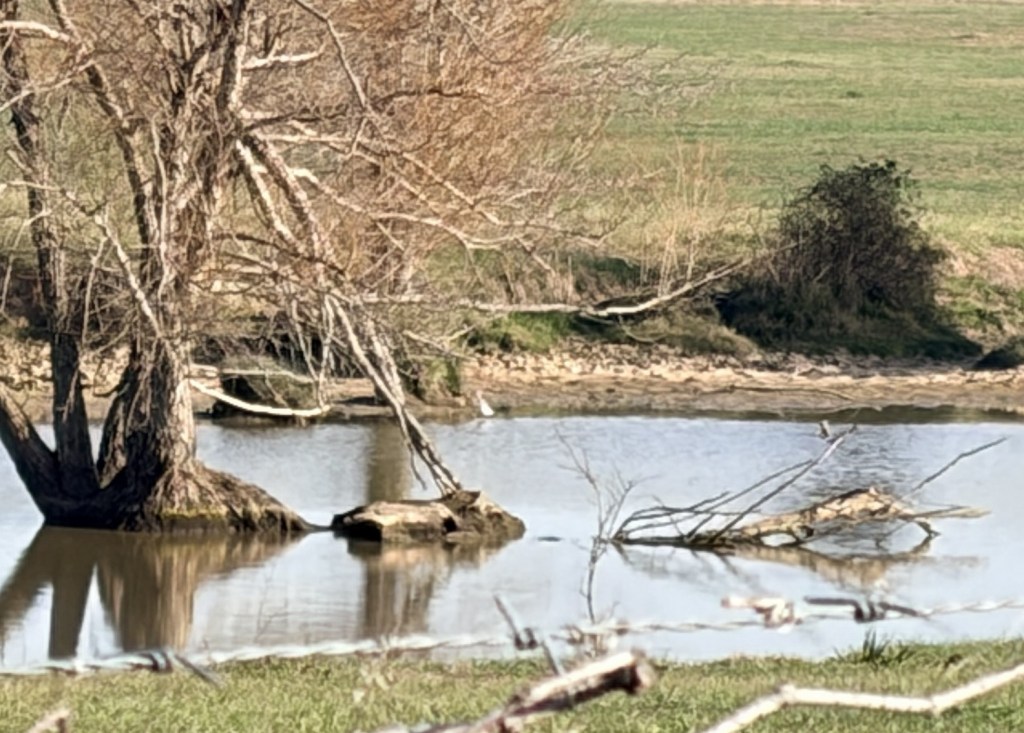
The natural world greeted me as soon as I woke up on New Year’s morning. I looked out the side window and saw a large bird walking along the pond shore, of which there is a lot, thanks to inadequate rain. What was it?
The white blob to the right of the tree is the bird.
Luckily one of my many pairs of binoculars is stored on the windowsill for just this kind of occasion (along with the tools Lee used on his most recent home improvement attempt). Now I could see it, and I was happy.
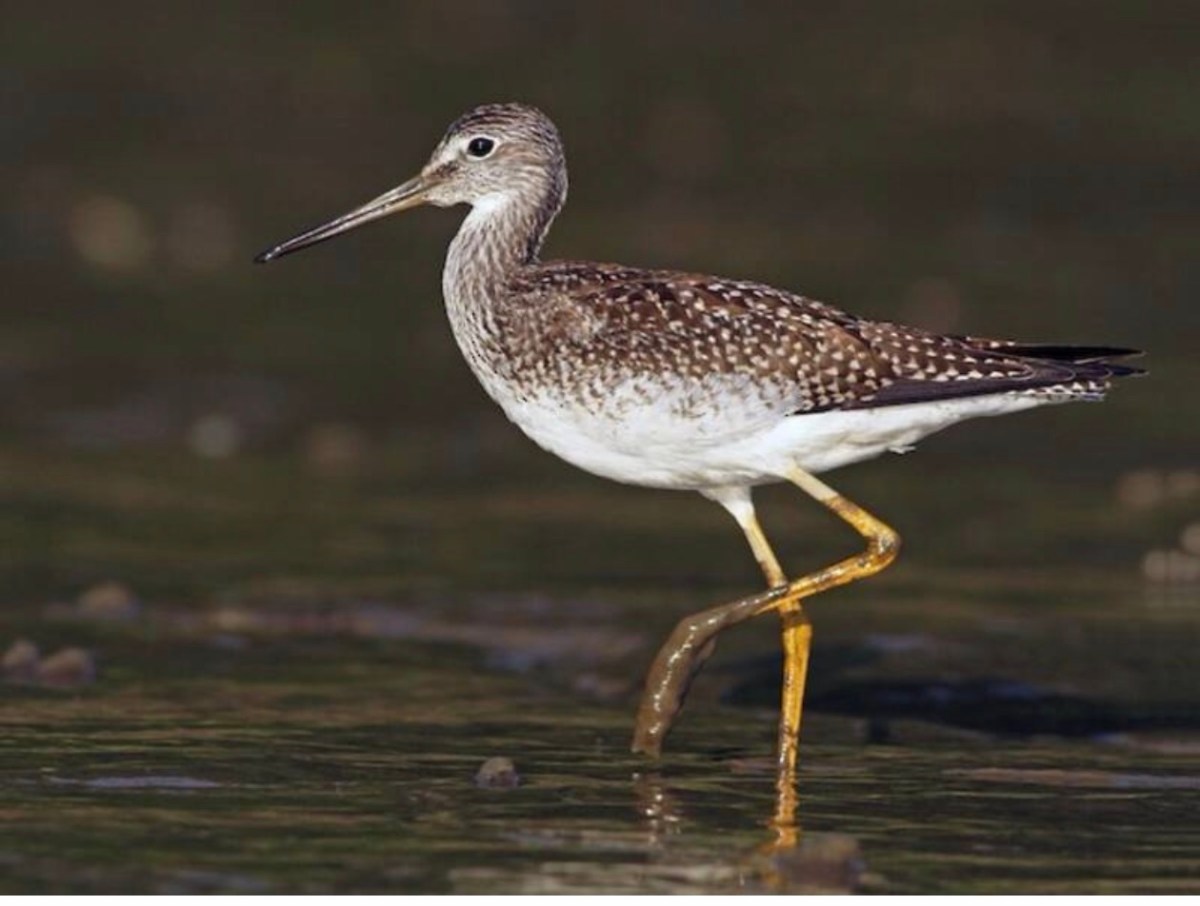
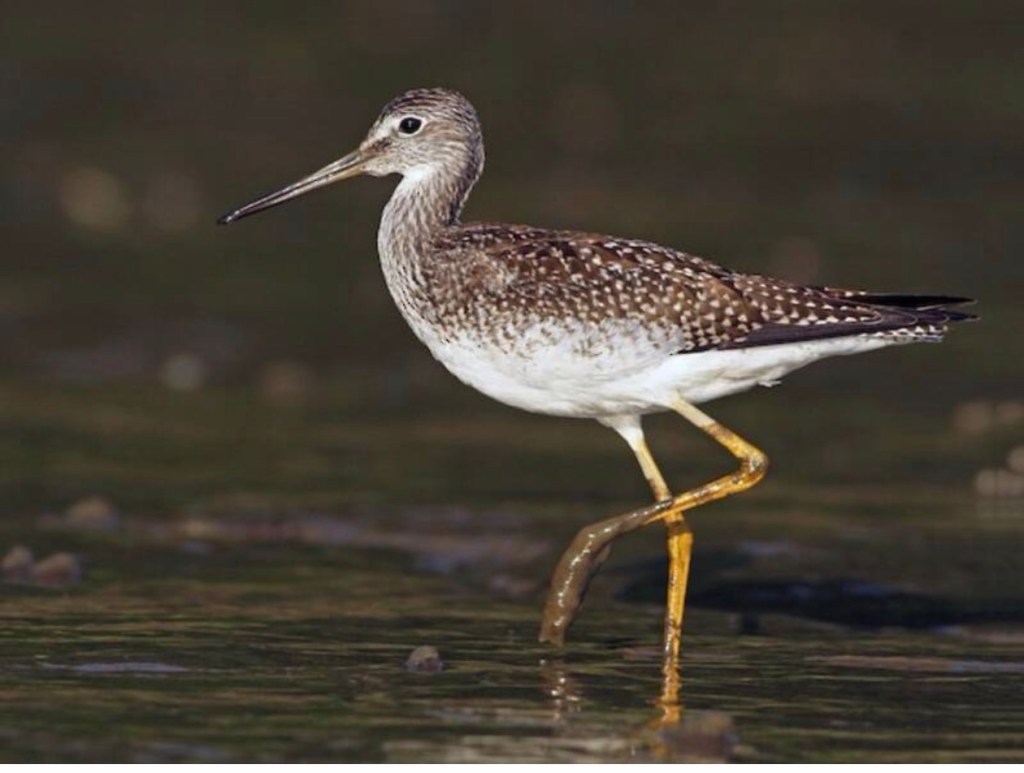
It’s a Greater Yellowlegs
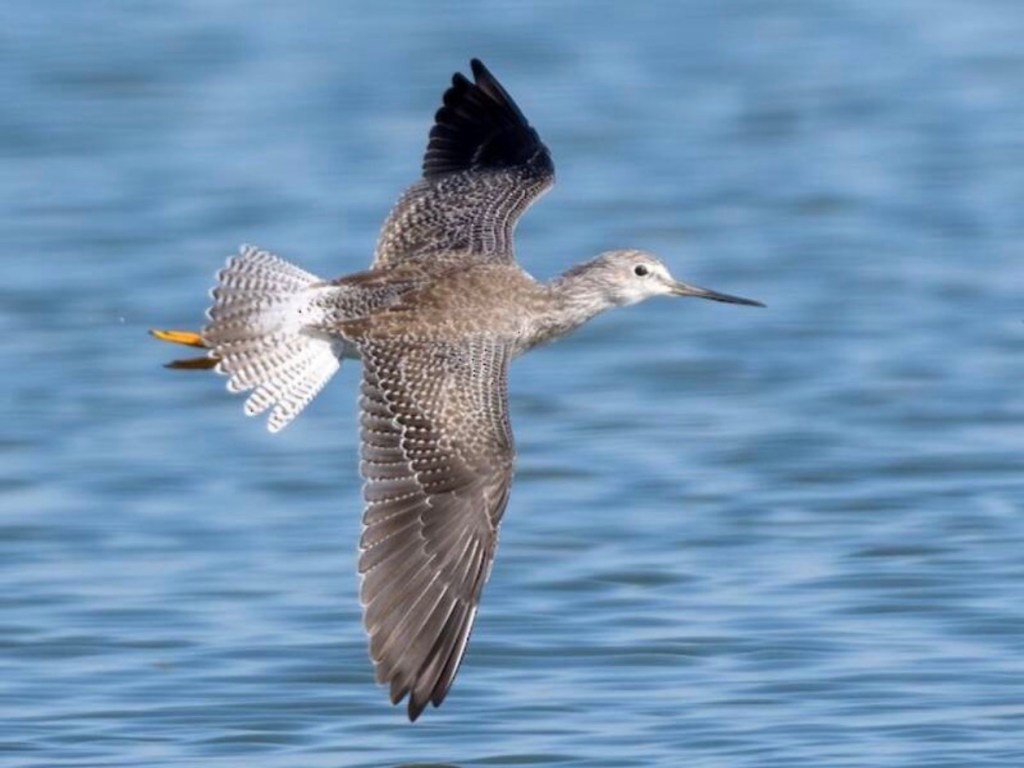
Why was I so happy to see a bird that’s around here all the time? Because I so rarely see them on the ground, doing their shorebird thing. Usually I hear their very distinctive call, and occasionally see them flying with their legs tucked under like landing gear.
I tend to see the underside. Photos are from Merlin Bird ID. My only photos are blobs.
I like these birds lots, mainly because they were the first bird to visit our front pond after it filled with water. I had to ID it, gasp, from a book! They were also one of the first shorebirds whose call I learned. Here’s more from Merlin on Greater Yellowlegs:
Fairly large shorebird with bright yellow legs. Plumage is essentially identical to Lesser Yellowlegs: gray upperparts with white speckling, streaky neck, and white belly. Proportions are most important for identification. Greater is larger overall with longer, thicker, more upturned bill, longer neck, blockier head, and bigger chest. Forages actively on mudflats and in shallow pools and marshes, often in loose mixed flocks with Lesser Yellowlegs. Somewhat more likely to be found in larger, more open habitats than Lesser, but much overlap. Listen for strong, ringing “tew tew tew!” calls, louder than Lesser, and usually three or four notes instead of one or two (though Greater can also give single notes). (from Merlin Bird ID)
The highlight of yesterday’s sighting was that it stayed, along with some Killdeer, long enough for me to watch it with the good binoculars as it ran through shallow water sticking its slightly curved bill just under the surface, sorta like how a skimmer does when flying. I now know they don’t poke into the dirt, but rather skim the water. Yay for citizen science!
Once I settled into the birding station, I also got to watch a cute Eastern Phoebe get all plumped up for an extended grooming session. I like how the ones here are more yellow than others I’ve seen.
Blob to the right of the pole is the Phoebe. I still hate this phone camera.
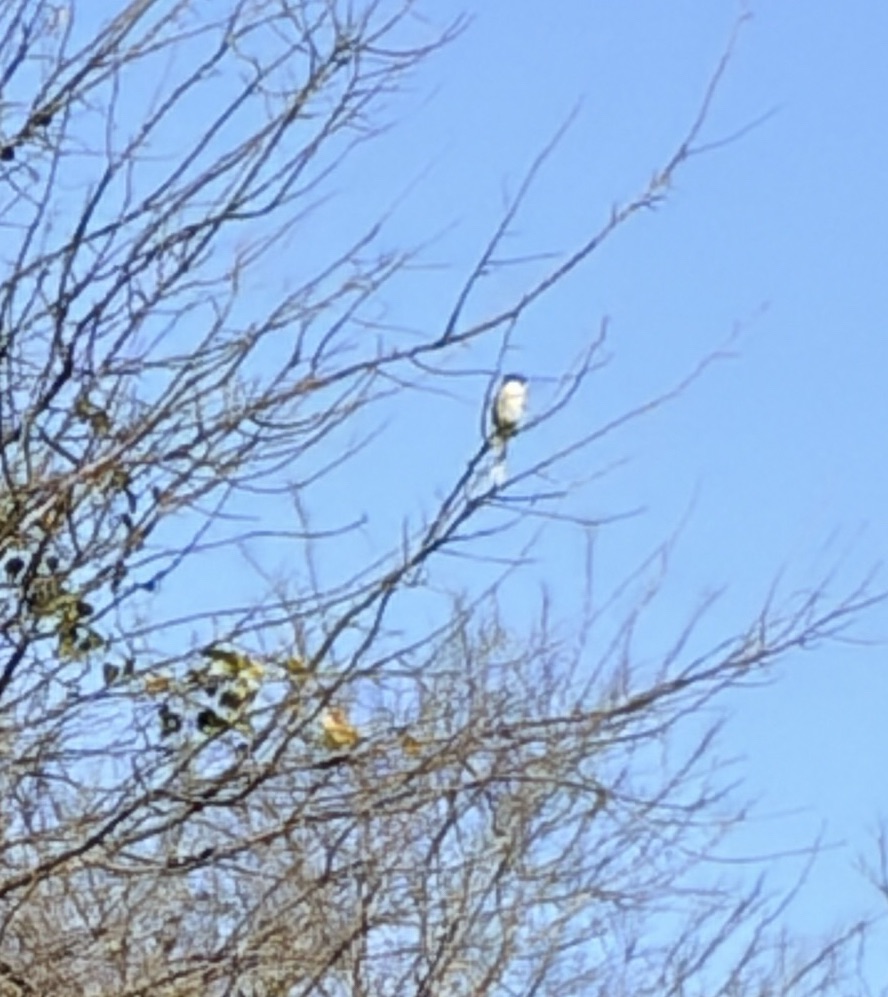
This morning I had a Loggerhead Shrike land on the birding station roof. I know that because it then sat on the fence right in front of me. Such striking birds. Wish I’d had the good camera.
That blob is the shrike.
I’m off to an adventure this afternoon, so maybe I’ll get more blurry photos (too much walking to carry the big lens camera).
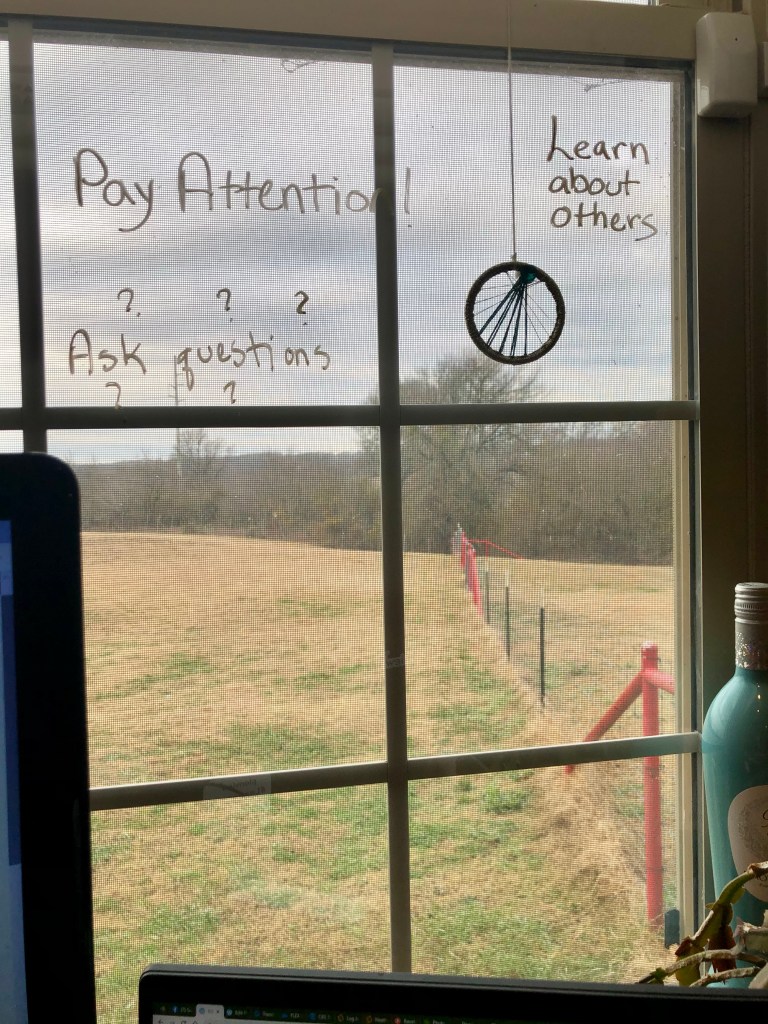
I’ve mentioned that I’m spending a couple of weeks quarantined in the Hermits’ Rest house, working from my little den (which is lovely, other than poor connectivity). A real highlight has been looking out the window, where I can see a long fence that leads to the woods.
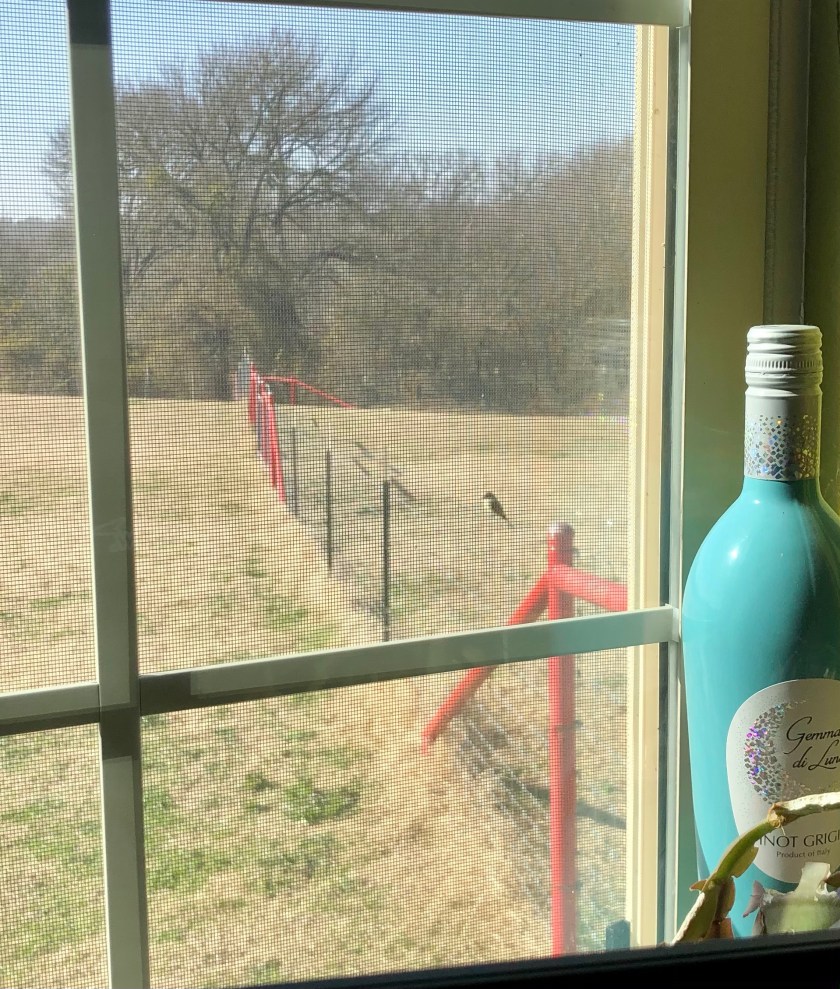
The view out my window, bordered by the computer monitors I try my best to focus on. Notice that the window also tells me how to not be a better conversationalist.
The main thing I regret about my window is that there’s a window screen. Otherwise, I’d be getting some really good photos of gray birds. Gray birds just love that fence. It’s apparently an ideal insect-hunting platform. Let me introduce you to the friends I see every day.
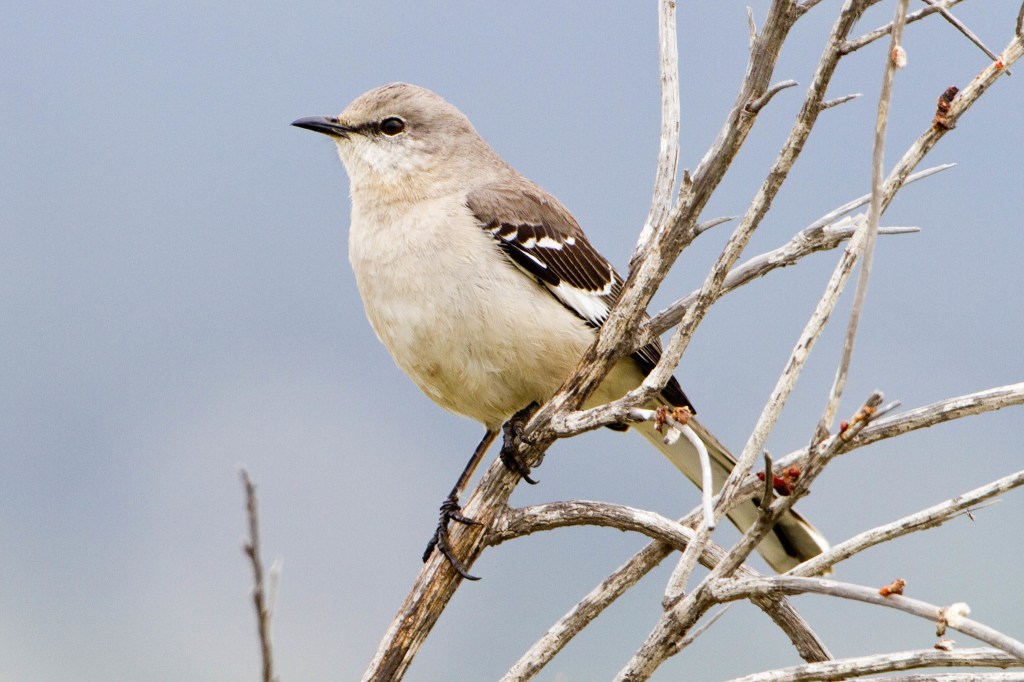
Northern Mockingbird Mimus polyglottos
Like most of you in North America, I’ve lived around mockingbirds my whole life. They are the state bird of Florida, where I grew up, so I’ve known them my whole life. When I was a kid, I thought they were a boring bird. I have changed my mind!
Northern mockingbird. Photo copyright BJ Stanley (CC)
Through the years, I grew to love the birds that sat on the streetlight outside my house in Brushy Creek, Texas. They would sing so many songs, and occasionally emit the sound of a car alarm or cell phone. They are amazing singers.
Now that I’m at the ranch and working in Cameron, I watch mockingbirds every day. They’re big and bold, and very hungry. I love watching them catching bugs and finding food on the ground. The flash of white you see when one of these guys takes off means something interesting’s about to happen. I always know them on the fence by their long tails that are quite mobile.
Over at my fence, the mockingbirds are pretty bossy. They often make all the other birds move, so they get the best observation spot. They are fearless.
Here, the mockingbird chased off one phoebe, and moved the other one out of the prime viewing area.
Now, the mockingbirds don’t only hunt out in the open. I often see them flying into the woods, and singing from the tip-tops of the trees (when crows aren’t using those spots!). So, I salute these fascinating creatures, my first gray bird friends.
Eastern Phoebe Sayornis phoebe
I had never run into phoebes until I got to the ranch here. Since then, I’ve heard and seen them often in my house in Austin. I guess there just weren’t any at my first Texas house.
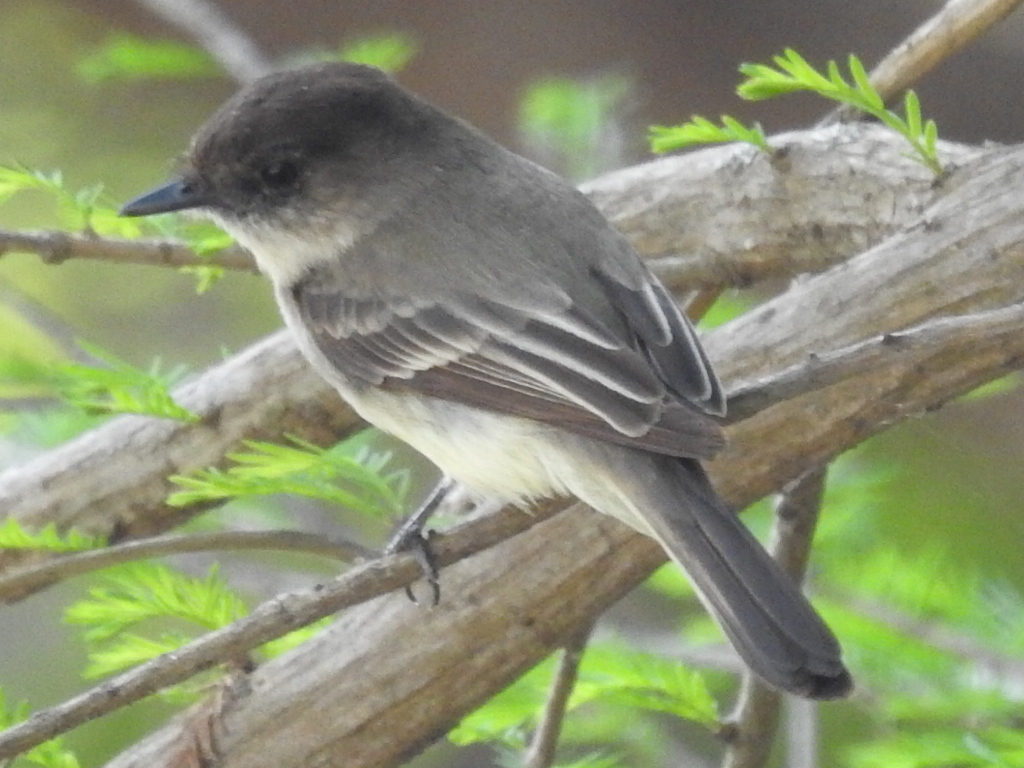
These may be gray, but they’re striking. Their heads are founded, and they have lovely light breasts. Photo copyright Pedro Alanis (CC).
Here, you can’t miss the little darlings. They have been nesting and raising babies in our porches, and sitting on the porches announcing their presence. They conveniently announce who they are by strongly shouting, “Phoebe! Phoebe!” You can’t miss them.
When they’re out on the fence among the other gray birds, the easiest way to distinguish phoebes from the others is the shape of their heads. They have some feathers at the top of their heads that makes it look bigger or more rounded than other birds. It makes them look sort of “husky.” They also have much shorter tails than the mockingbirds.
This photo by Benjamin Schwartz shows the little crest on its head.
Phoebes are flycatchers (actually tyrant flycatchers), so it’s no wonder they are out there every day going after insects. It’s their job. They’re so acrobatic, too, making loops and circles before heading back to the fence to chew and spot the next bug.
Right now I have at least a pair of them hanging around (the males are slightly darker), so I often get to enjoy two at a time. I’m so glad to share my home with them!
Loggerhead Shrike Lanius ludovicianus
I’ve written about these birds before, but they are the third gray bird I keep seeing on my fence. I feel honored to have a rare bird on the property.
Loggerhead Shrike Lanius ludovicianus along FM 2810 SW of Marfa, Presidio Co., Texas 12 September 2005. Photo copyright Greg Lasley (CC) – he’s one of the guys I looked at shrikes with before.
These are incredibly beautiful birds. I was just out back looking at a flock of American robins (they were eating smilax berries so loudly I could find them by ear), when I saw one of our shrikes in a tree by the pond. Their black-and white feathers are really striking from behind.
This beautiful photo by Jonathan Eisen (CC) of a parent and baby shows how easy it is to ID them from the back.
When I try to look at the gray birds out my window, the phoebe and the loggerhead shrike are initially hard to tell apart, thanks to the darned window screen, since they are both grayish birds with pale breasts.
That IS the shrike, however.
But, the phoebe is a more brownish gray, and has an entirely dark head, while the shrike has that cool “bandit mask” through its eyes. And of course, their behavior is different. I really enjoy running across the kills made by the shrikes, who impale them on our fences.
Here’s a photo I took last September of a bug caught by a shrike. You don’t even have to see them to know they were here!
As you can imagine, I keep seeing movement in my peripheral vision and feel compelled to check it out. Usually it’s one of these gray birds, but that’s not all I see. Right now I see a male cardinal (who I’d been hearing in the woods when I was looking at the robins), a mockingbird and the female phoebe. A few minutes ago, a troop of eastern meadowlarks (Sturnella magna) came marching by in their quest for bugs on the ground.
Oh, and three large duck-shaped birds with rings around their necks flew over, and I had no idea what they were until I checked Merlin Bird ID and realized they were wood ducks! I sure wish I’d seen them in the water, since they are so beautiful
Winter is a FUN season for bird watching around here!
What can you see at your house?
PS: I looked out just now and saw another gray bird, but I easily identified it as Gertie, our guinea fowl.
Pretty much any knitting pattern that is not an amorphous blob is supposed to come out a certain size. To do that, you have to knit a certain number of stitches per inch or four centimeters. You frequently see this (with the capital letters):
TAKE TIME TO CHECK YOUR GAUGE!
That means, don’t knit an entire sweater, only to discover it’s a baby sweater, not one for you, or vice versa. Knitting a little square in the pattern used in the item and measuring your stitches will help you make something come out like you wanted it to.
But, do people do that? Well, professionals usually do. Regular people just say, “What the heck,” and use the size of needles called for in the pattern and some yarn they figure is close to the one called for in the pattern (which is, quite often, no longer available).
What do I do? I immediately go two sizes of needles smaller than what’s called for, knowing that I knit loosely, and I try to use a yarn of the same weight as the one called for in the pattern. That often works. And it’s fine for a shawl, afghan, or other item that doesn’t need to be an exact size.
My latest project uses a simple lace pattern called Montague, by Berroco, which calls for a Linen blend worsted weight yarn (the original yarn is no longer available!). I’m using a 100% wool worsted weight yarn with a thick-and-thin texture, Noro Kureopatora (New). It’s for a table runner in Lee’s office. I started off using the size needle in the smaller range for the yarn, a 6. I knitted an inch or so, and Lee asked, “Doesn’t that seem a bit big?”
It does sorta look like a snake
Argh. Well, I hadn’t gotten too far, and it did show how nicely the seed stitch border will look. I frogged it (ripped it out), and re-started on two sizes smaller needles, size 4, which I should have done in the first place.
It came out significantly less wide, and most important, will fit on the piece of furniture it’s destined to rest on.
It’s still not 22 inches, as the instructions call for, but that’s okay. I just needed it to be more narrow than the stereo cabinet it will decorate. Now I can happily knit away.
Lesson? I should have checked my gauge!
It looks like delicious ice cream flavors.
The above picture is the entire border. Next is the lace pattern, which will require a bit of concentration. I got the first row established on my lunch hour, though, so I can work on it this evening after work.
Speaking of work, it is very hard to concentrate on it, because there is a pair of phoebes outside flitting around, catching bugs, and chasing each other. They are such beautiful birds. And with two of them, they are just like their call, “Phoebe! Phoebe!”
The screen makes it hard to see, but there’s a second bird farther along the fence.
That’s from yesterday. Today it’s raining again. Great news!
Have a good Tuesday. Those of you who pray, let’s pray for an uneventful day tomorrow. That’s where what spare energy I have is going!




 The Hermits' Rest